

Derryvree Beneath the Drumlin31200 BCE
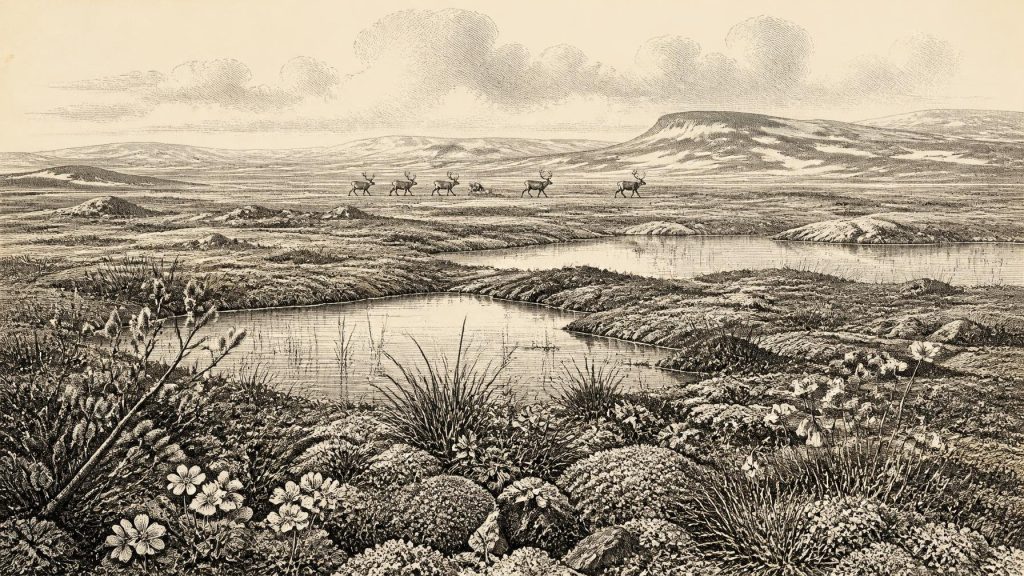
Around 31,200 BCE, Ireland’s history can be reconstructed only through uncertain archaeological and environmental evidence. Derryvree, County Fermanagh, preserves freshwater sediments between glacial tills, dated broadly to 36,900–31,700 calibrated years BP, showing an ice-free but severe tundra wetland before later ice-sheet expansion. Mosses, sedges, aquatic plants and sparse shrubs occupied cold, treeless ground. Castlepook Cave, County Cork, records a long span of Ice Age fauna, including reindeer, mammoth, giant deer, bears and hyenas, though not as one contemporary community. A possibly tool-marked reindeer bone suggests early human presence, but cannot establish occupation. Evidence depicts a locally varied, intermittently habitable landscape.
Dateline
The label 31,200 BCE is useful only as a modern signpost. Ireland cannot be recovered year by year at this depth of time: there are no written records, named communities, annual environmental archives or securely dated settlements capable of fixing events to a single calendar year. In archaeological terms, the date falls about 33,150 years before AD 1950, within the later part of Marine Isotope Stage 3, an unstable interval of the last Ice Age. The responsible history is therefore one of ranges, deposits and probabilities rather than an event list.
The most informative Irish evidence comes from Derryvree, near Maguiresbridge in County Fermanagh. Roadworks in 1969 exposed organic freshwater silts and fine sands sealed between two thick tills in a drumlin. Their radiocarbon determination, BIRM-166, was 30,500 +1,170/−1,030 radiocarbon years BP. Later published calibration places the deposit broadly between about 36,900 and 31,700 calibrated years BP. A date around 31,200 BCE lies within that wide interval, but cannot be isolated within it. Derryvree is thus not a snapshot of one year; it is a rare surviving record of a cold, ice-free phase in northern Ireland before later ice overran and buried the landscape.
A Land Between Ice Advances
The Derryvree sediments matter because their position is as important as their contents. They lie between older and younger glacial deposits. This proves that, at some point during their formation, open water, wet ground, vegetation and animal life existed where a drumlin was later built into the glacial landscape. The deposit does not show an untouched countryside. It records a landscape already shaped by cold climates and vulnerable to renewed glaciation.
At this time Ireland was not yet uniformly entombed beneath the great British–Irish Ice Sheet of the Last Glacial Maximum. Modern reconstructions show major ice-sheet growth and changing margins over a long period rather than a single simple advance. Derryvree and other pre-maximum evidence indicate that parts of Ireland remained ice-free during the earlier stages of that growth. By the later maximum, generally placed around 27,000 to 23,000 years BP in different sectors, ice covered much of the island and extended across adjacent shelves. The country represented by Derryvree was therefore a precarious interval: not a warm refuge, but a biologically active landscape before more extensive ice transformed it.
That distinction is important. “Ice Age” does not mean every part of Ireland was permanently covered by glacier ice. Conditions could change sharply over centuries or millennia, with cold episodes, less severe interstadials, shifting snowfields and expanding ice margins. Speleothems in Crag Cave, County Kerry, provide an independent indication that milder phases during Marine Isotope Stage 3 could permit liquid water to circulate underground and calcite to grow. Such cave records do not describe Derryvree directly, but they support the wider conclusion that Irish climates at this time fluctuated greatly.
Wet Tundra, Not Woodland
The Derryvree evidence points to open tundra and muskeg rather than forest. Pollen was poorly preserved, yet it was dominated by herbaceous types. Plant macrofossils included cold-adapted mosses, while the broader assemblage has been interpreted as sedge-rich wet ground with pools, aquatic plants and sparse vegetation on drier patches. Fossils of bogbean and water-milfoil indicate freshwater habitats; dwarf willow, mountain-avens, juniper and other herbs belong to an exposed, treeless setting. Insects reinforce the picture of mossy, plant-rich wetland with open water.
This was not necessarily a featureless white wasteland. In the short growing season, wet hollows and pool margins could have been locally productive, supporting mosses, sedges and flowering tundra plants. Yet the overall climate was severe: winters were long and cold, ground conditions were affected by frost, and trees were absent or exceptionally scarce. The landscape was patchy, low-growing and open to wind. A traveller standing on a drier rise would have seen little that resembled later Irish woods, fields or bogs.
Regional variation mattered. Derryvree is a local archive in Fermanagh, not a map of the entire island. Its freshwater basin tells us most securely about its own catchment. Nonetheless, the sediment’s survival beneath later till demonstrates that portions of northern Ireland had open terrestrial and freshwater environments during this broad period. The same caution applies to southern Irish caves: they illuminate animal presence and cave processes, but not a continuous island-wide landscape.
Castlepook’s Animal Record
Castlepook Cave, also called Mammoth Cave, near Doneraile in County Cork is the chief southern counterpart to Derryvree. Excavations in the early twentieth century recovered more than 2,000 bones, making it Ireland’s richest cave assemblage for vertebrate life before the Last Glacial Maximum. Its dated animal remains span a very long period, roughly 45,700 to 19,950 years BP. They must not all be treated as contemporaries of 31,200 BCE, but they show that Ice Age Ireland at different points supported a striking fauna: woolly mammoth, giant deer, reindeer, brown bear and spotted hyena, with Arctic fox, wolf and lemmings appearing among later cold-stage material.
For the date in question, reindeer are especially relevant. Their presence is consistent with open, cold country in which grazing and browsing animals could move across extensive treeless ground. Mammoths and giant deer belong to the same broad Pleistocene world, but a cave assemblage is not a census of animals standing together on a single day. Caves collect remains through many processes: carnivores drag in carcass parts, animals die or shelter within them, water redistributes bones, and earlier excavations can disturb layers. Spotted hyena at Castlepook is particularly significant because hyenas could accumulate and modify bones. The cave is evidence for an ecological network, not a ready-made scene of harmonious cohabitation.
The revised radiocarbon work on Castlepook has also changed the chronology. Improved bone pretreatment produced dates substantially older than some results obtained in the 1990s, and suggests that species such as giant deer and spotted hyena may have disappeared locally before the Last Glacial Maximum. The lesson is methodological as well as historical: dates and identifications are not fixed forever. Old collections, especially those excavated before modern stratigraphic standards, can yield new knowledge but require rigorous re-examination.
The Human Question
There is no securely excavated camp, hearth, dwelling, tool assemblage or human burial in Ireland that can responsibly be assigned to 31,200 BCE. Consequently, there is no basis for describing a settled population, a language, a leader, political territory, conflict, alliance, religion or formal learning. Nor is there evidence for farming, domestic animals, fields, villages, long-distance commercial exchange or seafaring communities on the island at this point.
One find nevertheless makes this period unusually important. A reindeer femur from Castlepook, held in the National Museum of Ireland’s natural-history collections, was reported in 2021 as bearing a deep mark interpreted as the result of processing with a stone tool. The bone was publicised as being about 33,000 years old. If the mark is confirmed as anthropogenic and genuinely contemporary with the fresh bone, it would indicate that one or more Upper Palaeolithic people handled a reindeer carcass in Ireland far earlier than the formerly accepted human record.
That is a consequential but limited interpretation. A marked bone would not prove permanent occupation, a camp at Castlepook, or the killing of the animal at the cave. It might reflect a short visit, scavenging or butchery elsewhere followed by transport or redeposition. The cave’s complex excavation history and the known role of water and carnivores make caution essential. Recent archaeological work has sought surviving deposits in the cave, but it has not transformed the old assemblage into a securely stratified Upper Palaeolithic settlement. The strongest statement remains conditional: early human activity in Ireland around this broad period is possible and potentially evidenced by one remarkable object, but it is not yet documented as a community.
No Politics, but a Changing World
Political history cannot be written for this Ireland. There were no Irish kingdoms, borders, treaties or institutions to observe, and it would be misleading to project later social categories onto a glacial landscape. If people did visit, their social world would have been that of mobile Upper Palaeolithic hunter-gatherers known elsewhere in north-west Europe: small groups reliant on knowledge of animals, seasons, stone and shelter. This is a comparison, not direct evidence from Ireland. No Irish artefact assemblage permits a reconstruction of clothing, kinship, ritual or technology for 31,200 BCE.
The most important development was environmental. A cold wetland-and-tundra mosaic existed in places within Ireland during a window before expanding ice reshaped the island. Freshwater sediments at Derryvree preserve that fact; Castlepook preserves evidence of the larger mammals and carnivores that used Irish landscapes over a broad span of the Ice Age. Together they replace the older image of a uniformly empty, frozen island with a more exact one: an intermittently habitable, ecologically varied land whose evidence is sparse, local and often buried beneath the work of later glaciers.
For 31,200 BCE, therefore, the honest history of Ireland is one of uncertainty disciplined by evidence. The year itself cannot be singled out. But the calibrated Derryvree interval, the cave fauna of County Cork, and the approaching growth of the British–Irish Ice Sheet allow a defensible reconstruction of the wider world: open cold country, shallow freshwater, tundra plants, grazing animals and predators, with the tantalising but unproven possibility that people briefly entered that world too.
Primary Sources
- A Middle Midlandian Freshwater Series at Derryvree, Maguiresbridge, County Fermanagh, Northern Ireland
- Trimlines, Blockfields and the Vertical Extent of the Last Ice Sheet in Southern Ireland
- Episodic Speleothem Deposition Tracks the Terrestrial Impact of Millennial-Scale Last Glacial Climate Variability in SW Ireland
- A Reconsideration of the Radiocarbon Dating of the Marine Isotope Stage 3 Fauna from Southern Ireland
- The Irish Quaternary Fauna Project
- Castlepook Cave, Cork: County Geological Site Report
- The Exploration of Castlepook Cave, Co. Cork
- 2022:564 – Castlepook Cave, Castlepook South, Cork
- Heritage Artefacts of County Cork
- Palaeoecology: Irish Quaternary Association Field Guide
- The Subdivision of the Quaternary Period in Ireland
- Irish Pleistocene Biostratigraphy
- Growth and Retreat of the Last British–Irish Ice Sheet, 31,000 to 15,000 Years Ago: the BRITICE-CHRONO Reconstruction
- Exploring Controls of the Early and Stepped Deglaciation on the Western Margin of the British Irish Ice Sheet
- Timing and Pace of Ice-Sheet Withdrawal Across the Marine–Terrestrial Transition West of Ireland During the Last Glaciation
- The Timing and Magnitude of the British–Irish Ice Sheet Between Marine Isotope Stages 5d and 2
- The IntCal20 Northern Hemisphere Radiocarbon Age Calibration Curve (0–55 cal kBP)
- Occurrence of Mammalia Relicts at Site Castlepook Cave
- New Insights on the Fauna of Ireland's Younger Dryas and Early Holocene from Alice & Gwendoline Cave
- Karst of Ireland