Mammoth Cave’s Reindeer Puzzle30540 BCE
30,540 BCE cannot describe a precise Irish year, but falls within a climatically unstable later Pleistocene phase before the Last Glacial Maximum. Derryvree, County Fermanagh, preserves freshwater sediments between glacial tills, indicating cold, treeless wetland mosaics. Castlepook Cave, County Cork, yielded remains of mammoth, reindeer, giant deer, carnivores and other cold-adapted fauna, accumulated over long periods rather than simultaneously. A marked reindeer femur may indicate Upper Palaeolithic butchery, but requires confirmation and does not prove settlement. No contemporary Irish society, politics or culture can be reconstructed. Instead, evidence reveals shifting habitats, animal movements, local refuges and advancing ice during glaciation.
Dateline
30,540 BCE is a modern chronological label, not a recoverable year in Ireland’s past. It corresponds arithmetically to about 32,490 calibrated years before present, with “present” conventionally fixed at AD 1950. But no Irish evidence can be dated to that individual year. There were no written records, calendars, named communities or securely dated settlements from which an annual narrative could be made. The responsible view is therefore a wider one: Ireland during the later Pleistocene, in Marine Isotope Stage 3, before the Last Glacial Maximum transformed much of the island beneath expanding ice.
The nearest evidence comes in large, sometimes uncertain ranges. It includes organic deposits preserved below glacial sediments in County Fermanagh and animal remains from caves, especially Castlepook Cave near Doneraile in north County Cork. These sources reveal a cold and dynamic country inhabited, at different times, by Arctic-adapted and large grazing mammals. They do not demonstrate that every species, every deposit and every possible human trace belonged to one moment around 30,540 BCE.
Time Measured in Ranges
At this depth of time, chronology requires particular care. Radiocarbon years are not identical to calendar years because atmospheric carbon-14 has varied through time. They must be calibrated against internationally maintained curves, and older measurements usually carry broad uncertainties. The important Derryvree determination, BIRM-166, came from organic freshwater sediments and gave a conventional radiocarbon age of 30,500 years BP, with an uncertainty of roughly 1,100 years. A later compilation expressed that result at about 35.9 ± 1.1 thousand calibrated years BP. It is therefore a valuable guide to the wider Middle Midlandian cold phase, but it cannot securely be turned into a witness for 30,540 BCE itself.
That distinction matters. The numerical date in this article falls later than the central estimate for Derryvree, while both belong to a period of sharp climatic variability in north-west Europe. A buried wetland, a cave bone and an ice-sheet reconstruction may each tell us something real about the Ice-Age island; none should be assembled into a falsely precise snapshot. The landscape changed across regions and through generations, not according to the neat borders of a modern annual timeline.
A Wet Hollow Beneath Fermanagh
Derryvree townland, near Maguiresbridge in County Fermanagh, provides Ireland’s most informative environmental archive for this broad interval. Road works in 1969 cut through a drumlin and exposed freshwater silts and fine sands trapped between two substantial sheets of till: unsorted debris deposited by glacier ice. The sequence proved that, between separate local episodes of glaciation, water and organic sediments accumulated in a hollow.
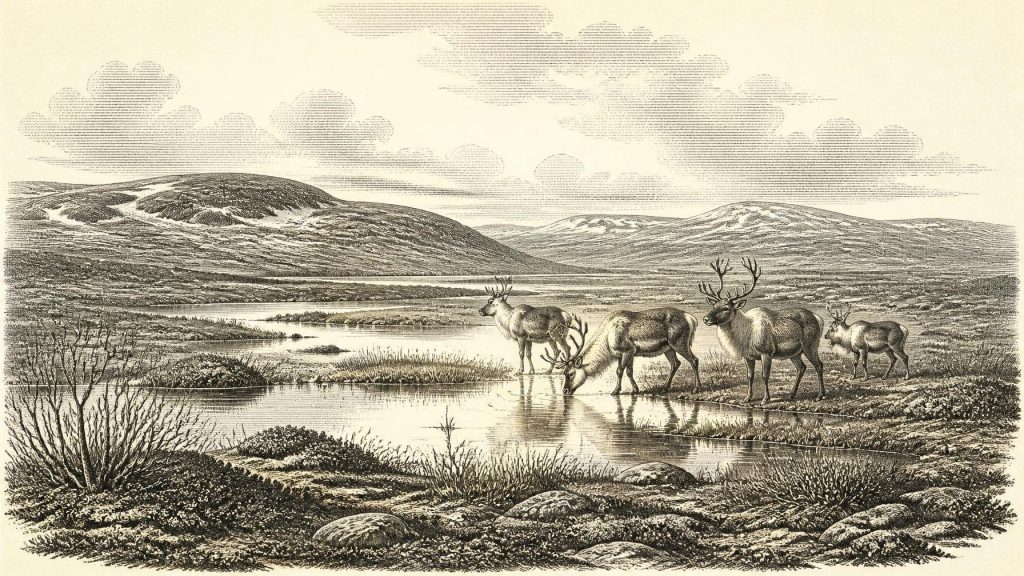
The fossils from the organic layer point to a treeless, periglacial landscape rather than woodland or anything resembling modern rural Ireland. Mosses, pollen, insects and plant remains indicate wet, open ground. A seed of bogbean, Menyanthes trifoliata, is especially striking. The plant still grows in suitable Irish wetlands, yet its presence in this ancient deposit speaks of shallow water and saturated ground amid a markedly colder world. Sedges, moss-rich margins and pools could survive locally, while exposed soil and frost-affected terrain lay nearby.
This was not necessarily a single uniform tundra plain. The evidence supports a mosaic: waterlogged hollows, low vegetation, muddy pool edges, mineral ground, patches sheltered by snow and more exposed surfaces vulnerable to frost and wind. Such conditions could offer summer plant growth and water to animals, but they also imposed severe seasonal constraints. The Derryvree deposits are evidence for a local environment in Fermanagh, not proof that every part of Ireland was ice-free or ecologically identical.
Cork’s Long Cave Record
Castlepook Cave, also called Mammoth Cave, supplies a different kind of evidence. Antiquarian excavations there recovered an exceptional but complicated collection of animal remains. The cave has produced bones attributed to woolly mammoth, reindeer, giant deer, wolf, brown bear, Arctic fox, lemmings and spotted hyaena. Such a list evokes the mammoth-steppe and tundra communities familiar from other parts of Pleistocene Europe, and shows that Ireland was not always biologically isolated from the wider north-west European world.
Yet the cave collection must be handled cautiously. Many bones were recovered during early twentieth-century digging, before modern excavation methods and fine stratigraphic recording. Carnivores could have dragged carcass parts into the cave; later disturbance may have mixed deposits; and direct dates show that the fauna accumulated over long periods. A mammoth bone from Castlepook produced an old radiocarbon age of about 33,400 ± 1,200 BP, while the wider Irish Quaternary Fauna Project demonstrated that mammals reached Ireland over a broad span between at least about 45,000 and 20,000 radiocarbon years ago. Castlepook is a record of repeated animal presence, not a photograph of one season.
Still, the fauna is important. Reindeer imply open country with accessible grazing; Arctic fox and lemmings reinforce the cold-climate setting; wolves and hyaenas point to a food web in which large carcasses were contested and scavenged. Mammoth and giant deer remains show that large herbivores could reach Ireland during parts of the last glacial cycle. Their presence depended on changing routes, habitats and ice margins. It does not mean that every one of these species lived together at 30,540 BCE, but it makes clear that Ice-Age Ireland could sustain a more varied mammal community than the later, familiar island fauna.
The Reindeer Femur Question
The most provocative object relevant to this era is a reindeer femur from Castlepook. Public reports in 2021 described it as around 33,000 years old and identified a deep mark as damage made while a fresh carcass was processed with a stone tool. If that interpretation is confirmed through full dating, microscopic study and secure contextual analysis, it would be remarkable evidence that people handled a reindeer in Ireland during the Upper Palaeolithic—far earlier than the island’s better-established terminal-Pleistocene human evidence.
For now, it should remain a carefully bounded possibility rather than the foundation of a population history. A date on bone establishes when the animal died, not automatically when a surface mark was made. Nor can a single modified bone establish whether people camped nearby, made a short hunting visit, arrived as a small travelling party or returned repeatedly. No securely dated dwelling, hearth, stone-tool assemblage, burial ground, workshop or settlement has been published for Ireland around 30,540 BCE. There is likewise no evidence from which to identify a language, kin group, named culture or line of descent.
The possibility is nevertheless historically valuable because it directs attention to Ireland’s place at the western edge of Upper Palaeolithic Europe. During lower-sea-level phases, the geography of the Irish Sea basin differed greatly from today, but routes between Ireland, Britain and the continent were shaped by shifting water, coastlines and ice. Movement by animals—and possibly by people—cannot be reduced to a simple permanent land bridge. Any visitors would have had to negotiate a demanding, changeable northern landscape.
No Politics, No Proven Society
Political affairs, diplomacy and organised warfare cannot responsibly be described for Ireland at this date. There are no chiefs, territories, forts, weapons deposits or monuments that can be assigned to the period. Nor is there evidence for religious practice, art, formal learning, trade networks or domestic life on the island. The absence of such evidence does not prove that no person ever entered Ireland; it does mean that historians should not invent Ice-Age tribes, rituals or economies to fill the silence.
If humans did briefly visit, their immediate concerns would probably have been practical: shelter, warmth, route-finding, animal behaviour, water and the seasonal availability of food. That is an inference from Upper Palaeolithic lifeways elsewhere in Europe, not direct evidence from an Irish camp. No Irish artefact assemblage currently permits a more detailed reconstruction. The cave bone, if ultimately validated as butchered, would demonstrate only a narrow act—tool use on a reindeer carcass—not an established society.
Before the Ice Maximum
The major regional development was environmental, not political. Around this broad phase, Ireland lay within a fluctuating glacial world. The later maximum expansion of the last British–Irish Ice Sheet is generally placed around 27,000–23,000 calibrated years BP, when ice covered Ireland and its continental shelf to the Atlantic and Celtic Sea shelf edges. At 30,540 BCE that maximum still lay ahead. Earlier glaciations and local ice advances had already affected the island, as the tills below and above the Derryvree wetland demonstrate, but the ice sheet did not behave as one static blanket.
For Ireland, then, the significance of 30,540 BCE lies in thresholds. It belongs to an age when cold-adapted animals had reached the island, wetlands could exist between glacial episodes, and the prospect of a very early human presence is being reassessed. It also preceded the harsher maximum conditions that would erase, bury or make inaccessible much evidence of earlier landscapes. The surviving record is fragmentary, but it is enough to replace an older image of an empty and unchanging Ice-Age Ireland with one of ecological movement, local refuges and profound climatic instability.
Primary Sources
- Middle Midlandian Freshwater Series at Derryvree, Maguiresbridge, County Fermanagh, Northern Ireland
- Middle Midlandian Freshwater Series at Derryvree, Maguiresbridge, County Fermanagh, Northern Ireland
- The Irish Quaternary Fauna Project
- First Evidence of a Late Upper Palaeolithic Human Presence in Ireland
- First Evidence of a Late Upper Palaeolithic Human Presence in Ireland
- New Insights on the Fauna of Ireland's Younger Dryas and Early Holocene from Alice & Gwendoline Cave
- The Timing and Magnitude of the British–Irish Ice Sheet Between Marine Isotope Stages 5d and 2
- Ireland: Submerged Prehistoric Sites and Landscapes
- New Data for the Last Glacial Maximum in Great Britain and Ireland
- Maximum Extent and Dynamic Behaviour of the Last British–Irish Ice Sheet West of Ireland
- The IntCal20 Northern Hemisphere Radiocarbon Age Calibration Curve (0–55 cal kBP)
- IntCal Publications
- NGRIP Ice-Core Data and the GICC05modelext Timescale
- Palaeoecology
- The Subdivision of the Quaternary Period in Ireland
- The Quaternary Geology of Ireland
- Mammoth Cave (Castlepook Cave)
- The Exploration of Castlepook Cave, Co. Cork
- Castlepook Cave, Co. Cork, 2022
- Archaeological Heritage of County Cork
- The Irish Quaternary Fauna Project