Derryvree’s Buckbean and Willow30539 BCE
Circa 30,539 BCE, Ireland lay within the volatile Late Pleistocene, but the date represents a broad calibrated range rather than a recorded year. At Derryvree, County Fermanagh, freshwater sediments between glacial tills preserve evidence of a tundra wetland, including buckbean, dwarf willow, sedges, mosses and aquatic plants, demonstrating an interval between ice advances. Castlepook Cave, County Cork, contains remains of cold-adapted mammals, although accumulated across long periods. A cut-marked reindeer bone may indicate human butchery around 33,000 years ago, but cannot prove settlement. The evidence depicts environmentally dynamic Ireland, with uncertain access, no agriculture, institutions or securely established human population.
Dateline
The label 30,539 BCE gives an apparent precision that the evidence cannot sustain. It is a modern conversion, roughly 32,489 years before AD 1950, not a year recorded by people then living in Ireland. There were no Irish calendars, texts, named communities or datable events from which an annal can be written. The responsible account is therefore one of deposits, fossils and broad calibrated ranges. These place the notional date within the Late Pleistocene, broadly Marine Isotope Stage 3: a long, unstable part of the last Ice Age, well before the Last Glacial Maximum.
A Freshwater Archive at Derryvree
The most useful Irish evidence lies at Derryvree, near Maguiresbridge in County Fermanagh. Roadworks in 1969 cut through a drumlin and revealed an exceptional sequence: a lower till, freshwater silts and fine sands rich in organic material, and an upper till. Till is the unsorted clay, stones and boulders deposited by glacier ice. The order of these layers is the central fact. Ice had occupied the locality; an interval followed in which open water, sediment and wetland life accumulated; then ice returned, burying and preserving the deposit beneath another advance.
Organic material from the freshwater bed produced the conventional radiocarbon determination BIRM-166: 30,500 radiocarbon years BP, with a substantial uncertainty of +1,170 and −1,030 years. A radiocarbon age is not the same as a calendar age. Calibration converts the measurement by comparison with independently dated environmental records, but at this depth in time the resulting range remains wide. The Derryvree date has been expressed broadly as about 36,900–31,700 calibrated years BP, approximately 34,950–29,750 BCE. Thus 30,539 BCE falls within the range relevant to the deposit, but no plant, animal, pond-edge or human action can honestly be assigned to that single year.
Derryvree does not prove that all Ireland was ice-free at once. It is local evidence, and ice-sheet growth was regionally uneven. It does, however, rule out a simplistic image of a uniformly ice-entombed island throughout this part of the glacial cycle. In north Fermanagh, at some point during this broad interval, a freshwater wetland existed between two phases of glaciation. That is a powerful survival story in its own right.
Cold Ground, Open Water
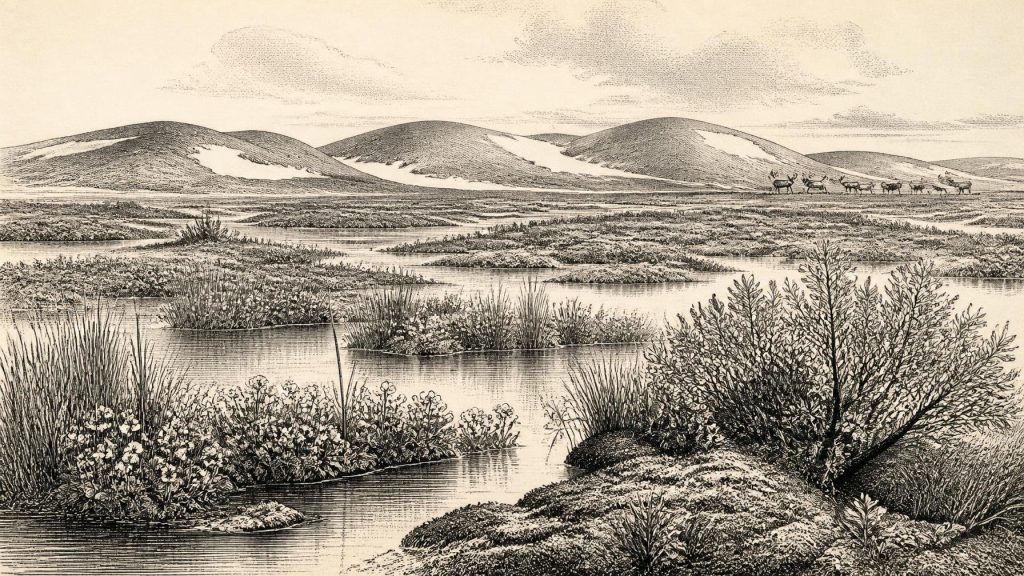
The Derryvree plant and insect remains indicate open tundra and a periglacial climate. “Periglacial” does not mean that the site itself lay under ice. It describes conditions shaped by severe cold, frost action, seasonal thaw and ground that may have been frozen for long periods. The terrain would not have resembled the wooded, hedge-lined Ireland of later millennia. It was a sparse, exposed landscape in which wet hollows, shallow water and sedge-rich margins interrupted more open ground.
Macrofossils recovered from the sediments include plants suited to cold, wet and treeless conditions. They include bogbean or buckbean (Menyanthes trifoliata), water-milfoil, sedges and freshwater mosses, alongside arctic-alpine plants such as mountain avens (Dryas octopetala), dwarf willow (Salix herbacea) and alpine sandwort. These remains are evidence, not merely scenic detail: seeds, leaves, moss fragments and insect traces demonstrate that plants grew and reproduced locally or nearby, and that freshwater conditions persisted long enough for organic sediment to build up.
The picture should still be handled carefully. A wetland deposit records its own catchment particularly well, not every hillside in Ireland. It can show that a pond or slow-moving watercourse supported aquatic and marginal vegetation; it cannot supply a complete island-wide weather report. Nor should a Greenland ice-core event be simply renamed as an Irish season. Comparison with North Atlantic climate chronologies places this nominal date near the beginning of Greenland Interstadial 5.2, a relatively milder pulse in the Greenland record. Yet Irish deposits are not resolved finely enough to demonstrate exactly how that shift was experienced at Derryvree. The broader lesson is climatic volatility, not a precise annual forecast.
Animals on an Unsettled Island
Caves in the south and south-east of Ireland offer another window onto this wider period. Castlepook Cave, near Doneraile in County Cork and once called Mammoth Cave, has yielded a remarkable Pleistocene fauna. Reindeer, woolly mammoth, giant deer, brown bear, wolf, Arctic fox, hare, lemmings and spotted hyaena are among the animals represented in its old collections and more recent investigations. These species make clear that Ireland could support a varied cold-climate fauna during parts of Marine Isotope Stage 3.
But Castlepook is not a single frozen tableau. Its bones accumulated over tens of thousands of years, through different processes: animals falling into or entering caves, carnivores using chambers and water later redistributing remains. Earlier excavation also removed much contextual information. Improved radiocarbon methods have shown that some older Irish cave dates needed revision, while re-dating has pushed some Castlepook animal remains much farther back in time than once thought. A mammoth bone, a hyaena tooth and a reindeer limb from the cave need not describe neighbours seen on the same day, decade or even millennium.
Nevertheless, the evidence supports a credible ecological setting for the period around 30,539 BCE. Reindeer were suited to open, cold country and would have exploited seasonal vegetation. Carnivores followed prey and scavenging opportunities. Hyaenas and wolves, if present in the same broad climatic phase, were competitors and scavengers as well as predators. Brown bears, foxes, hares and small mammals occupied different ecological niches. Their presence was governed by shifting habitat, access routes and food, rather than by any political frontier. In this early Irish past, the closest evidence for conflict is ecological: animals competing, hunting, denning and surviving in a changing cold environment.
The Human Question
A reindeer femur from Castlepook has made this distant period important to Irish archaeology in a new way. The specimen has been reported as approximately 33,000 years old and carries a deep linear mark interpreted by zooarchaeologist Ruth Carden as damage from a stone tool used in butchery. If that interpretation is confirmed, it could be the earliest evidence that people handled an animal in Ireland, immensely earlier than the island’s long-established post-glacial settlement record.
Its limits matter as much as its promise. The radiocarbon measurement dates the animal bone, not an exact moment of cutting. The specimen derives from an old cave collection, not a freshly excavated occupation floor containing an associated hearth, stone-tool scatter, shelter, human remains and refitting butchered bones. No securely dated settlement, workshop, burial or art assemblage demonstrates a resident human community in Ireland around 30,539 BCE. The femur therefore supports a possible episode of carcass processing in the broad period, not an assertion that Ireland had a permanent population, a named Upper Palaeolithic culture or a continuous line of inhabitants.
That distinction also governs what can be said about society. There is no evidence here for political authority, diplomacy, territorial institutions, formal religion, trade networks or learning in the later written sense. It would be misleading to fill those absences with imagined chiefs, clans, rituals or exchange routes. If people did reach Ireland, the most defensible interpretation is of small, mobile hunter-gatherer parties moving through a wider north-west European world, perhaps on brief visits when geography, climate and animal movements allowed. Even that is an inference from a disputedly sparse record, not a demonstrated social history.
Landscape Before History
The economy visible at Derryvree was nature’s economy: plant growth in short seasons, freshwater productivity, animal mobility and the physical movement of ice and meltwater. There is no evidence for farming, domesticated animals, metal, pottery, trade goods or built settlement. Sea levels were lower than today because vast volumes of water were locked in ice sheets, altering the shelves and coastlines around north-west Europe. Yet lowered sea level must not be translated automatically into a simple, continuous land bridge to Ireland. The changing Irish Sea basin, glacial margins and marine channels made access complex, and the exact routes available at any particular moment remain uncertain.
For Ireland at this notional date, Derryvree’s buried wetland is more illuminating than any invented historical event. Its buckbean, dwarf willow, mosses and sediments record life between ice advances. Castlepook’s faunal archive shows that cold-adapted mammals reached the island across a far longer and more complicated timespan than older narratives allowed. Together they reveal a place neither timelessly frozen nor securely peopled: an environmentally dynamic island on the edge of expanding ice, where the evidence is real, valuable and necessarily incomplete.
Primary Sources
- A Middle Midlandian Freshwater Series at Derryvree, Maguiresbridge, County Fermanagh, Northern Ireland
- Middle Midlandian Freshwater Series at Derryvree, Maguiresbridge, County Fermanagh, Northern Ireland
- Early Midlandian–Middle Midlandian, Pleistocene, Northern Ireland
- The Subdivision of the Quaternary Period in Ireland
- A Reconsideration of the Radiocarbon Dating of the Marine Isotope Stage 3 Fauna from Southern Ireland
- The Irish Quaternary Fauna Project
- New Insights on the Fauna of Ireland's Younger Dryas and Early Holocene from Alice & Gwendoline Cave
- Archaeology Research Excavation Grant 2022: Castlepook Caves Project Final Report
- 2022:564 – Castlepook Cave, Castlepook South, Cork
- Heritage Artefacts of County Cork
- The Archaeological Heritage of County Cork
- Growth and Retreat of the Last British–Irish Ice Sheet, 31,000 to 15,000 Years Ago: the BRITICE-CHRONO Reconstruction
- Pattern and Timing of Retreat of the Last British-Irish Ice Sheet
- Maximum Extent and Dynamic Behaviour of the Last British–Irish Ice Sheet West of Ireland
- Stratigraphic and Palaeo-Geomorphological Evidence for the Glacial-Deglacial History of the Last British-Irish Ice Sheet in the North-Western Irish Sea
- The Island of Ireland: Drowning the Myth of an Irish Land-Bridge?
- The IntCal20 Northern Hemisphere Radiocarbon Age Calibration Curve (0–55 cal kBP)
- IntCal Publications
- A Stratigraphic Framework for Abrupt Climatic Changes During the Last Glacial Period Based on Three Synchronized Greenland Ice-Core Records
- Menyanthes trifoliata
- Salix herbacea
- Dryas octopetala