Castlepook’s Limestone Bonebed30532 BCE
Circa 30,532 BCE, Ireland lay within the unstable later Ice Age, with no written history or securely dated human settlement. Derryvree’s freshwater deposits indicate open, cold tundra-steppe, wet ground and sparse vegetation, rather than woodland. Castlepook Cave preserves a fragmentary faunal record including mammoth, reindeer, horse, giant deer, predators and Arctic species, demonstrating intermittently habitable cold-climate environments. Cave remains accumulated over long periods and cannot prove species coexisted. A possibly cut-marked reindeer bone suggests but does not establish earlier human activity. Growing British–Irish ice later disrupted habitats, displaced fauna and destroyed evidence, leaving an uneven archaeological record of dynamic landscapes.
Dateline
The label “30,532 BCE” is useful only as a modern point of reference. It does not identify a recorded Irish year, season, ruler or event. At this depth of time there are no written sources, no calendar kept by people in Ireland, and no archaeological deposits precise enough to be assigned responsibly to one numbered year. In radiocarbon practice, “before present” is measured from 1950; the calendar equivalent of this nominal date is roughly 32,500 years before present. Yet the evidence that can illuminate Ireland around then normally comes with ranges of centuries or millennia, and with important uncertainties in both calibration and archaeological context.
That caution matters especially here. Around the broad period represented by 30,532 BCE, Ireland belonged to the later part of Marine Isotope Stage 3, an unstable chapter of the last Ice Age before the Last Glacial Maximum. The island was not the familiar green, wooded Ireland of later prehistory. Nor was it necessarily one uniform frozen waste. Its landscapes, coastlines and ice margins changed over long timescales. What survives is a scattered environmental archive: animal bones from caves, freshwater deposits buried beneath glacial sediments, fossil plants and insects, landforms moulded by ice, and radiocarbon determinations that date particular specimens rather than a whole landscape at once.
A Date Without a Diary
Modern calendar notation can create a misleading impression of precision. A bone dated by radiocarbon is not a timestamp for a historical occurrence: it may date when the animal died, while the sediment enclosing it may have been moved later. Calibration converts radiocarbon measurements into calendar-age probability ranges, rather than a single incontrovertible year. At more than 30,000 years ago, the calibration curve itself is built from several kinds of scientific archive and carries wider uncertainty than recent chronology.
The most responsible view, therefore, is regional and chronological. Ireland was part of the north-west European Ice Age world, separated from or connected to neighbouring lands in ways that varied with sea level, local ice and changing geography. Lower global sea levels exposed large areas of continental shelf. But this does not prove an easy, dry route across every stretch of the Irish Sea at every moment, or establish that people used one. Questions of access must be kept separate from evidence of actual human presence.
There was no Irish state, kingship, diplomacy, army, tribe known by name, or political frontier that archaeology can identify at this date. There are no securely attributable settlements, cemeteries, houses, hearths, art panels, tools or personal ornaments from Ireland that allow an account of social institutions. Political history begins here with an absence of evidence, not with a blank space to fill imaginatively.
Open Ground and Fresh Water
The clearest environmental evidence for an Ice Age Ireland comes from particular sites rather than island-wide surveys. At Derryvree near Maguiresbridge in County Fermanagh, roadworks exposed silts and fine sands containing organic material between two substantial layers of glacial till. This freshwater sequence was sealed between episodes of ice advance. Its conventional radiocarbon determination of 30,500 ± c.1,000 radiocarbon years before present does not equate neatly to 30,532 BCE, but it belongs to the same broad middle-to-late Midlandian discussion and provides an indispensable picture of a cold Pleistocene habitat.
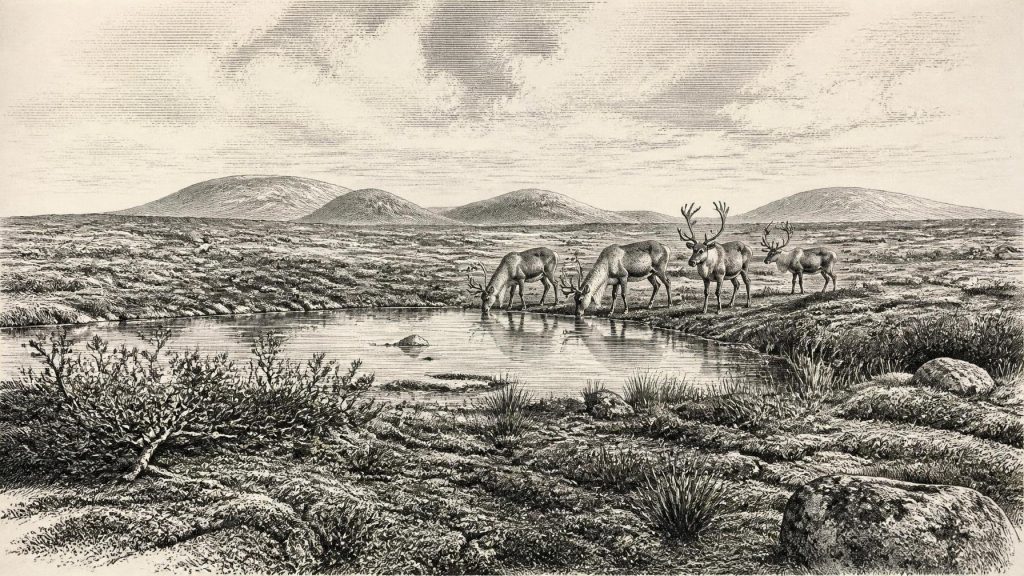
The plant remains at Derryvree point to open tundra or tundra-steppe conditions and a periglacial climate. Mosses, sedges and herbs, alongside aquatic plants such as water-milfoil and bogbean, indicate that shallow fresh water and wet ground existed locally. Dwarf willow, mountain-avens and other cold-adapted taxa speak of low vegetation rather than closed forest. Pollen was poorly preserved, so it cannot support overly detailed reconstruction, but the combined macrofossil and pollen evidence strongly rejects a wooded landscape comparable with modern Fermanagh.
This was an environment with sharp local contrasts: wet hollows, lake margins, sedge-rich ground, exposed mineral soils and sparse plant cover beyond them. Seasonal thaw could produce water and plant growth, while long winters, frost action and permafrost conditions constrained soils and vegetation. Such a mosaic could sustain insects, small mammals and grazing or browsing animals without becoming lush country. It also shows why terms such as “barren” are inadequate. Cold ground could be biologically productive in short summers, even as it remained difficult terrain for large mammals and people.
Later ice sheets profoundly altered the record. Glacial erosion removed or mixed older deposits across much of the island; rising post-glacial seas submerged former coastal plains; antiquarian cave excavations frequently disturbed stratigraphy before modern recording standards existed. The scarcity of sites is therefore evidence partly of preservation history, not simply proof that nothing ever lived or travelled in Ireland.
The Castlepook Faunal World
Castlepook Cave, also called Mammoth Cave or Doneraile Cave, in the Awbeg Valley below the Ballyhoura Hills of north Cork, is the central faunal archive for pre-Last Glacial Maximum Ireland. Its bone assemblage is remarkable precisely because it records animals absent from later Irish history: woolly mammoth, reindeer, giant deer, horse, brown bear, wolf, Arctic fox, spotted hyaena, hare and lemmings are among the species associated with the cave system and comparable southern Irish deposits.
That list must not be read as a photograph of one afternoon around 30,532 BCE. Cave deposits accumulate through many processes and over long spans. Carnivores can drag prey or scavenged bones underground; animals may die in caves; water can redeposit material; and early digging can combine layers. Direct dating undertaken through the Irish Quaternary Fauna Project demonstrated that Ireland’s Pleistocene cave fauna covered a long period, broadly from at least about 45,000 to 20,000 radiocarbon years before present. Individual species in museum collections need not have lived together, and a species’ presence at Castlepook does not prove that it occupied every Irish region.
Nevertheless, the assemblage establishes an important fact: before the maximum expansion of the last ice sheet, parts of Ireland could intermittently support a far richer cold-climate mammal community than the later island. Reindeer imply open terrain and migratory possibilities; lemmings and Arctic fox fit severe northern conditions; mammoth and horse evoke broad grass- and herb-rich habitats; hyaenas, wolves and bears show that predators and omnivores formed part of the ecological web. Giant deer, where chronologically appropriate, warn against treating the phrase “Irish elk” as evidence of a uniquely Irish animal or landscape: it was a widespread Eurasian species, and its Irish fossil record belongs to more than one climatic episode.
For everyday life, the safest conclusion is ecological rather than human. Animals found food, water and shelter in an exposed Ice Age landscape. Their movements may have followed seasonal vegetation, valleys and easier routes around ice, but precise migration paths cannot be recovered. Caves such as Castlepook may have served as carnivore dens, traps, shelters or bone-collecting places; they are not demonstrated human homes.
The Human Question
The possibility of people in Ireland during this earlier Upper Palaeolithic interval is important but unresolved. A reindeer bone from Castlepook has been discussed in recent public and archaeological reporting as bearing a mark consistent with use of a sharp stone implement. If made during fresh butchery, that mark could indicate a brief human encounter with a carcass in Ice Age Cork. It is a serious observation worth further testing, not a licence to announce an established population.
The evidential limits are substantial. The specimen derives from earlier cave investigations, not from a modern sealed occupation floor. It has no securely associated lithic assemblage, hearth, dwelling structure, human remains or repeated butchery assemblage. Its date is the date of the animal bone, not necessarily an independently dated cut. Recent excavation at Castlepook has underlined both the site’s importance and the need to recover material in secure context; it did not supply a confirmed Upper Palaeolithic toolkit or settlement. The interpretation should remain possible rather than certain.
Comparison with the much later evidence from Alice and Gwendoline Cave, County Clare, is instructive. There, a brown-bear kneecap bearing butchery marks has been directly dated to about 12,800–12,600 calibrated years before present, furnishing Ireland’s strongest published evidence for a Late Upper Palaeolithic human visit. Even that discovery represents a slender trace, not a detailed social history. It shows how little evidence a short stay may leave, but it cannot demonstrate that people occupied Ireland more than twenty millennia earlier.
Accordingly, there is no responsible basis for describing warfare, leadership, exchange networks, religious practice, language, art, formal learning or diplomacy in Ireland around this nominal year. There is likewise no evidence for farming, herding, permanent villages, metalwork or trade. If humans entered the island, they would have been mobile hunter-gatherers within the wider Upper Palaeolithic world of north-west Europe, dependent on knowledge, cooperation and perishable technologies. That is a comparative inference from neighbouring regions, however, not a documented description of an Irish community.
Approaching the Ice Maximum
The large-scale development that gives this period its significance was environmental change. The British–Irish Ice Sheet grew towards its Last Glacial Maximum, reached later than this nominal date. Modern reconstructions place major ice-sheet growth and widespread coverage in the interval after roughly 31,000 years ago, with maximum conditions principally in the period around 29,000–20,000 years ago, though timing and extent differed by sector. Ireland’s topography, the Atlantic margin, local precipitation and the behaviour of marine-terminating ice all mattered. It is misleading to portray an ice front as a single line marching evenly across the island.
For Ireland, the consequence was repeated disruption. Habitats contracted, shifted or vanished beneath advancing ice; animal populations could be isolated, displaced or eliminated; sediments were overridden and older surfaces destroyed. The Derryvree freshwater horizon and the Castlepook bone collections survive because of exceptional local circumstances, not because they are representative samples of every county. Their survival is a reminder that Ice Age history is recovered unevenly.
Thus the most important Irish development around 30,532 BCE was not a dated human event but a threshold in deep environmental history. In a changing, largely treeless land, freshwater pockets supported cold-adapted plants while southern caves accumulated evidence of mammals whose descendants would not be part of later Ireland. Whether a very occasional human visitor stood among that fauna remains an open archaeological question. The evidence is fragmentary, but it is enough to replace the old image of an eternally empty Ice Age island with a more precise one: a dynamic and sometimes habitable northern landscape, increasingly threatened by the return of major ice.
Primary Sources
- A Middle Midlandian Freshwater Series at Derryvree, Maguiresbridge, County Fermanagh, Northern Ireland
- The Irish Quaternary Fauna Project
- First Evidence of a Late Upper Palaeolithic Human Presence in Ireland
- New Insights on the Fauna of Ireland’s Younger Dryas and Early Holocene from Alice & Gwendoline Cave
- Growth and Retreat of the Last British–Irish Ice Sheet, 31,000 to 15,000 Years Ago: the BRITICE-CHRONO Reconstruction
- Maximum Extent and Dynamic Behaviour of the Last British–Irish Ice Sheet West of Ireland
- Early Deglaciation of the British-Irish Ice Sheet on the Atlantic Shelf Northwest of Ireland Driven by Glacioisostatic Depression and High Relative Sea Level
- Timing and Pace of Ice-Sheet Withdrawal Across the Marine–Terrestrial Transition West of Ireland During the Last Glaciation
- Palaeoecology
- Castlepook Caves
- 2022:564 – Castlepook Cave, Castlepook South, Cork
- Mammoth Cave, County Cork
- Archaeological Excavations at Killuragh Cave, Co. Limerick
- The Antiquity of Man in Ireland
- The IntCal20 Northern Hemisphere Radiocarbon Age Calibration Curve (0–55 cal kBP)
- Landscapes and Environments of the Last Glacial-Interglacial Transition: a Time of Amazingly Rapid Change in Ireland
- Irish Pleistocene Biostratigraphy
- Pleistocene Vertebrates in the British Isles
- The Eastern Sector of Ice Masses Located in the Irish Sea Basin
- Early Deglaciation of the British-Irish Ice Sheet on the Atlantic Shelf Northwest of Ireland Driven by Glacioisostatic Depression and High Relative Sea Level