The Labour Rate Winter1846 CE
In 1846, a second, devastating potato blight transformed Ireland’s food crisis into catastrophe, destroying the staple relied upon by labourers, cottiers and smallholders. Although food continued to be produced and imported, poverty and rising prices denied many access. After Peel resigned, Russell’s government prioritised market supply and paid public works over direct food provision. The Labour Rate Act rapidly expanded employment schemes, but delayed wages, harsh outdoor labour, local debt and administrative failures deepened suffering and disease. Political division split the Repeal movement, while local and Quaker relief networks emerged. By winter, conditions had laid the foundations for Black ’47.
Dateline
In 1846 the Irish crisis ceased to look like a bad harvest followed by a difficult winter and became a national catastrophe. Potato blight had damaged the 1845 crop, but many households had struggled through with some remaining potatoes, seasonal earnings, charity and food bought through local relief arrangements. The new crop offered the hope of recovery. Its destruction instead removed the principal food of millions whose holdings, wages and customary diet had made them exceptionally dependent upon it. By the year’s end, hunger, debt, disease and the search for relief had altered the practical routines of life across much of rural Ireland.
The calendar year matters because its sequence exposed the failure of assumptions made after the first blight. Government policy through the spring and summer was still framed around a short emergency: food depots and local committees would tide people over until the harvest, while paid public works would offer labour rather than free food. When the 1846 potato crop failed far more comprehensively, those arrangements were neither extensive enough nor swift enough to meet the need. Ireland entered the winter with an immense emergency-relief machine being improvised, but with the people who needed it increasingly weakened.
A Harvest Lost Again
The cause of the immediate disaster was Phytophthora infestans, the potato blight first recognised in Ireland in 1845. In 1846 it returned with devastating effect. Contemporary reports during the summer and early autumn recorded the disease’s spread, while officials and relief committees began to understand that the expected harvest would not restore normality. The damage was not uniform in every place or to every variety, and contemporaries could not yet measure the final shortfall with modern precision. Yet there is no serious doubt that the crop on which the poorest households relied was, in practical terms, ruined over very wide areas.
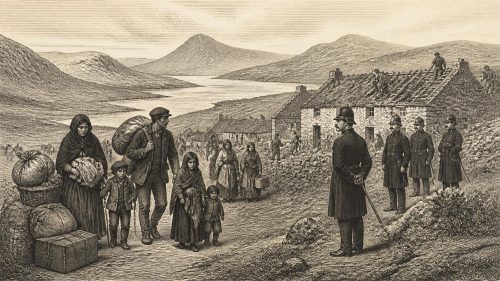
That dependence had deep roots. For landless labourers, cottiers and smallholders, potatoes supplied cheap calories from very small plots and could sustain large families where grain or livestock could not. A crop failure therefore did more than reduce one item on a market stall. It struck at food, seed, rent-paying capacity and employment together. Families that had eaten their reserves, sold possessions or accumulated arrears after 1845 now confronted a second failure with fewer resources. The hungry did not form a single social class, but risk was greatest among those who had little land, insecure work and no cash with which to replace potatoes at rising market prices.
Other food continued to be grown, sold and exported from Ireland. That fact is essential, but it should not be used to minimise the famine. Grain, cattle, butter, pork and other commodities belonged to commercial systems, were unevenly distributed, and could not simply replace the vast subsistence value of the lost potato crop. Imports also arrived, including Indian meal, but access depended on price, local supply and purchasing power. The central problem in 1846 was not an empty island; it was that a huge proportion of the population had lost its normal food and lacked the means to secure sufficient alternatives.
Peel’s Departure, Russell’s Choice
Ireland’s emergency unfolded amid a major change in British politics. Sir Robert Peel’s Conservative ministry had responded to the 1845 failure by importing Indian corn, opening depots and supporting relief works. It also used the crisis to advance repeal of the Corn Laws. The repeal legislation received royal assent on 26 June 1846, but the division it provoked destroyed Peel’s parliamentary position; he resigned on 29 June. Lord John Russell’s Whig administration took office at the end of that month, just as evidence mounted that the new Irish potato crop was failing.
The change was consequential. Russell’s ministers rejected a continuing government role in importing and retailing food on Peel’s scale. Their expectation was that free trade and ordinary commerce would bring supplies to Ireland, while the state’s principal task would be to create employment. Charles Trevelyan, the powerful permanent official at the Treasury, was central to administering this approach. Ministers did not deny distress, nor did they provide no aid. Their choice was instead to make wages from public employment, supplemented by locally organised provision, the main route by which destitute people would buy food.
That decision rested on political economy and on fears about dependency, cost and disruption to private trade. It also rested on a grievously mistaken reading of the scale and duration of the crisis. For people already short of food, a wage delayed by procedure, reduced by task-rates, or overtaken by the price of meal was not relief in any dependable sense. The contrast between a policy designed for scarcity and the reality of an almost lost staple harvest defined the worsening months ahead.
Making Work the Test of Hunger
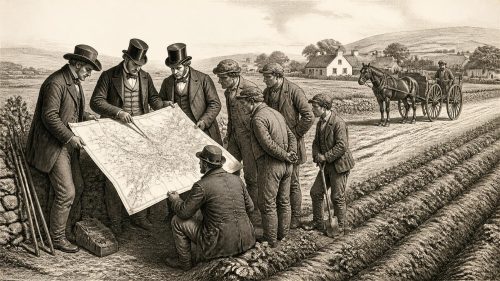
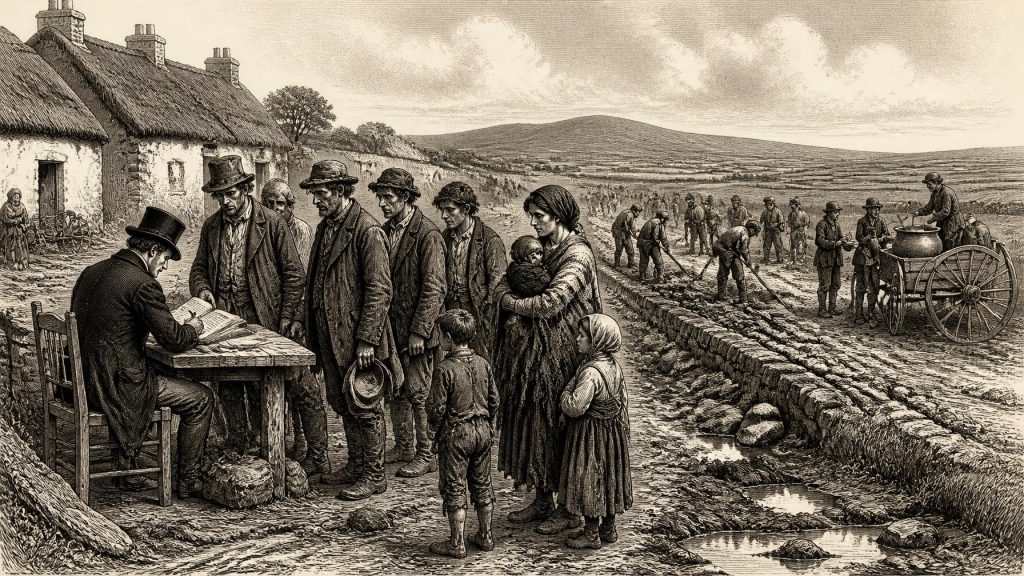
Public works were not new in 1846. Schemes had begun under Peel, commonly involving roads, drainage, walls, piers and other local projects. They were administered through relief committees, county and baronial structures, and the Commissioners of Public Works. In principle, employment gave able-bodied people money while producing useful improvements. In practice, the system made physical labour a test of need at precisely the point when many labourers were underfed, and it required applications, inspections, approvals, supervisors and pay arrangements across an entire country.
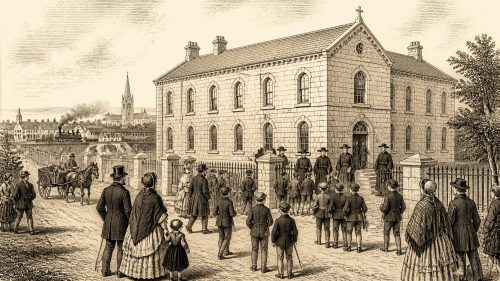
During July the authorities hoped to reduce employment so that labourers would return to harvest work. From 8 August, despite mounting warnings about the potato crop, the Treasury ordered a gradual closure of the earlier public works. The timing was disastrous. Requests for work were about to rise, not fall. Parliament consequently passed the Poor Employment (Ireland) Act on 28 August, widely known as the Labour Rate Act. It enabled new relief works in distressed districts, with the cost advanced by the Treasury but ultimately charged locally through rates and loans. Presentment sessions in September triggered a flood of proposals.
The programme expanded at extraordinary speed. Official figures later cited an increase from about 30,000 labourers in September to 440,687 in December. Such totals indicate both the desperate demand and the administrative impossibility of the undertaking. Roads were cut through remote districts, stones broken, embankments formed and drainage attempted. Some projects had lasting utility; others became symbols of a relief system more concerned with finding tasks than with feeding people. The Board of Works had to recruit staff rapidly and oversee works scattered across hundreds of baronies, while local committees disputed eligibility and workers waited for tickets or wages.
For households, the arrangement made everyday survival contingent on exhausting labour and uncertain payment. Work was often performed outdoors in worsening weather. Poor nutrition reduced strength; low or delayed wages bought less as food prices rose; and people unable to work—including many children, older people and the sick—were especially ill served by an employment-centred system. Crowding at works and movement in search of them also compounded the danger from fever and dysentery. Official concern about disease had already been expressed in the spring, but hunger and infection increasingly reinforced one another as the year closed.
Politics Without Unity
The catastrophe did not suspend constitutional politics. Daniel O’Connell remained the foremost figure in Irish popular politics, but by 1846 his authority and health were in decline. He sought emergency action from the new Whig government and contemplated cooperation with it in pursuit of practical reforms. To younger nationalists clustered around The Nation, this appeared a retreat from the central demand for repeal of the Union.
The dispute became a decisive rupture on 28 July. The Repeal Association adopted ‘peace resolutions’ insisting that national liberty could never be sought by force of arms. Thomas Francis Meagher, William Smith O’Brien and other Young Ireland figures would not commit themselves to an absolute repudiation of physical force in every conceivable circumstance. They withdrew from the association. The Irish Confederation would not formally hold its first meeting until January 1847, so it should not be projected backwards as a fully formed organisation in 1846. But the secession itself belonged unmistakably to this year, and it split a movement already weakened by famine and by the fading capacity of O’Connell’s leadership.
The division mattered because the famine raised urgent questions of power as well as relief. Could Westminster be trusted to protect Irish lives? Should national politics concentrate on constitutional alliance, social assistance or more radical change? In 1846 those questions were debated amid worsening hunger, but no political movement yet possessed a remedy equal to the emergency.
Networks of Relief and a Darkening Winter
State institutions were not the only actors. Clergy, local committees, landlords, merchants and voluntary bodies raised subscriptions, distributed food where possible and reported distress to Dublin Castle. These efforts could save lives locally, but they varied greatly in resources and reach. Records of petitions, letters and inspectors’ reports from 1846 preserve a landscape of communities appealing for meal, work, money and official attention.
One important development came in Dublin in November, when Quakers led by Joseph Bewley established the Central Relief Committee of the Society of Friends. Irish Quakers were few in number, but their commercial, religious and transatlantic networks enabled them to organise an appeal and coordinate assistance with Friends in Britain and North America. Their larger operations belong chiefly to 1847 and later, yet the committee’s foundation in 1846 was significant: voluntary relief was beginning to build the channels through which food, clothing, seed and funds would later move. It did not absolve the state of responsibility, nor could charity meet a crisis of this magnitude, but it represented practical solidarity across religious and geographical boundaries.
By December, Ireland was entering the season later remembered as the prelude to Black ’47. That later name properly belongs to 1847, when mortality and fever reached still more terrible levels; it should not obscure the fact that the foundations of that disaster were laid in 1846. The second potato failure, the turn towards loan-funded public works, the swelling queues for employment, the split in repeal politics and the first organised charitable networks made this the year in which famine became unmistakably structural. Ireland’s roads, workhouses, markets, chapels, ports and homes were already being remade by a calamity that had only begun to reveal its full human cost.
Primary Sources
- Famine Records and Distress Papers
- Sources in the National Archives for Research into the Great Famine 1845–1850
- The Archives of the Office of Public Works
- Food Exports from Ireland 1846–47
- The Triumph of Dogma: Ideology and Famine Relief
- Quakers & the Famine
- Daniel O'Connell
- The Irish Crisis
- The Great Irish Famine
- How the Great Famine Changed Ireland Forever
- A Policy Disaster: British Famine Relief Measures
- ‘Hunger Will Break Through a Wall’: Food Riots During the Famine
- Distress in Ireland — Measures of Relief, House of Commons Debate, 17 August 1846
- Provisions for Ireland, House of Commons Debate, 27 July 1846
- Fever and Famine (Ireland), House of Commons Debate, 13 March 1846
- State of Ireland, House of Commons Debate, 25 January 1847
- Public Works (Ireland) (No. 2) Act 1846
- Ejectment and Distress (Ireland) Act 1846
- Famine Relief in Ireland (1846–1850)
- Address from the Committee of the Society of Friends in London, on the Subject of the Distress in Ireland
- Political Background to the Exiles in Paradise
- IV. The Irish Board of Works in the Famine Years
- Coping with the Great Irish Famine: The Agency of Skibbereen