The Irish Felon’s Last Issue1848 CE
In 1848, renewed potato blight shattered hopes of Irish recovery after the catastrophic famine year of 1847, deepening hunger, disease and regional inequality. With soup kitchens closed, Poor Law unions, overcrowded workhouses and restricted outdoor relief became central, often forcing destitute tenants to surrender land. Cholera’s arrival foreshadowed mortality. Meanwhile, European revolutions inspired Young Ireland militants. John Mitchel’s United Irishman prompted the Treason Felony Act and his transportation; The Irish Felon briefly continued radical journalism. After habeas corpus was suspended, Smith O’Brien’s poorly supplied rising collapsed at Ballingarry. Subsequent trials created nationalist martyrs, while emigration, eviction and death devastated communities.
Dateline
In 1848 Ireland endured a second crisis within the Great Famine: the renewed failure of the potato, the mounting burden placed upon the Poor Law, and an attempt at rebellion by the Young Ireland movement. These developments were connected, but they should not be reduced to a single story. Hunger, disease, poverty, political conviction and coercive government policy shaped lives differently in different regions. The year is best understood as a time when the prospects of recovery after the catastrophic mortality of 1847 proved tragically premature.
Blight Returns
The potato crop again suffered badly in 1848. This was a devastating reversal for families whose food supply, labour patterns and small holdings had already been shattered by the failures of 1845 and 1846 and by the hunger and epidemic disease of 1847. The blight was caused by Phytophthora infestans, though contemporaries did not possess a secure modern explanation or a means of preventing it. For labourers, cottiers and small tenants with little land and few reserves, another damaged crop meant that survival could not simply be postponed until the following harvest.
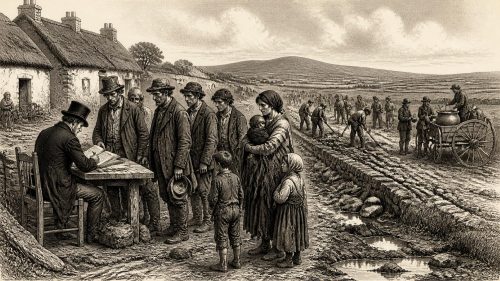
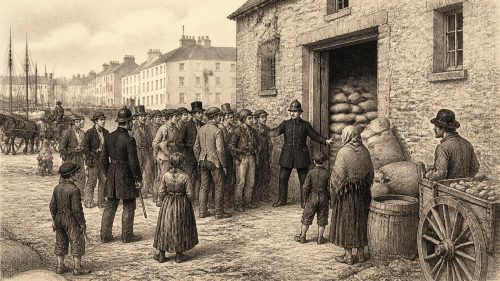
Famine was never merely a shortage of potatoes. It was a social calamity intensified by unequal access to land, wages, credit and food. Some households retained livestock, a trade, a remittance or access to a larger farm; many did not. The loss of potatoes forced people towards bought meal, charity, the workhouse, begging, migration or dependence on kin. Food relief commonly included Indian meal and rice rather than the familiar potato diet. Preparing unfamiliar food, finding fuel, and feeding children while weakened by hunger were practical, daily difficulties as well as questions of policy.
Conditions varied sharply. Parts of Ulster and the east had begun to recover more quickly than many western and southern districts, while the crisis remained grave in places where poverty, weak local rate bases and dependence on tiny holdings converged. The return of blight in 1848 therefore exposed the danger of treating the previous summer’s apparent improvement as an ending. It was not. The worst excess mortality of the wider famine would continue into the following years, with starvation making people exceptionally vulnerable to infectious disease.
Relief at Its Limits
By 1848 the emergency soup-kitchen system of 1847 had ended, leaving the Irish Poor Law as the principal official machinery of relief. This was a profound change. Assistance was increasingly tied to Poor Law Unions, boards of guardians and the poor rate levied locally on property. Workhouses, originally intended as a deterrent and a tightly restricted refuge, had become overwhelmed during the famine. Outdoor relief, given to people outside the institution under specified conditions, was now indispensable, yet access was constrained and uneven.
Registers from Milford Union in Donegal offer a small but revealing view of the system in operation. They record outdoor-relief cases from January 1848, naming people, occupations, ages, religious affiliation and townlands. Such paperwork shows that famine relief was administered person by person, through rules and local decisions, rather than arriving as an undifferentiated national provision. The categories in the registers also show a society of labourers, weavers, blacksmiths, dressmakers and people described simply as mendicants. Destitution crossed occupations, gender and age.
The rules could be harsh. Outdoor relief under the 1847 extension of the Poor Law was directed especially towards the aged, sick, infirm and widows with dependent children; the able-bodied had more limited provision. The notorious quarter-acre rule, often called the Gregory clause, excluded occupiers of more than a quarter acre from relief unless they surrendered their holding. In practice, this could make assistance conditional upon abandoning the fragile economic foothold that had sustained a family before the famine. By mid-year, hundreds of thousands of people nationally depended on outdoor relief.
Workhouse life was no safer guarantee. Overcrowded wards and fever hospitals brought the sick into close proximity. Officers, nurses, medical staff, chaplains and paupers all faced danger. Cholera appeared in Ireland late in 1848, adding another lethal disease to a population already debilitated by hunger, fever and dysentery. Its full impact belongs chiefly to 1849, but its arrival in the closing months of this year was an ominous sign. Burial, nursing and the provision of basic sanitary care became urgent local concerns, while guardians faced bills they could scarcely meet.
Revolutionary Hopes
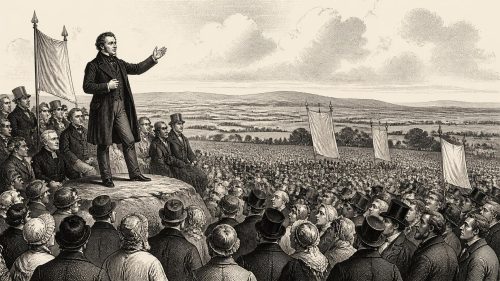
The European revolutions of 1848 transformed the political atmosphere. News from Paris encouraged Irish nationalists who believed that the constitutional campaign for repeal of the Union had failed. The Irish Confederation, formed by Young Irelanders after their break with Daniel O’Connell’s Repeal Association, contained important differences of temperament and strategy. Some members remained wary of insurrection; others saw armed resistance as the only answer to British rule and to the famine’s devastation.
John Mitchel gave the militant tendency its fiercest journalistic voice. Having left The Nation, he founded the weekly United Irishman, first published on 12 February 1848. It attacked government policy, urged resistance and printed material concerning military organisation. Parliament responded with the Treason Felony Act, which received royal assent on 22 April. The measure made it a felony to express by writing or overt act an intention to depose the sovereign or levy war in ways specified by the statute, simplifying prosecution where treason law had been difficult to use.
Mitchel was convicted under that new law on 26 May and sentenced to fourteen years’ transportation. His removal was both a blow to the radicals and a warning to other editors. Yet it did not end their publishing. John Martin, Thomas Devin Reilly and James Fintan Lalor produced The Irish Felon, a short-lived successor newspaper issued in Dublin from 24 June to 22 July. Its title deliberately embraced the government’s accusation. Print culture was itself a field of political conflict: newspapers carried arguments, reports from abroad, appeals to readers and competing visions of Irish liberty.
The year also gave enduring form to a political symbol, though its precise early public appearances require care. Thomas Francis Meagher returned from Paris in April carrying a green, white and orange tricolour presented by French sympathisers. At a Dublin meeting that month he explained the white as a hoped-for truce between Irish Catholics and Protestants. Later memory strongly associated Meagher with a flag displayed at Waterford in March, but contemporary sequences and later accounts are not wholly straightforward. What is firm is that the tricolour became a Young Ireland emblem in 1848, expressing an aspiration to reconciliation as well as national separation.
Ballingarry
Government pressure intensified during July. John Martin was arrested; other editors and Confederation figures were pursued; and on 25 July Parliament suspended habeas corpus in Ireland, empowering the authorities to detain people suspected of conspiracy. The measure helped make a planned August rising seem impossible to delay. William Smith O’Brien, Thomas Francis Meagher, John Blake Dillon and their associates travelled through south Tipperary seeking support. They found crowds, anger and sympathy, but not the arms, supplies, unified command or sustained local commitment required for a successful revolt.
On 29 July O’Brien and his followers confronted a detachment of Irish Constabulary at Farranrory near Ballingarry, County Tipperary. The policemen took refuge in the house of the widow Margaret McCormack, holding members of her family inside. An exchange of fire followed. The encounter, later remembered as the battle of Ballingarry or ‘Widow McCormack’s cabbage patch’, was small in military terms but momentous politically. Two insurgents were killed, the expected wider rising did not materialise, and the rebels dispersed when reinforcements approached.
The episode must not be treated as comic relief after famine. It revealed the terrible distance between political intention and popular capacity in a starving country. Many potential supporters were ill-fed, poorly armed and responsible for families in desperate need. Clerical influence also mattered: Catholic priests did not act as a single bloc, but significant clerical opposition limited support for an uprising whose likely consequences included military repression. O’Brien’s force could neither feed itself nor hold territory. The state, by contrast, could deploy police, soldiers, courts and emergency powers.
Trials and Consequences
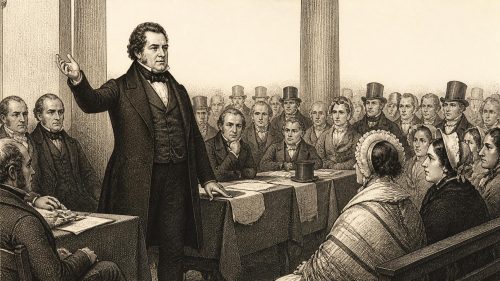
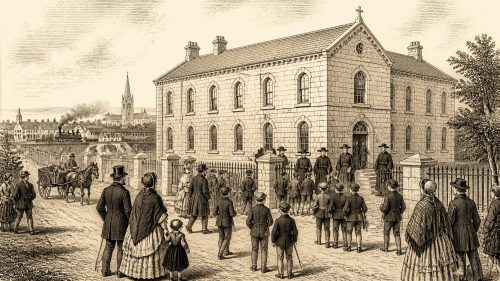
Arrests followed. O’Brien was captured at Thurles on 5 August; Meagher was arrested near Cashel on 13 August. At Clonmel, O’Brien was found guilty of high treason on 7 October and sentenced two days later to death. Meagher, Terence Bellew MacManus and Patrick O’Donoghue were also convicted and received death sentences on 23 October. Those sentences were not carried out: they were later commuted to transportation for life. That commutation belongs to 1849, but the trials of 1848 already turned the defeated leaders into potent figures in nationalist memory.
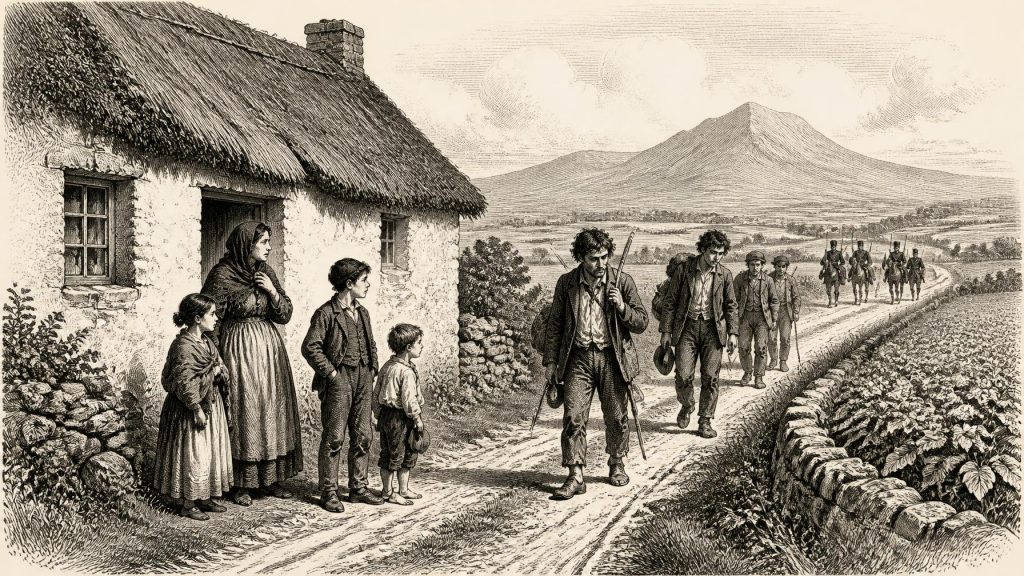
For most people in Ireland, however, the decisive realities of 1848 were not courtroom speeches or rebel banners but food, rent, disease, debt and departure. Emigration continued as families and individuals sought survival across the Atlantic and in Britain. Communities lost neighbours through death, removal to the workhouse, eviction, migration and imprisonment. The year’s political drama was real, but it unfolded within a far larger human catastrophe. By its end, the renewed blight and the first cholera cases made clear that neither relief nor repression had resolved the conditions from which crisis had grown.
Primary Sources
- Famine Records and Distress Papers
- Ireland’s Great Famine
- IVRLA Research Report: Irish Famine
- The Great Irish Famine
- The Irish Crisis
- The Scientific Investigation of the Failure of the Potato Crop in Ireland, 1845–6
- The Famine Years
- Outdoor Relief
- The Establishment of the Poor Law System
- The Union
- Poor Relief (Ireland) Act 1848
- Treason Felony Act 1848
- Suspension of the Habeas Corpus Act (Ireland) Bill
- Mitchel, John
- Meagher, Thomas Francis
- Dillon, John Blake
- The Irish Felon
- William Smith O’Brien Papers
- Political Background to the Exiles in Paradise
- Repeal and Revolution: 1848 in Ireland
- ‘A Sacred Obligation’: July 1848
- Trial of the Irish Patriots at Clonmel, Oct. 22nd, 1848
- William Smith O’Brien
- The State Trials