
Archived: 10 October 2026
Abstract
In 1851, Ireland’s census recorded 6,552,385 inhabitants, a decline of 1,659,330 since 1841, exposing famine mortality, disease, eviction and emigration while imperfectly distinguishing deaths from departures. Losses were greatest in western and southern potato-dependent districts, accelerating the disappearance of poor cabins and weakening Irish-speaking communities. Emigration remained immense, reshaping families and local economies. Estate sales under the Encumbered Estates Act, limited tenant-improvement legislation and Tenant Right agitation intensified land questions. The Medical Charities Act expanded dispensary provision. John Henry Newman’s appointment advanced plans for a Catholic university. Meanwhile, Ulster linen exhibitors at the Great Exhibition displayed industrial strength amid devastation.
Read Article

Archived: 10 October 2026
Abstract
In 1850, Ireland remained scarred by famine despite a less destructive, uneven potato blight. Workhouses, poor-law debt, eviction, emigration and a shrinking rural labour market continued to shape survival. Land insecurity intensified as the Encumbered Estates Court facilitated sales of indebted properties. The Dublin Tenant-Right Conference formed the Irish Tenant League, uniting diverse reformers behind fair rents, secure tenure and free sale of tenants’ interests. The Synod of Thurles, led by Paul Cullen, strengthened Catholic discipline, episcopal authority and Roman alignment, while opposing the Queen’s Colleges. These initiatives made 1850 a hinge between catastrophe and political, social and religious change.
Read Article

Archived: 10 October 2026
Abstract
In 1849, the Great Famine continued as blight, hunger, eviction, overcrowded workhouses and disease devastated Ireland. Cholera killed 772 of 1,077 recorded cases at Ballinasloe Union Workhouse, illustrating inmates’ vulnerability. Relief depended heavily on inadequate local rates; the May rate-in-aid redistributed Irish, rather than British, resources. The Incumbered Estates Act signalled restructuring of landownership, while emigration, consolidation and evictions altered rural life. Young Ireland leaders were transported, and unrest persisted; Dolly’s Brae exposed sectarian tensions. Victoria’s tour, new Queen’s Colleges and the Dublin–Cork railway projected progress, yet famine, political conflict and social upheaval still continued across the island’s fractured communities.
Read Article

Archived: 10 October 2026
Abstract
In 1848, renewed potato blight shattered hopes of Irish recovery after the catastrophic famine year of 1847, deepening hunger, disease and regional inequality. With soup kitchens closed, Poor Law unions, overcrowded workhouses and restricted outdoor relief became central, often forcing destitute tenants to surrender land. Cholera’s arrival foreshadowed mortality. Meanwhile, European revolutions inspired Young Ireland militants. John Mitchel’s United Irishman prompted the Treason Felony Act and his transportation; The Irish Felon briefly continued radical journalism. After habeas corpus was suspended, Smith O’Brien’s poorly supplied rising collapsed at Ballingarry. Subsequent trials created nationalist martyrs, while emigration, eviction and death devastated communities.
Read Article

Archived: 10 October 2026
Abstract
Black ’47 marked the Great Famine’s worst turning point, after potato failure had exhausted household resources and public works proved inadequate. The Temporary Relief Act replaced wages with cooked rations, feeding about three million people daily at its peak through local soup kitchens, aided by Quakers and publicised by Alexis Soyer. Hunger and overcrowding accelerated fever, while Poor Law reforms expanded outdoor relief but shifted costs to impoverished localities. The Gregory Clause pressured small occupiers to surrender land for aid. Political divisions persisted amid O’Connell’s death. Kitchens closed prematurely, workhouses overflowed, and mass emigration intensified, leaving Ireland’s countryside fundamentally altered.
Read Article
Archived: 10 October 2026
Abstract
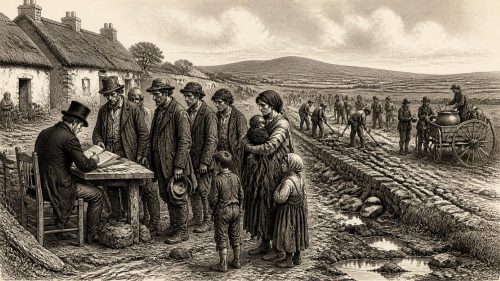
In 1846, a second, devastating potato blight transformed Ireland’s food crisis into catastrophe, destroying the staple relied upon by labourers, cottiers and smallholders. Although food continued to be produced and imported, poverty and rising prices denied many access. After Peel resigned, Russell’s government prioritised market supply and paid public works over direct food provision. The Labour Rate Act rapidly expanded employment schemes, but delayed wages, harsh outdoor labour, local debt and administrative failures deepened suffering and disease. Political division split the Repeal movement, while local and Quaker relief networks emerged. By winter, conditions had laid the foundations for Black ’47.
Read Article

Archived: 10 October 2026
Abstract
In 1845, potato blight initiated Ireland’s Great Famine, although mortality remained limited compared with later years. Dependence on potatoes left labourers, cottiers and smallholders especially vulnerable, while food production continued beyond their purchasing power. Peel’s government commissioned scientific inquiries, secretly bought American maize, and linked the crisis to Corn Law repeal, but relief remained cautious. The Devon Commission documented insecure tenure and rural inequality. Educational reforms funding Maynooth and Queen’s Colleges provoked religious and nationalist disputes. Thomas Davis, Young Ireland’s inclusive cultural nationalist, died in September. By year’s end, blight, poverty, weak tenure and political division foreshadowed catastrophe to come.
Read Article




