
Ballinasloe’s Cholera Spring1849 CE
In 1849, the Great Famine continued as blight, hunger, eviction, overcrowded workhouses and disease devastated Ireland. Cholera killed 772 of 1,077 recorded cases at Ballinasloe Union Workhouse, illustrating inmates’ vulnerability. Relief depended heavily on inadequate local rates; the May rate-in-aid redistributed Irish, rather than British, resources. The Incumbered Estates Act signalled restructuring of landownership, while emigration, consolidation and evictions altered rural life. Young Ireland leaders were transported, and unrest persisted; Dolly’s Brae exposed sectarian tensions. Victoria’s tour, new Queen’s Colleges and the Dublin–Cork railway projected progress, yet famine, political conflict and social upheaval still continued across the island’s fractured communities.
Dateline
In 1849 Ireland remained in the grip of the Great Famine, despite hopes in Britain that the worst had passed with the terrible mortality of 1847. The crisis had changed shape rather than ended. Hunger, eviction, overcrowded poor-law institutions, emigration and infectious disease combined to make this another year of profound loss. The return of potato blight threatened households that had attempted to plant again, while cholera struck a population already weakened by years of inadequate food and recurrent fever. Government policy increasingly placed responsibility for relief on Irish property, even as the capacity of many localities to raise rates had collapsed.
The year also contained striking contrasts. Queen Victoria’s carefully managed August tour produced scenes of ceremony in Cork, Dublin and Belfast. New colleges began teaching at Belfast, Galway and Cork, projecting an official confidence in educational improvement. Railways pressed southwards to Cork. Yet these emblems of connection and progress existed alongside workhouse burial grounds, crowded wards and the dispersal of families from the countryside. For many Irish people, 1849 was not a recovery but a harsh passage from emergency famine relief into a reordered and more precarious society.
Famine After Black ’47
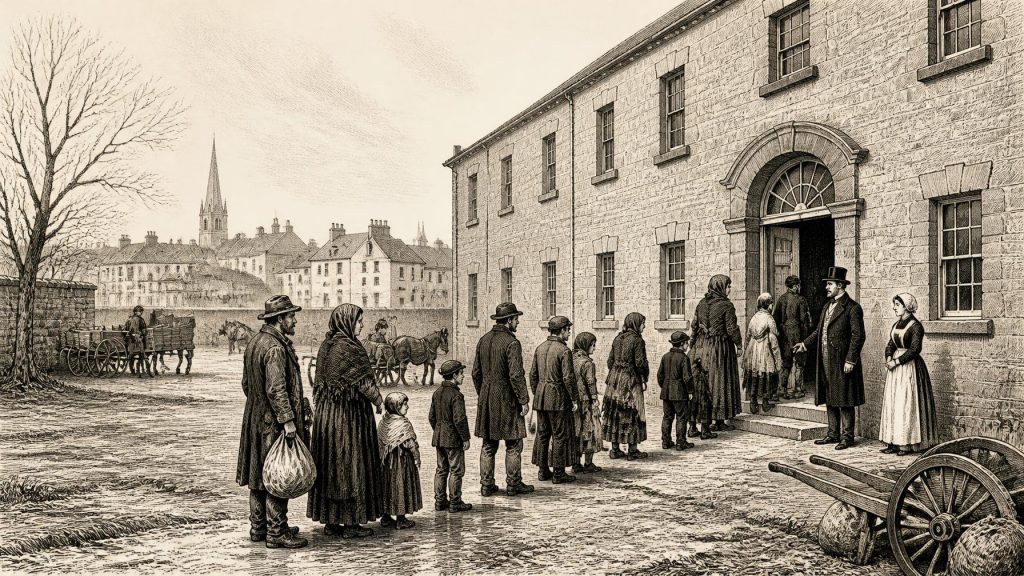
The immediate background was decisive. The potato failure of 1845 and the catastrophic failure of 1846 had exposed the dependence of a vast rural population on a single crop. Soup kitchens and relief works had eased suffering for a time, but their closure left the Poor Law as the principal official machinery of support. That system had been designed for ordinary destitution, not for a nationwide subsistence disaster. Admission to a workhouse often meant the break-up of a household, since men, women and children were separated into different wards. For people already ill, exhausted or homeless, however, the workhouse could seem the only remaining refuge.
By the summer of 1849, the scale of dependency remained immense. Contemporary administration and later historical work both show that hundreds of thousands were receiving outdoor relief, while more than 200,000 people were inside workhouses. These totals convey pressure rather than safety. Relief was often meagre, local guardians struggled to finance it, and institutions were congested with people who had arrived already debilitated. Famine mortality was rarely a simple matter of starvation alone. Malnutrition made dysentery, typhus, fever and respiratory illness more dangerous; overcrowding and poor sanitation helped disease to travel.
Cholera supplied the year’s most lethal additional blow. The epidemic had reached Ireland late in 1848 and spread widely in 1849. Its effect at Ballinasloe Union Workhouse in County Galway was reported to the House of Commons in June. Between 22 April and 24 May, 1,077 cases of cholera were recorded there, of which 772 proved fatal. Such figures should be treated as a record from one institution, not as a measure for the whole country; nevertheless, they reveal the terrible vulnerability of inmates. Officials acknowledged that many people entered in an emaciated state after three years of famine, with little physical reserve to survive acute disease.
Relief, Rates and Property
The political argument over relief centred on who should pay. Since 1847, much of the financial responsibility had been imposed on Irish local rates. This bore especially heavily on western and southern unions where destitution was greatest, rateable property was limited and collection itself was difficult. In 1849 the Westminster government introduced a rate-in-aid: a general levy on Irish rateable property, intended to assist the most distressed unions and electoral divisions. The measure was enacted in May and was limited to sixpence in the pound.
The rate-in-aid was an acknowledgement that the poorest districts could not bear the burden alone, but it was not an imperial grant from British taxation. It redistributed resources within Ireland. This produced sharp resistance, particularly among northern proprietors and ratepayers who believed they were being charged for mismanagement elsewhere. Supporters argued that an island-wide catastrophe required an island-wide contribution. The dispute exposed both regional inequalities and the limits of the Union’s promise of shared responsibility. It also showed how famine relief had become inseparable from questions of property, representation and political power.
Legislation passed during the year also pointed towards a remaking of landownership. The Incumbered Estates Act of July 1849 created a special legal process for the sale of heavily indebted Irish estates. Many landlords were overwhelmed by mortgages, falling rental income, arrears and poor-law demands. The new court was intended to clear complicated claims and allow estates to be sold with a secure title. Its most important consequences unfolded over the following years, so it would be misleading to present 1849 as the moment when Ireland’s landed order suddenly changed. Yet the Act marked a clear turning point: famine had made the financial fragility of many estates a matter of national policy.
For tenants and labourers, estate insolvency offered no automatic protection. The movement away from tiny potato-dependent holdings, already under way before the famine, accelerated in its aftermath. Consolidation, assisted emigration, eviction and the abandonment of cabins could transform the landscape. Individual circumstances varied greatly: some tenants retained farms, some emigrated with help from landlords or poor-law guardians, and others sought seasonal work or relief. What was unmistakable in 1849 was the erosion of an older rural arrangement in which cottiers and labourers had relied on a minute plot of potatoes as the basis of survival.
Conflict and Political Aftershocks
The failure of the Young Ireland rising in 1848 did not end political unrest. During 1849, leading Young Ireland prisoners, including William Smith O’Brien, Thomas Francis Meagher and Terence MacManus, were transported to Van Diemen’s Land, now Tasmania. Their removal was intended to demonstrate the authority of the state after the rebellion. It also ensured that Irish nationalism acquired an exile dimension. The transported men would become prominent symbols in Irish and Irish-American political memory, while their punishment connected Irish dissent to the wider British imperial system of convict transportation.
Smaller conspiratorial efforts persisted in the south. James Fintan Lalor, whose famine-era writing had placed land and tenant rights at the centre of national politics, remained involved with radical organisers. An attempted rising at Cappoquin, County Waterford, on 16 September was quickly defeated after an attack on the police barracks. Lalor’s significance in 1849 lay less in military success than in the survival of his argument: political liberty could not be separated from control of land and security for those who worked it. He died in December, aged only forty-two, leaving ideas that later land movements would revisit.
In Ulster, sectarian violence demonstrated a different kind of insecurity. On 12 July an Orange procession passed through Dolly’s Brae near Castlewellan, County Down, where it encountered an armed Catholic gathering that included Ribbonmen. Six or seven Catholics were killed in the ensuing violence and many Catholic homes were burned. The later inquiry led to the dismissal from the county magistracy of Lord Roden, grand master of the Orange Order. Dolly’s Brae was not a famine event in a narrow sense, but it belonged to the political climate of the year: social fear, religious division and unequal authority could turn a ceremonial procession into deadly confrontation.
Ceremony, Learning and Connection
Queen Victoria’s visit from 2 to 12 August offered a conspicuous counter-image to destitution. She arrived at Cove, County Cork, accompanied by Prince Albert and members of the royal family; the town was renamed Queenstown in her honour. She proceeded to Cork city, then Dublin and Belfast before departing for Scotland. The royal itinerary was deliberately less formal than a full state visit, since ministers recognised the impropriety of extravagant display amid continuing distress. Nevertheless, civic bodies organised addresses, decorations and crowds, and the visit was widely publicised as evidence of loyalty.
The contrast between royal pageantry and famine conditions should not be overstated into a simple story of unanimous enthusiasm or universal resentment. Receptions could be genuinely warm, particularly in towns with strong commercial and civic interests, while poverty remained visible beyond the route of ceremony. The visit mattered because it allowed the monarchy and Dublin Castle to stage reassurance at a moment when relief dependence was still vast. It also underlined the unevenness of nineteenth-century Ireland: port towns, merchants, municipal elites and industrialising Belfast inhabited worlds connected to, but not identical with, the devastated western countryside.
Education and transport supplied quieter signs of change. The three non-denominational Queen’s Colleges, created under the 1845 legislation, opened for teaching in 1849 at Belfast, Galway and Cork. Queen’s College Cork held its first lectures on 7 November under its first president, the chemist Sir Robert Kane; George Boole was among its original professors. The colleges promised instruction in arts, law and medicine without denominational tests, but their religiously mixed model was controversial among many Catholic bishops and clergy. Their opening therefore began a long argument about education, faith and public authority rather than resolving it.
On 18 October the Great Southern and Western Railway completed the Mallow-to-Cork section, enabling through rail travel between Dublin and Cork. Railway construction provided employment and brought new speed to communications, trade and official movement. It did not remedy famine poverty, and railways could serve state power as well as commerce. Still, the completed line joined Ireland’s principal southern city more closely to Dublin and the wider British transport network, foreshadowing the growing importance of urban markets and mobility.
A Year of Continuing Rupture
By the end of 1849, no honest observer could treat the famine as over. Blight had reappeared, cholera had carried off thousands, and poor-law relief remained stretched beyond its intended limits. The year’s laws and institutions nevertheless helped set the shape of post-famine Ireland: land would change hands more readily, rural families would continue to leave, education would become a major confessional question, and political nationalism would draw strength from both agrarian grievance and exile. Ballinasloe’s cholera deaths, the rate-in-aid controversy, Dolly’s Brae, the Queen’s tour and the opening of the colleges all belonged to the same unsettled year—one in which official optimism and human catastrophe stood uncomfortably close together.
Primary Sources
- Famine Records: Distress Papers and the Relief Commission
- Sources in the National Archives for Researching the Great Famine
- Atlas of the Great Irish Famine 1845–1852
- Ireland’s Great Famine, Britain’s Great Failure
- The Mortality in Ballinasloe
- Famine in Ireland
- Poor Laws (Ireland)—Rate In Aid Bill
- Poor Laws (Ireland)—Rate In Aid
- The Poor Relief (Ireland) Act 1849
- Irish Statute Book: Acts of 1849
- The Great Famine and the Poor Law in Ulster: the Rate-in-Aid Issue of 1849
- Medicine in Ulster in Relation to the Great Famine and ‘the Troubles’
- Lalor, James Fintan
- Brenan, Joseph
- Cavanagh, Michael
- Rea, John
- Their Story: Young Irelanders—Exiles in Paradise
- Oireachtas Library Display Case: Queen Victoria’s First Visit to Ireland
- Queen Victoria’s Letters, Volume II
- Parliamentary Commissions: Wide Streets Commissioners
- University College Cork Archives
- Historical Timeline for UCC
- History of the National University of Ireland
- Queen’s University Belfast Timeline
- Cultural Heritage: Cork Line Level Crossings Project
- Farming Since the Famine: Appendices
- The Office of the Chief Secretary of Ireland: Chronology