Membership is completely free, giving members unlimited access to all available resources, services, features, and benefits without any restrictions or fees.
Welcome back. Sign in to continue enjoying unlimited access to all available resources, services, features, and member benefits at no cost.
The census night of Sunday, 30 March 1851 supplied the year’s clearest fixed point. William Donnelly, the Registrar-General of Marriages, directed the census operation, while the surgeon and antiquary William Wilde played a prominent role in its intellectual and statistical work. Enumerators and householders recorded the people who remained in each dwelling, their ages, occupations, literacy and other characteristics. The census also gathered information on houses, schools, agriculture, disease and disability. Its ambition reflected the expanding Victorian belief that social problems could be made legible through numbers.
The potato was still the immediate measure by which many people judged their prospects. Blight had returned in 1849, prolonging distress after the worst mortality of 1846–47. In 1850 it appeared again, though far less destructively and unevenly. Contemporary reporting during the late summer registered damp weather and disease in potatoes, while an official report on the year’s crop was issued in September. It would be misleading, however, to present the harvest as either a complete failure or a clean recovery. The scale of planting had collapsed from its pre-famine level, seed supplies and household reserves were weak, and a modest disease incidence could still terrify communities whose subsistence had so recently disintegrated.
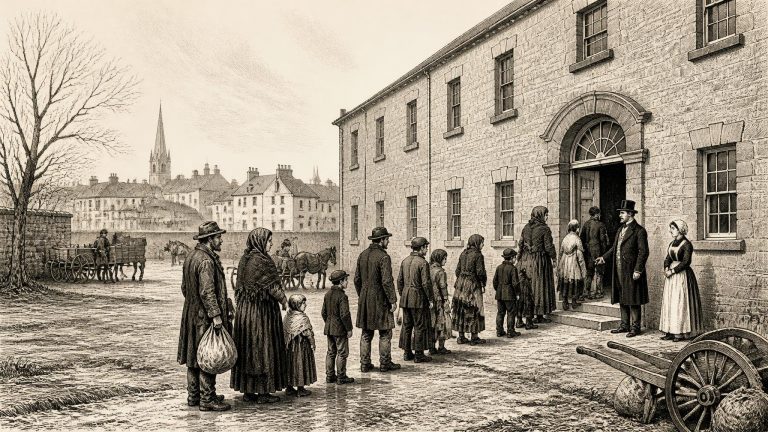
The immediate background was decisive. The potato failure of 1845 and the catastrophic failure of 1846 had exposed the dependence of a vast rural population on a single crop. Soup kitchens and relief works had eased suffering for a time, but their closure left the Poor Law as the principal official machinery of support. That system had been designed for ordinary destitution, not for a nationwide subsistence disaster. Admission to a workhouse often meant the break-up of a household, since men, women and children were separated into different wards. For people already ill, exhausted or homeless, however, the workhouse could seem the only remaining refuge.
The potato crop again suffered badly in 1848. This was a devastating reversal for families whose food supply, labour patterns and small holdings had already been shattered by the failures of 1845 and 1846 and by the hunger and epidemic disease of 1847. The blight was caused by Phytophthora infestans, though contemporaries did not possess a secure modern explanation or a means of preventing it. For labourers, cottiers and small tenants with little land and few reserves, another damaged crop meant that survival could not simply be postponed until the following harvest.
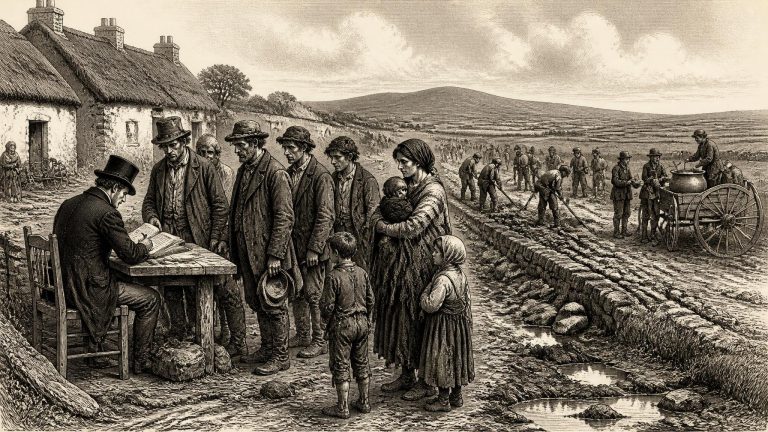
Parliament answered first with the Temporary Relief Act of February 1847, widely known as the Soup Kitchen Act. It authorised a temporary national machinery of local relief committees under central direction. In each electoral division, magistrates, clergy, Poor Law guardians and leading ratepayers were drawn into the task of identifying destitution, obtaining provisions and distributing cooked food or rations. The Act was an extraordinary admission that the existing Poor Law, based chiefly on relief inside the workhouse, could not meet the emergency. It also marked a practical shift away from the idea that famine assistance should be earned through labour. Food was to be given because people were starving.
The cause of the immediate disaster was Phytophthora infestans, the potato blight first recognised in Ireland in 1845. In 1846 it returned with devastating effect. Contemporary reports during the summer and early autumn recorded the disease’s spread, while officials and relief committees began to understand that the expected harvest would not restore normality. The damage was not uniform in every place or to every variety, and contemporaries could not yet measure the final shortfall with modern precision. Yet there is no serious doubt that the crop on which the poorest households relied was, in practical terms, ruined over very wide areas.
The potato was not Ireland’s only crop, nor was every Irish person dependent on it in the same way. Grain, livestock and dairy produce formed major commercial sectors, while townspeople, stronger farmers and many artisans had more varied diets. Yet for a vast rural population of labourers, cottiers and very small occupiers, potatoes supplied the essential daily food. A small plot, cultivated intensively, could sustain a family when wages were low, land access insecure and cash scarce. The same system left households exceptionally exposed when the crop failed. Potatoes also fed pigs and helped to support the small, interlocking economies of cabins, petty trade, rent payments and seasonal labour.