
Liffey Works and Rightboys1786 CE
In 1786, Ireland combined constitutional autonomy with entrenched exclusion. The Dublin parliament, dominated by Protestant elites under Lord Lieutenant Rutland, operated after Pitt’s failed commercial proposals. In Dublin, Rutland laid the Four Courts foundation stone, while the Dublin Port Act created the Ballast Board to improve harbour administration and trade. These projects symbolised state infrastructure and employment. Meanwhile, Munster Rightboys protested tithes, rents and religious charges through intimidation and violence, exposing rural insecurity despite Catholic relief. The execution of George Robert FitzGerald demonstrated limits upon landed privilege. Declining Volunteers and restricted political participation underscored Ireland’s deep confessional and economic tensions.
Dateline
A Year of Unequal Change
In 1786, Ireland stood in the unsettled interval after the constitutional victories of the early 1780s and before the more dramatic crises of the 1790s. Its parliament at College Green enjoyed a new measure of legislative autonomy, secured in 1782–83, but this did not make it representative of the island’s people. Political power remained concentrated among Anglican landowners, office-holders and borough patrons; Catholics, though forming the great majority of the population, could neither vote nor sit in parliament. The year is therefore best understood not as one decisive national turning point, but as a revealing cross-section: public institutions in Dublin acquired durable new forms while agrarian resistance exposed the strain beneath rural society.
The Irish parliament’s third session of the reign-year 26 George III met from 19 January to 8 May. Charles Manners, fourth duke of Rutland, was lord lieutenant, governing for William Pitt’s ministry in London with Thomas Orde as chief secretary. The failure in 1785 of Pitt’s proposed commercial settlement between Britain and Ireland still shadowed politics. Many Irish politicians had rejected the amended scheme because they believed it would compromise the trading and legislative liberties recently won. In 1786, consequently, Dublin Castle had to govern in a political atmosphere where ‘independence’ was prized in rhetoric but the executive still depended upon patronage, managed parliamentary majorities and the social authority of the Protestant elite.
The Four Courts Ceremony
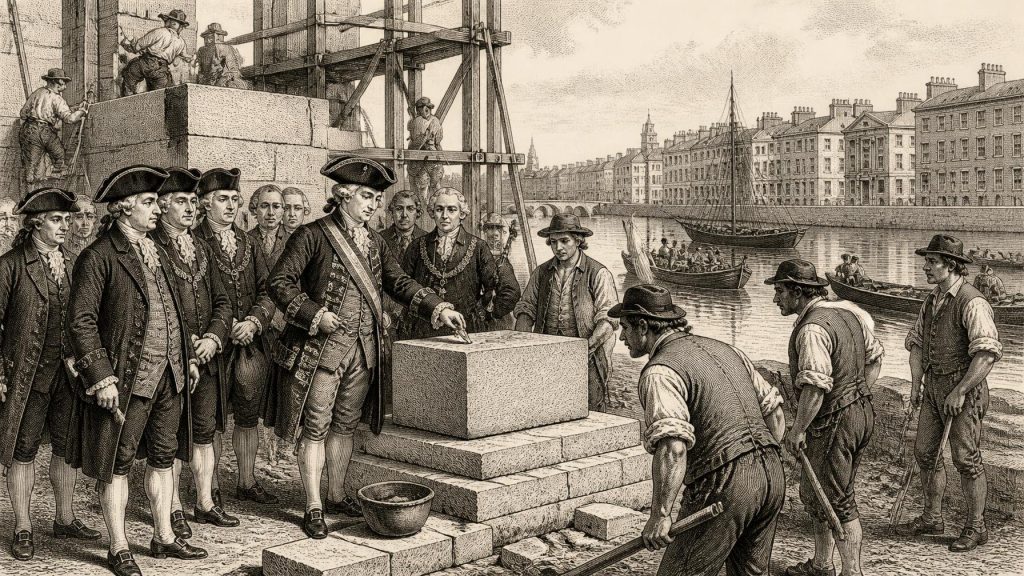
One firmly dated public event gave physical form to the state’s aspirations. On 13 March, Rutland laid the foundation stone for the major rebuilding at the Four Courts site on Inns Quay. The occasion belonged to a longer and complicated building history. Thomas Cooley had designed earlier ranges associated with the Public Record Office and public offices, but died in 1784; James Gandon then reshaped the project that would become the monumental courts complex familiar from later Dublin. It would take decades to complete, so it would be misleading to treat the Four Courts of later memory as finished in 1786. Yet the ceremonial beginning mattered. On the north bank of the Liffey, the administration marked its confidence in law, records and metropolitan improvement with a conspicuous architectural investment.
For ordinary litigants, the ceremony did not promise equal justice. The courts served a legal order in which wealth, confession, landlord influence and access to lawyers mattered profoundly. Even so, the proposed complex reflected a genuine enlargement of Dublin’s administrative and professional world. Barristers, attorneys, clerks, masons, carpenters, stonecutters, carriers and suppliers all had a stake in such works. Georgian Dublin was not merely a seat of aristocratic display: it was also a city of government employment, building contracts, river traffic and expanding professional life. The rebuilding programme joined other late eighteenth-century projects, notably the Custom House downstream, that altered the Liffey quays and concentrated state power in the capital.
A Port Given Corporate Form
The parliament also passed the Dublin Port Act of 1786, formally titled an act for promoting Dublin trade by making its port and harbour more commodious. It created the Corporation for Preserving and Improving the Port of Dublin, later commonly called the Ballast Board. This was more than a narrow piece of harbour housekeeping. Dublin’s shallow, shifting estuary demanded continuous labour: channels needed protecting and deepening, ballast had to be regulated, quays maintained and walls repaired. The new corporation separated much port administration from Dublin Corporation, while retaining connections with civic office and bringing merchants and shipping interests into the machinery of management.
The act connected 1786 directly to the material conditions of trade. Ireland’s economy depended heavily on agricultural produce and on linen, especially in Ulster, while Dublin imported manufactured goods and colonial commodities and acted as a collecting and distributing centre for a wider hinterland. Better harbour management could lower delays and risks for vessels entering the Liffey, but it could not erase Ireland’s unequal relationship with British markets or the vulnerability of small producers to prices, rents and bad seasons. The corporation’s later association with Irish coastal lights should not be projected backwards too far: its 1786 remit concerned Dublin port and harbour, while its island-wide lighthouse powers came only in 1810.
Rural Anger in Munster
The most urgent counterpoint to Dublin improvement lay in the countryside. In Munster, a wave of agrarian secret-society activity generally known as Rightboyism was active in the middle years of the decade. The movement is usually dated 1785–88, and evidence from 1786 shows the conflict was not simply an abstract dispute about land. Rural people objected to tithes and other ecclesiastical exactions, to rents, and to payments associated with religious rites. They used threatening notices, night assemblies and coercion to impose their own limits on what clergy, landlords, agents or tenants should demand and pay. Contemporary language often called such protesters Whiteboys, but ‘Rightboys’ better identifies this particular phase and its claims to enforce a popular notion of right.
These conflicts illuminate everyday insecurity. Tithes were payments due to support the established Church of Ireland, although most rural inhabitants were Catholic and many others were Presbyterian. They could be charged in cash or kind and were keenly resented where holdings were small, incomes irregular and other dues already pressing. Rightboy intimidation was not harmless: it could terrify targets and sometimes involved serious violence. But it also expressed a practical politics from below, aimed at controlling the local costs of farming, worship, marriage and household survival. The 1786 parliamentary session considered protective legislation for resident Church of Ireland clergy, but the proposed measure failed. The episode demonstrated both official alarm and disagreement over how far coercive law should go.
Religion After Partial Relief
Religious life in 1786 was shaped by partial, not complete, relaxation of the penal laws. The relief acts of 1778 and 1782 had removed important restrictions on Catholic property and on Catholic worship, clergy and education. Catholic life was therefore more secure than it had been earlier in the century. Nevertheless, Catholics remained excluded from parliament and the franchise, and the Church of Ireland retained its established position, revenues and political weight. The Rightboy disputes show why formal toleration did not settle the social consequences of establishment: many Catholic farmers still bore tithes for a church to which they did not belong. Presbyterian communities, particularly strong in Ulster, also remained outside the established church, contributing another layer to Ireland’s confessional and political complexity.
The Irish Volunteers likewise belonged to the immediate background rather than to a single 1786 event. Their armed mobilisation had helped exert pressure during the American Revolutionary War era, and their conventions had been influential in the constitutional struggles of 1782–83. By the middle of the decade their force and political coherence were declining. Peace reduced their original defensive rationale; divisions over parliamentary reform and Catholic inclusion weakened shared purpose; and Rutland regarded any renewed national organisation of armed volunteers with suspicion. Their fading influence left parliament less exposed to organised extra-parliamentary pressure just as rural unrest was demonstrating a very different, poorer and more threatening kind of popular mobilisation.
Castlebar’s Public Execution
On 12 June, George Robert FitzGerald, the Mayo landowner and magistrate known as ‘Fighting Fitzgerald’, was executed at Castlebar with his agent Timothy Brecknock after conviction for conspiracy to murder Patrick Randall McDonnell, an attorney. FitzGerald’s punishment—hanging, followed by the statutory penalties then attached to conviction for such a capital crime—was a spectacular assertion that rank did not provide absolute immunity. It also revealed the violent culture of honour and local power available to some members of the landed class. His case was exceptional, not a summary of Irish society, but its publicity sharply contrasted with official claims of orderly improvement. In the same year that the state ceremonially laid stones beside the Liffey, it also had to demonstrate criminal justice before a large provincial crowd.
Thus 1786 joined two Irelands rather than resolving them. Dublin’s courts and harbour legislation pointed towards more specialised public administration, commercial infrastructure and a capital increasingly shaped by grand construction. In Munster, Rightboy activity registered the fragility of household economies and the explosive politics of tithes, rents and local authority. The political nation at College Green could legislate for ports and buildings, but it did not include most of those whose labour sustained the country. The tensions visible in this apparently quiet year—between constitutional pride and restricted participation, improvement and inequality, confessional relief and established privilege—would deepen rather than disappear in the years ahead.
Primary Sources
- Manners, Charles
- Orde (Orde-Powlett), Thomas
- Grattan, Henry
- Fitzgerald, George Robert
- Dictionary of Irish Architects: Four Courts, Inns Quay
- The Walls Came Tumbling Down
- Dublin Port Yearbook 1967
- Foundation
- Harbours Act, 1946
- Dublin Improvement Act 1849
- The Liffey and a Bridge Too Far: Bridge-Building and Governance in Dublin 1870–1960
- History of the Commercial and Financial Relations Between England and Ireland from the Period of the Restoration
- Part 8 of History of the Commercial and Financial Relations Between England and Ireland from the Period of the Restoration
- The Catholic Question in the Eighteenth Century
- Ecclesiastical Politics and the Dismantling of the Penal Laws in Ireland, 1774–82
- The Catholic Relief Act, 1782
- Whiteboys
- Irish History Online: Boys
- Chapter I: On Local Disturbances in Ireland and on the Irish Church Question
- The Militia in Eighteenth-Century Ireland: 1785–93: Indecision and an Act
- RTÉ Archives: Grattan's Parliament
- Journals of the House of Commons of the Kingdom of Ireland
- Irish Legislation Database: Sources
- Background: Chronology of Key Events 1169 to 1799