Rightboy Unrest1787 CE
In 1787, Ireland’s Dublin parliament responded to agrarian unrest by passing the general Riot Act, amid Rightboy disturbances and attacks on property, tolls and officials. It also promoted manufactures, linen, trade and maritime regulation, while fiscal measures extended state oversight. Thomas Orde’s proposed nationwide school system, including free parish education, failed amid confessional distrust. John Butler, Catholic bishop of Cork and heir to Dunboyne, conformed to the Church of Ireland, an exceptional conversion reflecting Protestant privilege. Lord Lieutenant Rutland died in October, disrupting Castle politics. Cultural life saw Dublin theatre reorganisation and Prince William Henry’s visit to Curraghmore in December.
Dateline
In 1787 Ireland’s public life was marked less by a single decisive upheaval than by a series of revealing episodes: coercive legislation against rural disturbance, an ambitious but abortive plan for education, the dramatic conversion of a Catholic bishop, and the death of the king’s representative in Dublin. Together they showed the tensions within the post-1782 Irish political settlement. Ireland had a legislature in Dublin with newly asserted independence from Westminster, yet executive power still rested with a lord lieutenant, a Castle administration and a narrow political class. Beyond College Green, disputes over tithe, land, local charges and authority made the countryside anything but tranquil.
Parliament and Rural Disorder
The Irish parliament sat from 18 January to 28 May. Its proceedings belonged to a constitution celebrated by many Protestant patriots after 1782, when Britain had conceded Ireland’s legislative autonomy. But its electorate remained exceptionally restricted, its boroughs were often under aristocratic influence, and Roman Catholics were excluded from parliament. The year’s legislation accordingly offers a better guide to official priorities than to the experience or wishes of most inhabitants.
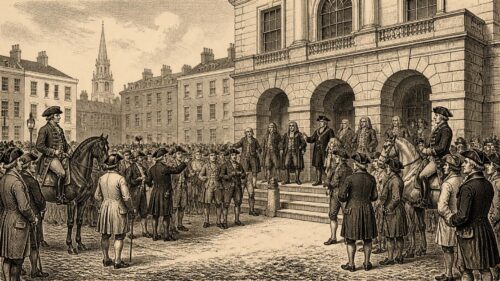
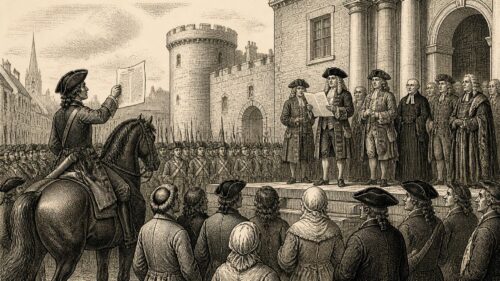
Those priorities included order. On 26 March parliament passed the Riot Act 1787, formally titled an act to prevent tumultuous risings and assemblies and to punish outrage, riot, illegal combination and unlawful oaths. It was the first general Irish measure of its kind. The wording matters: government was concerned not merely with isolated violence, but with collective action, clandestine organisation and the binding oaths through which rural movements maintained solidarity. The statute gave a broad legal expression to the anxieties of landowners, clergy and magistrates in a decade of agrarian protest.
That concern was directly connected to the Rightboy disturbances in Munster. The movement had emerged during the mid-1780s amid grievances that could include tithes, church cess, rents, access to land and the treatment of labourers. It should not be reduced to one cause or one creed. Its participants and opponents lived in local worlds where religious dues, tenancy, seasonal work and parish authority overlapped. In parliamentary debate early in 1787, the attorney general, John FitzGibbon, pressed for severe action. A proposed clause permitting the destruction of Catholic chapels alleged to have been used for unlawful gatherings provoked strong objection and was removed; the wider coercive bill nevertheless became law. The episode exposed both the hardening temper of the administration and the danger of treating Catholic worship as synonymous with disorder.
Official notices issued after parliament had risen show that the state faced unruly incidents in towns as well as countryside. On 18 June, proclamations offered reward and pardon for information about a riotous assembly and fire at the house of Thomas Potter on Upper Ormond Quay in Dublin, and separately about attacks on toll gates on the Dublin–Malahide road and at Killester. Three days later a further reward concerned an assault on Daniel Lea, a hearth-money collector in County Kerry. These notices do not establish that the cases formed one movement; they do, however, show the practical range of confrontation with taxes, tolls, property and officials that lay behind the year’s emphasis on security.
Trade, Revenue and Regulation
The same session was preoccupied with the machinery of commerce and revenue. Parliament voted £17,000 for bounties intended to promote specified manufactures and another £4,000 to the trustees of the linen manufacture. Linen was central to Ireland’s export economy, especially in Ulster, while bounties reflected the longstanding belief that the state should encourage productive improvement. Duties on carriages, licences for a variety of occupations, postal charges, and licensing for hawkers and pedlars also made government visible in everyday economic life. A travelling seller, a hired porter or a carriage owner encountered the fiscal state more directly than the grand constitutional language of the Dublin parliament.
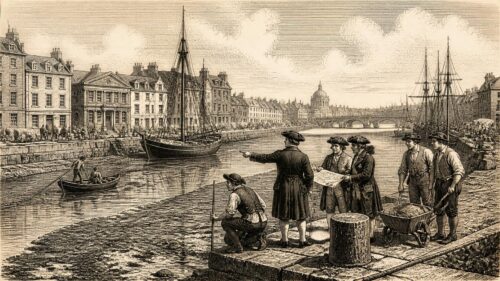
Maritime regulation was equally prominent. The acts of 1787 addressed the registration of ships, the appointment of harbour pilots, manifests of cargoes and weights and measures. These measures were practical instruments for a kingdom whose prosperity depended on ports, coastal shipping and overseas markets. On 14 May a proclamation opened Irish ports to goods from France under the Anglo-French commercial treaty. It was a concrete reminder that Irish trade, despite the gains of the early 1780s, remained entangled with British diplomacy and imperial policy. Dublin merchants, shipowners, customs officers and provincial port towns all had reason to watch such changes closely.
Economic improvement did not mean uniform prosperity. Private acts of parliament from the same year reveal indebted estates being sold, mortgaged or rearranged in counties from Clare and Cork to Galway, Donegal and Fermanagh. Such acts concerned particular families rather than the country as a whole, but they show the financial strain behind the polished world of the landed elite. The contrast between bounties for manufacture, new maritime rules and the pressure on landed property helps explain why ‘improvement’ could sound hopeful in Dublin while insecurity remained palpable elsewhere.
An Unfinished School System
On 12 April Thomas Orde, the chief secretary, presented a far-reaching proposal for educational reform. His scheme envisaged a connected structure of parish, provincial, diocesan and collegiate schools, together with two universities. It was notably more systematic than simply supporting individual charitable foundations. At its base stood the proposal for schoolhouses in every parish and free instruction for poor children. In principle, it acknowledged that education was a matter of national administration rather than private benevolence alone.
Yet its promise was limited by the religious politics of the age. Churches defended their own educational interests, and Catholic opinion had good reason to distrust a plan shaped by a Protestant government in a society where Catholics still lacked full civil and political equality. The scheme generated resistance and was not implemented. It is important not to portray it as a national school system in existence: it was a parliamentary project, debated in 1787 and then left without legislative fulfilment. Even so, it revealed an emerging official recognition that poverty, schooling and social order were connected questions.
Dunboyne at Clonmel
The most startling religious event of the year occurred at Clonmel on 19 August. John Butler, Catholic bishop of Cork and heir to the barony of Dunboyne, formally renounced Catholicism and conformed to the established Church of Ireland in St Mary’s church. He had sought to resign his bishopric in December 1786 and had married his cousin Maria Butler by April 1787; the precise date and place of the marriage are not securely established. His public conformity, however, is firmly dated.
Butler’s motives combined inheritance, family strategy and personal decision, though they cannot be reduced with certainty to any one of them. His change was spectacular because he was a Catholic bishop from a prominent clerical family, not because it represented a general Catholic drift towards the established church. Indeed, his case was exceptional. The episode instead illustrates the unequal religious landscape of late eighteenth-century Ireland: recent relief measures had softened parts of the penal code, but legal privilege, political power and institutional prestige remained overwhelmingly Protestant. One aristocratic cleric’s conversion could make national news precisely because it was so unusual.
A Viceregal Death
Political uncertainty deepened in the autumn. Charles Manners, fourth duke of Rutland, lord lieutenant since 1784, died at the Viceregal Lodge in Dublin on 24 October. Still only thirty-three, he left an administration associated with the difficult aftermath of the failed commercial settlement of 1785, the containment of Volunteer politics and the attempt to impose firmer order. His chief secretary, Thomas Orde, was already in failing health and preparing to leave Irish office. In November George Nugent-Temple-Grenville, later marquess of Buckingham, was appointed to succeed Rutland. Thus a year that had begun with routine parliamentary business ended with a change at the head of government.
Rutland’s death did not alter the constitutional structure, but it interrupted the relationships of patronage and confidence through which that structure worked. It also helped consign Orde’s educational design to suspension. The contrast is striking: in 1787 the Castle could secure a general Riot Act, regulate trade and collect duties, yet it could not easily carry through a reform of schooling across Ireland’s confessional divisions.
Stages and Great Houses
Dublin’s cultural geography was changing too. By the end of the year Richard Daly closed the Smock Alley theatre and concentrated his resources on refitting the Crow Street playhouse, which was due to reopen as the Theatre Royal in January 1788. The change was not merely theatrical. It represented the cost, competition and patronage involved in maintaining public entertainment in the capital, where a royal patent determined who could legally stage serious drama.
Elite sociability also had a conspicuous moment in December, when Prince William Henry, the future William IV, visited Curraghmore in County Waterford. A contemporary commonplace book records his arrival on 12 December and a great supper and ball on the following night. This was a small event in national terms, but a vivid glimpse of the networks linking Irish great houses to the monarchy. The year closed, then, with Dublin administration unsettled, the countryside under sharper law, and the social world of the ascendancy continuing its ceremonies of rank and connection.
Primary Sources
- Pre-Union Irish Statutes Affected: 1787 (27 Geo. 3)
- Statute Law Revision Act 2015
- Criminal Law Act, 1997
- Butler, John
- Manners, Charles
- Orde (Orde-Powlett), Thomas
- FitzGibbon, John
- Daly, Richard
- Giffard, John
- Riot Acts, Popular Protest, and Protestant Mentalities in Eighteenth-Century Ireland
- An Account of a Debate in the Irish Parliament, 1787
- State Policy in Irish Education, A.D. 1536 to 1816
- The Dublin Gazette, Number 4884: Tuesday, 27 February 1787 to Thursday, 1 March 1787
- The Dublin Gazette, Number 4938: Tuesday, 3 July 1787 to Thursday, 5 July 1787
- The Dublin Gazette, Number 4975: Thursday, 27 September 1787 to Saturday, 29 September 1787
- Meeting Ireland’s Terms
- Ecclesiastical Politics and the Dismantling of the Penal Laws in Ireland, 1774–82
- The Development of Catholic Chapels in Ireland Prior to Catholic Emancipation, 1778–1829
- RDS Proceedings · RDS Digital Archive
- Premiums and Progress—How the Dublin Society Shaped Eighteenth-Century Ireland
- Theatre Royal, Dublin
- Smock Alley Theatre: Dublin’s Historic Stage
- James Ryan’s Commonplace Book
- Curraghmore: The Great Irish House Transformed by the Most ‘Brilliant, Exasperating, Expensive and Chaotic’ Architect of the 18th Century
- To His Grace Charles, Duke of Rutland, Lord Lieutenant General and General Governor of Ireland