

Lough Derg’s Sealed Cave1632 CE
In 1632, Ireland experienced mounting political, fiscal and religious strain under Lords Justices Adam Loftus and Richard Boyle, while Charles I appointed Thomas Wentworth as future lord deputy. Government need for army revenue prompted Boyle’s proposed recusancy fines, but Loftus and Wentworth favoured negotiation, preserving fragile Catholic expectations surrounding the Graces. In October, Bishop James Spottiswood destroyed St Patrick’s Purgatory cave at Lough Derg, forcefully suppressing a major Catholic pilgrimage. Meanwhile Catholic synodical discipline, Ussher’s historical scholarship, plantations and planned towns reflected competing religious and colonial visions. The year exposed an uneasy peace, foreshadowing Wentworth’s more rigorous administration in Ireland.
Dateline
In 1632 Ireland was not at war, but it was governed in an atmosphere of strain: financial pressure at Dublin Castle, unresolved arguments over Catholic worship and land security, and growing uncertainty about the Crown’s intentions. The year brought no single national settlement. Instead, it produced a set of revealing episodes—from a change in the projected leadership of government to the destruction of a celebrated pilgrimage site—which exposed how precarious the peace of Charles I’s Irish kingdom had become.
A Deputy Appointed, but Absent
On 12 January 1632 Charles I appointed Sir Thomas Wentworth, Viscount Wentworth, as lord deputy of Ireland. The appointment mattered immediately, even though Wentworth did not set foot in Ireland until July 1633. It announced that the king intended a more forceful and closely managed administration after several years in which the country had been ruled by two lords justices: Adam Loftus, viscount Loftus of Ely and lord chancellor, and Richard Boyle, earl of Cork and lord treasurer.
Wentworth was an English political figure with a strong belief in royal authority, administrative order and dependable revenue. His later government in Ireland would become notorious for its determination and reach, but that lay ahead. In 1632 he was still preparing in England: gathering trusted associates, considering appointments, and seeking assurances that grants and directions affecting Ireland would not be issued over his head. The distinction is important. Ireland in 1632 remained under the immediate direction of Loftus and Cork, not under Wentworth’s personal rule.
Nevertheless, the prospect of his arrival altered political calculations. Both lords justices were powerful men, but their joint government was an interim arrangement and their interests did not always coincide. Boyle, in particular, had assembled an enormous Munster estate, commercial network and political following. In June he composed his True Remembrances, a self-conscious account of a career which he dated 23 June 1632. It presented his rise from modest beginnings to the earldom, the treasury and the lord justiceship as providential success. The timing was significant: a new deputy with a reputation for scrutiny threatened to disturb the influence that Cork had built.
Revenue, Soldiers and Recusancy
The immediate difficulty was money. Taxes paid by Irish landholders for the maintenance of the royal army were due to end in December 1632. The government needed a way to avert a shortfall, while army pay, public works and coastal security already demanded attention. Earlier descriptions of the administration’s condition spoke of arrears, decaying public buildings and vulnerability to seaborne raiders. Such problems reached far beyond the offices of Dublin Castle. A poorly funded army affected garrisons, suppliers and communities required to lodge or provision soldiers; neglected fortifications and harbours raised anxieties among merchants as well as officials.
Cork proposed a fiscal answer with grave political consequences: enforcing fines on Catholics who did not attend services of the established Church of Ireland. The law against recusancy existed, but its application had been uneven. To turn it into a major source of income would have made the practice of the great Catholic majority a direct and regular financial liability. It would also have damaged the Crown’s relations with Catholic nobles and gentry at a time when those relations rested upon fragile expectations rather than secure trust.
Those expectations were connected with the ‘Graces’, concessions promised by the Crown in return for substantial financial support in the late 1620s. They included protections sought by Catholic landholders and measures that might ease religious burdens. Many had not received the statutory confirmation that their supporters desired. By 1632, therefore, Catholics had reason to regard a renewed campaign of fines as a breach of the spirit, if not always the precise wording, of what had been offered.
Wentworth, still in England, preferred negotiations to a sudden and wholesale recourse to punishment. Loftus, who had ties to Catholic members of the political elite, backed that position. In November 1632 he compelled Cork to abandon the proposed persecution after a sharp debate and a closely divided vote in the Irish privy council. This was not toleration in the modern sense: Catholic worship remained legally insecure and the established church retained the backing of the state. Yet the episode showed that policy was contested inside government itself, and that financial necessity could not simply be separated from religion and land.
The Cave at Lough Derg
The clearest act of religious repression in the year occurred far from Dublin, on Station Island in Lough Derg, County Donegal. St Patrick’s Purgatory had long been one of Ireland’s best-known sacred places. Its traditions of penitential pilgrimage had drawn visitors from Ireland and continental Europe for centuries. For Catholic devotees, the island’s prayers, fasting and vigil formed part of a deeply rooted religious landscape. For many Protestant critics, however, the shrine’s association with purgatory represented precisely the kind of belief and practice that the Reformation had rejected.
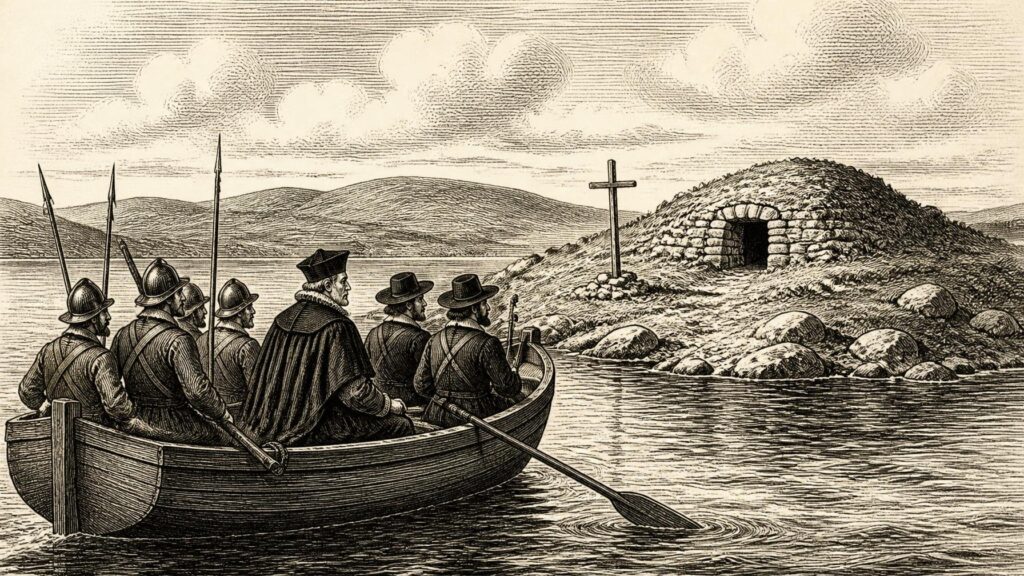
In October 1632 James Spottiswood, Church of Ireland bishop of Clogher, supervised the suppression of the pilgrimage site. Acting under an order from the lords justices, and accompanied by the sheriffs of Donegal and Fermanagh and an armed party, he went out to the island. The target was the cave identified with St Patrick’s Purgatory. Spottiswood later described it dismissively as a rudimentary structure of stones and earth. His description was polemical, but the action itself was unmistakable: the cave was destroyed and the ceremonies, pilgrimages and offerings associated with it were to be stopped.
The event carried meanings larger than its physical scale. A cave on a small island was not merely a building which could be broken up; it was the focus of memory, ritual, local movement and international reputation. Its destruction demonstrated the capacity of the state, when it chose, to bring force to bear upon a Catholic devotional site. It also showed the limits of the November compromise over recusancy. Government could refrain from an all-Ireland campaign of fines while authorising a dramatic intervention against a particular manifestation of popular Catholic piety.
For Spottiswood, the operation suited a long-standing militant Protestant outlook. His diocese stretched across an Ulster transformed by plantation, migration and contested ecclesiastical property. Many parish churches were in ruin, ministers were scarce, and bishops battled local landholders over revenues and jurisdiction. His action at Lough Derg therefore belonged both to a confessional struggle and to the practical assertion of Church of Ireland authority in a borderland shaped by older Gaelic lordships, new settler interests and rival legal claims.
Two Churches, Many Religious Worlds
Religion in 1632 cannot be reduced to a confrontation between an official Protestant state and a passive Catholic population. The Catholic church had rebuilt much of its episcopal organisation through links with Rome and the Irish colleges of continental Europe. Bishops, secular priests and members of religious orders worked in difficult conditions, while also disputing among themselves over jurisdiction, chapels and the authority of bishops over regular clergy. These were signs of an active religious culture, not of a church simply driven underground.
A provincial Catholic synod of Armagh held in 1632 offers a glimpse of its pastoral concerns. Its condemnations of sorcery, magic, demonic compacts, fortune-telling and ‘superstitious prayers’ indicate clergy attempting to shape everyday belief and practice. Such language should not be treated as proof that these activities were universally followed. It does, however, show churchmen addressing practices they considered spiritually dangerous among the people to whom they ministered. The synod belongs beside, rather than beneath, the more visible state action at Lough Derg: both Catholic and Protestant authorities sought to define acceptable religious conduct.
At the same time James Ussher, Church of Ireland archbishop of Armagh, advanced a different kind of religious authority: scholarship. In 1632 he published Veterum epistolarum Hibernicarum sylloge, an edition of fifty texts relating to Ireland’s early and medieval church. Ussher’s work drew on manuscripts, correspondence and learned networks across confessional boundaries. It was part of an effort to establish the antiquity and historical character of Irish Christianity through documentary evidence. In a country where the past was constantly invoked to defend present claims, historical learning had political as well as intellectual weight.
Plantation Landscapes and Town Life
The most visible physical changes in many districts still arose from plantations and estate-building begun before 1632. Ulster had been reshaped after the defeat of the Gaelic lords, while Munster contained estates, towns and markets developed by magnates such as Cork. In his June memoir Boyle celebrated Bandon Bridge as a fortified Protestant town, claiming strong walls, churches, market houses, a bridge and orderly inhabitants. It is a boastful source and should be read as such. Yet it conveys an important reality: landlords and settlers understood planned towns, religious conformity, fortification and commercial exchange as inseparable elements of colonial order.
Beyond these showpieces, ordinary life was structured by agriculture, rents, seasonal labour, local markets, courts and the movement of goods. Early Stuart government records preserve a world of brewers, builders, shoemakers, carriers, merchants, soldiers and petitioners as well as bishops and noblemen. They also record protections sought after losses at sea or in bad weather, reminders that the island’s economy depended upon vulnerable coastal and overland connections. Ireland’s regions were not alike. The commercial Atlantic-facing towns of Munster, plantation settlements in Ulster, the old political centre around Dublin and the predominantly rural west experienced royal policy through different local arrangements.
An Unsettled Pause
For all its significance, 1632 was a year of preparation and exposure rather than final decision. Wentworth’s appointment foreshadowed a more exacting regime, but he had not yet arrived. The recusancy dispute revealed both the government’s need for revenue and the political risks of extracting it through religious coercion. The destruction of the Lough Derg cave made clear that Catholic practice could still be attacked with force. Meanwhile, Catholic clergy legislated for belief and discipline, Protestant scholars assembled claims from the early Irish past, and estate-builders advertised new towns as proof of improvement.
The year’s most enduring image may therefore be the sealed cave on a Donegal island. It represented neither the disappearance of Catholic devotion nor the completion of Protestant authority. Rather, it captured an Ireland in which state power, faith, property and memory were being tested against one another—uneasily, and with consequences that would become far more severe in the following decade.
Primary Sources
- Wentworth, Sir Thomas
- Loftus, Adam
- Boyle, Richard
- Sir Richard Boyle knight, earl of Cork, his true remembrances
- Spottiswood, James
- St Patrick’s Purgatory: Theology and History in the Reformation and Counter-Reformation
- Have there been synods in Ireland in the past?
- Ussher, James
- The Government of Wentworth, 1632–40
- The lord deputy’s deputy: Christopher Wandesford’s role in Sir Thomas Wentworth’s Irish administration of Charles I’s reign
- The Appointment of Wentworth
- Early Stuart Irish Warrants, 1623–1639: The Falkland and Wentworth Administrations
- Briefe relation of Ireland, and the diversity of Irish in the same [and] Priests in Ireland and Gentlemen gone abroad
- State intervention in disputes between secular and regular clergy in early seventeenth-century Ireland
- Rothe, David
- Messingham, Thomas
- Bramhall, John
- Keating, Geoffrey (Céitinn, Seathrún)
- Geoffrey Keating
- ‘A Basis for Knowledge about Ireland’: Geoffrey Keating’s Foras Feasa ar Éirinn (c.1634)
- An Irish Counter-Reformation