

Baltimore’s Stolen Households1631 CE
In 1631, Baltimore, a West Cork fishing settlement shaped by plantation, local rivalries and Atlantic commerce, suffered a corsair raid. Before dawn on 20 June, forces led by Murad Reis the Younger seized 107 inhabitants, chiefly women and children, after landing from vessels sailing from Algiers. The captives entered North African systems of sale, labour, ransom and household service; few are known to have returned. Suspicions of local collusion remain unproven. The raid exposed limited coastal protection. Elsewhere, royal honours reinforced hierarchy, Patrick Fleming founded a college in Prague and died in Bohemia, and Sir Henry Docwra died in Dublin.
Dateline
In 1631, the most consequential Irish event that can be firmly assigned to a single day was a night attack on Baltimore, the small fishing settlement on West Cork’s Roaringwater Bay. Before dawn on 20 June, corsairs from North Africa and Europe came ashore, broke into homes and carried away 107 people: twenty men, thirty-three women and fifty-four children and young people. The raid is often called the Sack of Baltimore. That name can obscure its central reality. This was not simply the plundering of a port but the seizure of households, intended for sale, servitude and ransom across the Mediterranean.
A Settlement Facing the Atlantic
Baltimore was a vulnerable place precisely because it was connected. It sat among islands, creeks and deep-water channels that offered shelter to fishing boats and passing vessels. Its harbour opened towards the Atlantic routes linking Ireland, England, Iberia and the wider ocean. The settlement had been developed in the early seventeenth century by Sir Thomas Crooke, an English lawyer and planter, on lands long associated with the O’Driscolls. English Protestant settlers had come for the fishery, especially the valuable pilchard trade, while local Irish society and older lordly interests remained close at hand.
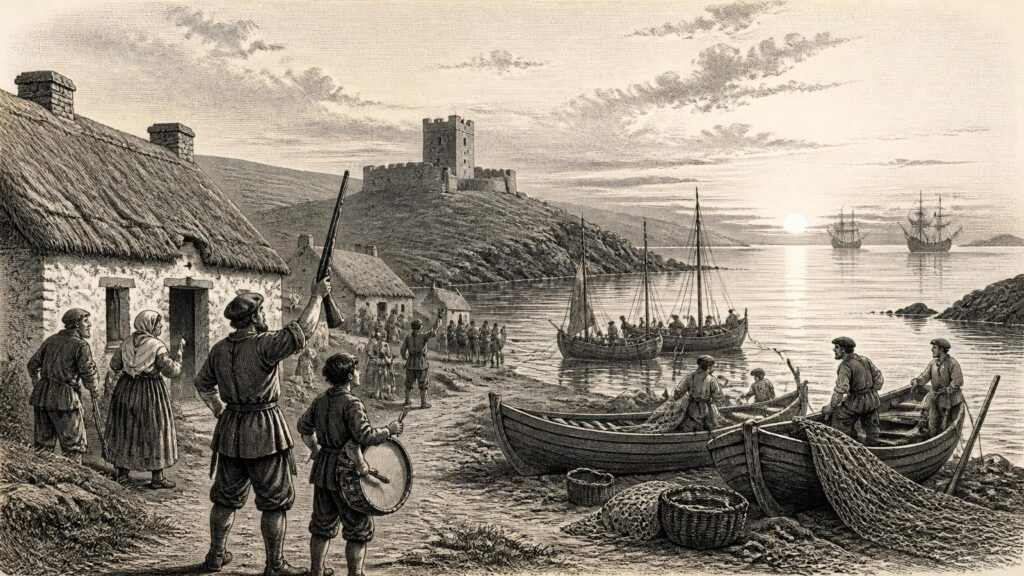
The available evidence does not permit a confident population total for Baltimore in 1631. It does, however, allow a more tangible picture than the word ‘village’ suggests. An early seventeenth-century map shows dwellings at the Cove and around Dún na Séad Castle, boats in the bay and fishing activity that may represent seine-net fishing. Storehouses, dwellings, catches, salt, barrels, nets, labour and credit were all parts of the economy that made such a settlement viable. Baltimore was not isolated in the sense of being unknown; it was exposed because sea-borne commerce brought wealth, information and danger to its doorstep.
It also stood in a region with a complicated recent relationship to piracy. Roaringwater Bay, Crookhaven, Sherkin and other West Cork anchorages had served English, Irish and international seafarers during the previous decades. Some had operated as privateers during war; others were straightforward pirates. Crown officials had tried intermittently to suppress the traffic in stolen cargoes and to establish tighter control, but the coastline was long and enforcement expensive. By 1631 the prosperity and insecurity of Baltimore both sprang from the same maritime geography.
The Corsairs Arrive
The chronology of the raid is unusually clear. On 17 June, two corsair vessels sailing from Algiers captured a Dartmouth ship between England and Ireland. By 19 June they had taken two small fishing boats from Dungarvan. One was commanded by John Hackett. Later accounts identify him as an Irish Catholic and say that he guided the corsairs westwards after they rejected an entry into Kinsale, where a royal naval vessel was present. It is safest not to convert that allegation into a settled account of motive. Hackett had been captured; what he said or did under that pressure, and whether he had any prior understanding with the raiders, cannot now be recovered with certainty.
The commander was Morat Rais, generally known as Murad Reis the Younger, a Dutch-born convert to Islam who had become a prominent corsair captain. Describing the attackers simply as ‘Algerians’ is incomplete. They sailed from the regency of Algiers, but their force included men of varied origins, among them North Africans, Ottomans and European converts or adventurers. Such mixed crews were characteristic of the early modern Mediterranean and Atlantic world. Their arrival at Baltimore was therefore an Irish encounter with a conflict and captive trade that crossed religious, political and linguistic frontiers.
On the evening of 19 June the vessels anchored outside Baltimore harbour. A reconnaissance party went towards the Cove, learning the layout of the settlement. At about 2am on 20 June, an estimated 230 armed men landed. The reports describe attackers posted at the doors of the cottages, striking together to prevent warning spreading from house to house. At the Cove they seized around a hundred inhabitants. Thomas Corlew and John Davis were killed during the violence. The raiders then moved towards the larger settlement near the castle.
Alarm at the Cove
Surprise was not complete for long. William Harris fired a musket to rouse neighbours, while another inhabitant beat a drum. These details matter because they show the practical means by which a scattered coastal community answered danger: sound carried where formal communications did not. The alarm appears to have persuaded Morat Rais that delay was risky. The party withdrew along the track to the Cove and returned to its ships.
The recorded total of 107 captives is the strongest contemporary figure: twenty adult men, thirty-three women and fifty-four children or youths. It conveys the character of the disaster. A fishing settlement lost not merely potential defenders but mothers, children, workers and dependants. The separation of families was itself an economic shock. Boats might remain, houses might be repaired, but the people who knew the work, held the household goods together and sustained future settlement had gone.
The captives were carried south to North Africa. They entered systems in which captives might be sold, employed, held for ransom or absorbed into households. Their individual later histories are difficult to trace, and it would be wrong to assign every person a single fate. What can be said is stark enough: only a very small number were later known to have returned or been redeemed. For relatives left in Cork, the immediate uncertainty of 1631 was compounded by the practical difficulty of communicating across the sea, raising ransom money and locating people in foreign ports.
Rumour, Property and Defence
The raid soon attracted suspicions that it had served local as well as corsair interests. Sir Walter Coppinger, a powerful Cork figure, had long disputed control of Baltimore with Crooke’s settlers and with the O’Driscoll interest. The coincidence of the attack with unresolved questions of property has encouraged later allegations of collusion. Yet proof that Coppinger arranged the raid has not been established. The responsible conclusion is that Baltimore’s tense landholding history made the accusation plausible to contemporaries and later writers, not that it demonstrates a conspiracy.
Nor should the episode be treated as evidence that the Irish government had ignored the coast altogether. Kinsale had a naval presence, and its very defensibility seems to have influenced the corsairs’ choice of another target. But one ship in one harbour could not protect every inlet of the south-west. Baltimore revealed the limits of a state whose authority was stronger in courts, offices and formal titles than in rapid coastal protection. Lord Deputy Viscount Falkland governed from Dublin Castle in 1631, but the distance between central administration and a sleeping community on Roaringwater Bay was measured in more than miles.
Two quieter acts of royal patronage during the year underline the same political order. On 28 March John Morres of Knockagh, County Tipperary, was created a baronet. On 22 December Sir Terence O’Dempsey received the Irish titles Baron of Philipstown and Viscount Clanmalier. These were firmly dated honours, not signs of a single new policy. Still, they show the crown continuing to bind landed families into its hierarchy while local authority in many parts of Ireland remained dependent on personal alliances, property claims and regional influence.
Learning Beyond Ireland
Irish life in 1631 also extended far beyond the island. Patrick Fleming, a Franciscan scholar from County Louth, helped establish the Irish College of the Immaculate Conception at Prague. He purchased a site for it in April, and its solemn opening took place on 6 July. Fleming had studied and taught at Louvain, travelled through major European libraries, and collected material on Irish saints and monasteries. His work demonstrates that Irish Catholic scholarship survived through continental institutions even when its position at home was constrained.
That achievement was brutally short-lived. As war reached Bohemia, Catholic clergy began to leave Prague. On 7 November Fleming and his companion Matthew Hore were killed near Benešov while travelling towards Vienna. Fleming’s death belongs to the history of the Thirty Years’ War, but it was directly relevant to Ireland: a learned Irish Franciscan, an Irish college and an ambitious programme of recovering Ireland’s Christian past were all caught in a European emergency.
The death of Sir Henry Docwra in Dublin on 18 April provides another, very different, marker of the year. Docwra had been a soldier and administrator whose earlier career at Lough Foyle and Derry was closely connected with English conquest and plantation in Ulster. By 1631, his passing belonged to the generation that had helped create the political landscape inherited by Falkland’s administration.
Yet Baltimore remains the year’s clearest human story. Its fishing boats, cottages and castle stood at the meeting point of local rivalries, colonial settlement and international seaborne violence. On 20 June 1631, the Atlantic did not merely bring trade to West Cork. It took more than a hundred of Baltimore’s people away.
Primary Sources
- Calendar of the State Papers Relating to Ireland of the Reign of Charles I: 1625–1632
- State Papers Ireland 1509–1782: government papers on Irish affairs
- Early Stuart Irish Warrants, 1623–1639: The Falkland and Wentworth Administrations
- The Original Correspondence of Henry Cary, Viscount Falkland, Lord Deputy of Ireland, with Other Papers Relating Chiefly to Irish Affairs, 1604–1632
- From Baltimore to Barbary: the 1631 sack of Baltimore
- The Sack of Baltimore
- An Early Seventeenth-Century Map of Baltimore
- Pirates of West Cork
- The Genealogy of Corca Laidhe
- Note 1 for ‘The Sack of Baltimore’
- The Sack of Baltimore
- Cork 800 Maritime Exhibition Catalogue
- Heritage Castles of County Cork
- Fleming, Patrick
- Docwra (Dowkra, Dockwra, Dockwraye, Dockquerye, Docura), Sir Henry
- The Complete Peerage: Clanmalier
- The Stolen Village: A Thrilling Account of the Seventeenth-Century Raid on Ireland by the Barbary Pirates
- Ireland Under the Stuarts and During the Interregnum, Volume I
- Calendar of State Papers, Domestic Series, of the Reign of Charles I
- Cork: Wills – Crooke, Sir Thomas, 17 February 1629