

Wentworth Takes Dublin Castle1633 CE
In 1633 Thomas Wentworth arrived as Charles I’s lord deputy, replacing interim rule by the lords justices and initiating a centralised Irish administration. Facing heavy debts and limited revenue, he prioritised customs, trade regulation, provincial accounts and a self-financing government, while cautiously managing Catholic and Protestant interests. He promoted allies, including Christopher Wandesford, John Bramhall and the earl of Ormond, and prepared for a future parliament. Church developments included St Columb’s Cathedral’s completion and inquiries into ecclesiastical resources. Meanwhile, the Four Masters continued preserving Gaelic history in Donegal. The year established stronger royal direction amid confessional, social and cultural divisions.
Dateline
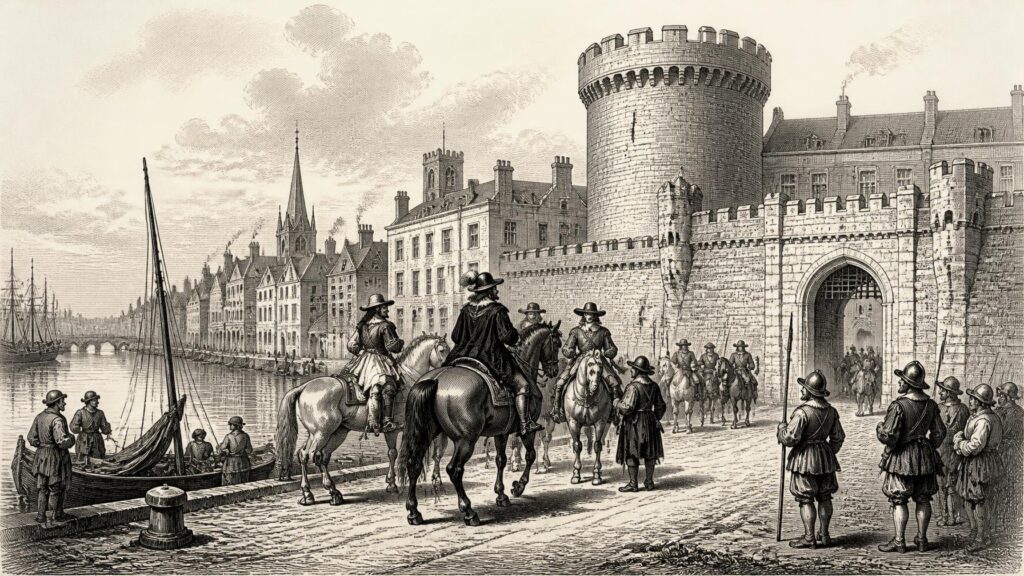
In 1633, Ireland acquired a new chief governor whose arrival altered the tone and machinery of government almost at once. Thomas Wentworth, Viscount Wentworth, landed in Dublin on 23 July to serve Charles I as lord deputy. The year did not yet bring the later parliamentary subsidies, plantation schemes or spectacular confrontations for which Wentworth’s Irish rule became notorious. It did, however, mark the beginning of an administration determined to make the kingdom more profitable, more orderly and more obedient to the crown. His arrival mattered because it joined political authority, fiscal urgency and religious reform in one unusually forceful office-holder.
A New Deputy in Dublin
Wentworth had been appointed in January 1632 but did not cross to Ireland until the following summer. During the delay, government had been carried on by the lords justices, principally Richard Boyle, earl of Cork, and Adam Loftus, lord chancellor. Their position was necessarily provisional. Cork was among the wealthiest and most powerful men in the kingdom; Loftus possessed the great seal and formidable legal authority. Yet both were now required to yield the centre of power to a deputy sent directly by the king.
On the afternoon of his arrival, Wentworth met the lords justices and the Irish privy council in the council chamber at Dublin Castle. Christopher Wandesford, his trusted Yorkshire associate, read the royal commission. Wandesford had been sworn master of the rolls the previous day and was also admitted to the privy council, a pointed early sign that Wentworth intended to govern through dependable collaborators as well as through established Irish office-holders. Contemporary anxiety was understandable: one diarist recorded simply that “many men feare[d]” the new deputy’s arrival.
That apprehension reflected Wentworth’s reputation, not an outbreak of warfare. Ireland in 1633 was not at war internally. The military establishment maintained by the crown was nevertheless expensive, while the political settlement following the defeat of the Gaelic lordships and the Ulster plantation remained incomplete and uneven. English and Scottish Protestant settlers held important positions in Ulster and in towns across the kingdom; older Anglo-Irish families retained great estates, especially in Leinster and Munster; and most of the population remained Catholic. Authority reached much further than it had a generation earlier, but it rested on bargains, local influence and continuing uncertainty about religion and land.
Revenue as Statecraft
The immediate problem at Dublin Castle was money. In 1633 the Irish administration carried debts of roughly £94,000 while its ordinary annual revenue stood at about £40,000. These figures belong to the condition of government in the year, not to a completed Wentworth reform programme. They explain why revenue occupied so much of his attention from the outset. The crown needed to pay soldiers, officials and pensioners, sustain the workings of the courts and preserve a governmental presence throughout the kingdom without constant financial rescue from England.
Trade supplied a visible route to income. Ireland’s overseas commerce was dominated by the products of a pastoral and maritime economy: cattle, hides, wool, butter and tallow, alongside fish, timber, linen yarn and coarse woollen goods. Grain could be important locally and was exported from some districts, but livestock and animal products remained the principal taxable staples. Ports connected Dublin, Waterford, Youghal, Cork and Ulster harbours to England, Scotland, continental Europe and Atlantic markets. Customs officers, merchants, shipowners, fishermen, graziers and the labourers who processed hides, salt meat or butter all felt the practical consequences of official regulation.
A specific pre-arrival order of 31 May 1633 had forbidden the export of tallow without licence. The restriction provoked a remonstrance from the customs farmers, demonstrating both the value of the commodity and the friction generated when the crown attempted to direct trade. Wentworth inherited that dispute. In August he complained that restraint on tallow, which he described as a major native commodity, damaged commerce and customs alike. By 6 November an abstract of revenue arranged by province was being prepared. Such paperwork may seem remote from daily life, but it was the basis on which the government assessed where wealth lay and how it might be drawn into the exchequer.
Wentworth’s purpose was not merely economical improvement in a modern sense. He hoped for a self-financing kingdom that could strengthen Charles I’s authority. Still, the distinction should not be overstated: better collection, safer trading conditions and tighter supervision could assist merchants and landlords as well as the crown, while monopolies, licences and new demands could raise prices or constrict opportunity. In 1633 the direction was set; many of the more burdensome instruments associated with Wentworth’s rule came later.
Catholics, Protestants and Calculation
Religion presented an equally difficult calculation. The legally established church was Protestant, but Catholic worship and clerical networks endured widely. Before Wentworth’s arrival, Cork had favoured making up a revenue shortfall by enforcing recusancy fines against Catholics who did not attend established worship. Wentworth opposed the policy. This was not an embrace of religious equality. He judged that conspicuous pressure on Catholic landowners would make government dependent on the Protestant interest and would obstruct his wider political management of rival communities.
His approach in 1633 was therefore pragmatic and hierarchical. Catholic gentry remained subject to a Protestant crown and vulnerable to laws that were selectively enforced; Protestant office-holders could not assume that anti-Catholic zeal would determine policy. Wentworth sought room to manoeuvre between them. He also understood that a future parliament would require careful handling. Discussion among his closest advisers about calling one was under way by the summer of 1633, though the parliament itself did not meet until July 1634. It would be misleading to assign its later votes or controversies to this year; what 1633 supplied was the administrative preparation and political calculation.
Church Buildings and Church Power
The year nevertheless produced two conspicuous signs of the established church’s ambitions. In Derry, St Columb’s Cathedral was completed in 1633. Built between 1628 and 1633 within the plantation city, it was the first post-Reformation Anglican cathedral constructed in the British Isles. Its sturdy, compact form expressed the union of urban settlement, Protestant worship and civic confidence on the north-western frontier. The cathedral’s completion did not mean that the city or surrounding countryside had become religiously uniform. Rather, it gave the planted city an imposing institutional centre at a time when confessional division remained fundamental to Irish society.
In Dublin, Wentworth brought John Bramhall with him as chaplain. Bramhall first preached before the chief governor at Christ Church Cathedral on 4 August, choosing the text “Thou art Peter”. On 3 September he became treasurer of Christ Church; in October he received the archdeaconry of Meath by royal patent. These were firm advances for a cleric who would become Wentworth’s most influential ecclesiastical ally. Bramhall favoured a better endowed, better administered Church of Ireland and enjoyed the support of William Laud, recently nominated archbishop of Canterbury.
James Ussher, archbishop of Armagh and primate of all Ireland, remained a scholarly and powerful figure, but the arrival of Wentworth and Bramhall began to change the balance within the church. In September 1633 Wentworth commissioned Ussher to investigate the lands belonging to his northern see. This was an inquiry into resources as well as ecclesiastical order. The government’s developing view was that the established church could not effectively compete with Catholicism while parishes, clergy and revenues were poorly supplied. The major measures to recover church income and reshape doctrine followed later; the commission of 1633 belongs to the beginning of that process, not its completion.
Landlords and Allies
Among the great landowners, the year also marked a generational shift. James Butler succeeded as twelfth earl of Ormond on 24 February 1633. His inheritance, combined with that of his wife Elizabeth Preston, reunited an immense estate centred on Kilkenny and Tipperary and extending across several counties. The young earl was heavily indebted, Protestant by religion but connected to the predominantly Catholic Old English political world, and potentially important to any deputy seeking influence beyond the New English settler interest.
Ormond returned to Ireland shortly before Wentworth. By November he had expressed satisfaction with the new lord deputy. This was the start of a consequential political association, but not yet a guarantee of agreement. Ormond’s estate required stringent management, and the crown’s appetite for revenue and land would ultimately threaten many proprietors. In 1633, however, Wentworth had found an aristocratic ally whose local reach and Protestant allegiance made him especially useful. Cork, meanwhile, remained a towering Munster magnate, but the end of his role in interim government foreshadowed a less comfortable relationship with the new administration.
Writing Ireland’s Past
Not all the year’s important work occurred at Dublin Castle. At the Franciscan house of Donegal at Bundrowes, near the River Drowes, Mícheál Ó Cléirigh and fellow scholars continued compiling the great Irish chronicle later known as the Annals of the Four Masters. The enterprise had begun in January 1632 and continued until 1636, so it cannot responsibly be reduced to a single event of 1633. Yet 1633 was certainly one of its working years: scribes assembled, compared and copied material from older annals, genealogies and historical manuscripts.
The compilation was a cultural act of preservation in an Ireland transformed by conquest, plantation, migration and confessional change. Its makers were not detached antiquarians. They worked within a Franciscan scholarly network linked to Ireland and the Irish colleges of continental Europe, seeking to secure a record of Gaelic Ireland’s past. Thus, while Wentworth’s officials in Dublin assessed customs, offices and revenues, Irish scholars in Donegal were organising a written inheritance whose importance would far outlast the deputy’s administration.
For that reason, 1633 should be seen less as a year of one dramatic national crisis than as a hinge. Wentworth’s landing gave Charles I a disciplined representative at Dublin Castle. Revenue accounts, church appointments, elite alliances and plans for a parliament began to be aligned behind stronger royal direction. At the same time, the completion of Derry’s cathedral and the continuing labour of the Four Masters reveal an Ireland of competing institutions and memories: plantation city and Franciscan refuge, royal finance and inherited learning, official Protestant authority and a resilient Catholic majority.
Primary Sources
- Wentworth, Sir Thomas
- The Lord Deputy’s Deputy: Christopher Wandesford’s Role in Sir Thomas Wentworth’s Irish Administration of Charles I’s Reign
- Wentworth’s ‘Eye of the Court’: Sir George Radcliffe’s Management of the Irish Parliaments of Charles I’s Reign
- Bramhall, John
- Ussher, James
- Butler, James
- Boyle, Richard
- Wandesforde, Christopher
- St Columb’s Cathedral: Historic Building Record
- Wentworth’s Economic Policy
- Crown Servants: Series One: Papers of Thomas Wentworth
- State Papers Ireland 1509–1782: Government Papers on Irish Affairs
- Ó Cléirigh, Mícheál (O’Clery, Michael)
- Ó Cléirigh, Cú Choigcríche (O’Clery, Peregrine)
- Irish Script on Screen: MS 23 P 6, The Annals of the Four Masters
- Irish Script on Screen: MS A 13, Annals of the Four Masters
- The Annals of the Four Masters Reunited for First Time Since 1636 in Landmark Exhibition
- James Ussher and John Bramhall
- Studies in Irish History, 1603–1649
- A True Relation of the Life and Death of the Right Reverend Father in God William Bedell, Lord Bishop of Kilmore, in Ireland
- Irish Warrants—Hidden Treasures from the East Riding
- The Personal and Professional Relationships Between Thomas Wentworth, Earl of Strafford, and Francis, Lord Cottington