

Greenwich’s Thomond Bargain1543 CE
Dateline
In 1543 the Tudor crown made one of its clearest attempts to translate Irish lordship into a form it could recognise, reward and regulate. The year’s decisive moments were not battles or conquests but acts of negotiation: Gaelic and Gaelicised magnates travelled to Henry VIII’s court; titles were exchanged for patents; rival kinsmen were reconciled at Dublin; and the vacancy at Armagh exposed the unsettled religious authority of the realm. These developments did not make Ireland obedient to a central government, nor did they erase older political habits. They did, however, show how Anthony St Leger’s administration hoped to extend the recently proclaimed kingdom of Ireland: by turning powerful local rulers into titled subjects of the king.
Earls at Greenwich
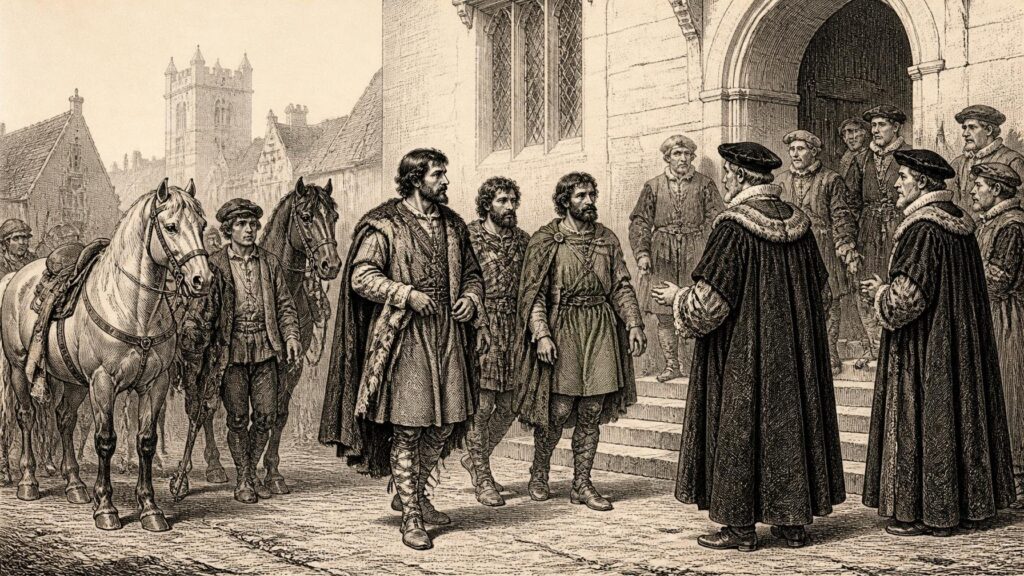
The best documented event of the year came on 1 July at Greenwich. Murrough O’Brien, ruler of Thomond, was created earl of Thomond and baron of Inchiquin; Ulick na gCeann Burke, the Mac William of Clanricarde, became earl of Clanricarde and baron of Dunkellin. Both men had already negotiated with the crown, but their elevation gave the policy commonly called ‘surrender and regrant’ its most striking public expression.
The phrase can be misleading if it suggests a simple transfer of territory from an Irish lord to an all-powerful government. It was a bargain. A lord acknowledged Henry VIII’s sovereignty, formally surrendered claims held under Gaelic custom, and received a royal grant that defined land, inheritance and status in the crown’s terms. The new titles supplied prestige within the king’s political world, while the patents aimed to make succession more predictable and to bind their holders to English law and allegiance. They also offered the government a way to deal with men whom it could not easily compel by force.
For Murrough, the arrangements sought to contain a dangerous O’Brien family dispute as well as to secure Thomond’s loyalty. He held the earldom for life, while his nephew Donnchadh O’Brien was made baron of Ibrackan and designated to succeed to the earldom. Murrough’s barony of Inchiquin, by contrast, was to descend in his own male line. The settlement therefore divided honours and expectations between branches of the family rather than simply confirming the senior ruler’s authority. Its careful drafting reveals the crown’s interest in making inheritance, not election within a kindred, the basis of political continuity.
Ulick Burke’s promotion similarly addressed a lordship whose succession had long been contested. The Clanricarde Burkes were descended from Anglo-Norman settlers but had for generations operated as a Gaelic lordly dynasty in south Connacht, using the title Mac William Uachtar. Ulick retained authority in Clanricarde and received substantial lands, including property taken from religious houses. His new earldom was deliberately styled Clanricarde rather than Connacht: it recognised a powerful regional lord but did not concede that he possessed a province-wide sovereignty.
Neither grant required its recipient to become culturally English overnight. Murrough and Ulick were experienced rulers with their own clients, armed followers, tenants, learned families and networks of marriage. The crown’s expectations included obedience, the maintenance of peace and acceptance of royal jurisdiction, but its practical strategy rested on their continuing local influence. The point was not to replace them with officials from Dublin. It was to make their authority useful to the king.
A Council and a Reconciliation
The Annals of the Four Masters, compiled later from Irish chronicle traditions, place another important episode under 1543. Manus O’Donnell of Tír Chonaill came to a great council at Dublin with two kinsmen, Éigneachán and Donnchadh, whom he had kept in fetters. On the advice of the Lord Justice and Irish chiefs, the prisoners were released and peace was made between them. Con O’Donnell, Manus’s brother, who had spent a long period in England, was also reconciled with him before returning to the king.
The annal does not provide a day or month, and its wording should not be inflated into a claim that Dublin had settled the politics of north-west Ulster permanently. Yet it records a meaningful encounter. The crown’s government was acting as mediator within one of Ireland’s foremost Gaelic dynasties, while Manus was willing to appear at a council beyond his own territory. The episode also illustrates the material reality behind high politics: kinship disputes could involve detention, armed retainers and the control of rivals’ persons, not merely arguments over legal titles.
That reconciliation belonged to a wider pattern of diplomacy rather than a peaceful transformation of the island. In Fanad, the heir to the Mac Sweeny lordship, Mulmurry son of Donnell Óg, was killed by rival members of his own lineage during 1543. Brian O’Boyle was killed treacherously by men described as being in his friendship, company and pay. Such entries are brief, but they are a warning against reading royal grants at Greenwich as an end to local conflict. Lordship depended upon alliances that could be contested within a household as well as across a frontier.
Armagh Between Authorities
Church affairs provided a second measure of the kingdom’s incomplete integration. George Cromer, archbishop of Armagh and formerly lord chancellor of Ireland, died on 16 March 1543. His death opened a vacancy in a see whose importance was both religious and political. Armagh carried the primatial claim associated with St Patrick, while its northern diocesan hinterland lay far beyond the routine reach of Dublin government.
Henry VIII nominated George Dowdall, formerly prior of the dissolved Crutched Friars’ house at Ardee and Cromer’s principal official, as Cromer’s successor in April. Dowdall was consecrated in December. His appointment came through royal authority, but this did not settle the question in the eyes of Rome: Robert Wauchope had already been provided by the papacy against Cromer and remained the papal claimant. The result was not simply a contest between ‘Irish’ and ‘English’ churches. Dowdall himself was a conservative cleric who accepted the king’s appointment while remaining attached to traditional doctrine and worship.
The year also brought a more local ecclesiastical loss. Edmond O’Gallagher, bishop of Raphoe, died on 26 February after facing opposition over the bishopric. His death, and the chronicler’s emphasis on dispute, underline the fact that episcopal office could be entangled with regional power. Church benefices, lands and jurisdiction mattered to lordly families; the upheaval caused by dissolution and royal supremacy did not remove those older pressures.
The Limits of Reform
By November 1543 the Irish parliament was dissolved, and St Leger’s reforming programme was suspended. The lord deputy had achieved notable agreements, but Henry VIII was uneasy about the concessions made to Irish rulers and the cost of government. The crown’s ambitions were large: one kingdom, a royal church, English legal norms, orderly inheritance and reliable service. Its means remained limited: a small administration centred on Dublin, bargaining with magnates, grants of land and honour, and occasional military pressure.
For ordinary communities, the immediate effects of the year’s famous ceremonies were likely indirect. A farmer in Thomond, a household dependent on a Burke lord in Connacht, or a family in Fanad would have encountered power through rents and exactions, the movement of armed companies, local courts, church dues and the fortunes of their lord’s kin. Yet decisions taken at Greenwich and Dublin could alter who claimed authority, which heir expected land, and where a dispute might be appealed.
1543 therefore deserves attention less as a year of completed conquest than as a year of political translation. Henry VIII’s government recognised Murrough O’Brien and Ulick Burke precisely because their established regional authority could not be ignored. The new earldoms placed that authority within a royal vocabulary, but they did not dissolve the older languages of lordship, lineage, fosterage, military following and local custom. Ireland was being drawn more explicitly into Tudor constitutional forms, while remaining politically plural, regionally diverse and far from securely governed.
Primary Sources
- O'Brien (Ó Briain), Murchadh | Dictionary of Irish Biography
- Burke, Ulick (de Burgh, Uilleag) (‘Uilleag na gCeann’) | Dictionary of Irish Biography
- St Leger, Sir Anthony | Dictionary of Irish Biography
- Cromer, George | Dictionary of Irish Biography
- Annals of the Four Masters, Part 5 | Corpus of Electronic Texts, University College Cork
- Annals of the Four Masters: Project and Editorial Information | Corpus of Electronic Texts, University College Cork
- Researches in the South of Ireland | Corpus of Electronic Texts, University College Cork
- Chartae Hen. VIII: Grants concerning Murrough O’Brien and Donough O’Brien, 1543 | National Library of Ireland Sources
- Con Oneal's Answer to Certain Letters of the King's, 1542–43 | National Library of Ireland Sources
- Peerages: Reign – Kingdom of Ireland – Henry VIII | History of Parliament Online
- State Papers Ireland 1509–1782: Government Papers on Irish Affairs | The National Archives
- Ireland in the Reign of Henry VIII | Trinity College Dublin Research Repository
- Irish Dimensions to the Anglo-French War, 1543–1546 | Cambridge Core
- The Rise and Fall of the Viceroy's Settlement: Property, Canon Law and Politics during the St Leger Era, 1542–53 | Cambridge Core
- Armagh Diocesan Registry Archive
- Dowdall, George | Dictionary of National Biography, 1885–1900
- Armagh Clergy and Parishes | Internet Archive scan via Wikimedia Commons
- Irish Statute Book: Pre-Union Irish Statutes
- Calendar of State Papers, Ireland: Tudor Period, 1509–1547 | Irish Manuscripts Commission
- Calendar of the State Papers Relating to Ireland, 1509–1573 | Google Books
- Calendar of the State Papers Relating to Ireland | O Dochartaigh Association Library
- The Complete Peerage, Volume 2, page 258: Clanricarde | Wikisource
- Butler, Edmund | Dictionary of Irish Biography