Tigernán’s Pass Ambush1391 CE
In 1391, Irish annals recorded fragmented but revealing struggles for power. Tigernán Mór Ó Ruairc escaped an ambush at a Breifne pass while travelling to meet John Ó Raighillaigh, defeating attackers despite conflicting accounts of their numbers. Diarmaid Mac Eochagáin, lord of Cenél Fiachach, died in January. Domhnall Óg Mac Carthaigh Mór, king of Desmond, died and was succeeded by his son Tadhg. In Ulster, Mac Gilla-Muire of Uí nDerca-Céin and Ó hAnluain of Oirthir were killed by kinsmen. Poet-scholar Tadhg Ó hUiginn and Bébhinn Ó Maelconaire died. English statutes applied in the Dublin lordship, but Gaelic authority remained decisive.
Dateline
The surviving evidence for 1391 is concentrated, not in one national narrative, but in a handful of sharply observed notices from across Ireland. It records a dangerous meeting in Breifne, the death and succession of a king in Desmond, killings within ruling families in Ulster, and the passing of a distinguished poet-scholar in Connacht. Taken together, these entries reveal an Ireland in which authority rested on personal alliances, armed followings, inherited learning and the capacity to secure a route, a household or a succession. They also require care: the annals preserve memorable incidents, not a complete account of every region or of ordinary life.
A Meeting in Breifne Turns Violent
The year’s fullest narrative concerns Tigernán Mór Ó Ruairc, ruler of a branch of the powerful Ó Ruairc kindred in Breifne. He travelled to Druimlethan to meet John Ó Raighillaigh, the leading figure of east Breifne, later County Cavan. The meeting ostensibly followed a peace made between the two rulers in the preceding year. That earlier settlement had involved payments, the expulsion of Ó Ruairc’s enemies, and hostages as sureties. Such arrangements were not merely ceremonial. They tried to turn a personal bargain into something durable by binding families and dependants to it.
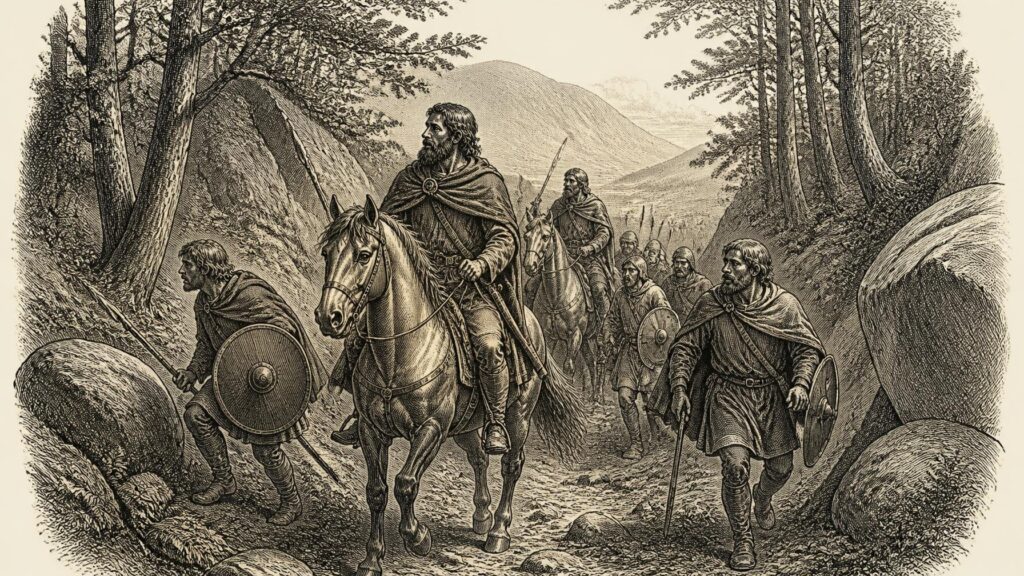
In 1391, however, Tigernán travelled with only a very small household. The Annals of Ulster say that he had twenty-one men with him. At a pass called Belach-in-crinaigh, men of Clann Muirchertaigh Ó Conchobair moved to intercept him. The annal gives their number as twenty-five. Its account is concise: Tigernán broke through the pass; John, son of Mathghamhain Ó Conchobair, and a grandson of Aodh ‘of the Quill’ were killed, along with some followers; the rest were routed.
The Annals of Loch Cé tell the same episode more expansively, while differing in a significant detail. They put the opposing force at sixty-five, name the slain more fully, and depict Tigernán himself killing John Mór, grandson of the ban-fhí, with a lance, followed by Donnchadh son of Aodh an Chleithigh. Thomas Ó Gáithín also fell. The discrepancy cannot be tidied away. It may arise from different reports, or from the chroniclers’ differing purposes; either way, it is safer to say that a small party accompanying Ó Ruairc escaped a planned interception than to insist on an exact size for the force confronting it.
What is clear is the political character of the violence. This was neither an anonymous roadside robbery nor a pitched campaign between large armies. A meeting between regional rulers, protected by a limited escort, became the occasion for an attack by a rival Connacht-linked kin-group. The pass mattered because movement through such places could be watched and controlled. A lord’s safety depended upon scouts, loyal retainers, knowledge of terrain and the reliability of agreements that could fail in an instant. That Ó Ruairc left with spoils, according to Loch Cé, also shows that victory brought an immediate material reward as well as prestige.
Deaths and Authority in the Midlands
Loch Cé places one firmly dated death near the beginning of the year. Diarmaid, son of Donnchadh and grandson of Muirchertach Mór Mac Eochagáin, died on the day before the Ides of January, conventionally 12 January. He is styled dux of Cenél Fiachach mic Néill, a territory associated with the central Irish midlands. The Latin title should not be mistaken for a modern office: it signals lordship and military leadership within a Gaelic polity. His notice demonstrates that local power remained dispersed among dynasties whose standing was recognised in both Irish and Latin vocabulary.
The Breifne episode also belongs to a wider chain of local instability. The peace of 1390 had been intended to contain divisions involving Ó Ruairc’s opponents; in 1391, an armed group was ready to exploit his exposed journey. The sources do not permit a confident reconstruction of every alliance behind the ambush, nor do they describe the response of John Ó Raighillaigh. Yet their preservation of the incident indicates how closely regional chroniclers followed the fortunes of ruling houses around the borderlands of Breifne, Connacht and Ulster.
A Succession in Desmond
Far to the south-west, Domhnall Óg Mac Carthaigh Mór, king of Desmond, died in 1391. The annals describe his death as occurring ‘after penitence’, the conventional but meaningful language of a Christian good death. Later biographical scholarship identifies Loch Léin in modern County Kerry as the place of his death and Corcaigh as his burial place. The exact circumstances are not elaborated in the contemporary annal, but the notice places the end of his long reign firmly in this year.
The Annals of Ulster immediately add that his son Tadhg Mac Carthaigh was made king in his stead. This was an important transfer within the Mac Carthaigh Mór dynasty, whose authority extended across much of Gaelic Desmond despite the presence of other Gaelic and Anglo-Irish lordships in Munster. The uncomplicated wording of the annal should not be read as proof that succession was automatic in principle. Gaelic kingship was shaped by descent, seniority, military support and acceptance by leading kin. Rather, it shows that Tadhg’s accession was successfully recognised by the annalist as the outcome of his father’s death.
Domhnall Óg’s reign, from 1359 to 1391, is poorly documented, a reminder that silence in the record is not evidence of political quiet. His death nevertheless marked a generational change. Tadhg, later known as Tadhg na Mainistreach, would maintain and strengthen his position in the decades that followed. For 1391 alone, the responsible conclusion is narrower: a king of Desmond died, and his son assumed the kingship. In a period when rival branches could contest inheritance, a recognised succession itself was a consequential political achievement.
Kinship, Treachery and Local Kingship
Two brief Ulster notices convey the harsher side of dynastic politics. Mac Gilla-Muire, king of Uí nDerca-Céin, was killed by one of his own kinsmen. The territory lay in the Castlereagh area of modern County Down. Elsewhere, Ó hAnluain, king of the Oirthir, was killed ‘in treachery’ by his own kin. Oirthir was a lordship in the wider Armagh region. The chroniclers supply no motive, and it would be irresponsible to invent one: they do not say whether these were succession disputes, revenge killings or conflicts over land and clientship.
Still, the wording matters. Kingship was embedded in kindreds large enough to furnish followers and legitimate candidates, but that same structure created competitors close at hand. The contrast with Tadhg Mac Carthaigh’s recorded accession is striking. In Desmond the annal notes continuity from father to son; in Uí nDerca-Céin and Oirthir it records violent rupture within the ruling family. Political order in late medieval Ireland was therefore not a simple division between a supposedly governed English lordship and an ungoverned Gaelic world. It was a mosaic of jurisdictions, each dependent on local relationships that might be secured by agreement, hostage-taking, marriage, patronage or force.
The Passing of an Ollam
1391 also brought the death of Tadhg, son of Gilla-Coluim Ó hUiginn. The Annals of Ulster call him a competent ollam in poetry; Loch Cé praises him more broadly as a worthy doctor in poetry and humanity. The difference in phrasing is revealing rather than contradictory. An ollam was not simply a composer of verses. He belonged to the professional learned world whose members preserved genealogies, praised patrons, instructed students and exercised authority over refined literary language.
The Ó hUiginn family was one of the major hereditary bardic lineages of later medieval Ireland. Its schools and poets served Gaelic lords, especially in Connacht and neighbouring regions, and their work depended on patronage in land, goods, protection and hospitality. Tadhg’s son, Tadhg Óg Ó hUiginn, became an important praise poet in his own right. Thus the annal’s brief obituary records not merely an individual death but a moment in the continuity of a learned household.
Loch Cé also records the death, after great penitence, of Bébhinn, daughter of Ó Maelconaire. Her father’s family likewise belonged to Connacht’s hereditary learned elite. The pairing of these notices is one of the year’s few glimpses of women within that cultural milieu. It does not tell us Bébhinn’s occupation, education or household circumstances, but it confirms that chroniclers considered her identity and family connection worth preserving.
Law, Lordship and the Limits of Record
In the English lordship centred on Dublin, the statutory record associates 1391, the fifteenth regnal year of Richard II, with the observance in Ireland of statutes of England. This was a legal assertion of connection between English legislation and the lordship. It should not be exaggerated into evidence of uniform enforcement throughout the island. The events at Druimlethan, Desmond and Oirthir show that Gaelic rulers conducted their affairs according to their own political resources and institutions, beyond the routine reach of Dublin government.
No surviving entry for 1391 permits a confident island-wide statement about harvests, epidemic disease, prices, shipping or population. The annals’ silence on these subjects cannot prove that conditions were ordinary. What the evidence does show is an Ireland connected by routes and lordly networks: a ruler travelling to a negotiated meeting in Breifne; dynasties managing succession from Kerry to Armagh; and scholarly families maintaining cultural authority in Connacht. In that sense, 1391 was not defined by one national event. It was a year in which the precarious work of holding power together was exposed most vividly at a narrow pass.
Primary Sources
- The Annals of Ulster, Year U1391
- Annals of Loch Cé A.D. 1014–1590
- The Annals of Connacht
- Annála Connacht
- Annals of Connacht: Editorial and Bibliographical Information
- Mac Carthaigh's Book
- Mac Carthaigh's Book, Annal MCB1398
- MacCarthy Mór (Mac Carthaigh Mór), Domhnall Óg
- MacCarthy Mór (Mac Carthaigh Mór), Tadhg na Mainistreach
- Irish Language: Dictionary of Irish Biography Search Results
- Beag nar dhearmadas mo dhúthaigh
- Dá bhrághaid uaim i nInis
- Leabhar Buí Leacáin: Manuscript Information
- Statute Law Revision Act, 1983, Schedule
- Pre-Union Irish Statutes
- Statute Law Revision Act 2007
- Short Titles Act, 1962
- Calendar of the Patent Rolls Preserved in the Public Record Office: Richard II
- Calendar of the Patent Rolls Preserved in the Public Record Office: 1391–1396
- Richard II and the Submissions of Gaelic Ireland
- English Government and Noble Power in English Ireland, c.1361–1423
- Annals of the Four Masters: Document Information
- Irish Texts at CELT
- The Annals of Tigernach, Part 21