Galway’s Six-Pound Charter1396 CE
In 1396, Richard II’s charter granted Galway’s provost and burgesses annual election of a sovereign, restricted retail trade to resident burgesses, and extended Drogheda’s liberties, for £6 13s 4d. Building on 1395 murage, it strengthened defence, commerce and civic government, while preserving Roger Mortimer’s seigneurial rights. The charter reflected insecurity in Connacht, where rival dynasties raided, fought and burned Sligo, while O’Tooles defeated English forces in Leinster. Off Aran, Ó Máille raiders drowned when their plunder-laden ship sank. Church life saw Thomas Sparkford appointed to Waterford and Lismore, and scholar-herenagh Matthew Ó Luinín’s death, illustrating enduring ecclesiastical and learned traditions.

Dateline
For Ireland, 1396 was not a year dominated by a single island-wide campaign or royal visit. Instead, its surviving evidence reveals a country of sharply different local worlds: a west-coast town seeking stronger legal and commercial protection; lordships unsettled by raids, rivalries and retaliatory violence; seafarers gambling lives and plunder on the Atlantic; and ecclesiastical communities still sustaining learned specialists in poetry, history and music. The most consequential firmly dated development came at Galway on 26 January, when Richard II issued a charter that gave its provost and burgesses important new rights. It was a modest-looking document in the language of fees, markets and liberties, but it addressed the central problem of late medieval urban life in Connacht: how could a small trading settlement survive, and prosper, amid competing regional powers?
A Charter for a Frontier Town
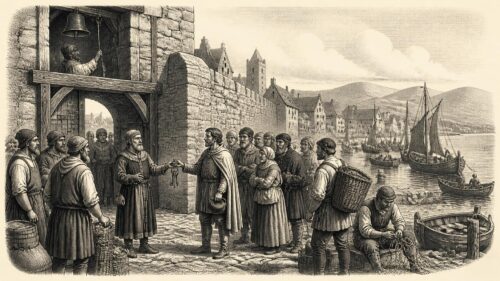
The charter of 26 January granted Galway’s provost and burgesses the right to elect annually a sovereign, an officer charged with governing the town. It also limited retail trade within the town’s liberty to resident burgesses, while extending to Galway the liberties enjoyed by Drogheda’s burgesses. The grant was made for a payment of £6 13s. 4d. Its economic purpose was plain. By reserving local retailing to people who lived in the town, had taken the burgess oath and carried its burdens, the charter protected a recognised civic body whose members could be called upon to maintain defences, contribute taxes and regulate a market.
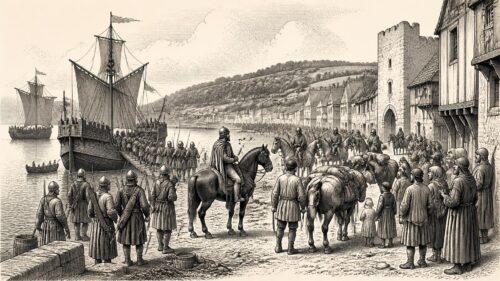
Its language also makes the town’s insecurity unusually visible. Galway was described as the “key of Connacht”, ringed by the king’s Irish enemies and English rebels. The document claimed that inhabitants and visitors could not safely enter or leave for trade or other business, by land or water, without a substantial guard. Such wording was part of the case made for privilege, not a neutral description of every journey made that year. Yet it accurately indicates why civic jurisdiction, regulated commerce and defence belonged together. A town dependent on traffic through Galway Bay and roads into Connacht could not separate its market from the safety of merchants, goods and boats.
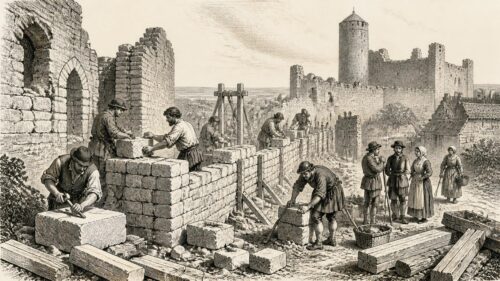
The January charter built upon a grant of murage issued in November 1395, which was intended to assist enclosure with a stone wall and the paving of the town. Murage was a time-limited toll raised on goods entering a settlement, intended to finance walls and associated works. Thus the physical town and its legal community were being strengthened in successive measures: toll income for enclosure and paving, then powers over government and retail trade. The evidence does not permit us to imagine a complete new circuit of walls rising in 1396, nor does it justify treating Galway as wholly independent. It does, however, show a town investing in the means to make itself more defensible, orderly and commercially attractive.
Liberty, But Not Independence
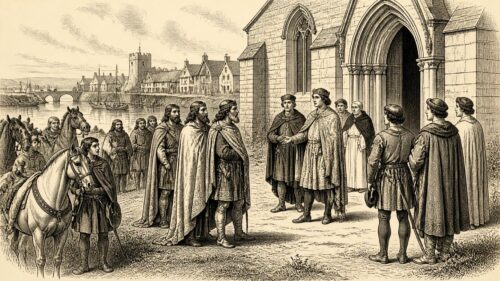
Galway’s advance was real, but carefully limited. The charter preserved to the town’s lord and his heirs the accustomed rents, services, fines and profits from Galway and its courts. Roger Mortimer, earl of March and lord with de Burgh interests in Connacht, was the first witness. The grant therefore did not turn Galway into a royal town detached from seigneurial control. Rather, royal authority was used to give the burgesses useful corporate privileges while reinforcing Mortimer’s lordship. That distinction matters. Medieval towns often acquired room to manage their own affairs without escaping the claims of a lord above them.
The immediate background was the return of Richard II to England in May 1395 after his first Irish expedition. Richard had left Mortimer as his representative, while the settlements made with major Irish rulers were already fragile. In Galway, the Crown and Mortimer had reason to cultivate a dependable body of resident merchants after the town’s political disturbances of the late 1380s. The charter offered an incentive to residence and investment, but it also tied the town more tightly to an English legal and political framework at a moment when power in Connacht remained divided among Gaelic and Anglo-Irish lords.
Conflict Beyond the Walls
Irish annals place several serious conflicts in 1396, though they do not provide a single connected narrative and their emphases are regional. In Leinster, the Annals of the Four Masters record a victory by the O’Tooles over Anglo-Irish and English forces, with heavy losses and prisoners taken. It is a useful corrective to any impression that Richard II’s expedition had settled the east. Art Mac Murchadha Caomhánach had submitted to the king in 1395 under severe terms, but the political settlement did not remove the military capacity of his allies in the Wicklow uplands. Later scholarship, drawing on the annals, likewise identifies a substantial O’Toole defeat of English forces in 1396.
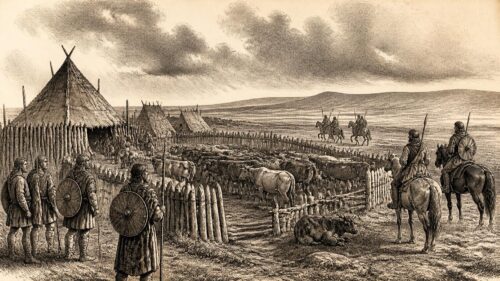
The same annalistic record places conflict across Connacht. Turlough an Fhíona Ó Domhnaill led an army into Carbury, defeated men guarding the country for Connacht and carried off prey. A victory at Creag was credited to Ó Conchobair Ruadh and his kinsmen over Ó Conchobair Donn and allies. These notices show no simple opposition between “Irish” and “English”. The combatants were members of rival Irish dynasties and regional coalitions, pursuing cattle, horses, authority and security. Raiding was not random background violence: it could damage food supplies, redistribute portable wealth, compel submission and establish a lord’s ability to protect followers.
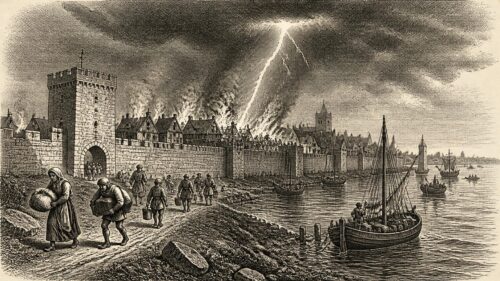
At Sligo, the annals say that Ó Domhnaill and Tadhg, son of Cathal Ó Conchobair, burned the town, including buildings of stone and timber. The chronicler’s regret at the destruction of its fine structures is striking. It reminds us that north-western Ireland possessed settled places of substantial construction as well as castles, churches, dispersed farms and seasonal camps. The entry cannot tell us how quickly Sligo recovered, but it records an immediate human cost in lost homes, stores and civic fabric, and it demonstrates how a town could become both prize and instrument in a wider struggle for Connacht and the north-west.
Sea, Islands and Corcomroe
On the western seaboard, the year brought a disaster which makes the risks of maritime raiding unusually tangible. Conchobur, son of Eógan Ó Máille, sailed with a ship’s company on an attack in west Connacht. Their vessel was loaded with valuables gained in the expedition, but it sank between Ireland and Aran; the Annals of Ulster simply state that the raiders drowned. The later Four Masters preserves a tradition that only one man survived. The difference cautions against certainty about the number of survivors, but both accounts agree on the essentials: a crew carried plunder to sea and was lost in the waters near the Aran Islands.
This was not merely an episode of piracy in a modern sense. Maritime expeditions formed part of the politics and economy of the Atlantic fringe. Ships enabled movement between coastal lordships, islands and markets, but also sudden attack and the transport of livestock, goods and captives. The same sea that connected Galway to trade routes and made its waters worth guarding exposed communities to such ventures and to storms, shipwreck and navigational danger. The loss of vessel, crew and booty was therefore a blow to a household or kin-group’s manpower and resources as well as a grim reminder that wealth taken by force could vanish in a single crossing.
In Corcomroe, north County Clare, Irial Ó Lochlainn was killed by a member of his own sept, according to the Annals of Ulster, in revenge for the earlier death of the killer’s foster-brother. The notice preserves the importance of fosterage, a relationship which created durable obligations between families and could be invoked alongside blood kinship in explanations of violence. It also reveals the vulnerability of a regional lord whose authority rested on relationships within, not simply against, his own kindred. The killing was local, but its inclusion in the annals shows how dynastic murder and vengeance were treated as events of political consequence.
Church Office and Learned Memory
Church life in 1396 joined institutional change to cultural loss. On 27 January Thomas Sparkford was appointed bishop of the united dioceses of Waterford and Lismore, succeeding Robert Read after Read’s translation to Carlisle. Sparkford’s brief tenure—he was dead before July 1397—illustrates the mobility of late medieval clerics within the English and Irish ecclesiastical world. For Waterford and Lismore, episcopal continuity mattered in matters of patronage, diocesan courts, clerical discipline and the management of church property, even though the surviving record says little about Sparkford’s acts in office.
More revealing of Gaelic learned culture was the death on 8 February of Matthew Ó Luinín, herenagh of Ard. The Annals of Ulster calls him expert in poetry, history, melody, literature and other arts. A herenagh held a hereditary ecclesiastical office connected with church lands and local religious administration; Ó Luinín’s obituary shows that such an office could sit alongside high scholarly accomplishment. His skills belonged to an oral and manuscript culture in which genealogies, historical memory, praise-poetry, music and ecclesiastical learning overlapped. The annal is a rare glimpse of the breadth expected from a learned man, and of the communities that valued and remembered such expertise.
Elsewhere, the deaths of Bishop Ó hEaghra, Ó Cinnéide of Ormond and other named figures were entered by later annalists under this year. The records are uneven, and silence should not be mistaken for quiet. What can responsibly be said is that 1396 combined civic adaptation at Galway with recurrent conflict across several regions, maritime loss off the west coast, and the continuing work of churchmen and hereditary scholars. Galway’s six-pound charter did not end the dangers named in its own preamble. It gave one vulnerable town better tools—walls, tolls, market rules and a recognised governing officer—with which to live among them.
Primary Sources
- The Annals of Ulster
- Annals of the Four Masters, Volume 4
- Annála Connacht
- Urban Rebels in Medieval Connacht: The Revolt of Galway, 1388–9
- Galway City & County
- Richard II and the Wider Gaelic World: A Reassessment
- Calendar of the Patent Rolls Preserved in the Public Record Office: Richard II, 1391–1396
- Calendar of the Patent Rolls Preserved in the Public Record Office: Richard II, 1396–1399
- Calendar of the Patent Rolls Preserved in the Public Record Office
- Calendar of the Patent and Close Rolls of Chancery in Ireland
- Fasti Ecclesiae Hibernicae: The Succession of the Prelates and Members of the Cathedral Bodies in Ireland, Volume I
- The Ancient and Present State of the County and City of Waterford
- The Roman Catholic Church: List of Bishops of Lismore and Waterford
- King Richard II’s Two Visits to Kilkenny
- In the Footsteps of a King
- The Annals of Clonmacnoise, Being Annals of Ireland from the Earliest Period to A.D. 1408
- Murphy: The Annals of Clonmacnoise
- Printed Primary Sources
- County Galway Urban Archaeology Survey
- Schedule of Tolls: Within the Walls of Medieval Galway