Roscommon’s Michaelmas Convoy1409 CE

Dateline
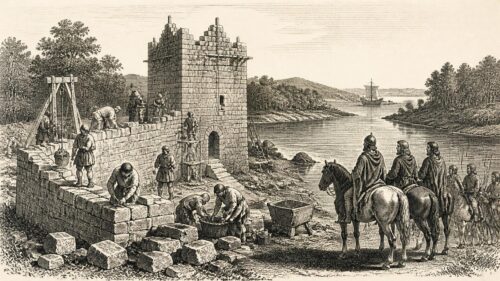
The most sharply dated Irish event of 1409 came in Connacht on the Monday after Michaelmas, the feast of St Michael on 29 September. A relieving force fought its way to the besieged castle of Roscommon with food and stores. The annalists regarded the operation as exceptionally daring. It was not a campaign of a unitary Irish kingdom, nor a clash simply between ‘Irish’ and ‘English’. It was a regional struggle among Gaelic dynasties and their allies, conducted around a formidable castle whose survival depended upon grain, supplies, mounted men and dependable political partnerships.
Elsewhere, the year exposed the limited reach of the English lordship. Thomas of Lancaster, second son of Henry IV and lord lieutenant of Ireland, left in March after hearing alarming reports about his father’s health, having released Gerald fitz Maurice FitzGerald, earl of Kildare, from custody. Thomas retained the lieutenancy on paper but never returned. Governance within the lordship passed in practice to his deputy, Thomas Butler, prior of Kilmainham. In the north-west, midlands and Munster, meanwhile, lordship continued to be made and unmade by local warfare, succession, hostage-taking, cattle-raiding and alliances.
A Castle Under Pressure
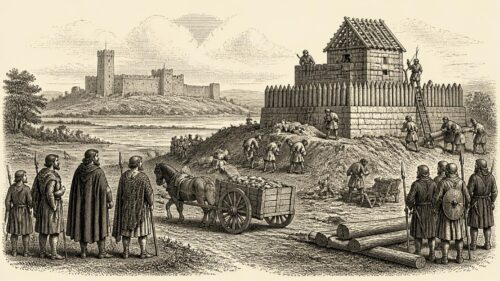
The siege of Roscommon must be read against the divided politics of Connacht. Roscommon Castle, founded by the Anglo-Norman administration in the thirteenth century, had become a prize in the contest between branches of the Ó Conchobair kindred. By this period the Ó Conchobair Don and Ó Conchobair Roe lines each possessed territories, followers and strongholds. The castle’s ownership mattered because it commanded a settlement and its agricultural hinterland, while also carrying the prestige of an older royal and administrative centre.
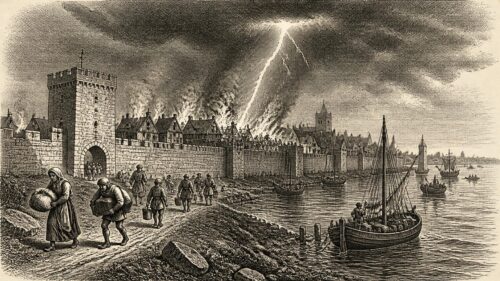
The Annals of the Four Masters report that Ó Conchobair Roe and Ó Cellaigh camped around Roscommon. They destroyed the corn belonging both to the town and to its monastery, and expelled the friars so that intelligence could not be sent to the castle. That compressed notice conveys much. Crops were military resources: denying standing grain to a garrison damaged its capacity to endure, while the town and monastery were exposed places around a stone fortress. The friars were not described as combatants, but their possible role as informants was sufficiently feared for them to be driven out. Religious communities could be victims of war precisely because they stood within networks of travel, correspondence and local knowledge.
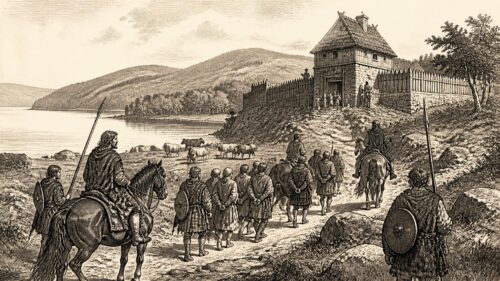
The fuller Connacht chronicle gives the relief an exact setting. Brian Ó Conchobair of Sligo, Conchobar Mac Donnchada, king of Tírerrill in present-day south County Sligo, and the sons of Tigernán Ó Ruairc assembled an expedition. Their opponents, the annalist says, included the men of Connacht south of the Curlew Mountains, gathered with horsemen, foot soldiers and gallóglaigh. The geographical division is important. The Curlews were more than a backdrop: they marked a difficult corridor between north Connacht and the central plain, shaping routes, communications and the practical possibilities of mustering an army.
The relieving party expected support from Clanricarde, but this promised army did not arrive. Mac William Burke came only with a small mounted force as far as Ballintober. According to the annalistic narrative, this near-failure prompted hesitation; Conchobar Mac Donnchada then declared that he would not withdraw until he had either died or provisioned the castle. He urged Mac William to remain alive rather than risk his small force, so that he might care for Conchobar’s children if necessary. Such reported speech cannot be treated as a verbatim record, but it preserves the ideals the chronicler wanted readers to see: courage, responsibility to dependants and the calculation of military strength.
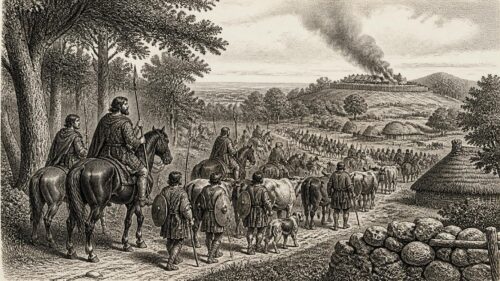
The convoy pushed on, reached Roscommon and got its supplies inside. The Annals of Connacht records the loss of one warrior, whose body was recovered; the Annals of Ulster simply confirms that provisions were put into the castle despite the assembled Connachtmen. The expedition then withdrew. The Four Masters places the force at Airm that same night and at home the following day. The accounts differ in detail, as annals often do, but agree on the central fact: a siege intended to starve out Roscommon Castle had been defeated, at least for the moment, by an organised relief effort.
Food, Faith and Fighting Men
The episode is a valuable, if narrow, glimpse of everyday vulnerability. A military decision could ruin a season’s produce, displace a community of friars and make a town’s food supply uncertain. ‘Provisions and stores’ were not incidental baggage. They were the means by which a garrison could continue to hold a castle and by which its lord could retain authority. The passage of troops also required access to fodder, food, horses and local labour. The annalists do not permit a reconstruction of prices, harvest yields or the experience of every household, but they leave no doubt that warfare reached directly into cultivation and religious settlement.
Connacht’s struggle was part of a wider landscape of mobile conflict. At Belleek, beside the Erne cataract, Tigernán Ó Ruairc raided the camps of Ó Domhnaill and of rival Ó Ruaircs, Cathal and Eógan. One camp stood on the far side of the rapids and the other on the near side; Tigernán carried off prey from both. The carefully observed geography suggests a raid exploiting a moment when rival forces were separately encamped, rather than a formal pitched battle. Livestock remained movable wealth, and taking it damaged an opponent while rewarding the raiders and their followers.
In the midlands, Máel Sechlainn Mór Mag Eochagáin was removed from the chieftainship and Fergal Ruad Mag Eochagáin was installed in his place. The annals do not explain the political process behind the replacement. Yet the blunt entry is a reminder that succession was not always automatic. A chieftainship rested on kinship, military backing and acceptance by leading men; a change in office could reorder obligations across a territory without needing a royal writ from Dublin or Westminster.
A Lieutenant Departs
Thomas of Lancaster’s departure provides the year’s clearest connection to the government of the English lordship. He had returned to Ireland only in August 1408, arrested Kildare on suspicion of treason and campaigned in Leinster, where he was wounded during the winter of 1408–09. The Connacht annalist wrote that ‘leprosy attacked the King of England’ and that the news prompted Thomas’s departure. That is evidence for the report circulating in Ireland, not a secure medical diagnosis of Henry IV. What is firm is that Thomas left in March 1409, released Kildare beforehand, and did not return, although he remained lieutenant until 1413.
The immediate consequence was another period of delegated rule. Thomas Butler, prior of the Hospitallers’ house at Kilmainham, became deputy lieutenant. His appointment illustrates how military-religious institutions and aristocratic networks supplied administrators as well as clergy. Thomas was half-brother to James Butler, earl of Ormond. The lordship’s government depended on such magnates, their affinities and their local resources, because Crown revenue in Ireland was severely constrained.
Administration nevertheless continued in particular places. James Cornwalsh served as a justice of the peace in Wexford in 1409. Patrick Barrett, bishop of Ferns, received permission that year to transfer his seat from disturbed Ferns to New Ross and was licensed to build a crenellated residence at Mountgarrett. These were practical responses to the insecurity of south Leinster: legal office, episcopal authority, town life and defensible building overlapped. Janico Dartas, a Gascon-born royal servant long established in Ireland, also campaigned in Ulster during the year. The surviving evidence does not allow the course of that campaign to be confidently reconstructed, but its occurrence indicates the continuing military demands on the northern frontier of the lordship.
Learning, Law and Loss
The annals also preserve events that do not fit neatly into a narrative of castles and armies. Brian Ó hEaghra, bishop of Achonry, died after receiving the rites of penance and extreme unction. In Teffia, Muirchertach Mac Aodhagáin, described as a law-ollave, died. The Mac Aodhagáin were among the learned legal families whose professional expertise sustained Gaelic law. His death marks the loss of a recognised jurist, not merely an individual household head.
Violence could penetrate learned society as well. Two members of Muintir Chuirnín were killed in the house of an Ó Duibhgeannáin at Castlefore. Their killer then sought refuge with Conchobar Crom Ó Ruairc, his lord and foster-brother. Conchobar arrested him and delivered him to the injured kindreds; after more than a fortnight in captivity, he was killed. The entry reveals the force of fosterage and lordship, but also their limits: kin violence required a response, and the lord’s authority was demonstrated by surrendering rather than protecting his foster-brother.
In Munster, the Four Masters records a major conflict between an Ó Briain and rival descendants of Brian Ó Briain. Ó Briain was defeated and expelled from much of Munster; a son of the earl of Kildare and Diarmait Ó Briain were captured. Several deaths among learned and noble families followed in the same annal, including the historian Muirchertach Mac Gilla-Ulltáin. Eicneach Ó Duinnín, described as an intended ollave of Desmond, died of plague. The latter notice responsibly establishes a plague death in 1409, but it cannot by itself demonstrate the scale or geographical extent of disease across Ireland.
Thus 1409 was not defined by one national turning point. It is better understood through connected local pressures: a castle sustained by a hazardous convoy; crops and a monastery damaged in siege warfare; a royal lieutenant departing; offices and episcopal building continuing within the lordship; and families of rulers, lawyers, clerics and historians navigating a world in which authority had to be supplied, defended and repeatedly renewed.
Primary Sources
- Annála Connacht
- The Annals of Ulster
- Part 32 of The Annals of Ulster
- Annals of the Four Masters, Volume 4: English Translation
- Part 4 of Annals of the Four Masters
- Annals of the Four Masters: Irish Text
- Annales Breves Hiberniae
- Thomas of Lancaster
- Dartasso (Dartas), Janico
- Cornwalsh, James
- Barrett, Patrick
- Ballintober Castle, Co. Roscommon: Archaeological Survey
- Calendar of Ormond Deeds, Volume II, 1350–1413
- A Lancastrian Prince in Ireland
- Holdings: The Duke of Lancaster to Henry IV, his father, concerning his own state in Ireland
- Lease by Janico Dartas, constable of Green Castle and Carlingford Castle, 31 December 1408
- Exploring the Irish Annals
- Annals of the Kingdom of Ireland, Volume IV
- History of England under Henry the Fourth, Volume III
- Chronology and Synchronisms of the Irish Annals