Caitil Find’s Munster Rout857 CE
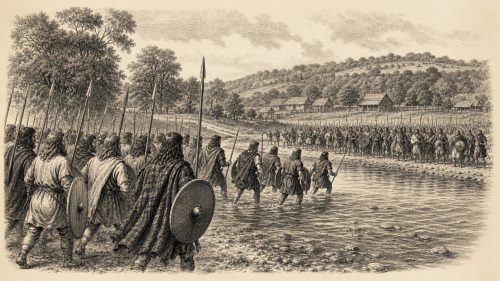
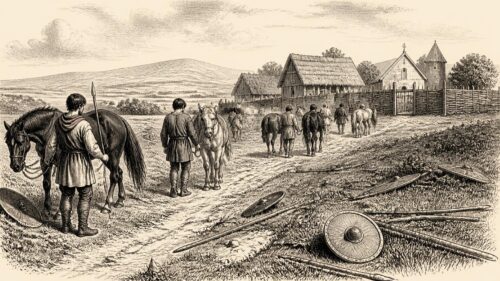
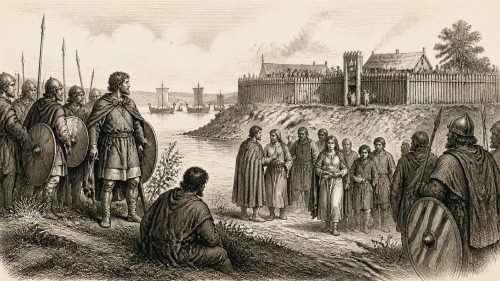
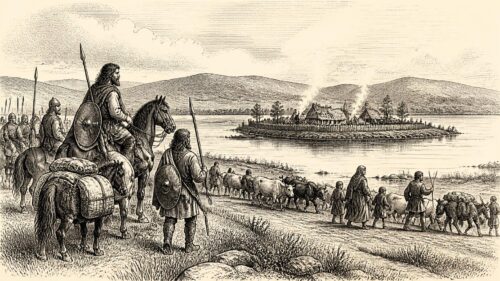
In 857, Ímar and Amlaíb routed Caitil Find and his Gall-Gaídil in Munster, demonstrating competition among Scandinavian-Gaelic forces rather than a simple Irish-Viking conflict. The annals provide no location, casualties or outcome for Caitil. The Annals of Inisfallen also record Búitíne’s fleet arriving in Ireland, without explaining its purpose. Matudán, king of Ulaid, died, possibly after entering clerical life, while Maengal of Fore and Siadal of Dísert Ciaráin also died. At Tailtiu, three people were killed by lightning, and a severe windstorm damaged trees and lake islands. These notices depict Ireland connected through maritime movement, regional power and monastic networks.
Dateline
In 857, Ireland’s surviving annals set down a small but revealing group of events: a defeat among Scandinavian and Gaelic-speaking war bands in Munster; the arrival of another fleet; the deaths of rulers and churchmen; a lethal strike of what the writers called “fire from heaven” at Tailtiu; and a destructive windstorm. None is described at great length. Together, however, they show an island in which political authority, seaborne power, monasteries and the natural world were closely entangled.
The dating needs a word of caution. Irish annals do not always align neatly with a modern calendar: their year headings, copied and recalculated across generations, can be offset. The campaign involving Ímar and Amlaíb is conventionally placed in 857 by the Annals of Ulster and Chronicon Scotorum, while the Annals of Inisfallen independently place the arrival of Búitíne’s fleet in 857. No source supplies a month, a battlefield location or a day for these events. What follows therefore treats 857 as the accepted annalistic year, while keeping the limits of the evidence in view.
A Rout in Munster
The year’s principal political and military notice records that Ímar and Amlaíb “inflicted a rout” on Caitil Find — Caitil the Fair — and his Gall-Gaídil, rendered in English as Norse-Irish or Foreign-Gaels, “in the lands of Munster”. The wording establishes a defeat, but no more. It does not name the site, explain the immediate cause of the fighting, give casualty totals or say whether Caitil himself died, escaped or made terms. These absences matter. Later historians have sometimes tried to turn such a compressed annal into a fully mapped campaign; the contemporary record does not permit that.
Even so, the entry is important. It is the first secure appearance of Ímar in the Irish annals, beside Amlaíb, who had arrived in Ireland a few years earlier and secured the submission of Scandinavian groups already active there. Their victory in Munster reveals that the “foreigners” of Irish chronicles were not a united invading people. They included rival leaders, mobile crews, settlers, allies of Irish kings and groups whose linguistic and family backgrounds crossed the Irish Sea.
Caitil’s name itself hints at this mixed world. Modern scholarship generally treats it as containing both Scandinavian and Gaelic elements, though neither his homeland nor his ancestry can be demonstrated. The Gall-Gaídil are equally difficult to define. The term literally suggests people identified with both “foreign” and Gaelic worlds, but it need not describe a single ethnic community or permanent polity. They may have included mixed Scandinavian-Gaelic military followers, men from the western seaways, Irish associates of Scandinavian leaders, or combinations of all these. Their appearance in the annals in the later 850s is brief and striking.
It would be wrong, then, to picture the clash as a straightforward encounter between Irish defenders and Viking attackers. The combatants named in 857 were competitors within a broad Irish Sea zone of ships, clientage, raiding and paid service. Munster was not merely a remote target. Its coasts, river routes, ecclesiastical centres and rival kingdoms made it a place where seaborne forces could land, obtain supplies, bargain with local rulers and contest influence. The annal’s use of the plural “lands of Munster” may indicate a campaign extending through the province, but it does not prove a long march across it.
The rout also belongs to a volatile sequence rather than an isolated episode. In the preceding years, Máel Sechnaill mac Máele Ruanaid, the powerful king of Tara from the Southern Uí Néill, had confronted warfare involving Scandinavian forces and Gall-Gaídil while pressing his own claims over Munster. In the following year, Ímar reappears with Cerball of Osraige in fighting against Gall-Gaídil and their allies. Those surrounding events help explain why Munster mattered in 857, but they should not be collapsed into the year itself. What can be dated firmly to 857 is the defeat of Caitil Find’s force by Ímar and Amlaíb.
Búitíne’s Fleet
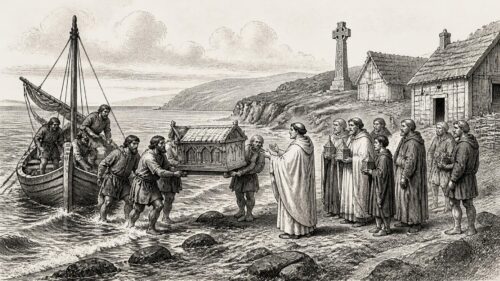
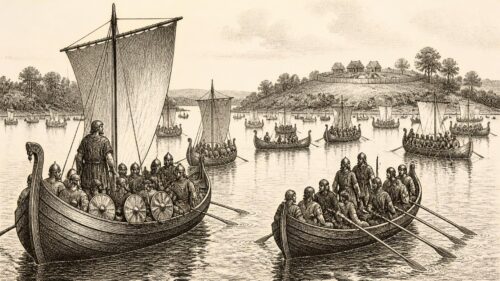
The Annals of Inisfallen, compiled in a Munster monastic milieu, add a second maritime notice: “The fleet of Búitíne came to Ireland.” This is an unusually bare statement, yet it is valuable precisely because it records arrival rather than an attack. Búitíne’s identity is otherwise uncertain; the annal does not say whether he was a Scandinavian leader, where his ships came from, where they made landfall, how many vessels were involved, or whether his fleet joined either side in the conflict involving Caitil, Ímar and Amlaíb.
Its inclusion nevertheless underlines the scale of movement across the Irish Sea. Fleets brought more than raiders. They could carry fighting men, traders, dependants, captives, livestock, portable wealth, messages and political expectations. By the mid-ninth century, Scandinavian maritime activity in Ireland had developed beyond occasional coastal strikes. Longphuirt, or defended ship-bases, and more settled waterfront communities gave some fleets places from which to operate, while Irish rulers could alternately fight, employ or negotiate with them. The arrival of Búitíne’s fleet is evidence for that continuing mobility, not proof of a particular settlement or alliance.
A King and Two Churchmen
Far from Munster, Matudán son of Muiredach, king of Ulaid, died in 857. A version preserved in the Fragmentary Annals of Ireland adds that he died “in clerical status”. That phrase may mean that he had entered religious life before death; it should not be stretched into a detailed story of abdication or retirement. Matudán had been a significant northern ruler in a region exposed both to Irish dynastic politics and to Scandinavian activity around the north-east coast and inland waterways. His death removed one established figure from Ulaid’s unstable political landscape, but the annals do not record a succession settlement in the same year.
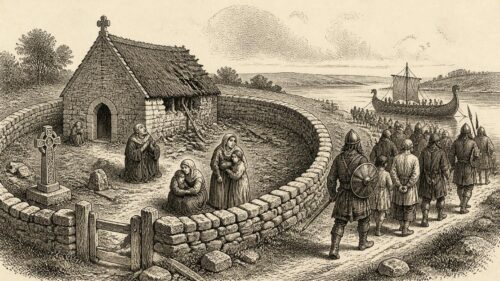
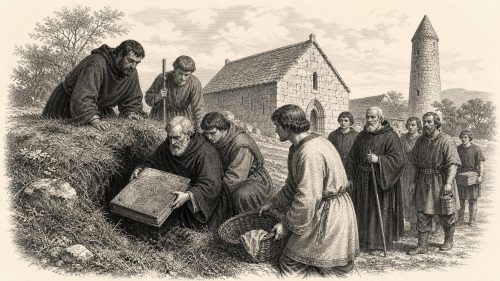
Two ecclesiastical deaths were also noted: Maengal, abbot of Fobar, generally identified with Fore in present-day County Westmeath, and Siadal of Dísert Ciaráin. The notices are short, but they show why monastic personnel were recorded beside kings and war leaders. An abbot was not simply the head of a prayer community. Major churches possessed land, tenants, learned traditions, relics, churches and other buildings; they were centres of hospitality, writing, teaching and political connection. The language of “rest” used for Maengal and Siadal is conventional, but their inclusion marks losses felt beyond a single household.
For ordinary people, these institutions structured daily life as well as worship. Monastic estates required food rents, labour, cattle, timber and skilled craftwork. Guests, pilgrims, scholars and messengers could be received there, while scribes produced the books and records through which events such as those of 857 could later be remembered. The annals do not allow us to reconstruct a day at Fore or Dísert Ciaráin in this particular year. They do show that religious communities remained integral to Ireland’s political and social map during a period of maritime conflict.
Tailtiu and the Violent Sky
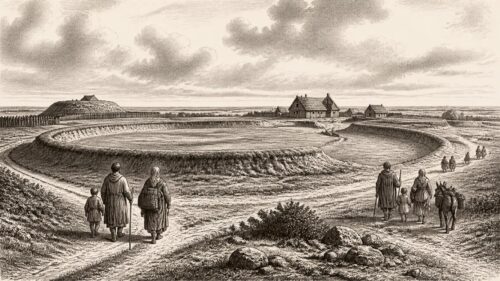
The most arresting local entry concerns Tailtiu, the important assembly landscape near the Blackwater in modern County Meath. Three people, the Annals of Ulster says, were burned there by “fire from heaven”. The phrase is best understood as an annalistic description of a lightning strike or related electrical event, not evidence for a miracle that can be reconstructed in literal detail. We do not know who the victims were, whether they had gathered for business or travel, or whether buildings were struck. Yet the report conveys the vulnerability of people in an open, intensively used landscape.
Tailtiu carried exceptional cultural and political weight. It was associated with a renowned seasonal fair and assembly, remembered in law, tradition and later historical writing as a place for gatherings, exchanges, contests and royal display. The 857 entry does not state that a fair was actually being held, and it must not be used to date one. Its significance lies instead in the annalist’s assumption that an incident at Tailtiu was worth preserving for a wide readership. The location was part of the public geography of the midlands.
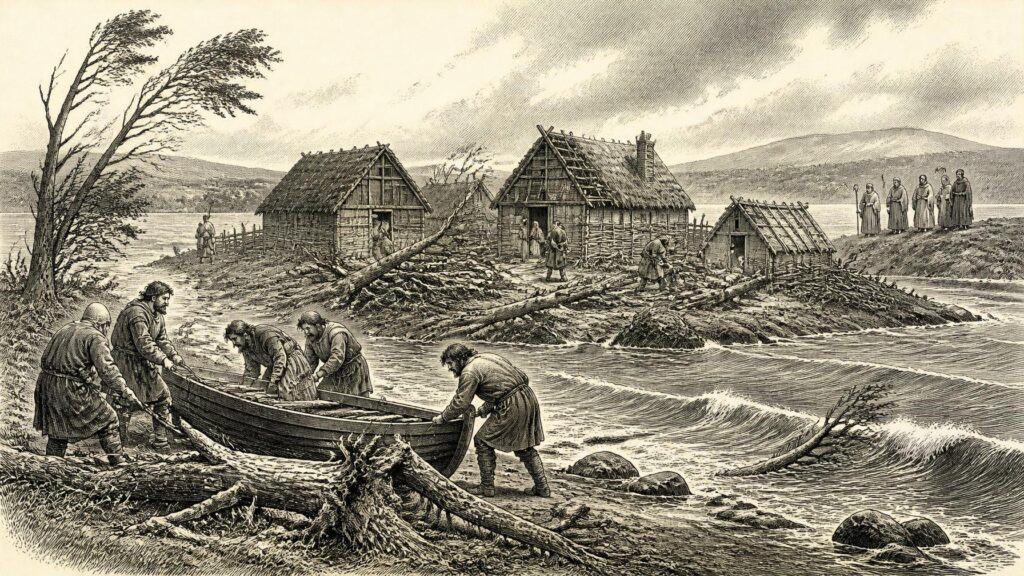
The same annal records a “great windstorm” which destroyed trees and damaged lake islands. The report is national in tone but does not identify individual lakes or settlements. Lake islands could include natural islands as well as inhabited or improved sites; it would therefore be unsafe to claim that a named crannóg was wrecked. Nonetheless, wind damage to trees, boats, shore installations and island access would have had practical consequences. Timber was essential for buildings, fuel, fences, tools and boats, while lakes and rivers were major routes through an Ireland where overland travel was often difficult.
The storm was followed by a verse attributed to Cellach, which links the year to the Council of Nicaea. This brief piece of chronological poetry is revealing. It shows learned Irish writers placing local catastrophe within a Christian universal timescale, counting years from a major fourth-century church council. The poem does not explain the weather scientifically; rather, it makes the event memorable within an ordered sacred history. Learning, commemoration and belief were not separate from political life: they supplied the intellectual framework through which communities understood danger and time.
An Island of Competing Connections
Thus 857 was not a year in which a single ruler mastered Ireland, nor one in which a simple opposition between Irish and Scandinavian peoples explains events. The documented defeat in Munster involved leaders and followers whose identities were already entangled across the Irish Sea. A new fleet reached Ireland, though its intentions remain unknown. Ulaid lost a king; church communities lost senior figures; and a central assembly landscape suffered a sudden deadly incident beneath a stormy sky.
The sources leave many questions unanswered, but their silences are instructive. They preserve no battlefield speech, no ship count, no exact route and no complete roll of victims. What they do preserve is a credible outline of an Ireland connected by sea lanes and monastic networks, governed through competing regional kingships, and exposed alike to organised violence and abrupt environmental shock. In that sense, Caitil Find’s rout was only one part of a year whose events were bound together by movement, authority, memory and weather.
Primary Sources
- The Annals of Ulster, Year U857
- CELT Project: The Annals of Ulster
- Annals of Inisfallen, Annals AI850–AI859
- CELT Project: Annals of Inisfallen
- Chronicon Scotorum
- Fragmentary Annals of Ireland, Irish text, Annals FA280–FA285
- Fragmentary Annals of Ireland, translated edition
- CELT Project: Fragmentary Annals of Ireland
- Vikings in Irish Chronicles, 794–902: Data
- Donnchadh Ó Corráin, Vikings in Scotland and Ireland in the Ninth Century
- Donnchadh Ó Corráin, The Vikings in Ireland
- Emer Purcell, The Vikings in Ninth-Century Ireland: Sources and Settlements
- Emer Purcell, The Vikings in Ninth-Century Ireland: Sources and Settlements (full text)
- Máel-Sechnaill, Dictionary of Irish Biography
- Cerball, Dictionary of Irish Biography
- The Annals of Tigernach, CELT Project
- The Annals of the Four Masters, CELT published texts
- Daniel P. McCarthy, Chronological Synchronisation of the Irish Annals
- Old Irish – Morphology, Part 1: Annals of Ulster 858.4
- Placenames of County Meath
- The Annals of Inisfallen to Go on Public Display in University College Cork