Carn Lugdach’s Munster Hostages858 CE
In 858 Máel Sechnaill mac Máel Ruanaid, king of Tara, led a large coalition into Osraige and Munster after resistance to his overlordship and complaints about Cerball of Osraige’s tribute-taking. His forces penetrated Munster, defeated its interests at the unlocated Carn Lugdach, killed Déisi king Máel Cróin, and extracted hostages across the province. Cerball nevertheless raided Leinster and, allied with Scandinavian ruler Ímar, defeated opponents in Ara Tíre. Ecclesiastical and regional royal deaths reflected fragmented authority, while notices of Pictish and West Saxon kings reveal wider connections. A wet autumn damaged crops, compounding disruption from armies, raiding, requisitions and hostage-taking.
Dateline
In 858, Máel Sechnaill mac Máel Ruanaid, king of Tara and leader of Clann Cholmáin in Mide, made an unusually forceful bid to impose his authority on the south of Ireland. His campaign against Munster, his collision with the ambitions of Cerball mac Dúnlainge of Osraige, and a wet autumn damaging the harvest together make this a year in which political command, food security and local rivalries were tightly entangled. Ireland was not a united kingdom in any modern sense. Yet a ruler who could raise a large host, defeat provincial kings and take hostages across a wide region could make a serious claim to supremacy.
A Campaign into Munster
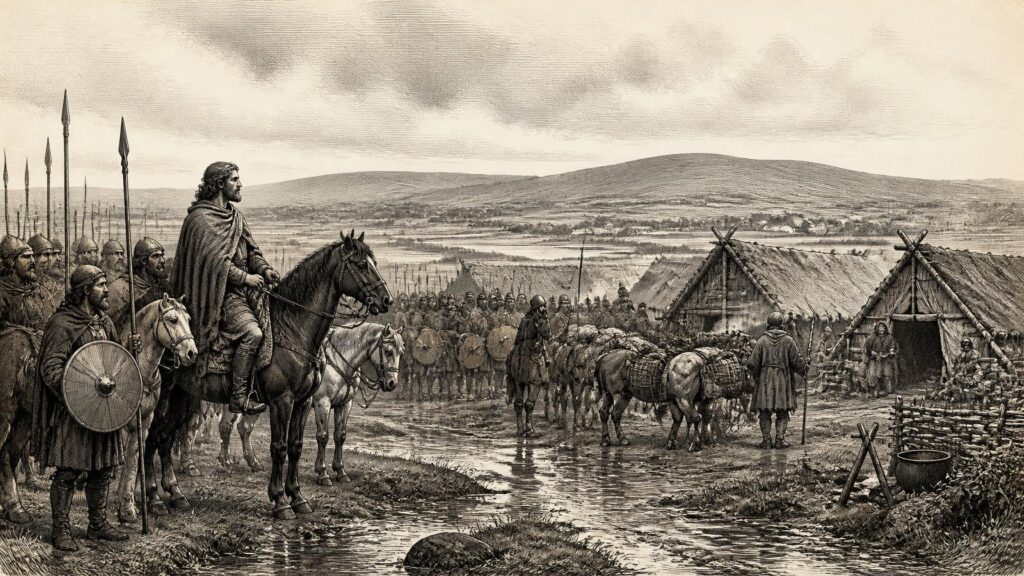
The central event is firmly placed in 858 by Chronicon Scotorum and the Fragmentary Annals of Ireland: Máel Sechnaill led a great hosting into Osraige and Munster. The immediate issue, as the later and more expansive Fragmentary Annals presents it, was Munster’s refusal to provide hostages. That account also assigns a second cause: Cerball of Osraige had been exacting annual tribute from Leinster territories under his influence, and his collectors had provoked grievances among the Leinster people. Their complaints gave Máel Sechnaill both a political opening and a reason to move against Cerball’s growing power.
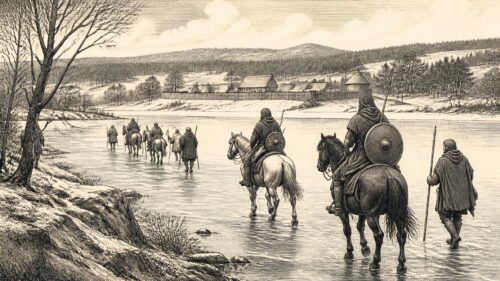
The language of the annals needs reading with care. A host described as drawn from “the men of Ireland” should not be mistaken for a national army or a united Irish state. It signals an imposing coalition under the Tara king’s leadership. Such a force was assembled from the military followings of allied rulers and lesser lords, with food, cattle, horses, weapons and labour drawn from the territories through which it moved. Its presence was itself a demand for submission. Campaigning was not confined to set-piece battles: it meant seizing supplies, burning or plundering opponents’ lands, taking cattle and compelling guarantees of obedience.
Máel Sechnaill’s force reached the Munster frontier by way of Gabráin, according to the detailed narrative. The Annals of Ulster, whose chronological headings at this point require caution, preserve a more concise account: the king came into Munster, halted for ten nights at a place called Niam, and ravaged the country southwards to the sea. The Fragmentary Annals instead place a month-long stay at Imlech, modern Emly. These descriptions should not be forced into a falsely exact itinerary. What is secure is the campaign’s scale, its penetration into Munster, and the use of a sustained encampment from which Máel Sechnaill’s army could threaten surrounding districts.
The Battle at Carn Lugdach
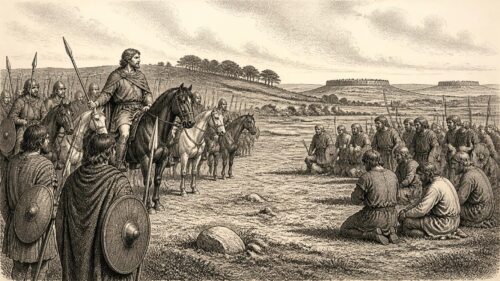
The campaign culminated in a victory at Carn Lugdach, a site that cannot now be located with certainty. The annals record that Máel Cróin, son of Muiredach and one of the kings of the Déisi, was killed. His death demonstrates that the encounter was not merely a raid but a defeat suffered by Munster’s ruling interests. The Fragmentary Annals add that Máel Gualae, king of Munster, initially came against Máel Sechnaill with mounted men, that Máel Sechnaill’s troops were hard pressed, and that infantry then turned the fight. This colourful version is valuable but should be treated as retrospective narrative rather than a literal battlefield report. Its immense casualty figure is especially unsafe to repeat as fact.
One point in that narrative is nevertheless historically revealing. Cerball and a body of Danish followers are said to have remained in a wooded camp rather than joining the main battle. Cerball had long demonstrated a willingness to work with Scandinavian military groups when it suited Osraige’s interests. The divisions of the 850s were therefore not simply Irish against Viking. Kings and war-bands made alliances across cultural and religious lines, while Norse, Danish and Norse-Irish groups competed with one another and with Irish rulers. The annalists’ hostile description of the Gall-Gaedil—people of Irish background associated with Scandinavian customs—tells us much about clerical attitudes, but should not be taken as a neutral ethnic label.
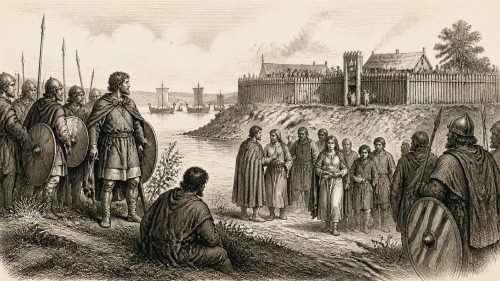
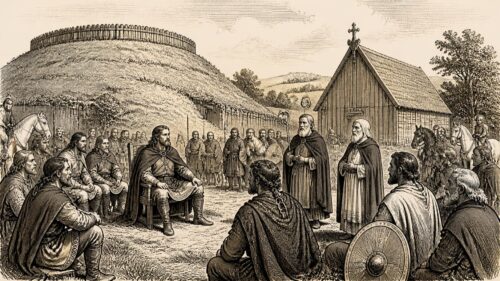
Máel Sechnaill’s victory did not mean that he annexed Munster. Instead, he imposed the more practical and recognisable mark of overlordship: hostages. The annals describe hostages being taken from an extensive sweep of Munster, from Comar Trí n-Uisce to Inis Tarbna, and from Dún Cermna to Ára Airthir. The named limits, whether every geographical detail is recoverable or not, advertise the breadth of the claim. Hostages were usually high-status persons, often relatives or dependants of rulers. Their custody bound local kings to an agreement because renewed defiance endangered people whose status made their fate politically consequential.
Cerball, Leinster and Ímar
Cerball was not simply swept aside. The evidence for 858 instead shows him operating on several fronts. The Fragmentary Annals state that he plundered Leinster and took hostages, including Cairpre son of Dúnlang and Suithemán son of Artúr. The same source is markedly sympathetic to Cerball, presenting him as an exceptional warrior and ruler; its claims about his motives and character deserve scepticism. Even so, the basic political pattern is clear enough. Osraige, centred on the Nore valley between Munster and Leinster, was seeking leverage beyond its own borders. Cerball’s actions in Leinster made him a problem for the Leinster dynasties, for Munster and for Máel Sechnaill alike.
A second recorded victory made the year still more complicated. Cerball and Ímar defeated Cenél Fiachach and the Gall-Gaedil of Leth Cuinn in Ara Tíre, in the region of modern north Tipperary. Chronicon Scotorum and the Annals of the Four Masters preserve the event, while the latter gives an implausibly precise total for Cerball and Ímar’s force. The number should be rejected, but the alliance should not. Ímar was among the leading Scandinavian rulers active in the Irish Sea world, and his cooperation with Cerball underlines how readily political interests could cut across the categories used by later readers.
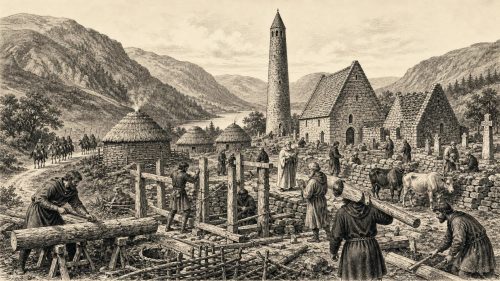
For ordinary communities, these manoeuvres brought immediate costs. Armies consumed food, requisitioned animals and disrupted travel; victorious rulers removed hostages; defeated territories faced plunder. A ruler’s right to levy tribute was not an abstract constitutional matter. It depended upon officials and armed followers entering communities to collect cattle, foodstuffs and other dues. The complaint against Cerball’s tribute collectors preserved in the annalistic narrative offers a rare glimpse of the friction generated by this everyday machinery of power.
Churches, Learning and Succession
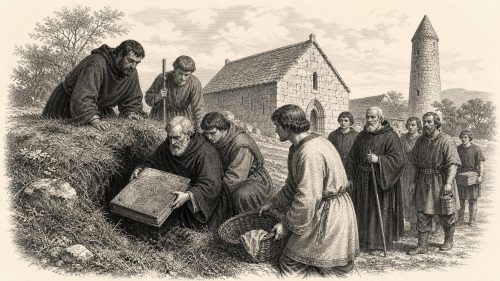
The annals also record a series of deaths within Ireland’s ecclesiastical and political networks. Cumsud, bishop and abbot of Cluain Iraird, died; so did Tipraite Bán, abbot of Tír dá Glas, and Máel Tuili, abbot of Imlech. These were not minor local offices. Great churches were religious communities, landholders, centres of education and writing, and places through which aristocratic families pursued influence. The combination of ecclesiastical and secular titles held by many figures in early medieval Ireland reflects a society in which kinship, lordship and church office overlapped rather than occupying wholly separate worlds.
The death of Cellach son of Guaire, king of south Leinster’s Uí Chennselaig, and that of Cernach son of Cináed, king of Uí Bairrche Tíre, also altered the political landscape. Neither obituary permits a confident reconstruction of succession in 858, but both remind us that authority was fragmented among many regional dynasties. Máel Sechnaill’s southern campaign took place amid these local transitions, not above them. His ability to exact hostages depended on persuading, intimidating or defeating rulers whose own power rested on similarly local foundations.
Two deaths beyond Ireland were noted by Irish chroniclers: Cináed mac Ailpín, king of the Picts, and Æthelwulf, king of the West Saxons. Their inclusion does not prove direct Irish involvement in their successions. It does, however, show that Irish learned communities followed the affairs of neighbouring kingdoms. Irish clerics, pilgrims, traders and raiders all moved through a wider world linking Ireland, Britain, the Hebrides and Scandinavia. The political and ecclesiastical record of 858 belongs to that connected Irish Sea setting.
A Damaging Autumn
The year closed under a darker environmental notice: a rainy autumn destructive to “the fruits of the earth”. The phrase is brief but important. Autumn rain could ruin ripening grain, hinder harvesting and spoil stored fodder. In a largely agrarian society, a poor harvest affected households, ecclesiastical estates and armies alike. It did not necessarily mean universal famine, and the sources do not justify claiming one. But after a season of major military mobilisation and raiding, damage to crops would have sharpened vulnerability in places already stripped of livestock or provisions.
Thus 858 was not merely a year of kings and battles. It exposed the practical limits beneath political ambition. Máel Sechnaill could defeat opponents at Carn Lugdach and carry off Munster hostages; Cerball could still make war in Leinster and cooperate with Ímar; churches could continue to record their dead and preserve their learning. Yet each development rested on the labour of farming communities whose harvest was threatened by weather as well as by armed men. The annals’ compressed notices, read cautiously together, preserve a year in which authority was won through movement, coercion and negotiation—and tested by the land itself.
Primary Sources
- The Annals of Ulster, Year U858
- The Annals of Ulster, Year U859
- The Annals of Ulster
- CELT Project: The Annals of Ulster
- Chronicon Scotorum, Annal CS858
- CELT Project: Chronicon Scotorum
- Fragmentary Annals of Ireland, Annal FA 260
- Fragmentary Annals of Ireland, Annals FA 261–265
- Fragmentary Annals of Ireland, Annals FA 281–300
- Fragmentary Annals of Ireland
- Annals of the Four Masters, Annals M856–M858
- Annals of the Four Masters
- Annals of Inisfallen, Annals AI860–AI869
- CELT Project: Annals of Inisfallen
- Cerball | Dictionary of Irish Biography
- Máel-Sechnaill | Dictionary of Irish Biography
- Vikings in Irish Chronicles, 794–902: Data
- Viking Ireland: An Afterthought
- General Vikings in Ireland
- Vikings in Ireland and Scotland
- The Vikings in Ninth-Century Ireland: Sources and Settlements
- CELT Project: Annals of Tigernach
- The Annals of Inisfallen: Manuscript and Source Description