Cianán’s Ravaged Oratory880 CE
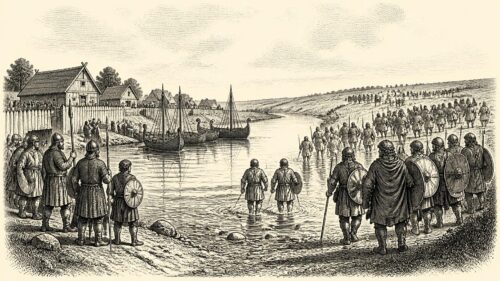
In the annalistic sequence assigned to AD 880, Scandinavian raiders destroyed Cianán’s oratory at Duleek, County Meath, and carried away many people. The attack struck a wealthy, well-connected ecclesiastical community, demonstrating the continuing vulnerability of Irish churches despite growing Scandinavian settlement around Dublin. Bárid, a prominent Norse leader probably linked to Dublin and perhaps son of Ímar, died soon afterwards; annalists attributed his death to Cianán’s supernatural vengeance, though its circumstances remain uncertain. Occurring early in Flann Sinna’s reign, the raid illustrates limited royal control, Irish Sea power, captivity’s human cost, and the overlap of raiding, settlement, religion, and politics.
Dateline
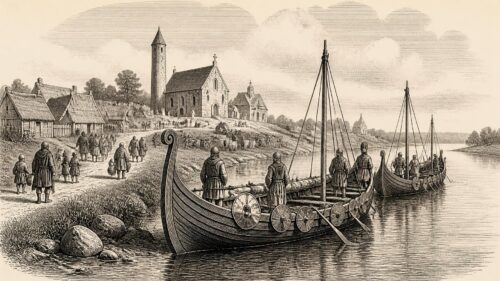
The clearest Irish event associated with 880 is a violent attack on the ecclesiastical community of Cianán at Duleek, in what is now County Meath. The surviving notices are short, but their economy makes them no less stark: the church-oratory was wrecked, people were carried away, and the Scandinavian leader Bárid died soon afterwards. This was not a set-piece battle between rival Irish kings. It was an assault on a religious settlement whose inhabitants, resources and sacred prestige made it a valuable target in the contested Irish Sea world of the late ninth century.
A Date With a Caveat
Medieval Irish annals do not always align neatly with modern calendar years. The relevant entry appears under the Annals of Ulster’s heading U881, but that heading itself gives the corresponding year as AD 880. Other annalistic compilations place related material under still different year numbers, and modern reference works commonly describe Bárid’s death as occurring in 881. The safest conclusion is that the raid on Duleek and Bárid’s immediate subsequent death belong to the annalistic sequence straddling 880–881; for an account of 880, they can responsibly be treated as events assigned to AD 880 by the Annals of Ulster, but not dated to any particular month or day.
The Attack at Duleek
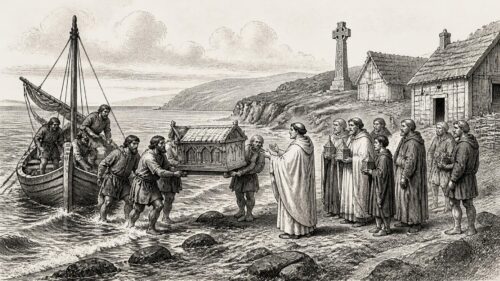
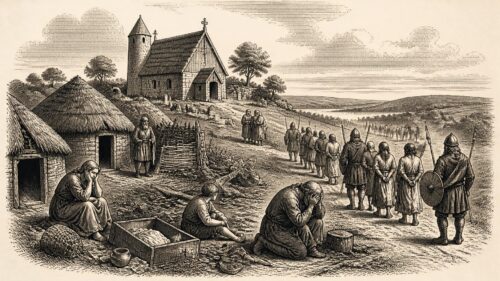
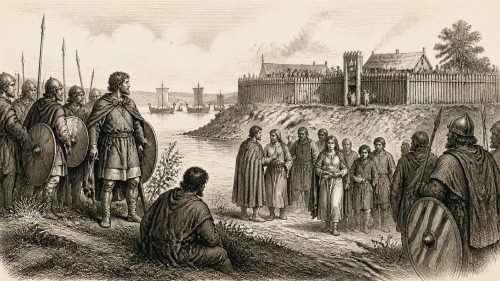
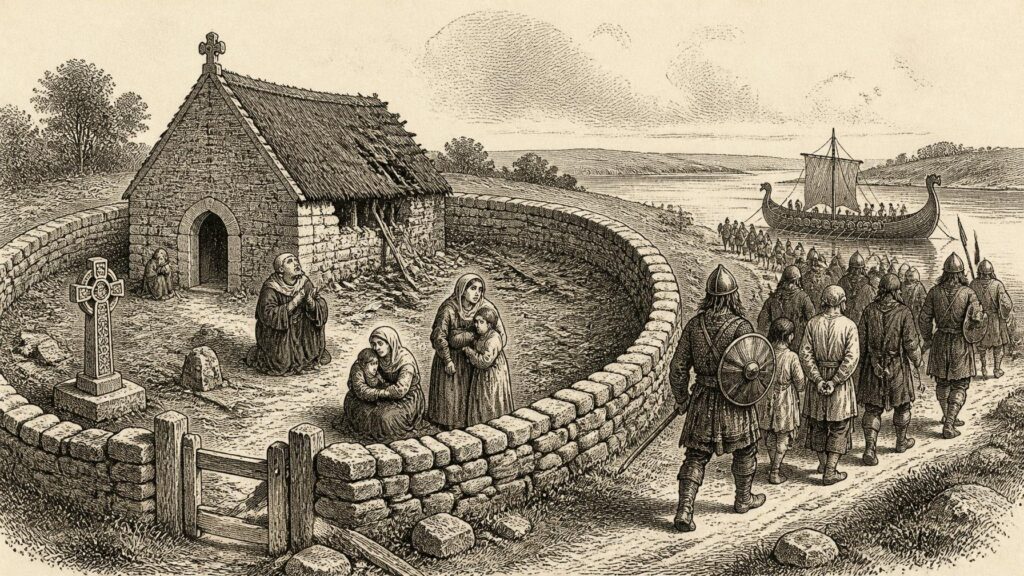
The Annals of Ulster records that “the oratory of Cianán” was destroyed by foreigners and that many people were taken from it. Its Irish text is especially forceful: the building was coscrath, torn apart or shattered, while the community was carried off in great number. The phrase does not permit a precise total, nor does it identify every captive. Yet it certainly points beyond the theft of portable church valuables. Clergy, dependants, tenants, visitors and other people present within the ecclesiastical enclosure may all have been vulnerable. Captivity was a central horror of Viking-age raiding, and captives were a commodity as well as political hostages and labourers.
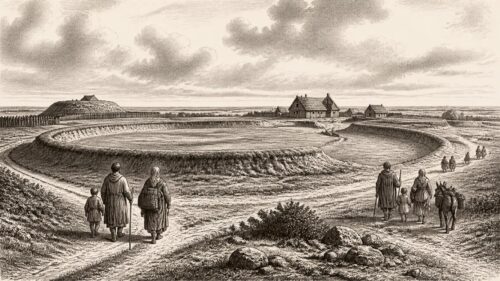
Duleek was an exceptionally consequential place to attack. Its Irish name, Damhliag or Daimliag, was understood as “stone church”, and the settlement stood in the fertile, well-connected country of east Meath, between the Boyne region and the approaches to Dublin. Archaeological and documentary evidence identifies an early medieval ecclesiastical complex around St Cianán’s church, with a large enclosure whose line has partly survived in the town’s layout. This was not an isolated chapel on a remote shore: it was a religious centre embedded in a settled agricultural landscape, with people, food, livestock, craft goods, books and church wealth concentrated within reach of sea-borne raiders.
Bárid’s End
The annal immediately follows the raid with the death of Bárid, called a tirannus magnus Norddmannorum—a great ruler or “tyrant” of the Northmen. The wording is deliberately moral as well as political. It says that he was killed by Cianán, meaning not that a long-dead saint physically struck him down, but that contemporaries or later annalists credited the saint with supernatural vengeance. Such explanations were a familiar way of presenting an assault on sacred property: the community’s patron saint was believed to defend his people, shrine and territory.
The fuller tradition complicates rather than confirms the physical circumstances of Bárid’s death. The Annals of the Four Masters says that he was killed and burned at Áth Cliath, Dublin, through the miracles of God and Cianán. Chronicum Scotorum likewise names him Bárid son of Ímar and attributes his death to divine and saintly intervention. The Ulster annalist gives neither a method nor a location. Historians can therefore state with confidence that a prominent Scandinavian leader died shortly after the Duleek raid; they cannot securely choose between death by killing, burning, drowning or another form of violence from these divergent and morally charged accounts.
Dublin and the Irish Sea
Bárid was probably one of the leading figures in Scandinavian Dublin and may have been a son of Ímar, though his precise family relationship remains uncertain. He belonged to the political world created by the longphort and settlement at Áth Cliath: a world of ships, armed retinues, tribute, raiding, alliances and commercial exchange extending across Ireland, Britain and the western seaways. Calling every Scandinavian in Ireland simply an invader obscures that reality. By this period some Norse leaders had durable bases and dealings with Irish rulers; Dublin was becoming a permanent power-centre rather than merely a seasonal raiders’ camp.
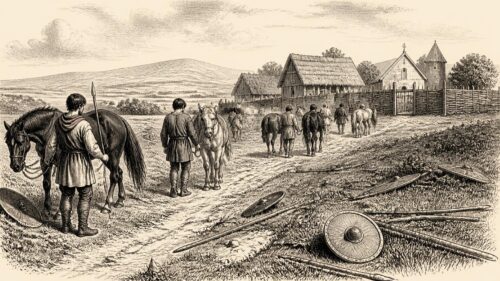
That wider context does not make the assault on Duleek any less destructive. Instead, it helps explain its scale. A leader with access to ships and a Dublin-based following could move rapidly along the east-coast river and road networks, choose rich ecclesiastical targets and transport people and valuables away. Duleek’s position in the region between Dublin and the north-eastern coast made it exposed to precisely such operations. The attack also demonstrates that established Scandinavian settlement and profitable raiding could coexist; settlement did not bring an end to coercion.
Royal Ireland in the Background
The raid occurred during the early reign of Flann Sinna of Clann Cholmáin, king of Mide and claimant to the overkingship of Tara. His accession followed the death of Áed Findliath, whose obituary in the Annals of Ulster is dated 20 November in the annal’s preceding chronological sequence. Flann’s authority, however, was not equivalent to control of a unified Irish state. Kingship rested on personal alliances, military expeditions, hostage-taking and the recognition of provincial and local dynasties. The ability of Bárid’s force to strike Duleek shows the limits of any king’s capacity to guarantee security, even in the politically central midlands and eastern regions.
No source places Flann Sinna personally at Duleek in 880, and it would be wrong to invent a royal response. Nor can the attack be presented securely as part of a recorded campaign between Flann and Bárid. What the evidence does show is a landscape in which Irish dynastic politics and Scandinavian power overlapped. Kings could make use of foreign military support, while Scandinavian rulers could exploit divisions among Irish kingdoms and ecclesiastical communities. The political significance of the raid lies in that exposure and interdependence, not in an undocumented confrontation.
A Religious Community Under Pressure
The destruction of an oratory was a material and spiritual blow. An early medieval Irish church was not merely a place of worship. It was a community of clerics and lay dependants, a centre of burial and commemoration, a landholder, a recipient of food-renders and gifts, and often a place where literacy, record-keeping and teaching were practised. Duleek’s later annalistic record includes several scribes, while its succession of abbots and bishops indicates an institution of enduring standing. The people taken in 880 therefore represented a loss felt in households and farms as much as at the altar.
Other notices assigned by the Annals of Ulster to AD 880 underscore how densely Ireland’s religious and political networks were populated. Ferchar, abbot of Bangor, and Crunnmael of Clonkeen, described as both bishop and anchorite, died. So too did local rulers including Máel Sinchill of Uí Fhailgi, as well as church superiors at Ardstraw and Lusk. These entries do not describe a nationwide crisis, but they reveal the ordinary framework within which the Duleek disaster was understood: a country of many small kingships and influential churches, linked by kinship, travel, patronage and rivalry.
What the Record Cannot Supply
The annals do not describe the appearance of Duleek’s oratory, name the captives, record the route of Bárid’s ships, or tell us how quickly the community rebuilt. They do not establish a precise death toll, nor can archaeology presently tie a burned layer or ruined structure directly to this particular raid. The saint’s miraculous revenge is invaluable evidence for religious interpretation, but not literal proof of how Bárid died. These absences matter. They prevent a vivid but false reconstruction of flames, weapons and individual suffering.
Even so, the year’s evidence is powerful. In the annalistic AD 880 sequence, Duleek appears as a substantial ecclesiastical settlement attacked by Scandinavian raiders; its people were carried away; and the leader held responsible, Bárid, died shortly afterwards. The memory of that sequence was preserved not simply as a Viking exploit, but as a violation of Cianán’s sanctuary followed by judgement. For Ireland, that is the enduring significance of 880: a local catastrophe at Duleek that illuminates the human cost of power centred on Dublin and the resilience of sacred communities in a fractured political world.
Primary Sources
- The Annals of Ulster: Year U881 (English translation)
- The Annals of Ulster: Year U881 (original text)
- The Annals of Ulster: Year U879
- The Annals of Ulster: Year U880
- Annals of the Four Masters: Annals M877–M886
- Vikings in Irish Chronicles, 794–902: Data
- Vikings in Irish Chronicles, 794–902: Introduction
- Vikings in Irish Chronicles, 794–902: Bibliography
- Barid (Bárith, Barðr)
- Cianán
- The Vikings in Ninth-Century Ireland: Sources and Settlements
- The Vikings in Ninth-Century Ireland: Sources and Settlements (full record)
- The Vikings in Scotland and Ireland in the Ninth Century
- Vikings in Ireland
- County Meath Urban Archaeological Survey: Duleek
- 1993:180 – Duleek: Navan Road, Meath
- 2008:952 – Duleek: Abbeyland/Balsaran Commons/Duleek/Knockisland/Prioryland, Meath
- 2009:644 – Duleek: Abbeylands, Meath
- The Vikings in Ninth-Century Ireland: Sources and Settlements (PDF)
- Viking Raids on Irish Church Settlements in the Ninth Century: A Reconsideration of the Annals
- Vikings in Early Medieval Ireland: Church-Raiding, Politics and Kingship
- Vikings in Early Medieval Ireland: Church-Raiding, Politics and Kingship (review)
- Vikings in Early Medieval Ireland: Church-Raiding, Politics and Kingship (review)
- Duleek – History and Development