

Captive Irish
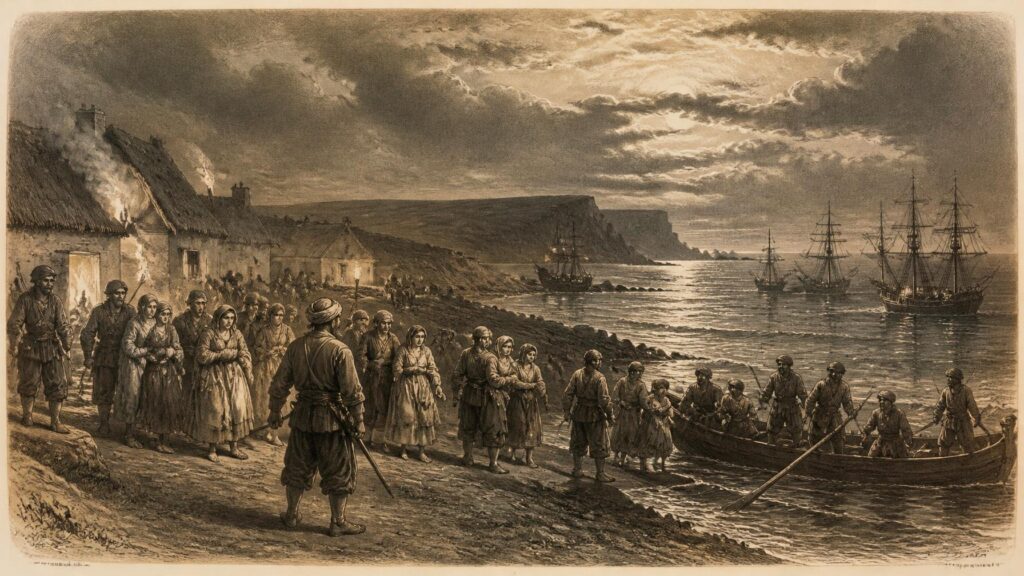
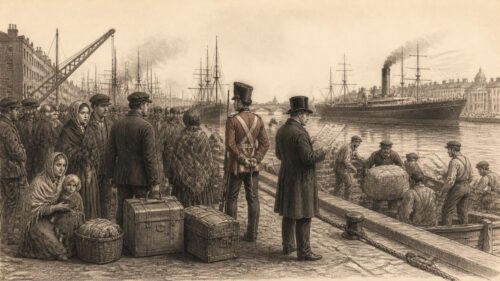
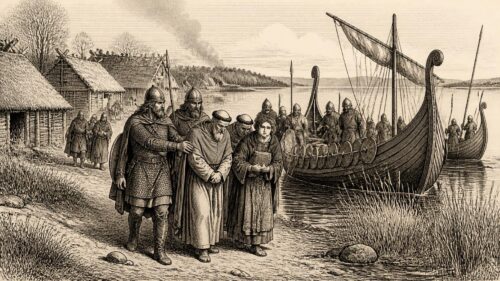
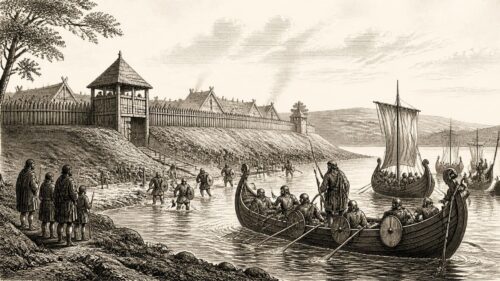
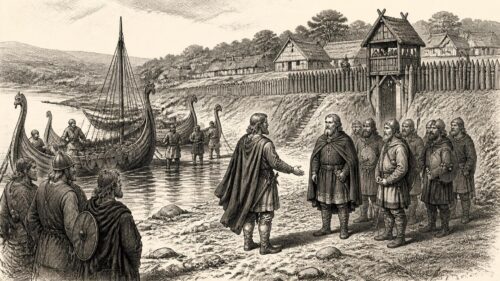
AI generated historical illustration, not a contemporary photograph.
At a Glance
Irish people were indeed enslaved or held in slavery beyond Ireland at several points in history, but the answer is neither a simple yes nor support for the modern claim that the Irish collectively endured the same system as Africans in the Atlantic world. Irish captives were carried overseas by Viking raiders; men, women and children seized in West Cork in 1631 were sold in Algiers; and many Irish people were coercively transported to Caribbean colonies in the seventeenth century. Yet the last of these experiences was generally indentured or penal servitude, however cruel in practice, rather than the hereditary racial chattel slavery imposed upon Africans and their descendants. Precision is not evasion. It is the means by which the suffering of Irish people can be recognised without obscuring the distinct catastrophe of Atlantic slavery.
Question Defined
The question ‘Were Irish people ever used as slaves in foreign countries?’ contains several different historical questions. It may ask whether people born in Ireland were captured, transported across a sea and sold or compelled to labour abroad. The answer is clearly yes. It may ask whether Irish people were legally enslaved as property, with no recognised term of service and little or no independent civil standing. Again, in particular periods and places, the answer is yes. It may instead mean whether the Irish population was subjected to the same racial, hereditary plantation slavery that shaped the Atlantic economies of the Americas. That answer is no. The differences are consequential, not merely verbal.
Historical language complicates the issue. For much of the medieval and early modern world, ‘slave’, ‘servant’, ‘captive’, ‘bondman’, ‘prisoner’, ‘transported person’ and related words were used inconsistently. A person could be described as a servant in one record and sold in a manner that looks, to a modern reader, like slavery. Conversely, propagandists and later writers often used ‘slave’ as a powerful metaphor for conquest, poverty, tenancy, political subordination or exile. Such uses may express real anguish, but they do not always report a legal status. The task is therefore to examine who was captured, where they were taken, what law governed them, whether their condition had a fixed end, whether their children inherited it, and whether they could be bought, sold, punished or freed.
No one vocabulary can carry every history. Enslavement in the Viking age, captivity in North Africa, transportation under the Commonwealth, and indentured labour on a Caribbean plantation all involved coercion, violence and unequal power. But they did not operate by one uniform system. The historical record is strongest when it permits a particular conclusion and weakest where later numbers or dramatic assertions have outrun surviving evidence. A responsible account must also keep in view an uncomfortable fact sometimes excluded from popular stories: Irish migrants and Irish-born families could themselves own enslaved Africans, administer plantations, trade in slave-produced goods and benefit from colonial slavery.
Early Bondage
Slavery was not unknown in early Ireland. Before the Viking age, Irish law and narrative evidence indicate forms of unfreedom, including people taken in war, debt bondage and servile labour. Early medieval societies around the Irish Sea did not divide humanity into the modern categories of citizen and slave. Status formed a spectrum. Kinship, legal rank, gender, debt, military defeat and foreign origin could sharply limit a person’s freedom. A captive from Britain, for example, might be forced into work in Ireland; the most famous literary association is Patrick, who wrote that he had been taken from Britain as a youth and held in Ireland before his escape. His testimony establishes the reality of cross-channel raiding and captivity in late Roman or post-Roman Britain, although it does not prove the details that later legend has supplied.
That context matters because it prevents an anachronism in either direction. Ireland was neither uniquely innocent of slavery before the Vikings nor uniquely singled out as a source of slaves after their arrival. Captive-taking was a grim feature of warfare and raiding in north-western Europe. Individuals could be ransomed, exchanged, absorbed into households, sold or killed. The line between hostage and slave could be unstable. A hostage from a powerful kindred might have value because relatives could pay for release; a person without such protection was more vulnerable to sale and permanent servitude.
Documentary evidence cannot always reveal the life that followed capture. Annalists were often more interested in kings, churches, battles and political consequences than in the names of ordinary victims. They recorded that captives were taken, but seldom identified their destinations or eventual fates. That limitation should temper confident claims about totals. It does not, however, erase the fact of captivity. Repeated reports of men, women and children being carried off, coupled with evidence for slave markets around the Irish Sea, leave little doubt that Irish people could be reduced to unfree status and moved beyond their homeland.
Viking Captivity
The Viking incursions of the ninth century supplied the clearest early evidence that Irish people were carried abroad as captives. Raiding parties sought portable wealth: church metalwork, cattle, food, weapons and human beings. The Irish annals describe attacks in which people were killed and others taken prisoner. Their wording is necessarily brief, but its recurrence is important. University College Cork’s editions of the annals preserve notices of raids that carried away numerous captives. A report for the early eleventh century, for example, describes a force taking cattle and a great number of captives from the Irish midlands. Earlier annalistic notices speak of women seized in coastal raids and of prisoners taken amid devastation.
Captivity did not automatically mean sale overseas. Some people were held for ransom, particularly clergy, nobles or persons with prominent kin. A ransom economy depended on communication and on the belief that a community would pay. Yet the possibility of ransom does not make the initial capture benign. It confirms that captors treated human beings as assets with a calculable return. Those who could not be redeemed were at greater risk of enslavement. Viking raiders operated within trade routes that connected Ireland to western Britain, the Isles, Scandinavia, England and, indirectly, continental Europe. Ships that could remove plunder could also transport people.
The celebrated Life of Saint Findan, though composed as a saint’s life and requiring careful reading, gives a rare individual narrative. Findan, a man from Leinster, was reportedly involved in efforts to ransom a sister seized by Vikings; he was himself captured in later events, taken through the northern islands and eventually escaped to the Continent. The story is not a statistical record, and hagiography aims to demonstrate divine purpose. Nevertheless, it accords with the wider contemporary world of raiding, hostage-taking, ransom and maritime movement. It is especially valuable because it illustrates that the path from Ireland could lead not merely to a neighbouring shore but into a wider northern European network.
Viking Dublin has often been described as a major slave market. The proposition is plausible and supported by documentary and comparative evidence, but its scale remains difficult to measure. Historians have warned against treating every captured person as proof of a vast commercial system or every port as a market of equal importance. Dublin was, however, an outward-looking settlement with connections across the Irish Sea. The trade in people formed part of the economy of the Viking world, and Irish captives were among those exposed to it. In that sense, Irish people were used as slaves in foreign lands long before the plantations of the Caribbean entered the historical imagination.
Foreign Markets
To speak of ‘the Vikings’ alone can conceal another part of the story. Irish rulers, warriors and urban communities were not merely passive spectators in an economy of captivity. As Scandinavian settlements became embedded in Ireland, alliances crossed ethnic and religious lines. Irish and Viking leaders fought one another, joined one another and used familiar forms of coercion. Later medieval sources refer to captives taken in warfare, and scholars have suggested that Irish political leaders could profit from the traffic in human beings as well as suffer from it. This does not imply a modern national guilt, nor does it make all parties equally powerful. It simply restores the uncomfortable complexity of a world in which enslavement was a recognised consequence of defeat.
The direction of travel was not one way. Ireland received captives from Britain and elsewhere, while Irish people were taken out. The Annals of Ulster and other records contain evidence of captive-taking across the sea in both directions. The Irish Sea was a zone of mobility, trade, war, exile and raiding rather than a boundary that safeguarded one population from another. People moved as merchants, pilgrims, warriors and settlers; others moved because someone had captured them. The fact that communities on both shores sometimes enslaved outsiders does not lessen the trauma of particular victims. It does show why a simple national story of exclusively Irish victimhood is historically inadequate.
Markets in enslaved people were embedded in a broader European pattern. In the early medieval period, Christians, Muslims and pagans all participated in forms of slave trading, though rules, practices and justifications varied. Religious affiliation might affect whom a trader was supposed to enslave, but it did not reliably protect people in practice. Ethnic labels were equally porous. A captive could be called Irish, British, Welsh, Saxon, Norse or foreign according to the observer’s perspective. The personal identities of many Irish victims have consequently disappeared, preserved only as an annalist’s ‘captives’ or a chronicler’s ‘booty’.
That erasure is one reason later generations have filled the gaps with romance and speculation. The documented core is severe enough: Irish people were seized in raids, sometimes ransomed and sometimes sold; some were transported far from home; and slavery was part of the economy surrounding Viking-age Ireland. What cannot safely be claimed is an exact total, a complete map of destinations or a uniform experience. Numbers often repeated in modern popular writing are rarely traceable to contemporary records. A history of captivity must resist the temptation to turn scattered evidence into false precision.
Barbary Captivity
The best-documented case of Irish people enslaved overseas in the early modern period followed the sack of Baltimore in West Cork in June 1631. It is essential to distinguish this Baltimore from the city in Maryland. The Irish settlement was attacked by corsairs connected with Algiers, assisted by men familiar with the coast and local circumstances. The raid was part of a larger pattern of North African corsair activity across the Mediterranean and Atlantic seaboard. Coastal communities from Italy to Iceland feared seizure, ransom and enslavement. Ireland was not outside that dangerous maritime world.
The number taken from Baltimore has been debated because contemporary reports differ and because captives were gathered from vessels and nearby places as well as from the town. The evidence discussed by historians indicates that roughly a hundred people from Baltimore were carried away, among a larger group taken during the raid. Men, women, children and young people were swept up in a night attack. The captives were brought to Algiers, where they entered a system in which sale, domestic labour, maritime service, forced conversion, ransom and death were possible outcomes. A community that had expected threats from local conflict or piracy found itself bound into a trans-Mediterranean market in people.
Calling these captives enslaved is not a rhetorical flourish. They were taken by force, transported abroad and exposed to sale and ownership. Some could be ransomed; ransom was central to the political and charitable efforts surrounding Barbary captivity. But ransom was the possibility of release from slavery, not proof that slavery had not occurred. A person’s market value often reflected the presumed ability of relatives, churches or states to raise money. For those without resources or diplomatic attention, the prospect of redemption was far weaker.
The records offer only fragments of individual lives. A small number of names emerge in correspondence and reports of redemption. Some women appear to have returned after many years. Many captives vanish from the documents. Contemporary European accounts could be sensational, hostile or shaped by religious polemic against Muslims, so their descriptions must not be accepted uncritically. Even so, the core event is securely documented: people from an Irish community were seized, carried to North Africa and enslaved. Their fate gives a direct and unambiguous answer to the question posed by this article.
Captive Worlds
Barbary slavery and Atlantic plantation slavery should not be conflated, but neither should either be minimised. Captivity in Algiers, Salé and other North African centres could encompass labour in households, workshops, agriculture, galleys, construction and military settings. Conditions depended on age, gender, skills, owner, wealth, religion and the likelihood of ransom. Conversion could alter a captive’s position, though it did not simply amount to liberation. Some captives escaped or were redeemed; others died, remained in bondage or became difficult to trace because records named them poorly or not at all.
European governments frequently portrayed corsair slavery as a uniquely shocking affront to Christian liberty. The outrage was genuine for families seeking loved ones, but it could coexist with European participation in other systems of enslavement. English and later British commercial expansion in the Atlantic depended increasingly upon the enslavement of Africans. The political language that deplored Christian captives in North Africa could therefore sit beside policies that protected colonial slave property. Ireland’s position within the English and then British imperial world made it connected to both histories: Irish coastal communities could be raided, while Irish merchants, landowners and migrants could participate in Atlantic plantation societies.
The Baltimore raid has accumulated folklore. Local memory understandably emphasises the sudden devastation of a small settlement and the disappearance of neighbours. In retellings, figures may grow, motives become more certain and the fates of captives acquire dramatic detail beyond what records establish. The story needs neither embellishment nor denial. Its documented outline is tragic: a raiding party struck West Cork, carried captives to Algiers, and left families and authorities struggling to respond. It is one of the strongest examples of Irish people being enslaved in a foreign country.
It also demonstrates a broader point. People in seventeenth-century Ireland could experience several types of coercive displacement at once: military conquest, eviction, forced migration, transportation, imprisonment, press-ganging, piracy and enslavement. Similar words sometimes described these experiences, but their mechanisms differed. The historian’s duty is to identify the mechanism rather than use suffering as a competitive measure.
Cromwellian Deportation
The most contentious part of the subject concerns the seventeenth-century Caribbean. After the wars of the 1640s and the Cromwellian conquest of Ireland, many Irish people were displaced, imprisoned, transported or induced to migrate to English colonies. Some were soldiers captured in war; some were civilians caught in the violence and social wreckage of conquest; some were poor people recruited or coerced into service; some travelled voluntarily, though under profoundly unequal conditions. Barbados, Montserrat, St Kitts, Nevis, Jamaica and other colonies received Irish labourers. This is a real history of dispossession and coercion, not an invention.
Government policy could be pitiless. The conquest brought land confiscation, population movement and punishments directed especially at those considered rebels, prisoners or security threats. Transportation served imperial as well as domestic purposes. Colonies needed labour, while authorities wanted to remove troublesome, impoverished or defeated people. Families could be fractured by deportation. Recruiters and shipmasters had strong incentives to acquire servants. Conditions during voyages could be lethal, and colonial labour regimes could be brutal. A fixed contract did not ensure humane treatment.
Some contemporary writers used the word ‘slavery’ for transported Irish people. That usage must be read in its setting. Early modern English speakers might call harsh service slavery without intending the technical legal category later associated with Atlantic chattel slavery. Authorities could also speak of people being ‘sold’ into service, a phrase that accurately conveys the commodification of their labour and the lack of meaningful consent. Such terminology is evidence of coercion; it is not by itself sufficient proof that every transported Irish person was legally a slave for life.
Surviving documentation is incomplete. The destruction and dispersal of records, the mobility of servants, and inconsistent terms make exact totals hazardous. Claims that hundreds of thousands of Irish people were shipped to the West Indies, or that Irish deportees outnumbered Africans in a particular period, require very close scrutiny. Some have circulated through polemical books and online posts without a transparent archival basis. It is more defensible to say that thousands of Irish people were transported or migrated under coercive circumstances during the seventeenth century, that many laboured in colonies, and that some suffered terribly. The records do not support turning that statement into a simple numerical contest with the Atlantic slave trade.
Servitude Defined
Indentured servitude generally bound a labourer to an employer for a specified number of years. The term could vary according to the contract, age, offence, cost of passage or punishment for escape. During service, an indentured person could be bought or assigned to another master. They could be beaten, confined and disciplined under laws heavily favouring employers. Their freedom to marry, travel, trade or leave an estate could be sharply restricted. In a plantation colony, where disease, overwork and isolation were common, a limited term of service was no guarantee that a person would live to see freedom.
Those features explain why Irish servants and their descendants remembered the experience as a form of slavery. From the servant’s viewpoint, sale of a contract, compulsion to labour and violent punishment could feel indistinguishable from enslavement. The moral force of that testimony should be acknowledged. Yet historians must also examine the legal distinctions that structured colonial society. An indenture normally had an end. A servant who survived and completed the term could become free, acquire land, work for wages, marry without a master’s consent and, in some colonies, vote or own property. The children of servants were not ordinarily born into their parents’ contract.
African chattel slavery was fundamentally different in law and design. Enslaved people were treated as property for life, unless emancipated by an owner or exceptional legal process. Their status was generally inherited through the mother, ensuring that children born to enslaved women increased an owner’s wealth. Colonial statutes increasingly made African descent central to this system, creating a racial order in which blackness was associated with permanent bondage and whiteness with legal privilege, however poor a white person might be. Enslaved Africans were not merely labourers with a more severe contract. They were denied ownership of their own persons and their descendants by a hereditary regime.
Differences did not mean that Irish servants were safe, equal or prosperous. They mean that Irish servitude and African slavery cannot be treated as identical historical institutions. A white servant might face the lash, hunger and an extended term after escape; an enslaved African might face all of these and have no contractual endpoint, no presumptive claim to a free-born child and no ordinary route into the legal category of free settler. Plantation owners often made the distinction plainly in inventories, laws and accounts. Servants appeared as time-limited labour obligations; enslaved people were entered as property, valued and inherited alongside livestock, land and equipment.
Racial Slavery
The rise of sugar colonies transformed the relationship between Irish labour and African enslavement. Early English settlements sometimes relied heavily on European indentured servants, including Irish people. As plantation economies expanded, planters increasingly preferred enslaved African labour. This preference was not simply a calculation about climate or labour supply. It was sustained by imperial law, commerce, racism, military violence in Africa and the Atlantic, and a system that allowed owners to claim perpetual rights over people and their children. The result was a racial plantation order from which free and freed white people, including many Irish people, could derive advantages even when they remained poor.
Montserrat is central to Irish-Caribbean memory because it acquired a substantial Irish and Irish-descended population. The island’s cultural connections to Ireland are genuine and long lasting. Yet Irish presence in Montserrat does not demonstrate an Irish nation of slaves. Irish servants became free; Irish planters and merchants acquired land and influence; Irish surnames could be borne by people of African descent because enslaved people were forced into owners’ households and naming systems. A shared surname, therefore, is not reliable evidence of shared ancestry, still less proof that an African-descended family descends from supposedly enslaved Irish people.
By the late seventeenth and eighteenth centuries, Irish-born people and people of Irish descent appeared at several levels of colonial society. Some were labourers, soldiers, artisans and clerks. Others were merchants, attorneys, overseers and plantation owners. The ownership of enslaved Africans was not confined to a single English elite. Irish Catholics, Protestants and Anglo-Irish families could participate, though access to political office and property varied according to time and place. The evidence of Irish involvement is not a reason to deny Irish victimhood under conquest or transportation. It is a reason to reject a comforting account in which Irish people stood wholly outside colonial power.
The system’s racial logic also changed the meaning of freedom. An Irish servant who obtained release could enter the legally privileged category of white settler, even when indigent. An African person freed from slavery still faced laws and customs designed to constrain people of African descent. This did not erase religious prejudice against Irish Catholics or hostility towards poor Irish migrants. It did establish a hierarchy whose central division was the inherited status of African-descended people. To call both groups slaves without qualification erases the very structure colonial lawmakers created.
Irish Complicity
The question of Irish involvement in slavery is sometimes met with resistance because it seems to threaten national narratives shaped by colonial subordination, famine and emigration. But historical maturity requires more than one story. Ireland was conquered and governed within an expanding English and British state. It was also connected to imperial commerce. Irish ports imported sugar, tobacco, rum and cotton produced by enslaved people. Irish investors and absentee proprietors benefited from plantation wealth. Irish migrants established themselves in Caribbean and North American slave societies. Some acquired enslaved people; others served institutions that protected slave property.
This participation was not evenly distributed. Most Irish people did not own plantations or command capital. Poverty, religious discrimination, land insecurity and forced emigration affected vast numbers. Yet a history confined to the experiences of the poorest cannot explain the whole relationship between Ireland and empire. Individuals and families from Ireland could become slaveholders abroad, and wealth derived from slavery could enter Irish society through trade, inheritance, consumption, education and political connections. University research into the legacies of British slave-ownership has made the surviving compensation records particularly important for tracing these links after emancipation.
There is a moral and historical distinction between saying that Irish people were implicated in slavery and saying that all Irish people were slaveholders. The latter would be absurd. The former is demonstrably true. The same care is needed when discussing abolition. Irish people participated in anti-slavery campaigns, religious missions and humanitarian activism, but Irish public opinion was never uniformly abolitionist. Some Irish nationalists invoked the suffering of enslaved Africans with sympathy; others deployed the word slavery primarily as a metaphor for British rule; still others supported the Confederate cause during the American Civil War or defended plantation interests.
A fuller history therefore has room for Irish victims of enslavement, Irish victims of coercive colonial labour, Irish opponents of slavery and Irish beneficiaries of slavery. These positions are not mutually exclusive across generations or even within a single family. The point is not to distribute collective blame or innocence. It is to describe the world as the evidence shows it: entangled, hierarchical and often cruel.
Myth Making
The modern ‘Irish slaves’ narrative usually begins with genuine fragments of history: Cromwellian violence, transportation to Barbados, harsh indentures, white servants sold from one employer to another, and the suffering of poor migrants. It becomes misleading when it turns those fragments into the claim that the Irish experienced the same racial chattel slavery as Africans, that Irish people were enslaved in greater numbers than Africans, or that African slavery was comparatively mild. Such claims are frequently repeated online with invented quotations, altered images, unsupported totals and assertions that colonial laws made no distinction between Irish servants and Africans.
The appeal of the myth is understandable. It offers a dramatic tale of Irish endurance and appears to place Irish history within a global story of oppression. It may also seem to answer perceived demands for historical solidarity by saying that everyone was enslaved. But it achieves this by making African slavery interchangeable with other forms of unfreedom. That is not solidarity. It is historical flattening. The suffering of a transported Irish child or a beaten servant deserves attention on its own terms; it does not need to be misrepresented to become serious.
Nationalist rhetoric has sometimes contributed to confusion. Nineteenth-century writers frequently called Ireland ‘enslaved’ to Britain. They were using a familiar political metaphor, not normally arguing that all Irish people were saleable chattels. Such language could mobilise opposition to injustice, but modern readers should not turn it into literal evidence. Equally, colonial records can use ‘slave’ loosely for servants and prisoners. The historian’s solution is not to police language coldly; it is to establish what the speaker meant in context and how the relevant law actually worked.
Folklore has a legitimate place in historical memory when identified as folklore. Local traditions preserve names, fears and emotional truths that formal archives often omit. They should be compared with documents rather than dismissed automatically. The Baltimore story, for instance, survives in both records and memory. The claim that every Irish Caribbean labourer was an enslaved chattel, by contrast, does not become true through repetition. Evidence should determine where commemoration ends and assertion begins.
Evidence Weighed
What, then, can be said with confidence? First, Irish people were captured and enslaved abroad during the Viking age. The annals and related scholarship document raids, captive-taking and the Irish Sea networks in which people could be transported. The precise number and destinations of captives remain uncertain. Second, Irish people seized in the 1631 sack of Baltimore were taken to Algiers and enslaved within the Barbary captive system. The raid is exceptionally well documented for an Irish event of this kind, although many personal outcomes remain unknown.
Third, substantial numbers of Irish people were sent to Caribbean colonies in the seventeenth century, including prisoners, coerced civilians and servants under contracts that could be imposed in highly abusive circumstances. Their treatment could be savage and mortality could be high. Describing their condition as ‘indentured servitude’ does not excuse it. It identifies its normal legal form. Fourth, this condition was distinct from the racial, perpetual, hereditary chattel slavery imposed on Africans and their descendants. The distinction appears not only in modern scholarship but in the workings of colonial law, plantation accounting and inheritance.
Fifth, Irish connections to slavery include more than victimhood. Some Irish people and Irish-descended colonists profited from the ownership and exploitation of enslaved Africans. This fact belongs beside, rather than against, histories of Irish dispossession. A people can be oppressed in one context and implicated in oppression in another. The past rarely supplies a single innocent collective character.
There are limits to the evidence. Medieval sources tend to record events rather than the biographies of the unfree. Seventeenth-century administrative records are partial and often use terms inconsistently. Later writers sometimes copied one another’s estimates without checking their foundations. For those reasons, cautious language is a strength. It is more truthful to say ‘many’, ‘thousands’, ‘some’, or ‘the surviving evidence indicates’ where appropriate than to reproduce arresting but unverified totals.
Lasting Lessons
The history of Irish captivity abroad should widen, rather than narrow, public understanding of slavery. It reveals Ireland’s place in the violent maritime worlds of the Vikings, the Mediterranean corsairs and the Atlantic empire. It shows that Irish men, women and children could be treated as booty, saleable labour or ransomable property outside their homeland. It also shows why institutions matter. A person seized in a ninth-century raid, a Baltimore captive sold in Algiers, and an Irish servant bound to a Barbadian planter may all have known terror, separation and compulsion. Their circumstances were related by coercion but differentiated by law, race, duration and inheritance.
That distinction is particularly important in a present where claims about ‘Irish slaves’ are often used to belittle the history of African enslavement or to reject discussion of its legacies. The evidence offers no warrant for that use. Irish historical experience supplies many reasons for empathy with dispossession and forced labour. It also supplies reasons to confront how readily vulnerable people can be made into commodities, and how societies invent categories to justify unequal treatment.
The most accurate answer to the original question is therefore concise but qualified. Yes: Irish people were at times enslaved in foreign countries, most visibly as medieval captives taken through Viking networks and as victims of the 1631 raid on Baltimore who were carried to North Africa. Many more were forcibly transported or bound to arduous service in colonial societies. But the widespread assertion that the Irish as a people were subjected to the same plantation chattel slavery as Africans is not supported by the evidence. Remembering both truths honours the Irish captives whose names were lost and the millions of Africans whose enslavement created the Atlantic plantation world.
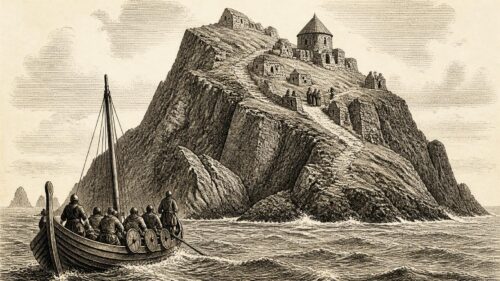
The article’s distinction between Viking and Barbary enslavement, Cromwellian transportation, and hereditary Atlantic chattel slavery shows why coercion cannot be understood through a single label. It also raises the important implication that Ireland’s history includes both victimisation and participation in colonial slaveholding, complicating nationalist interpretations without diminishing suffering. The Baltimore raid offers stark evidence of overseas enslavement, while Caribbean indentures reveal brutality within a legally different framework. How should historians, teachers and public memorials connect these experiences so that audiences understand their shared violence, their differing legal structures, and Ireland’s varied relationships with slavery across medieval and early modern worlds?