

Healthy Authority
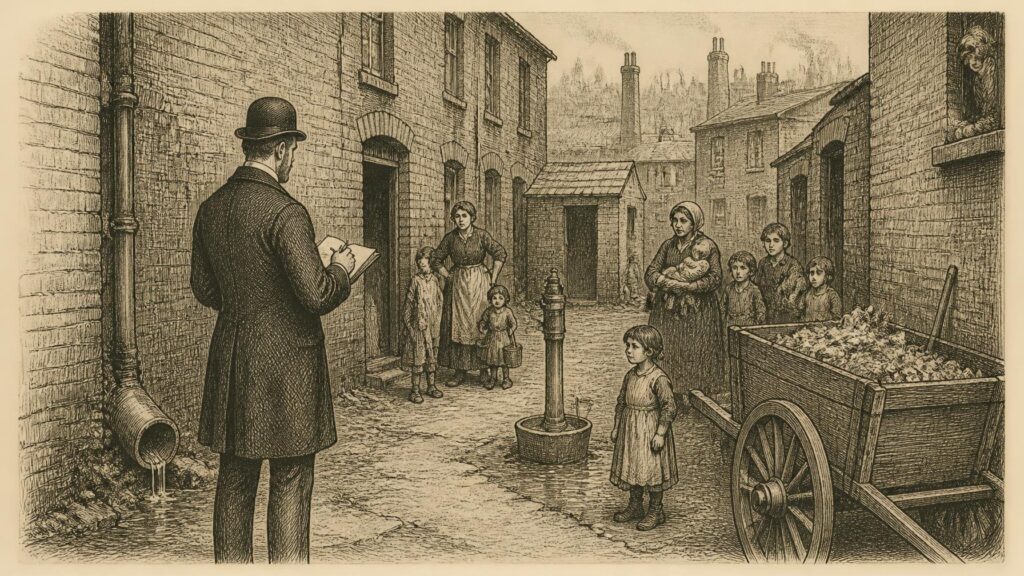
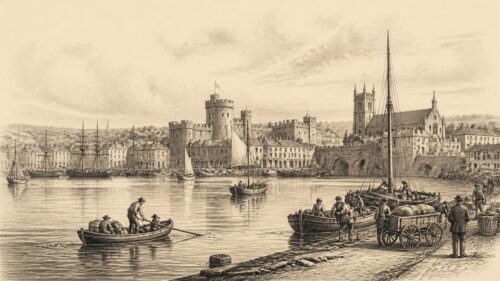
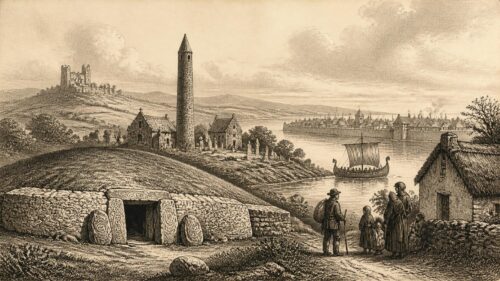
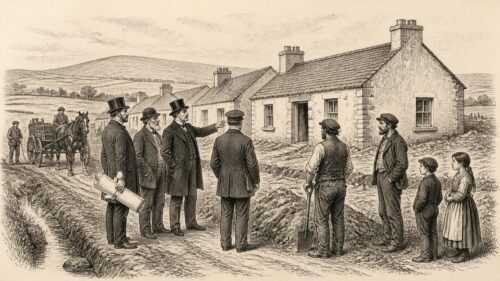
AI generated historical illustration, not a contemporary photograph.
At a Glance
Public health regulation in Ireland was never simply a story of doctors defeating disease. It was a changing apparatus of law, local taxation, inspection, policing, charitable effort and political argument, formed in response to fever, cholera, overcrowded dwellings, contaminated food, tuberculosis and infant death. Its history shows both an expanding recognition that health depended upon shared surroundings and an enduring uncertainty about who should pay, who should be supervised, and how far the state might properly enter private life.
Collective Protection
The phrase “public health” can suggest a settled field of expertise, but its historical meaning was neither fixed nor confined to medicine. In Ireland, as elsewhere, it developed through practical responses to conditions that no household could resolve alone: unsafe water, uncollected refuse, insanitary streets, overcrowded lodging houses, contagious illness, badly regulated food and the absence of decent burial, drainage or housing. Regulation supplied the means by which an authority could define a danger, assign responsibility and, if necessary, compel action.
That did not mean that the state invented concern for health. Families, neighbours, religious congregations, charitable institutions, physicians, surgeons and local patrons all acted before a coherent sanitary administration existed. County infirmaries, dispensaries and fever hospitals provided care or isolation, often through a mixture of private subscriptions and public money. Their reach, however, was uneven. Access depended on geography, local influence, class and, in some cases, the willingness of the sick to enter institutions which could appear frightening, disciplinary or socially discrediting.
The historical importance of regulation lies in its attempt to turn intermittent relief into continuing obligation. A fever hospital could be erected during alarm and allowed to decline when danger appeared to recede. A sanitary authority, by contrast, was expected to maintain streets, inspect premises, receive complaints, issue notices, control nuisances and report on conditions year after year. The difference was substantial, though the ideal was always constrained by money, personnel and local politics.
It is also important not to read later assumptions backwards. Nineteenth-century administrators often worked within miasmatic ideas, believing that foul air arising from decay, dirt and stagnant matter generated disease. Germ theory gradually altered medical explanation, but older sanitary measures did not thereby become pointless. Drainage, clean water, refuse removal, ventilation and less crowded housing could reduce exposure to several dangers even when officials misunderstood the precise biological mechanism. Public health was therefore a field in which useful practice and imperfect theory commonly coexisted.
The Irish story must further be located in constitutional change. Before 1922, much legislation for Ireland was enacted at Westminster and administered through Dublin Castle departments, boards and local bodies. Partition created separate political jurisdictions and, eventually, markedly different systems of health administration north and south. A history of Irish public health regulation must therefore attend to the island-wide institutional inheritance while resisting the temptation to flatten the distinct experiences of the Irish Free State, later Ireland, and Northern Ireland.
Fever Emergency
Long before modern departments of health, epidemic fever made visible the relationship between illness and social conditions. The National Archives records a major epidemic beginning in 1816 and lasting into 1819, amid a period of food scarcity and widespread hardship. Contemporary terminology was broad: “fever” could describe illnesses that later medical classification would separate. Typhus, transmitted by lice, was one principal danger, and it flourished where poverty, crowding and inadequate washing facilities aided infestation. Historians should be careful, however, not to equate every historical reference to fever with one modern diagnosis.
The emergency prompted a more organised response. Fever hospitals were built or expanded, local boards of health operated in various places, and legislation enabled local contributions towards institutions and disease control. The purpose was not merely therapeutic. Separating the ill from the healthy was understood as a means of checking spread. This created an early administrative vocabulary of notification, inspection, temporary accommodation and local responsibility, although the resources available varied radically between prosperous towns and impoverished districts.
Archival material from the Chief Secretary’s Office illustrates the precarious character of this machinery. In the 1820s, officials observed that hospitals opened during the earlier crisis had subsequently closed. When fever returned in Dublin, temporary sheds, extra inspectors and health officers had to be arranged again. The recurrence reveals a persistent difficulty: public health institutions were often easier to mobilise in a crisis than to sustain in ordinary years. There was no inevitable straight line from emergency provision to a stable national service.
Boards of health had powers, but their effectiveness depended upon local cooperation, rates, available buildings and the trust of those expected to comply. Removal to hospital could involve separation from family, loss of income and anxiety about treatment. In an age before antibiotics, institutional isolation did not guarantee recovery. Reluctance to enter hospital should therefore not be dismissed as irrational resistance to scientific progress; it could be an understandable response to material insecurity and to institutions whose standards varied considerably.
The early fever measures nonetheless established a vital precedent. They treated communicable disease as a matter requiring public coordination rather than private charity alone. They also brought medical officers, magistrates, clergy, grand juries and central government into closer contact. This was not yet a democratic public health system. Authority remained strongly shaped by property, denominational influence and elite administration. Yet the principle that disease justified organised intervention had acquired practical force.
Famine Conditions
The Great Famine transformed the scale and urgency of health questions. Starvation, eviction, migration and overcrowding created conditions in which infectious disease spread with terrible ease. It is misleading to treat the catastrophe as a single medical event, because hunger, economic collapse and official relief policy were inseparable from its mortality. Fever, dysentery and other illnesses accompanied nutritional deprivation and displacement. Public health regulation could alleviate some immediate dangers, but it could not substitute for adequate food, secure shelter or political decisions capable of preventing mass destitution.
The Irish Poor Law, introduced in 1838, had already created a nationwide network of unions governed by boards of guardians. Its primary purpose was poor relief, not a comprehensive health service. Workhouses were deliberately designed within a deterrent framework: assistance was to be less attractive than independent labour. Yet the system acquired substantial medical significance. Workhouse infirmaries, dispensary arrangements and fever accommodation became major elements in the institutional landscape. The Famine drove vast numbers towards institutions never designed for such need.
Overcrowding in workhouses and auxiliary buildings exposed the cruel tension between relief and contagion. Institutions intended to shelter the destitute could also concentrate disease. Medical officers and guardians had to decide how to isolate fever patients, procure bedding, manage ventilation, bury the dead and protect staff. The surviving record is evidence of administrative activity, but it is also evidence of systems overwhelmed by human need. Regulations mattered; they did not remove the structural causes of the disaster.
Famine history cautions against a celebratory account of public health. It would be wrong to claim that sanitary administration simply emerged as a benevolent answer to suffering. Officials often interpreted disease through moral judgements about cleanliness, domestic habits and supposed improvidence. Such interpretations could obscure the effects of low wages, insecure tenancies, landlord power and unequal access to land. The language of hygiene occasionally identified genuine hazards, but it could also shift responsibility from political economy to the behaviour of the poor.
At the same time, the crisis strengthened the administrative importance of the Poor Law system. Local bodies increasingly dealt with hospitals, medical relief and sanitary questions as well as destitution. This institutional enlargement would shape later Irish public health. Its inheritance was mixed: a geographically extensive apparatus existed, but it was associated with stigma, coercion and the grim memory of the Famine. Later reformers could use its local framework while attempting, with uneven success, to detach health care from the punitive associations of the workhouse.
Sanitary Reform
The later nineteenth century brought a more systematic sanitary programme. Urban growth, improved statistical reporting, repeated epidemics and changing ideas of disease all encouraged legislation that linked health to the built environment. Reformers stressed water supply, drainage, refuse removal, ventilation, overcrowding, slaughterhouses and the condition of food. The approach was broad because the dangers were broad. It asked local government to treat the street, dwelling, market and burial ground as sites of public responsibility.
The Public Health (Ireland) Act 1878 was the central consolidating measure of this period. It brought together and amended earlier law relating to public health in Ireland, defined urban and rural sanitary authorities, and connected their work to the Local Government Board for Ireland. The statute’s scope was striking. It dealt with nuisances, drainage, water, offensive trades, lodging houses, infectious disease, hospitals, food and other matters which crossed the boundary between domestic life and public administration.
The word “nuisance” was especially important. In ordinary speech it might mean an annoyance. In sanitary law it was a legal category through which an authority could address conditions thought injurious to health: foul drains, accumulated refuse, overcrowded or unventilated rooms, polluted water and certain industrial emissions. The category gave officials a route into private property, but it did not make intervention automatic. Inspectors had to establish facts, serve notices, negotiate with owners, seek compliance and sometimes prosecute. A law on the statute book was not the same as a repaired house or a working sewer.
Sanitary reform was often presented as technical common sense, yet it was unavoidably political. Drainage schemes and waterworks required borrowing and rates. Property owners could resist expenditure or contest notices. Tenants might lack the means to improve a dwelling they did not own. Elected representatives had to balance public demands against ratepayer objections. The strongest local authorities could undertake ambitious works; smaller or poorer areas might struggle to finance even basic improvements. Thus regulation tended to reproduce, though not simply mirror, wider inequalities of wealth and municipal capacity.
The 1878 Act also reflected the administrative faith of its age. It assumed that named authorities, properly defined duties and central oversight could produce healthier environments. That assumption had real consequences. It helped establish routine inspection and records. But the statutory model relied on people: medical officers, sanitary inspectors, clerks, engineers, councillors and magistrates. Their competence, commitment and independence shaped how far the paper system operated in practice.
Local Machinery
The local machinery of public health was built from institutions with older origins. The Poor Law Commissioners had been created after the 1838 Poor Relief Act. In 1872 their successor body, the Local Government Board for Ireland, acquired wider supervisory functions connected with hospitals, disease control, medical services, sanitation and housing. This administrative development is significant because it demonstrates that public health was not a separate, self-contained department. It grew out of poor relief, local government and state supervision.
Under the 1878 framework, urban and rural sanitary authorities carried distinct responsibilities. In towns, municipal bodies or town commissioners might take on the role. In rural districts, boards of guardians often became sanitary authorities. The arrangement offered practical coverage, since guardians already possessed local boundaries, officials and experience of raising rates. Yet it also tied sanitary administration to institutions whose principal reputation was poor relief. In many places, the same local elite who oversaw the workhouse influenced health decisions.
Central supervision could require returns, approve borrowing and issue orders, but it could not inspect every drain or compel civic zeal. The Local Government Board was part regulator, part adviser and part financial gatekeeper. This relationship between central direction and local implementation remained a defining feature of Irish public health administration. Officials in Dublin could formulate policy, but local decisions determined whether a water source was protected, a nuisance abated or a lodging house inspected.
The Local Government (Ireland) Act 1898 altered the civic setting by establishing elected county and district councils, replacing the old grand jury system in many local functions. Its importance for public health was considerable. Sanitary concerns now operated within more representative local government, although franchise restrictions still limited full democratic equality. Councils inherited difficult tasks and unequal resources. They could become arenas where national politics, local rivalries, landlord and tenant interests, and arguments over public expenditure met the daily business of drains, roads and housing.
It would be simplistic to say that elected councils automatically made public health more responsive. Representation could widen debate and scrutiny, but local authorities could also be cautious, partisan or underfunded. Nevertheless, the shift helped make sanitary questions recognisable as civic questions. Clean water and decent streets were not solely charitable improvements bestowed from above. They increasingly became matters about which electors could petition, complain and judge their representatives.
Inspecting Homes
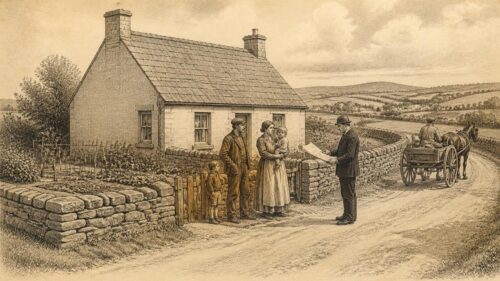
The sanitary inspector was among the most visible figures created by this regulatory order. Inspectors investigated complaints, examined drains and privies, checked refuse arrangements, recorded defects and pursued the abatement of nuisances. Their work lay at the boundary of public authority and ordinary domestic life. They might enter a yard, a lodging house, a workshop, a slaughterhouse or a shop; their reports converted sights and smells into administrative evidence.
Annual reports are especially revealing. They often list defects with a procedural precision: defective roofs, broken rainwater pipes, foul accumulations, blocked drains, damp rooms, unsafe wells, uncleaned yards or sewage entering a cellar. Such documents can seem dry, but their detail preserves a material history of daily life. They show that public health was not only concerned with spectacular epidemics. It was concerned with the repeated, mundane failures of housing and infrastructure which made illness more likely and dignity harder to maintain.
Inspection was neither neutral nor universally welcome. The authority’s gaze fell particularly on poorer housing, lodging houses, street trading and premises associated with low-income work. Some intervention plainly addressed grave risks. Yet inspection also carried moral assumptions about housekeeping, respectability and the management of families. A dirty or overcrowded home could be read as evidence of individual failure when low income, landlord neglect and inadequate municipal services were the deeper causes.
Gender mattered within this process. Women were commonly expected to maintain domestic cleanliness and care for children, despite limited control over wages, water supply, housing quality or the actions of landlords. Health education could provide useful information, but it could also make mothers the principal bearers of responsibility for conditions produced by poverty. The historical record therefore requires a distinction between the value of hygiene advice and the social judgement which sometimes accompanied it.
Enforcement itself had limits. An inspector could identify a problem, but repairs required an owner, money and often legal follow-through. Tenants could fear retaliation or rent increases if they complained. Councils might hesitate to prosecute influential proprietors. In rural areas, dispersed settlement made regular inspection difficult; in cities, the sheer volume of substandard accommodation could exceed available staff. The history of inspection is thus evidence of both growing state capacity and the stubborn persistence of conditions beyond an inspector’s immediate power.
Water Politics
Water was one of the clearest tests of public health regulation. A safe supply required more than a source. It depended on engineering, ownership, distribution, maintenance and protection against contamination. Wells could be vulnerable to nearby drainage; rivers and streams could receive waste; intermittent supply could compel households to store water in unsafe conditions. The law gave sanitary authorities powers relating to water, but large schemes demanded capital investment and long-term administration.
Urban waterworks could transform daily life, yet their benefits were unequally distributed. House connections, charges and the geography of pipes shaped access. A town might possess a municipal supply while poorer households still relied on shared taps or doubtful sources. Rural districts presented different obstacles: dispersed population, difficult terrain and limited rateable resources made networks expensive. The contrast cautions against measuring progress solely by the existence of legislation or a completed civic scheme.
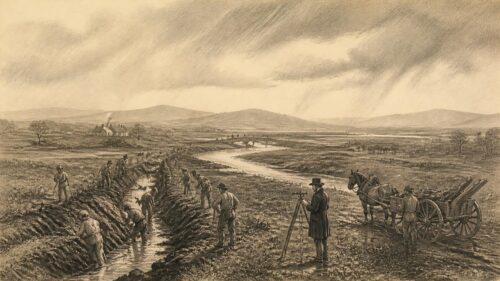
Drainage was linked to water in both engineering and imagination. Reformers feared cesspools, open channels and stagnant waste because they visibly represented decay and, under miasmatic thinking, supposedly poisoned the atmosphere. Even after bacteriology became influential, sewerage remained central to public health policy. Proper removal of waste helped prevent contamination and improved urban conditions, but its construction could be controversial. Borrowing for major works burdened local finances, while construction disrupted streets and private property.
The politics of water also reveals the relationship between collective goods and private property. A local authority might need land, easements or access to construct works. It might impose rates on those who disputed the benefit or affordability of a scheme. Such conflicts were not incidental to sanitary reform; they were its ordinary terrain. The healthier town was an administrative and financial achievement as much as a medical one.
Public debate sometimes simplified this history into a contrast between enlightened engineers and ignorant opponents. The evidence supports a more careful interpretation. Some resistance undoubtedly reflected reluctance to spend money or accept regulation. But ratepayers could also raise legitimate questions about cost, contracts, water quality and local priorities. Public health measures gained durability when authorities could demonstrate competence, fairness and material benefit, rather than relying on legal power alone.
Food Control
Food regulation formed another branch of sanitary authority. Unsound meat, contaminated milk, adulterated goods and unhygienic slaughtering could spread illness or deceive consumers. Nineteenth-century public health law empowered authorities to inspect certain foodstuffs, regulate slaughterhouses and seize products judged unfit for human consumption. Such powers made health protection part of the marketplace.
The practical difficulties were considerable. Assessing whether food was unfit required expertise, and the seller’s loss could be substantial. Inspectors and medical officers had to work within procedural rules so that enforcement would survive challenge. Markets, dairies and slaughterhouses were economically important local institutions, not merely health hazards. Regulation consequently involved negotiation between public safety, trade practices and property rights.
Milk became particularly important in the late nineteenth and early twentieth centuries because of its role in infant feeding. Its quality could be affected by disease in animals, handling, dilution and storage. Yet the burden of unsafe milk was not distributed equally. Better-off households might have more choice and more means to obtain alternatives, while poor families could be dependent on whatever was locally available. Programmes promoting pasteurised milk and infant welfare therefore combined education, charity, municipal action and regulation.
Food control also demonstrates how scientific knowledge gradually entered local administration. Laboratory testing, bacteriology and professional training enhanced the claims of medical officers and analysts. Still, science did not abolish judgement. Officials had to decide where to inspect, which cases to pursue and how to allocate limited resources. The law supplied powers; professional practice gave those powers everyday meaning.
Contagious Control
Communicable disease placed the sharpest pressure on the balance between personal liberty and collective safety. Smallpox, scarlet fever, diphtheria, tuberculosis and venereal diseases each generated different regulatory responses. Some measures centred on isolation, disinfection and hospital treatment. Others concerned vaccination, notification, contact with medical officers or the control of particular groups. The historical record shows that public health powers could protect communities, but also that they could be applied in discriminatory ways.
The Contagious Diseases Acts offer a stark example. Introduced from 1864 and extended through subsequent legislation, they permitted compulsory examination and detention of women suspected of prostitution in designated military districts, including Cork, Cobh and the Curragh. Men who used prostitution were not subject to comparable medical surveillance. The policy was framed as disease control for the armed forces, but its operation embodied a double standard: female bodies were regulated as a source of contagion while male sexual conduct was largely left outside the system.
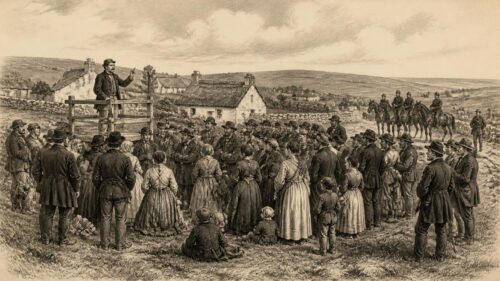
Irish opposition to the Acts formed part of a wider campaign for repeal. Activists challenged the injustice of allowing police suspicion to initiate intimate medical examination and confinement. The controversy is important because it refutes any assumption that public health regulation was always received as disinterested protection. Regulation could be contested on grounds of civil liberty, gender equality and moral authority. The Acts were eventually repealed, but their history remains a warning against granting coercive powers without attention to who bears them and who is exempt.
Tuberculosis posed a different kind of challenge. It was associated with poverty, poor housing, inadequate nutrition and prolonged illness. Sanatoria, dispensaries, health education and housing improvement all featured in responses, but no single measure provided an easy answer. In the early twentieth century, tuberculosis mortality in Ireland remained deeply troubling even as deaths from some other infections declined. The disease exposed the limits of a public health model focused only on visible environmental nuisances.
Vaccination likewise generated complex responses. Public authorities viewed it as a preventive tool against smallpox, while some individuals objected on grounds of safety, conscience, religion or distrust of compulsion. Historical analysis should not casually equate every objection with ignorance. Confidence in a medical intervention depended upon experience, information and relationships with authority. Yet neither should doubt obscure the devastating potential of epidemic disease. Public health history is most useful when it acknowledges this tension without pretending that it has a simple timeless answer.
Maternal Welfare
By the early twentieth century, public health increasingly addressed maternity, infancy and childhood. Concern about infant mortality encouraged milk depots, health visiting, mother and baby clubs, school meals and campaigns on feeding and hygiene. These initiatives reflected genuine alarm at preventable death, but they also extended official and voluntary authority into family life. Mothers, particularly poor mothers, became objects of advice, supervision and sometimes blame.
The Women’s National Health Association, established in 1907 under Lady Aberdeen’s patronage, played a prominent role in health education and anti-tuberculosis work. It promoted hygiene, nutrition and infant welfare, and supported accessible milk provision. Voluntary associations could reach communities in ways formal authorities could not, but their campaigns often reflected middle-class assumptions about domestic management. Advice was most effective when it recognised the practical realities of poverty rather than merely prescribing ideal behaviour.
Birth registration was itself a regulatory tool. Reliable records made population health more visible to authorities and helped identify patterns of infant death and maternal need. Statistics are indispensable to historical understanding, yet they must be read cautiously. Registration practices, diagnostic categories and local reporting quality affect the figures. A rise in recorded cases can sometimes reflect better detection rather than a sudden increase in disease. Numerical evidence is powerful, but not self-interpreting.
School meals and welfare measures also show that health could not be separated from income. Better nutrition increased resistance to disease and improved recovery, while cash resources shaped what families could buy, heat and wear. This insight was available to contemporaries as well as later historians. Public health advocates might speak of cleanliness and education, but many recognised that instruction could achieve little where families lacked food, fuel or secure accommodation.
In these developments, the boundary between welfare and public health became increasingly porous. Protecting children involved clinics and nurses, but also wages, social insurance, housing and food. The broadening of public health created new possibilities for preventive care; it also raised enduring questions about whether services should be universal, means-tested, voluntary or compulsory.
Partitioned Services
The revolutionary years and partition altered the administrative map without erasing the older sanitary inheritance. Northern Ireland, established in 1921, developed within the United Kingdom’s legislative and governmental framework. The Irish Free State inherited institutions and laws shaped by the pre-partition system, then adapted them to a new state. It is therefore inaccurate to speak of one uninterrupted post-1922 Irish public health regime.
In the south, the Department of Local Government and Public Health was created in 1924. The combined title itself is revealing. Health remained closely connected to local administration, housing, sanitation and public assistance rather than being conceived purely as hospital medicine. County and city structures carried much of the practical responsibility, while central government retained oversight and policy influence.
The interwar decades brought improvement in some indicators and services, but progress remained uneven. Urban and rural conditions differed; tuberculosis continued to cause serious concern; and access to reliable water, sanitary facilities and professional care was far from universal. Economic constraints were severe. State-building did not instantly produce the resources required to replace old infrastructure or provide comprehensive services.
In Northern Ireland, health administration followed a different trajectory, particularly after the creation of the National Health Service in 1948. Its development cannot simply be incorporated into a narrative of the Republic’s later health legislation. Nonetheless, shared historical conditions remained visible: poverty, housing, infectious disease, municipal responsibility and the legacy of nineteenth-century sanitary governance shaped policy in both jurisdictions.
Partition also complicates the use of statistics. All-island comparisons may conceal distinct laws, funding systems and administrative definitions after 1921. Conversely, exclusive focus on the border can obscure older networks of professional training, voluntary organisations and medical knowledge which had operated across the island. The historian’s task is to recognise both continuity and divergence.
Health Reorganisation
The Health Act 1947 marked a major reorganisation in the Republic of Ireland. It was enacted to make further and better provision for the health of the people, and it brought a broad range of functions within a revised legislative framework. Its contents encompassed health institutions, infectious disease, maternity and child welfare, food, health officers, enforcement powers, health education and other matters. The scope reflected the accumulated lesson that health administration could not be reduced to hospital treatment.
The Act must not be treated as a sudden creation from nothing. It built upon earlier local government, sanitary and poor-law structures, while seeking to rationalise and modernise them. It also reflected postwar expectations that the state should accept greater responsibility for social welfare and health. In 1947 the old Department of Local Government and Public Health was divided, creating a separate Department of Health. The institutional separation signalled a growing recognition of health as a major field of government in its own right.
Implementation was shaped by dispute as well as aspiration. Ireland’s proposed Mother and Child Scheme became one of the most famous conflicts in the history of Irish health policy. Arguments involved cost, professional interests, church authority, ministerial responsibility and competing understandings of entitlement. The controversy demonstrates that public health reform was not simply a technical matter for experts. It touched deeply held beliefs about family, morality, religion and the proper reach of the state.
The postwar period also exposed the continuing importance of basic infrastructure. Many rural households lacked piped water, fixed baths and modern sanitation well into the mid twentieth century. Such conditions remind us that legislation and departmental reorganisation did not immediately alter domestic reality. Public health depended on capital works, labour, local cooperation and long-term investment as much as on parliamentary enactment.
Over time, health services expanded through further legislation and administrative change. Yet the older sanitary tradition endured in food safety, environmental health, inspection, infectious-disease powers and the continuing role of local and central authorities. The history of regulation is therefore not superseded by the history of modern healthcare. It remains one of its foundations.
Democratic Limits
Public health regulation carries a democratic paradox. It is often most necessary when individual action cannot protect everyone: one household’s contaminated drainage can affect neighbours; an unreported infectious disease can spread beyond the sufferer; a landlord’s neglect can endanger tenants who lack power to repair their homes. Collective authority is therefore not an intrusion added to an otherwise private world. In many circumstances, it is the means by which ordinary people gain protection against hazards they cannot control alone.
But authority can be misused. The historical examples of gendered disease control, coercive institutional practices and intrusive inspection show why powers must be bounded, transparent and accountable. A policy described as protective can concentrate surveillance on poor people, women, migrants or other marginalised groups. Historical evidence does not support either an anti-regulatory romanticism or an uncritical faith in expertise. It supports scrutiny of purpose, evidence, proportionality and distribution of burdens.
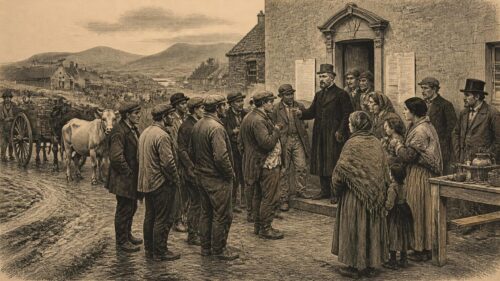
Folklore and retrospective anecdote also need careful handling. Communities often preserve powerful memories of fever carts, harsh workhouse rules, compulsory removal and unsympathetic officials. Such memories can illuminate experience and distrust, but they do not always establish exact dates, procedures or universal practice. Conversely, an official report may document a policy without revealing how it felt to the people subjected to it. A sound historical account places archival record, legislation, professional writing and remembered experience in conversation rather than allowing any one form of evidence to speak for all.
The central achievement of Irish public health regulation was not the complete conquest of disease; no such achievement occurred. It was the gradual establishment of a public principle: health is shaped by social and environmental conditions, and authorities have duties in relation to those conditions. The failures are equally instructive. Poverty could frustrate hygiene; local weakness could hollow out statutory powers; coercion could injure those whom policy claimed to protect.
That inheritance remains historically significant. Irish public health developed through crises, contested institutions and practical work carried out in streets, homes, hospitals and council offices. Its laws were instruments, not guarantees. Their value depended upon evidence, resources, fair enforcement and the willingness to understand illness not as an isolated private misfortune, but as part of the shared life of a community.
The article highlights a persistent tension: sanitary inspection identified real dangers in damp housing, polluted water and overcrowding, yet enforcement could place responsibility upon tenants and mothers who lacked power over rents, repairs or municipal infrastructure. This complicates any simple view of regulation as either protection or intrusion. It also raises questions about whether local authorities’ varying resources shaped whose health received attention, particularly before and after partition. How might inspection reports, council records and personal testimony help us assess whether Irish public health regulation reduced inequalities, merely managed their consequences, or sometimes deepened divisions across urban and rural communities?