Étgal and Comgall’s Shrine824 CE
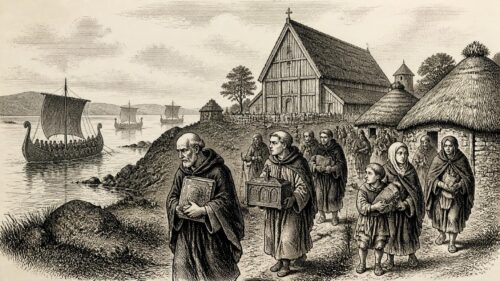
In 824 Scandinavian raiders attacked two Irish religious communities, Bangor in Ulaid and Sceilig off Kerry. At Bangor, they plundered the monastery, destroyed an oratory and violently disturbed the shrine and relics of its founder, Comgall, damaging a centre of dynastic and ecclesiastical prestige. At remote Sceilig, Étgal was captured and died of hunger and thirst, providing a rare named victim. Annalistic dating confirms both incidents despite manuscript chronological complications. The raids demonstrate mobile maritime danger across northern Irish Sea and Atlantic routes, not a unified campaign or permanent settlement. They marked early Viking-age insecurity; permanent Scandinavian bases came later.
Dateline
The evidence securely assigned to 824 CE is brief but unusually vivid. Irish annals record attacks by gentiles—the term then used for Scandinavian raiders—at two far-separated religious communities: Bangor, on the shores of Belfast Lough in the north-east, and Sceilig, now Skellig Michael, off the Iveragh Peninsula in the south-west. At Bangor, an oratory was wrecked and the relics of its founder, Comgall, were shaken from their shrine. At Skellig, a man named Étgal was taken captive and soon died of hunger and thirst. Neither notice supplies a month, a raiding leader, a ship-count or a battle narrative. Their force lies in their economy: in 824, violence at the sea’s edge reached both a powerful mainland monastery and one of Ireland’s most isolated religious retreats.
A small warning about dates is needed. In the modern edition of the Annals of Ulster, the entries conventionally cited as AU 824 appear under an annal headed “AD 824”, although the manuscript’s annal number is U825. This reflects the well-known chronological complexities of the Irish annals rather than uncertainty that the incidents belong in the calendar year 824. The Annals of Inisfallen, a separate annalistic tradition, also places both the Bangor and Skellig notices in 824. What follows therefore treats them as firmly dated events, while keeping later consequences and broader setting clearly separate.
Bangor’s Violated Shrine
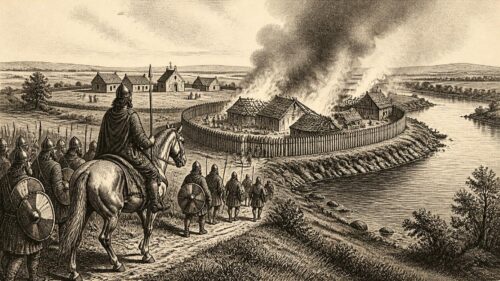
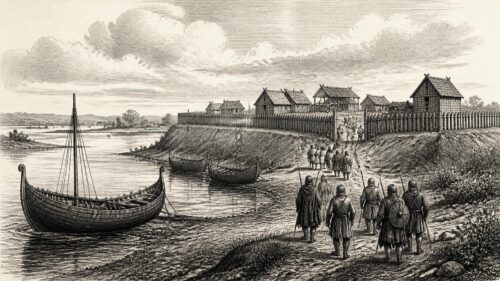
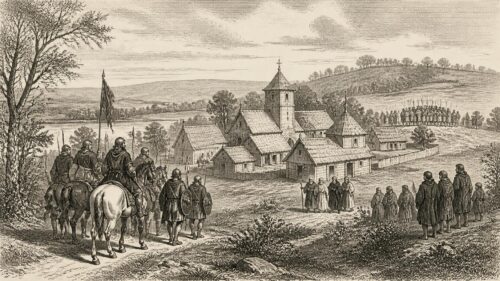
The northern attack was directed at Bennchor or Bangor, in the Ards area of Ulaid. The Annals of Ulster call it a plundering and add exceptional detail: its derthach, an oratory or church building, was torn apart, and the relics of Comgall were shaken out of their shrine. The wording does not prove that the relic-container itself was carried away, melted down or destroyed; it does prove a physical violation of the saint’s memorial and of the building which housed it. The Annals of Inisfallen additionally record raids on both Bangor and Mag Bile, the ecclesiastical centre known today as Movilla. That pairing suggests that raiders were active in the same north-eastern coastal zone, though it does not establish whether the assaults occurred on one day or in a single expedition.
Comgall, Bangor’s sixth-century founder, had long been central to the community’s prestige and identity. His relics were not merely objects of devotion. They asserted continuity with the founder, helped define the community’s rights and standing, and embodied the protection expected from a powerful saint. The annalist’s decision to preserve a short verse placed in Comgall’s voice makes the episode still more revealing. The poem foretells that his bones would be carried from warlike Bangor to Oentrub. It may preserve an older tradition, or it may be a literary framing added to make sense of disaster; it cannot be treated as a contemporary prophecy. But its inclusion shows how a ninth-century community could understand raid, damaged sanctuary and displaced relics within a sacred history rather than as simple loss.
Bangor was not an isolated hermitage. It was a major church of Dál Fiatach, the dominant dynasty in much of eastern Ulaid, and lay beside sheltered waters opening into the Irish Sea. Its ecclesiastical resources—land, livestock, food stores, metalwork, manuscripts, portable shrine furnishings and people who might be captured—made it valuable. Its political connections made an assault upon it an affront to local power as well as to religion. Nevertheless, the record does not state that the raiders intended to attack Dál Fiatach or that its king met them in battle in 824. That political interpretation is plausible context, not a firmly reported event.
A Second Blow in the Same Region
The destruction at Bangor came after an invasion there in 823, when another annal says that Comgall’s shrine was broken and the community’s learned men and bishops were put under the sword. The two notices should not be casually collapsed into one episode. They attest two successive years of violence, with different emphases: invasion in 823, plundering and the scattering of relics in 824. Nor should the 824 attack be treated as the opening of a permanent Scandinavian settlement at Bangor. The annals provide no longphort, garrison or winter camp for that year. They do, however, show that attackers returned to a known, high-value place.
The following year provides the immediate regional context, but must not be pulled backwards into 824. In 825 the annals record further attacks on Dún Lethglaise, modern Downpatrick, and Mag Bile, while the Ulaid inflicted a rout on raiders in Mag Inis. This sequence makes 824 part of a concentrated crisis in Dál Fiatach territory, not an isolated incident. Yet the victorious response belongs to 825, not to the year under review. For people at Bangor in 824, the more immediate reality was insecurity: a coastal monastery had already been struck once, struck again, and had seen the material focus of Comgall’s cult violently disturbed.
Étgal of Sceilig
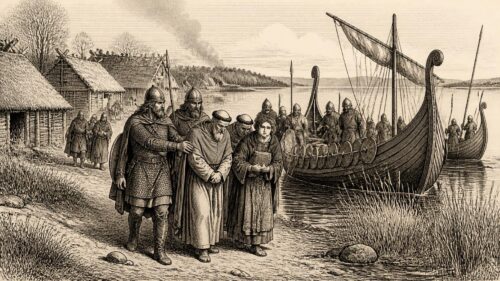
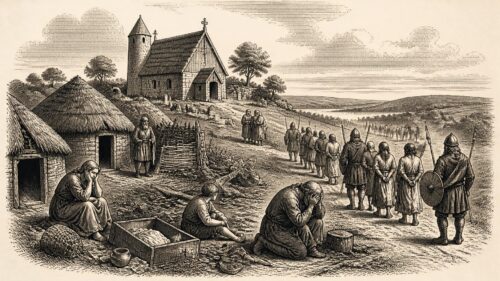
On the opposite side of the island, the annals offer a starkly personal record. Sceilig was raided, Étgal was carried off as booty or captive, and he died from hunger and thirst. The Annals of Ulster call him simply “Étgal of Sceilig”; the Annals of Inisfallen makes explicit that he was taken into captivity. The sources do not say whether he was abbot, monk, hermit, servant or visitor, nor do they describe the voyage, place of detention or exact circumstances of his death. To supply these missing details would be invention. His named death nonetheless gives rare human scale to the early raiding record, whose victims are more often anonymous communities or unnumbered captives.
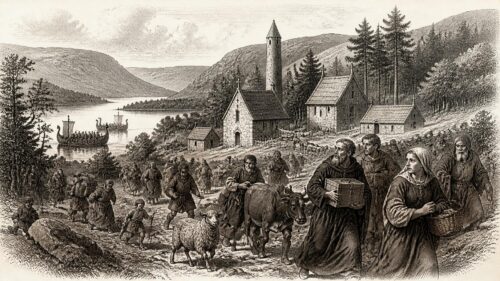
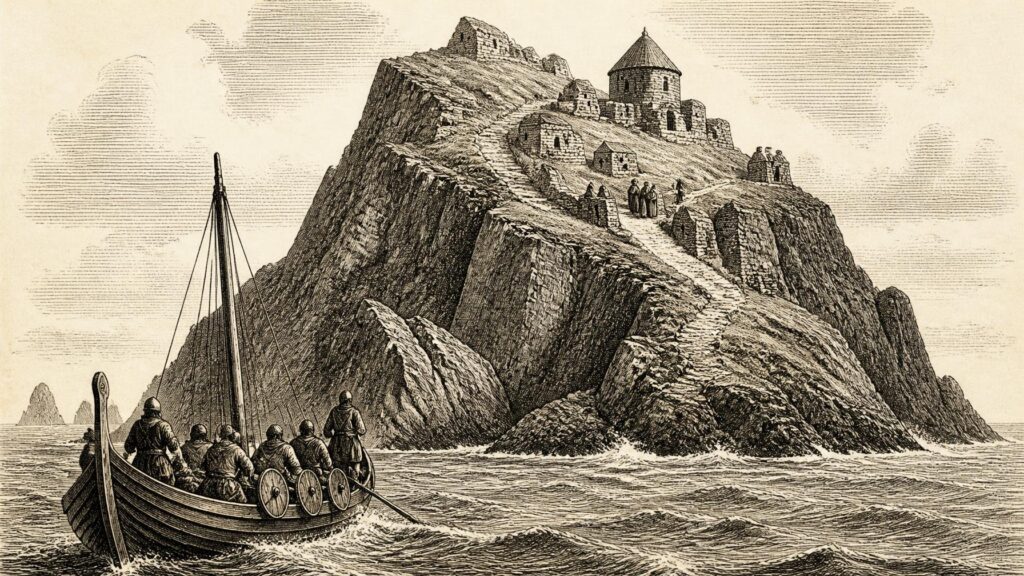
The choice of Sceilig is striking. The monastic site occupied a steep Atlantic rock roughly twelve kilometres from the Kerry coast, accessible only by sea and then by strenuous ascent. Archaeology and the surviving fabric demonstrate an early medieval religious settlement of stone cells, oratories, terraces and water-management features. Its remoteness served ascetic ideals: separation from ordinary society, prayer and disciplined communal life. It did not make the place unreachable. A raiding crew capable of navigating the south-western coast, landing in difficult conditions and climbing to the enclosure could reach a community with stores, vessels, religious valuables and captives, even if its wealth was modest beside that of a great inland monastery.
Modern Skellig Michael is named for St Michael, but that dedication is not documented until the tenth century. For 824, “Sceilig” is the safer historical name. Nor is there warrant for imagining the familiar later stone church in the scene of Étgal’s capture: parts of the present architectural complex developed over centuries. What can responsibly be pictured is a severe early medieval island monastery, its residents dependent on carefully conserved water, small cultivated plots, fishing and supply links with the mainland. A raid disrupted all of those fragile arrangements at once.
Seaways, Not a Single Front
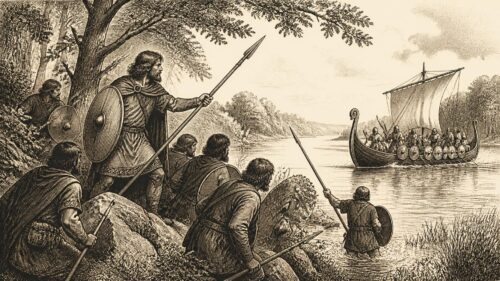
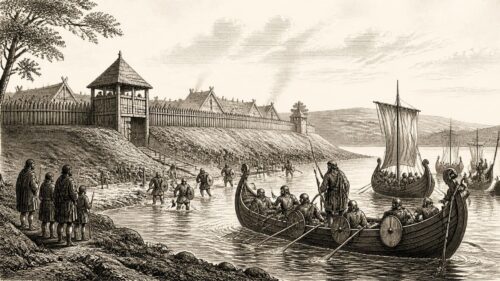
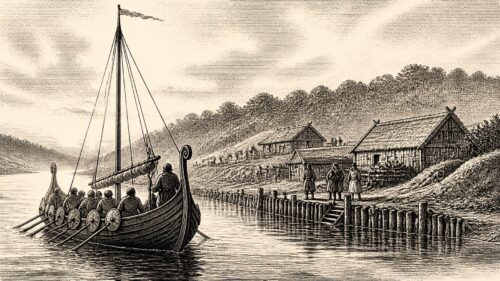
The two attacks reveal the geography of early Viking-age Ireland better than they reveal the raiders’ identities. Bangor faced the northern Irish Sea routes; Sceilig lay on the Atlantic approaches of the south-west. In 824 there was no Scandinavian town at Dublin, no established kingdom of the foreigners in Ireland, and no evidence that one unified force struck both sites. The annals instead point to mobile maritime raiding, in which coasts, islands and sea-loughs formed corridors as much as barriers. Earlier attacks had already tested Irish shores; the renewed raids of the early 820s were becoming more frequent and better able to threaten prominent religious centres.
This was not simply a story of passive churches and unstoppable outsiders. Irish political society was made up of many competing kingships, lordships and church federations, while the kingship of Tara was held in 824 by Conchobar mac Donnchada of Clann Cholmáin. His position did not amount to a modern central government with a national navy or permanent army. Defence depended upon regional rulers and local mobilisation. The 825 rout in Mag Inis demonstrates that the Ulaid could fight raiders successfully; it cannot tell us that they had been able to protect every landing place the year before.
For most households, 824 cannot be reconstructed day by day. The annals do not describe harvests, prices, weather, marriage, craftwork or local disputes for this year. But the attacks illuminate conditions that touched ordinary life. Monasteries were not sealed-off religious islands: they were employers, landholders, centres of hospitality and literacy, patrons of artisans, and places where nearby people sought worship, legal protection and exchange. Damage to an oratory, loss of treasured objects and the seizure of a resident therefore affected more than a small clerical elite. The record is too thin to calculate that impact, but it is sufficient to recognise the shock.
What 824 Changed—and What It Did Not
It would be misleading to make 824 the decisive beginning of the Viking Age in Ireland. Raids had been recorded since the late eighth century, and permanent Scandinavian bases emerged only later, especially in the 840s. It would be equally misleading to minimise the year as one more entry in a long list. Bangor’s desecrated shrine and Étgal’s death show an escalation in the emotional and institutional stakes of raiding. A founder’s relics could be scattered; even a retreat chosen for its distance from worldly life could be penetrated; captivity could end in death.
Thus 824 is best understood as a sharply documented year of exposure. Its two securely dated incidents join northern Ulaid and the south-western seaboard in the same developing maritime danger, while preserving their differences: one was an attack on a renowned dynastic church and its saint’s cult; the other a raid upon a rocky ascetic settlement, remembered through the fate of one captive. The surviving annals do not allow a fuller chronicle. They do allow that much, and it is more than enough to show why this year mattered.
Primary Sources
- The Annals of Ulster, Year U825 (AD 824)
- The Annals of Ulster: TEI Header and Editorial Information
- Annals of Inisfallen
- Annals of the Kingdom of Ireland by the Four Masters, Volume 1, English Translation
- Vikings in Irish Chronicles, 794–902: Data
- The Vikings in Ninth-Century Ireland: Sources and Settlements
- The Vikings in Ulaid
- Vikings in Ireland and Scotland
- Sceilg Mhichíl
- Skellig Michael: World Heritage List Nomination Documentation
- Sceilg Mhichíl UNESCO World Heritage Property
- National Monuments in State Care: Kerry
- Skellig Michael (Inner Enclosure), Great Skellig: Excavation Report
- Bangor: Excavation Report 2011
- The Forgotten Hermitage of Skellig Michael
- Impacts of Climate Change on Coastal Archaeological Sites in County Kerry, Ireland
- The Economy of Early Medieval Ireland
- Conchobar
- Conchobar mac Donnchada (d. 833), High-King of Ireland
- The Chronology and Sources of the Early Irish Annals
- The Dating of the Irish Annals
- Notes on Terminology in the Annals of Ulster, 650–1050