

Signed Citizenship
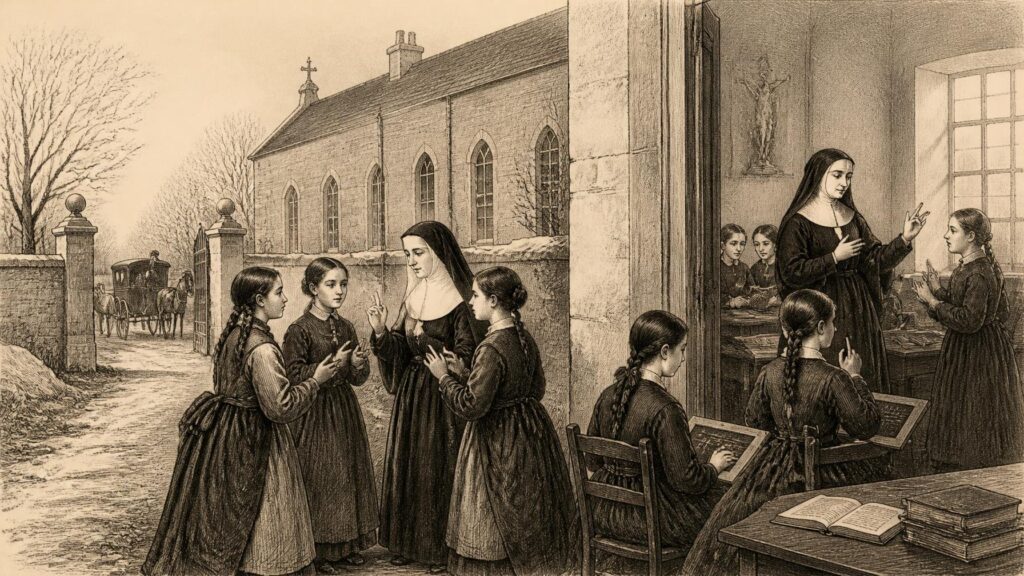
AI generated historical illustration, not a contemporary photograph.
At a Glance
Irish Sign Language rights belong to the history of modern Ireland not as a narrow specialist question, but as a record of language, education, citizenship and organised political action. The Irish Sign Language Act 2017 was a landmark achieved after generations in which Deaf people created communities, sustained a language, challenged assumptions about disability and pressed the State to recognise that access to public life cannot depend upon hearing.
Language Emerges
Irish Sign Language, commonly abbreviated to ISL, is the indigenous sign language of the Deaf community in Ireland. That description requires some care. It does not mean that every deaf or hard of hearing person uses ISL, nor that hearing people cannot become fluent users. It does mean that ISL is a natural language with its own grammar, vocabulary, history and community of users, rather than a collection of gestures representing spoken English or Irish word for word. This distinction lay at the heart of the campaign for rights. For much of the nineteenth and twentieth centuries, public policy and professional practice commonly treated deafness chiefly as an individual medical or educational problem. Deaf advocates increasingly insisted on another account: that a linguistic minority had been denied full access to institutions organised around sound.
There were undoubtedly signed means of communication in Ireland long before formal Deaf education. The historical evidence does not permit a neat origin story, and claims that a single date marks the birth of ISL should be treated cautiously. Families, neighbours, religious communities and deaf people themselves will have devised ways of communicating across generations. What can be documented more clearly is the decisive importance of nineteenth-century schools. They brought deaf pupils together in sustained numbers, created enduring peer networks and provided settings in which signing could be transmitted, reshaped and carried into adult community life.
That history also complicates any simple nationalist tale. Ireland was then within the United Kingdom, and different schools had different religious affiliations, teaching traditions and international connections. The early Protestant institution at Claremont in Glasnevin was associated with British educational influences. Catholic organisers and teachers, meanwhile, drew important inspiration from France. The later language did not descend mechanically from one foreign source. Languages develop through users, contact and local experience. Yet the schools’ different pathways help explain why Irish signing developed in a distinctive way and why Deaf people came to regard it as a central element of collective identity.
Modern accounts often use the word “indigenous” for ISL. In the statutory context, this is a recognition of its deep rootedness in Deaf life in Ireland, not a claim that its development occurred outside historical exchange. The Irish Sign Language Act 2017 recognises the right of ISL users to use, develop and preserve the language. Its wording matters because it rejects the older implication that sign was merely a temporary substitute for speech. A language can be learned, interpreted, studied and used in public administration; it can also be the medium through which people build family, friendship, faith, humour, argument and political organisation.
School Foundations
Formal deaf education in Ireland began in the early nineteenth century. In 1816 Dr Charles Orpen established the Claremont Institution for the Deaf and Dumb in Glasnevin, Dublin. The terminology is now obsolete and offensive, but it appears in contemporary institutional titles and documents and therefore remains part of the historical record. Claremont was a significant initiative at a time when many deaf children received little formal education. Its educational methods were linked to traditions then current in Britain, involving signs and forms of signed English as well as efforts directed towards written and spoken language.
Schooling was never simply educational. In nineteenth-century Ireland, religion, philanthropy and denominational identity powerfully shaped the institutions available to children. The fact that Claremont was Protestant gave particular urgency to Catholic efforts to establish schools for Catholic deaf pupils. A Catholic school opened in Cork in 1822 but did not survive financially. In 1845 the Catholic Institute for the Deaf was established, and in 1846 it secured the involvement of the Dominican Sisters at Cabra, Dublin, in founding St Mary’s School for Deaf Girls. The school was residential, a fact that would have far-reaching consequences for the formation of a shared language and social world.
The Dominican connection with Caen in Normandy is especially important. Two sisters travelled there to learn a method associated with French Deaf education, in which signing had a substantial place. Historians should not turn that episode into a claim that ISL was simply French Sign Language transplanted to Dublin. It is better understood as one influential channel through which teaching practices and signs travelled. Deaf pupils brought their own communication, acquired signs from one another and took them beyond school. The language that matured in Ireland was made in interaction, not delivered ready-made by a single educator or religious order.
Provision for boys followed. St Joseph’s School for Deaf Boys became established in Cabra under the Christian Brothers during the 1850s. By the later nineteenth century, the Cabra institutions had become exceptionally important in the national geography of Deaf life. Children from across the island could be sent to Dublin, often far from their families. Residential schooling imposed separation and discipline, and its history cannot be reduced to benevolence. Yet it also placed deaf children among peers who could communicate directly with them. For many, that was where a strong sense of belonging began.
The historical sources reveal a tension that remains essential to a rights-based reading of the period. Religious orders and charitable bodies provided opportunities in circumstances where the State did little. Their work gave some deaf children education, care and access to signing. At the same time, provision depended on denominational institutions, voluntary fundraising and the assumptions of those who governed schools. Deaf children were not recognised as rights holders entitled to a fully accessible education from the State. They were usually regarded as recipients of charitable or specialised provision. The later campaign for ISL rights grew partly from resistance to that unequal position.
Cabra Variants
One of the most striking features of Irish Sign Language history is the existence of gendered variants linked to the segregated schools at Cabra. Boys educated at St Joseph’s and girls educated at St Mary’s developed and maintained somewhat different vocabularies and signing practices. Researchers and community historians have described these as male and female variants of Cabra Sign, important ancestors of contemporary ISL. Their history is a reminder that languages are shaped not only by nations and states but by the social arrangements of daily life: who lives together, who studies together, who may meet and who is separated.
It would be misleading to portray the variants as two wholly separate languages. Nor should the subject be romanticised into a claim that every sign was divided by gender. The evidence supports a more measured interpretation. Separate residential education over many decades created conditions in which distinct signs and lexical preferences could develop. When former pupils met in adult organisations, workplaces, families and wider Deaf networks, their signing came into contact. As social boundaries altered and education became less segregated, many differences diminished, though the memory of them remained a valued part of community heritage.
Gender segregation had other implications. It reflected the religious and social norms of nineteenth-century Ireland, in which education, morality and domestic expectations were heavily gendered. Deaf girls and boys were not simply being taught a language; they were being prepared for different roles as those roles were understood by their institutions. The historical experience of Deaf women consequently deserves attention in its own right. Research on Catholic girls’ schools has shown that sisters who had initially little specialised knowledge attempted to teach literacy and religious instruction through signing. Their efforts created educational openings, even within a system that placed considerable authority in the hands of hearing religious and male clerical organisers.
The variants also show why the word “Irish” in Irish Sign Language should not be assumed to mean that the language maps neatly onto spoken Irish. ISL developed in a multilingual society in which English, Irish, French influences, British educational methods and local social networks all mattered. It is not signed Irish, and it is not British Sign Language. Like other natural sign languages, it has its own structure. Recognition of that fact was a major intellectual and political achievement, because earlier policies frequently judged signing only by how closely it appeared to reproduce speech.
Community memory can preserve truths that official records overlook, but it must still be handled critically. Recollections of school signs, famous teachers and lost practices are invaluable evidence of lived experience. They are not automatically precise chronologies. The most responsible history sets memories alongside institutional records, linguistic research and oral testimony. Doing so allows the Cabra story to be appreciated both as an account of linguistic creativity and as an account of segregation, institutional control and the resourcefulness of children and adults who made community under constrained conditions.
Oralist Ascendancy
During the late nineteenth and twentieth centuries, oralism gained increasing influence in Deaf education internationally. Oralism prioritised speech training, lip-reading and the use of residual hearing, often treating signing as an obstacle to integration into hearing society. Its advocates believed that deaf children would fare better if they could speak and understand spoken language. Some pupils and families did value speech, lip-reading, hearing technology or combinations of communication methods. The historical problem was not that speech was taught. It was that oralist systems could make speech the measure of educational worth and restrict children’s access to the language most fully available to them.
In Ireland, the effects of oralism were felt particularly strongly in the schools that had earlier helped to consolidate signing communities. Accounts of Deaf education indicate that the Cabra schools moved towards oral approaches in the mid twentieth century. Signing did not disappear from Deaf life; pupils continued to sign with one another, in dormitories, playgrounds, homes and later adult gatherings. But where signing was discouraged or excluded from classroom teaching, access to curriculum and discussion could be curtailed. A pupil may learn to reproduce words without receiving the full language access needed to understand complex ideas, participate freely or develop literacy on equal terms.
The history ought not to be flattened into a morality play in which every educator acted with hostility and every oral method was identical. Teachers worked within the theories, training and resources of their period, and many believed they were expanding opportunities. Nevertheless, the structural result was clear enough: the authority to decide how deaf children should communicate usually rested with hearing institutions rather than with Deaf adults or children themselves. The language of “integration” often meant adapting the child to a hearing norm instead of adapting schools and public life to linguistic diversity.
For later activists, oralism was not merely an old educational technique. It stood for a wider experience of linguistic exclusion. People recalled punishment or shame associated with signing, a shortage of fluent sign-language teachers, and classrooms in which learning was mediated through methods they could not fully access. Individual recollections differ, and historians should avoid treating any single testimony as universal. Taken together, however, they help explain the strength of the demand for bilingual education and for Deaf people’s participation in decisions about deaf children.
The consequences were not confined to schools. Educational disadvantage could affect employment, confidence in dealings with state agencies and the ability to participate in civic life. In this context, sign language was not a cultural ornament added after essential services had been delivered. It was a condition of access to those services. The later rights campaign transformed that insight into a public claim: equality required interpretation, accessible information, education through ISL and recognition of Deaf people as citizens capable of speaking for themselves.
Community Institutions
Despite educational restrictions, Deaf people created and sustained a dense associational life. Clubs, sports organisations, social events, religious networks and advocacy bodies supplied spaces in which ISL could flourish. Such institutions were important because they countered isolation. A deaf child might be the only deaf member of a hearing family or the only signing person in a workplace. In a Deaf club or gathering, communication could be immediate, unmediated and socially ordinary. These settings also transmitted news, humour, courtship practices, political ideas and knowledge of services.
Community institutions should be understood as part of Ireland’s civil society. They were not simply leisure outlets for a marginal group. They trained organisers, produced leaders and built the trust needed for collective action. The Irish Deaf Society, established in 1981 by Deaf people concerned with equality, became especially significant in campaigning for recognition and access. Its work placed Deaf perspectives in public debate at a time when disability policy was beginning, though slowly, to move away from institutional and charitable models towards rights and participation.
The cultural dimension was equally important. A Deaf community is not defined solely by audiological categories. Some people who are medically deaf do not identify with Deaf culture or use sign language; some hearing children of Deaf adults and interpreters have close linguistic and cultural connections to it. The capitalised term “Deaf” is often used to indicate this cultural and linguistic sense, while “deaf” may refer more broadly to hearing status. Usage varies among individuals, and respectful history should not impose identity labels on people who did not choose them. Yet the distinction helps explain why recognition of ISL could be experienced as recognition of a community rather than merely an accessibility measure.
Deaf heritage work has played an important role in recovering a past that formal national narratives frequently ignored. School records, photographs, artefacts, newsletters and personal testimony preserve the history of institutions and community activism. Their survival is not accidental. Archives require people to collect, interpret and defend them. In the Irish case, Deaf historians, community archivists and researchers have made it possible to see that sign language users were not passive subjects of policy. They formed organisations, created social worlds and contested the terms under which others described them.
This is also the proper setting for folklore. Stories circulate in many Deaf communities about ingenious communication, forbidden signing, school escapes and encounters with unsympathetic officials. Such stories can convey shared emotional truths and values. They should not be presented as verified events without corroboration. A historical article can honour folklore by identifying it as community memory, while basing specific claims about legislation, schools and policy on documentary evidence. That distinction strengthens rather than weakens the record of Deaf experience.
Political Campaign
By the late twentieth century, international developments supplied new language for Irish claims. Deaf organisations elsewhere had pressed for official recognition of national sign languages, interpreter provision and bilingual education. Disability rights movements challenged paternalistic assumptions and argued that barriers in the built environment, communications and institutions produce exclusion. The United Nations Convention on the Rights of Persons with Disabilities later reinforced these principles by addressing accessibility, participation, education and the recognition and promotion of sign languages. Ireland ratified the Convention in 2018, after the ISL Act had passed, but the wider international rights climate shaped domestic debate before then.
The campaign for ISL recognition was not a sudden response to one parliamentary opportunity. Research based on interviews with activists traces a movement extending from 1980 to 2017. Its participants had to persuade politicians and civil servants that ISL was not an informal aid, that Deaf people were not adequately served by general disability measures, and that recognition had practical consequences. Campaigners worked through meetings, demonstrations, submissions, local government motions, media engagement and direct contact with representatives. They also drew on the lived evidence of people unable to obtain interpreters for essential appointments, education or legal proceedings.
The choice of language in the campaign mattered. Some public discussion asked whether ISL should become an “official language”, sometimes describing it as a possible third official language of the State. Constitutional language in Ireland is highly specific: Article 8 names Irish as the national and first official language and recognises English as a second official language. The ISL campaign raised genuine constitutional questions, but its central legal objective was not ultimately achieved through a constitutional amendment. The 2017 Act gave statutory recognition and particular rights and duties. It did not make ISL a third official language in the constitutional sense.
This distinction does not diminish the Act. On the contrary, it permits a more exact assessment of what was won. Statutory recognition could be tied to services, education, courts, broadcasting and public bodies. It could create enforceable directions for government action more quickly than a constitutional referendum. At the same time, campaigners and commentators have continued to note the difference between recognition in principle and a fully realised right to communicate with the State through ISL in every setting. The history of rights is often a history of that gap.
Political support broadened during the 2010s. The Oireachtas Joint Committee on Justice and Equality examined formal recognition in 2016 and set out the international context, constitutional issues and policy options. Senator Mark Daly introduced the Recognition of Irish Sign Language for the Deaf Community Bill in the Seanad. The Bill developed through parliamentary scrutiny and government engagement. Its journey demonstrates a characteristic feature of successful social movements: pressure from outside institutions was combined with careful legislative work inside them.
Legislative Recognition
The Irish Sign Language Act 2017 completed its passage through the Oireachtas in December 2017 and was signed into law on 24 December. Its title was shortened during the parliamentary process from the Recognition of Irish Sign Language for the Deaf Community Bill to the Irish Sign Language Act 2017. The title change may appear minor, but it marked a move towards a clearer public identity for the legislation. More importantly, the Act was the first Irish statute devoted to recognising ISL and setting out related duties.
Section 3 is the symbolic core. It recognises the right of ISL users to use ISL as their native language, to develop it, to preserve it and to use it in dealings with public bodies. The text deliberately speaks of users’ rights, not merely the State’s approval of a language. In historical terms, this was a reversal of the older pattern in which schools and authorities decided whether sign should be tolerated. The State now acknowledged that sign-language users had a legitimate claim to conduct public life through their own language.
Recognition was accompanied by provisions covering legal proceedings, education, public services, interpreting, broadcasting, events and reporting on the operation of the legislation. Such breadth reflected the campaign’s argument that language rights are indivisible. A child who can sign at home but not understand a classroom is not equal in education. An adult who can sign with friends but cannot obtain interpretation in court, in a hospital or when pursuing a statutory entitlement is not equal before institutions. The Act attempted to make this insight visible across several spheres.
Passage in 2017 did not mean immediate implementation. The Act provided for commencement by ministerial order, and the whole Act came into operation on 23 December 2020. That three-year interval is historically important. Rights on paper can remain dormant, and campaigners’ work did not stop at enactment. The delay also illustrates the difference between political celebration and administrative reality. A statute must be commenced, funded, interpreted by departments, communicated to public bodies and evaluated in relation to the actual experiences of users.
The parliamentary debates record broad acknowledgement of previous failures. Speakers referred to exclusion from public services, inadequate educational provision, insufficient media access and the absence of consistent interpreting arrangements. Parliamentary statements are political sources rather than neutral historical accounts, and their claims should be treated accordingly. Nonetheless, their existence demonstrates that issues once kept at the margins had entered the formal record of the State. Deaf citizens and their allies had made it impossible for legislators to regard sign language as a private matter.
Statutory Architecture
The Act’s structure reveals both its ambitions and its limits. It does not establish a general free-standing right to an interpreter on every conceivable occasion. Rather, it creates specific obligations and mechanisms. In legal proceedings, it provides for the use of ISL and for interpreters in circumstances set out by law. In relation to public bodies, it requires them to do all that is reasonable to provide ISL users with free interpretation when they are availing of, or seeking to access, statutory entitlements and services provided by or under statute.
The phrase “all that is reasonable” is consequential. It provides a duty, but it also leaves questions of capacity, planning and interpretation. How quickly should an interpreter be available? What counts as an appropriate service? How should a public body respond when a particular specialist interpreter is unavailable? Can remote interpreting meet the need in every circumstance? These are not merely administrative details. They determine whether recognition is experienced as a right or as a discretionary accommodation.
The legislation addresses the quality of interpretation as well as availability. It refers to verified competent ISL interpreters and allows for regulations concerning verification. This reflects a long-standing concern within the Deaf community: an interpreter is not simply any person who knows some signs. Effective interpretation demands high linguistic competence, ethical practice, contextual knowledge and, in sensitive settings, appropriate specialism. Courts, health care, education and mental-health services each create distinct challenges. Poor interpretation can turn apparent access into misunderstanding.
Another provision concerns broadcasting principles. It amended the Broadcasting Act framework so that broadcasters must have regard to the needs of people who are deaf or hard of hearing, including the provision of ISL programming. This was significant because public information and democratic debate increasingly occur through screen media. Captioning, sign interpretation and accessible formats serve overlapping but not identical needs. Captions assume literacy in the written language displayed; ISL interpretation permits access through the language many Deaf people use most naturally. Neither should be presented as a complete substitute for the other.
Section 9 provided for a support scheme intended to facilitate access to events, services and activities. The Act’s architecture therefore extended beyond government offices. It recognised that participation in social, cultural and civic life includes meetings, training, public events and voluntary activity. Such provision reflects an important historical change: equality was no longer defined only as entry to a building or receipt of a benefit. It included the ability to take part, understand, contribute and lead.
Education Promises
Education was one of the most contested areas because it joined historical injury to future possibility. Section 5 of the Act requires the Minister for Education and Skills to ensure that classes in ISL are made available for the parents, siblings and grandparents of a deaf child, subject to conditions set out in the provision. It also concerns the provision of ISL education for deaf children and the availability of appropriate supports. The inclusion of family learning acknowledged a basic reality: language access cannot wait until a child enters a specialised setting, and families need meaningful opportunities to communicate.
The Act did not resolve every question surrounding Deaf education. Irish deaf and hard of hearing children have diverse needs and family circumstances. Some use ISL as their primary language; some use spoken English or Irish, assistive technology, cued speech, other sign languages, or mixed approaches. A rights-based model should not force every child into one method. Its central demand is that children have timely, rich and age-appropriate access to language, education and participation, with families properly informed and Deaf expertise included in decisions.
For Deaf advocates, bilingual and bicultural education has often offered the strongest alternative to the historical dominance of oralism. In broad terms, that approach treats ISL as a language of learning and Deaf culture as an educational resource, while also supporting literacy and engagement with the wider hearing society. It rejects the false choice between sign and educational achievement. Yet translating the principle into practice requires qualified teachers, fluent ISL users, curricular materials, teacher education, family supports and sustained funding. Recognition alone cannot create these overnight.
Government measures after the Act included an ISL support scheme for children whose primary language is ISL and who attend recognised schools. Such measures are relevant evidence of implementation, but they should not be confused with a complete settlement of educational rights. The National Disability Authority’s first report on the operation of the Act identified areas requiring further work, while parliamentary questions continued to raise concerns about delivery. That is not a reason to dismiss the scheme. It is a reminder that policy must be assessed through outcomes for children and families, not only through announcements.
The historical significance of education provisions lies in what they repudiate. For generations, many deaf children were expected to adapt to systems that had not been designed for their language. The 2017 framework accepts, at least in statute, that the education system has duties towards ISL users. Whether those duties are met consistently is a continuing public question. The change in principle, however, is substantial: sign language moved from the margins of special provision towards the language of entitlement.
Public Access
The most immediate test of language rights is often mundane. Can a person arrange a medical appointment, report a crime, understand an emergency announcement, speak with a local authority, attend a job interview, follow a political debate or participate in a parents’ meeting? These encounters form the texture of citizenship. Before statutory recognition, access frequently depended on personal networks, voluntary goodwill, limited interpreting resources or the willingness of a family member to step in. Such dependence could compromise privacy, independence and equality.
The Act’s duties towards public bodies aimed to alter that arrangement. The user should not bear the financial burden of interpretation when seeking a statutory service or entitlement. This principle is particularly important in health care and justice, where inaccurate communication can have serious consequences. It also matters in welfare, housing, education and employment-related services, where a small misunderstanding can determine whether someone receives support to which they are entitled. Interpretation is not an additional luxury after the service has been designed; it is part of making the service intelligible.
Digital government has created both opportunities and risks. Video platforms, online information and remote services can make ISL content easier to distribute than in an exclusively print-based era. The Covid-19 pandemic made the question highly visible, as public health information and official briefings required accessible communication. Yet digital access cannot be assumed. A website may be technically available but linguistically inaccessible if complex written English is the only medium. A remote interpreted service may be helpful for some users and unsuitable for a confidential, emotionally difficult or technologically unstable appointment.
Access also depends on supply. A right to an interpreter is meaningful only if enough skilled interpreters are available, properly trained and fairly paid. Shortages can produce long waits, cancelled appointments and pressure on family members to interpret. The problem is circular: weak demand from public bodies discourages investment in training, while limited supply is then cited as a reason not to promise access. The Act placed the matter within a statutory framework, but resolving it requires long-term planning across higher education, professional verification and public procurement.
It is equally important to recognise Deaf people’s agency in service design. Consultation is not satisfied by asking a few individuals after a policy has been made. The campaign’s history shows why representative Deaf organisations, ISL users, interpreters and families should be involved from the outset. Access works best when communication needs are anticipated, budgeted for and built into ordinary procedures, rather than arranged as a last-minute exception.
Implementation Record
Section 10 required a report on the operation of the Act, first after three years and then at five-year intervals. The National Disability Authority was commissioned to prepare the first report, completed in December 2021, with an ISL translation finalised in January 2022. Publication was delayed before the report was laid before the Houses of the Oireachtas and released. The delay itself became part of the implementation story: reporting and review are valuable only when their findings are publicly available and can inform democratic scrutiny.
The first report treated the Act as an instrument still requiring practical development. Government statements accompanying publication noted the statutory duty on public bodies to provide free interpretation for access to statutory entitlements and services, alongside obligations relating to legal proceedings, education and broadcasting. The report and subsequent parliamentary discussion brought attention to uneven implementation, the need for clearer responsibility across departments and the importance of continuing engagement with the Deaf community. These are documented policy concerns, not evidence that recognition was meaningless. They show that legislation had opened a new phase of negotiation over delivery.
The commencement date is another useful corrective to oversimplified narratives. The Act passed in December 2017, but the whole Act commenced on 23 December 2020. To say simply that rights were “won in 2017” is politically understandable but historically incomplete. The period from 2017 to 2020 involved the gap between enactment and legal operation, while the years after 2020 involved the slower work of schemes, guidance, training, reporting and accountability. Historical change rarely follows the date on a commemorative plaque.
There is also a question of measurement. Governments may count interpreted events, translated materials or funds allocated. These figures are useful, but they cannot alone establish whether a Deaf person can exercise rights in a timely and dignified way. Qualitative evidence matters: whether users can book services without an exhausting struggle; whether children encounter fluent language models; whether a court participant can understand every stage; whether an interpreter is appropriately qualified; whether people can complain when access fails. The historical lesson of the campaign is that those affected must help define success.
Care is needed when judging the present. It would be inaccurate to claim that every provision remains unimplemented, just as it would be inaccurate to claim that the Act has removed all barriers. Statutory recognition, departmental schemes and increased public visibility are real achievements. Persistent questions about consistency, capacity and accountability are real as well. A balanced account should hold both truths together.
Historical Meaning
The Irish Sign Language Act belongs in the broader history of rights in independent Ireland. Like campaigns concerning gender, sexuality, housing, Traveller rights, institutional abuse and disability, it challenged a State accustomed to treating certain groups as objects of administration rather than equal participants in public life. The specific language of the ISL campaign gave that challenge a distinctive form. It asserted that exclusion arose not only from prejudice or lack of money but from the State’s failure to communicate in a language used by a section of its people.
This perspective changes how the earlier history is read. Nineteenth-century schools were not merely charitable foundations; they were sites where Deaf children formed linguistic communities under denominational authority. Oralism was not merely a teaching preference; it helped to determine whose language counted in education. Deaf clubs were not merely social venues; they were infrastructures of culture and political mobilisation. The 2017 Act was not simply a technical disability measure; it represented a public acknowledgement that those histories had constitutional importance for citizenship, even without changing the Constitution itself.
The campaign also demonstrates the significance of self-representation. Hearing professionals, parents, educators and politicians have all had roles in the history of Deaf services. But the central political shift came when Deaf people organised to speak in their own language and define their own claims. Scholarly research on activists involved in the 1980–2017 movement emphasises their capacity to negotiate political and legal systems despite substantial obstacles. That finding guards against a familiar historical error: narrating reform as something granted from above rather than won through sustained community action.
There are limits to the analogy between ISL and spoken minority-language politics. Deaf communities are dispersed geographically, many deaf children are born to hearing parents, and access frequently requires interpreters rather than territorial institutions. At the same time, ISL users share with other linguistic minorities a need for education, public services, cultural recognition and the ability to transmit language between generations. The Act’s emphasis on preservation and development therefore has cultural as well as practical significance.
History cannot promise that a statutory right will remain secure. Rights require institutions, budgets, trained people and political attention. They also require archives and memory, because public recognition can fade into formula unless later generations understand why it was necessary. The record of ISL rights in Ireland is consequently unfinished. Its central achievement is not that every barrier has vanished, but that Deaf people’s language and claims are now part of the legal and historical record of the State.
Living Questions
The future of ISL rights will be decided in practical choices. Will public bodies plan interpretation before services begin? Will children and families receive early language support without having to fight for it? Will the interpreting profession have sufficient pathways for training, verification and specialist work? Will broadcasting and emergency communications provide access as a normal part of public responsibility? Will Deaf people be present where these decisions are made? None of these questions can be answered by commemoration alone.
There is a wider lesson for historical writing. Deaf history should not be confined to stories of deprivation, though deprivation was real. Nor should it be reduced to a triumphant narrative that ends in 2017. The most accurate account contains institutions and friendships, discrimination and creativity, religious authority and community self-organisation, law and the uneven realities of implementation. It recognises both the endurance of ISL and the costs imposed when its users were denied access to education and public life.
For Emerald Archives, the subject offers a particularly clear example of modern Irish history made from below. The archive is not only the statute book, parliamentary report or school register. It also includes signed testimony, community records, photographs, correspondence, club material and the knowledge carried by older signers. Documents can establish dates and duties; lived memory explains why they mattered. Neither should be used carelessly. Together, they show a community that preserved a language through institutional change and transformed that survival into a demand for citizenship.
The Irish Sign Language Act 2017 should therefore be remembered as a beginning as well as a culmination. It followed a long history in which Deaf people were often expected to fit themselves to hearing institutions. It created a legal basis for reversing that expectation. Its fullest meaning will depend on whether Ireland continues to treat ISL not as an exceptional accommodation, but as one of the languages through which its people have the right to learn, deliberate, obtain services and belong.




The article’s treatment of the 2017 Act as a landmark rather than an endpoint is especially revealing. It suggests that legal recognition of Irish Sign Language can alter the terms of citizenship, yet cannot by itself guarantee accessible education, interpreting, public information or meaningful participation. The history of oralism also raises the question of who should shape communication choices for deaf children: institutions, families, or Deaf communities themselves. Considering the role of segregated schools in restricting lives and sustaining language, how should Ireland balance individual communication preferences with collective linguistic rights when designing genuinely inclusive education and public services today?