

Irish Identity
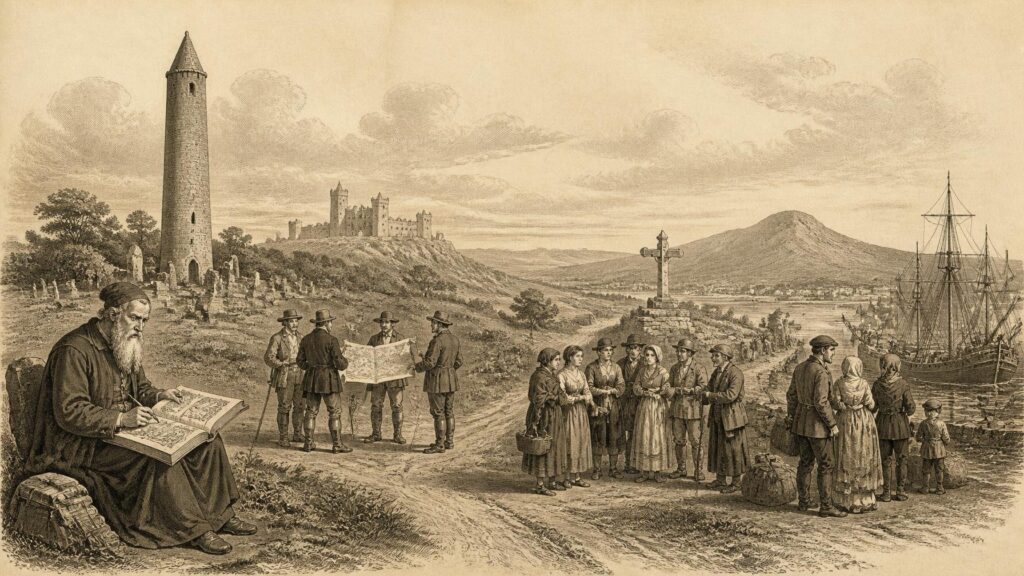
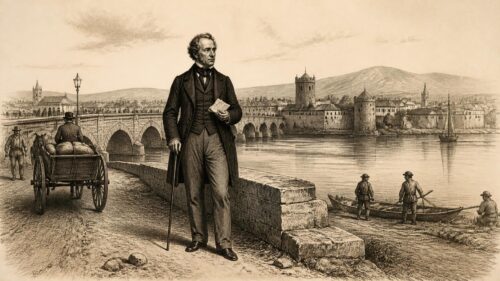
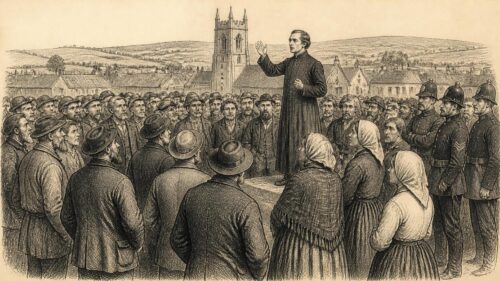
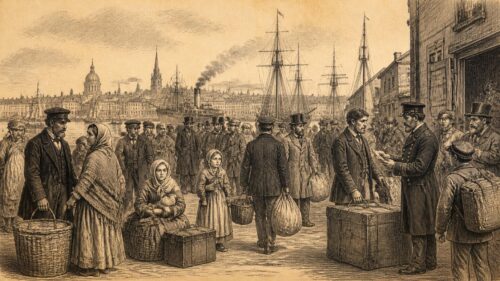
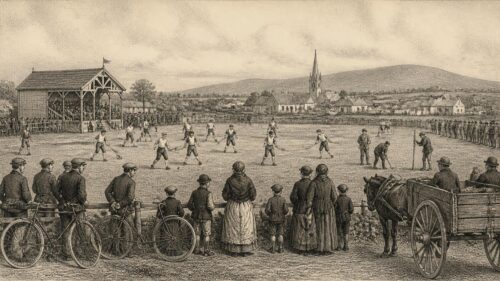
AI generated historical illustration, not a contemporary photograph.
At a Glance
To be Irish has never meant one uncomplicated thing. Across many centuries, people on the island and beyond it have understood belonging through language, kinship, place, faith, law, political loyalty, citizenship and memory. Irish identity has been inherited, chosen, imposed, resisted and continually remade. Its history is therefore not a straight march from an ancient people to a modern state, but a record of overlapping communities whose claims have sometimes converged and sometimes collided.
Words Belonging
The word “Irish” appears deceptively simple. In ordinary use it may describe a citizen of Ireland, a person born on the island, a member of the worldwide diaspora, a speaker of Irish, or someone who identifies with an Irish cultural inheritance. In historical sources, however, its meaning has altered sharply. Medieval writers often distinguished Gaels from newcomers. Early modern administrators used “Irish” in ways that could imply Gaelic, Catholic, native-born, rebellious, or simply resident in Ireland. In later centuries, Irish patriots, unionists, nationalists, republicans and constitutional governments all deployed the term, though they disagreed profoundly about the community it named.
That instability is not a flaw in the historical record; it is the subject itself. Identities are not merely private feelings. They are expressed through language, institutions, censuses, schools, churches, clubs, voting rights, passports and public commemoration. They are also shaped by unequal power. A governing authority may classify a population for taxation, land settlement or security. A movement seeking self-government may elevate particular symbols, histories or cultural practices as evidence of nationhood. Families may preserve a different, more intimate sense of belonging through stories, surnames, migration routes and local attachments.
It is useful, then, to distinguish evidence from interpretation. Evidence includes surviving annals, legal texts, estate records, census returns, newspapers, political manifestos and constitutional documents. Interpretation concerns what those materials mean: whether medieval Gaelic solidarity amounted to a national consciousness in a modern sense, whether the nineteenth-century cultural revival recovered an old tradition or created a new one, or whether contemporary Irishness is best understood as civic, cultural, national or plural. Folklore is also historically valuable, not because every tale establishes a literal event, but because tales show how people imagined ancestry, landscape and moral order.
Early Gaeldom
Long before the emergence of a modern Irish nation-state, the island contained numerous local kingdoms, lordships and peoples. Archaeology shows complex human settlement over a very long span, but it cannot supply a single prehistoric moment at which an identifiable Irish people suddenly came into being. Such claims belong more to later origin stories than to demonstrable fact. What can be stated with greater confidence is that, in the early medieval period, varieties of Goídelc, the ancestor of modern Irish Gaelic, became central to a shared learned and literary culture across much of Ireland.
The political order was fragmented. Kings ruled territories of very unequal scale, and the title of high king did not normally signify government of a unified territorial state. Yet fragmentation did not prevent wider forms of connection. Ecclesiastical networks, legal learning, genealogies, poetry and monastic scholarship travelled across regional boundaries. Learned classes cultivated accounts of common descent and of Ireland as a recognisable geographical and cultural world. Such accounts should not be read as modern nationalism in disguise. They were products of dynastic society, Christianity and elite literary conventions. Nonetheless, they demonstrate that medieval inhabitants could imagine the island as more than an accidental collection of local places.
Language mattered greatly. Gaelic was not simply speech; it was a medium of law, praise poetry, genealogy and political negotiation. The shared language helped give meaning to the term Gael, while outsiders could be marked as Gall, a word that broadly denoted foreigners but acquired different connotations in different contexts. The contrast was real, though never absolute. Trade, raiding, marriage, ecclesiastical exchange and settlement ensured that Ireland was connected to Britain, Scandinavia and continental Europe. A picture of a sealed, homogeneous Gaelic island is therefore misleading.
Christianity also supplied an important vocabulary of belonging. Irish churchmen and scholars participated in Latin Christendom while writing about their own island’s saints, churches and lineages. The famous image of an island of saints and scholars has been polished by later repetition, and it should not obscure conflict, slavery, warfare or social inequality. Still, early medieval scholarship and artistic production gave later generations a powerful cultural archive. Manuscripts, high crosses and monastic sites would eventually become national icons, although their makers did not work for a nineteenth- or twentieth-century Irish nation.
Medieval Encounters
Viking activity and settlement from the later first millennium complicated older distinctions without eliminating them. Scandinavian towns developed at Dublin, Waterford, Wexford, Cork and Limerick. These were not merely foreign intrusions on a Gaelic landscape. Over time, their inhabitants made alliances with Irish kings, intermarried, traded widely and participated in the island’s political life. Towns connected Ireland to seaborne commerce and introduced new social spaces in which language, law and ethnicity could be negotiated. The descendants of Norse settlers were not frozen outside Irish society, even if contemporary writers could still notice difference.
The Anglo-Norman intervention of the late twelfth century produced another profound transformation. Its immediate origins lay in Irish dynastic conflict and the ambitions of Welsh and Norman lords; it was then followed by the intervention of Henry II of England. Castles, boroughs, religious houses and new forms of lordship appeared across extensive parts of the island. English royal claims expanded, but neither conquest nor administration was total. For centuries afterwards, Gaelic lordships remained powerful, while the authority of the English crown varied enormously from one region to another.
Later medieval Ireland is often described through a simple opposition between “native Irish” and “Anglo-Irish”. That shorthand has some practical value, but it can obscure more than it reveals. Descendants of settlers might retain an English political identity and legal interests while adopting Irish language, fosterage, dress, marriage alliances and military practices. Gaelic rulers could employ Norman-style castles or cultivate relations with English authorities. In towns and frontier regions, daily life often encouraged cultural borrowing. The question was not whether one population wholly absorbed another; rather, it was how people balanced several affiliations in changing circumstances.
Contemporary anxieties reveal these porous boundaries. English authorities periodically complained that colonists had adopted Irish customs and had become difficult to distinguish from their Gaelic neighbours. The Statutes of Kilkenny, enacted in 1366, attempted to regulate intermarriage, language, dress and fosterage among the king’s subjects. Such legislation is evidence of official concern, not proof that it successfully imposed a neat ethnic division. Laws frequently advertise the limits of state power. The statutes show that cultural exchange was sufficiently common to trouble those seeking to preserve an English colonial community.
Colonial Kingdom
The sixteenth century brought a more forceful effort to create a centrally governed kingdom of Ireland under the English crown. Henry VIII adopted the title King of Ireland in 1541, replacing the older claim to a lordship. The change was political as well as ceremonial. Tudor governments sought to extend royal law, weaken autonomous lordships, reshape the church and bind Irish elites to a monarchy increasingly defined by English Reformation politics. Some Gaelic lords accepted English titles and negotiated their position within the new order. Others resisted, often with shifting alliances and motives.
This was not simply a clash between an English state and an undifferentiated Irish people. Old English families, Gaelic lords, urban merchants, churchmen and crown officials possessed different interests. Religion became increasingly important, yet confessional identity did not immediately map perfectly onto political loyalty. There were Catholic subjects loyal to the crown and Protestant officials who mistrusted local settlers. Nevertheless, the Reformation and subsequent wars gradually made the association of Gaelic culture, Catholicism and political opposition more potent in official thinking.
The conquest of the later Tudor period was achieved through extraordinary violence. The Desmond rebellions in Munster and the Nine Years’ War in Ulster involved famine, scorched-earth operations, displacement and mass mortality, though precise totals are difficult to establish. The defeat of Hugh O’Neill and his allies at Kinsale in 1601, followed by the settlement that ended the war, marked a decisive weakening of the great Gaelic lordships. The Flight of the Earls in 1607 became, in later memory, a symbol of the old Gaelic political order’s collapse. That symbolism should not make the event seem like an instant extinction of Gaelic society. Irish language, local power and customary practice endured, but under increasingly constrained conditions.
English officials increasingly described the island through categories of civilisation and improvement. These were not neutral descriptions. They justified intervention in landholding, law, language and religion. Gaelic institutions were portrayed as disorderly, while English rule was represented as reforming. Such rhetoric helped make dispossession appear necessary or benevolent. The historical evidence, however, shows people adapting creatively as well as resisting. They petitioned, litigated, entered crown service, preserved religious networks and maintained local solidarities. Irish identity in this setting was forged not only in open rebellion but also through survival within a transforming colonial kingdom.
Settler Worlds
The seventeenth-century plantations fundamentally altered the island’s social and political landscape. In Munster and, more dramatically, Ulster, land confiscated after rebellion was redistributed to undertakers, servitors, corporations and settlers from England and Scotland. The Ulster Plantation was carefully surveyed and planned, though its reality did not always conform to official design. Native Irish tenants continued to live and work in many areas, while some allotted estates failed, changed hands or developed mixed populations. Plantation was a process, not a single completed event.
Its consequences were nevertheless enduring. Large Protestant settler communities, especially in parts of Ulster, possessed religious, cultural and kinship links to Scotland and England as well as local attachments to Ireland. They were not simply temporary colonists waiting to go home. Generations were born on the island, developed regional interests and contributed to its commercial, agricultural and urban life. Yet their security and status were closely connected to landholding, crown authority and Protestant privilege. For many Gaelic Catholic communities, plantation represented dispossession, demographic upheaval and the narrowing of elite opportunity.
The words used by contemporaries mattered. Administrators spoke of “British” settlement, a term encompassing English and Scottish subjects under the Stuart monarchy. They also continued to use “Irish” in ways that could separate the Gaelic Catholic population from settlers. Over time, however, “Irish” would be claimed by people with very different backgrounds. This is one reason why ancestry alone cannot explain national identity. People descended from settlers might consider themselves Irish in some cultural or territorial sense, British in political allegiance, Protestant in confessional solidarity, and Ulster in regional attachment. These identities could reinforce one another or generate tension.
Popular memory has often compressed plantation into a story of absolute replacement. That story captures a genuine experience of coercion and loss, but it can obscure local complexity. Estate surveys, maps and land records show structured dispossession; they also reveal continuities of tenancy, labour and place names. Folklore preserved memories of lost estates, exiled chiefs and hidden treasure, often attaching them to specific hills, ruins and waterways. Such traditions cannot independently prove every remembered episode, but they show how historical upheaval became embedded in landscape and family memory.
Confessional Boundaries
The upheavals of the seventeenth century deepened the connection between religion, land and political identity. The rebellion of 1641 began amid fear, dispossession and political uncertainty, and it was followed by a complex series of wars involving Irish Confederate Catholics, royalists, parliamentarians, Scottish Covenanters and local forces. Later retellings frequently reduce this era to a binary contest, but its alliances were unstable and its violence was suffered by civilians of several communities. Reports of atrocity circulated widely and were used to sustain fear for generations.
The Cromwellian conquest brought further confiscation and transplantation. Catholic landownership was greatly reduced, while the political and economic position of Protestant interests was consolidated. The Williamite war at the end of the century, culminating in events such as the siege of Derry and the Battle of the Boyne, supplied later unionist and nationalist traditions with potent commemorative landmarks. These events should be understood in their wider British and European context as well as in Ireland. They concerned dynastic succession, religion, imperial politics and local rivalries, not an uncomplicated contest between two modern nations.
The penal laws that followed disadvantaged Catholics and, at stages, Protestant Dissenters. Their operation changed over time and was not uniformly enforced in every locality, but they helped institutionalise a Protestant ascendancy in politics, landholding and public office. In consequence, Catholic identity acquired a political charge that went beyond doctrine. Catholicism became linked, in the minds of many rulers, with suspected disloyalty; for many Catholics, it became a durable marker of communal endurance. Neither inference should be treated as inevitable. People made choices within restrictive circumstances, and practical cooperation crossed confessional lines in work, trade and neighbourhood life.
It is tempting to say that the religious divisions of this period made later conflict unavoidable. History does not support such fatalism. The seventeenth century created powerful inheritances of memory, unequal institutions and demographic geography, but it did not dictate every later political outcome. Identities were transmitted through sermons, family stories, anniversaries and organisations, then reinterpreted in new circumstances. The importance of memory lies not in its mechanical power but in the ways communities repeatedly chose to mobilise it.
Patriot Visions
By the eighteenth century, a Protestant political elite governed through the Irish parliament in Dublin, subject to significant British control. Some members of that elite began to articulate an Irish patriotism. They sought legislative independence, commercial freedom and a more dignified constitutional relationship with Britain. This patriot language could be proudly Irish without being democratic, Catholic or separatist. It often assumed Protestant ascendancy and did not automatically include the Catholic majority as equal participants.
The American and French revolutions transformed the political atmosphere. The Society of United Irishmen, founded in Belfast and Dublin in the 1790s, initially advocated parliamentary reform and Catholic inclusion. Its programme increasingly became republican and separatist under the pressure of war, repression and the failure of reform. The United Irish vision was ambitious: a political community in which Catholic, Protestant and Dissenter might act as citizens rather than as members of hostile religious blocs. It was also vulnerable to the sectarian tensions it sought to overcome.
The rebellion of 1798 was widespread but uneven, and its character differed by region. It included political idealism, local grievance, sectarian violence and severe state repression. No single account can adequately contain its experiences. The rebellion’s failure left a contested legacy. Nationalists later honoured the United Irishmen as founders of a non-sectarian republican tradition. Unionists and many Protestants remembered killings, insecurity and the risks of revolutionary politics. Both memories drew upon real suffering, though later political uses often simplified a confused and brutal conflict.
The Act of Union came into force in 1801 and abolished the separate Irish parliament. Supporters presented union as a means of securing stability and connecting Ireland more firmly to British power. Opponents regarded it as the destruction of an Irish legislature and a profound constitutional loss. The Union did not make the word Irish disappear. Instead, it opened new arguments: could Irish interests flourish inside the United Kingdom, or did Irish identity require restored self-government? Those questions would shape nineteenth-century politics.
Union Politics
Under the Union, Ireland sent representatives to Westminster, but political equality remained limited by property, religion and social hierarchy. Catholic Emancipation in 1829 was a decisive change. Daniel O’Connell’s mass campaign showed that Catholics could be organised into a modern political force using meetings, associations, newspapers and electoral pressure. O’Connell’s achievement did not erase class divisions or religious suspicion, but it altered the public meaning of Irish Catholicism. It was no longer only a condition endured under restrictive law; it became a basis for constitutional mobilisation.
O’Connell also campaigned for repeal of the Union. His methods were deliberately constitutional, and his vast “monster meetings” demonstrated a capacity for peaceful mass politics unusual in contemporary Europe. Repeal did not succeed, but it made the relationship between Irish nationhood and parliamentary representation central to public life. O’Connell’s Ireland was neither narrowly ethnic nor simply separatist. He could speak in a language of Catholic rights, moral politics and national self-government while engaging with British liberalism and imperial institutions.
Unionism, meanwhile, developed as more than a refusal of Irish identity. Many unionists considered themselves Irish by birth and local attachment while believing that the Union protected their liberties, religion, commerce and constitutional position. In Ulster especially, industrialisation, Presbyterian traditions, Protestant associational life and memories of seventeenth-century settlement nourished a distinctive political culture. Its members often understood Britishness not as an external label but as an integral inheritance. The later claim that Ireland contained competing national allegiances therefore had deep roots.
Class further complicated identity. Tenant farmers, labourers, urban workers, landlords, merchants and professionals did not experience the Union alike. National language could unite people rhetorically, but rents, wages, franchise rules and access to land often mattered more in daily life. A historical account that treats all Catholics as nationalists or all Protestants as unionists misses radical Protestant reformers, conservative Catholics, Irish-speaking unionists, and many people whose principal concerns were local survival rather than national doctrine.
Language Loss
The Irish language occupies a special place in the history of Irishness, but its story resists sentimental simplification. Irish remained widely spoken into the nineteenth century, especially in western and southern districts, while bilingualism was extensive. English, however, expanded through administration, commerce, migration, schooling and perceived economic necessity. The weakening of Irish was not caused by one policy alone. It resulted from centuries of political change and from practical pressures facing families who saw English as increasingly essential for employment and mobility.
The collapse of the old Gaelic aristocratic order had reduced the status of Irish in public life. Yet the language remained rich in oral tradition, local vocabulary, song, prayer, storytelling and everyday exchange. Its speakers were not relics of a vanished past. They participated in markets, migration networks and changing rural economies. The association of Irish with poverty and backwardness was itself historically produced: language became socially stigmatised because power and opportunity were concentrated in English-speaking institutions.
The national school system, established in the 1830s, generally taught through English. This did not mean every teacher or pupil was hostile to Irish, nor did it instantly eliminate Irish speech. But it reinforced the language’s exclusion from formal advancement. Census material later recorded language knowledge, making Irish visible to the state in numerical terms. Such figures are invaluable evidence, but they require caution. Census questions measure declared competence on a particular day, not the full emotional range of family use, passive understanding or local cultural attachment.
Language decline also generated a paradox. As Irish ceased to be the first language of many inhabitants, it became increasingly important as a national symbol for people who did not speak it fluently. This was not necessarily hypocrisy. A language can matter as heritage, aspiration and political statement as well as daily vernacular. But historians must recognise the distance between revivalist ideal and lived linguistic practice. The tension remains part of the modern history of Irish identity.
Famine Memory
The Great Famine of the 1840s was a demographic and cultural catastrophe. Potato blight was the immediate ecological trigger, but death, disease, eviction and emigration unfolded within an unequal land system and under policies devised by the British state. More than one million people died, while another million or more left Ireland during the famine years and their aftermath. Precise totals are necessarily estimates, yet the scale of loss is beyond doubt. The population decline transformed villages, families, language communities and expectations of the future.
The famine did not affect all places or classes identically. The poorest cottiers and labourers were especially exposed because of dependence on the potato and insecure access to land. Irish-speaking districts suffered heavily, although language was not itself the cause of starvation. Emigration accelerated in communities where Irish was strong, contributing to a long-term contraction of the language. Survivors and emigrants carried memories of hunger, eviction, workhouses and departures that could be transmitted within families across the Atlantic and beyond.
Interpretations of responsibility have long been contested. Some nationalist accounts emphasised British governmental failure and ideological indifference; other accounts placed greater stress on blight, structural poverty and the limits of contemporary relief. These are not mutually exclusive considerations. The failure of the potato crop was natural in origin, but human institutions shaped vulnerability and policy determined who received help, on what terms and with what consequences. It is historically unsound either to detach the famine from government or to explain it as a deliberate plan of extermination for which documentary proof is lacking.
Famine memory became part of Irish national consciousness, especially among diaspora communities. Memorials, songs, family stories and political speeches often turn catastrophe into a concise moral narrative. Those forms of remembrance deserve respect, but they should not be confused with complete explanation. The historian’s task is to retain grief and injustice while preserving complexity: local charity existed alongside official inadequacy; some landlords assisted tenants while others evicted them; emigration could be coerced, desperate or desired. Such distinctions do not diminish the disaster. They make its human reality clearer.
Cultural Revival
From the later nineteenth century, cultural organisations helped refashion Irishness in an age of mass politics. The Gaelic Athletic Association promoted indigenous games, while the Gaelic League, founded in 1893, sought to revive and extend the Irish language. Literary societies, antiquarians, folklorists, theatre practitioners, publishers and teachers also participated in a broad cultural revival. They collected manuscripts, published grammar books, staged plays, organised classes and celebrated an Irish past that they believed had been neglected or distorted.
This revival was not a single movement with one politics. Some participants were constitutional nationalists; others became republicans; some were primarily cultural reformers. Women played important roles as teachers, organisers, writers and performers, although they did not always receive equal recognition in later narratives. Protestant intellectuals participated prominently alongside Catholics. The revival was therefore more diverse than the retrospective image of an exclusively Catholic Gaelic awakening suggests.
Its relationship with tradition was complex. Revivalists preserved songs, stories and language forms that might otherwise have received little public support. At the same time, selection was unavoidable. Collectors and organisers decided which customs, games, dances and dialects represented the nation. Rural Irish-speaking communities could be praised as guardians of authenticity even as urban middle-class activists interpreted them for national audiences. The result was not a fraudulent invention, but neither was it a simple recovery of an untouched past. It was a creative, modern reconstruction of cultural inheritance.
Folklore became especially significant. Legends of Cú Chulainn, the Fianna, saintly founders, banshees and ancient kings offered emotionally resonant ways to connect people with place and ancestry. Their historical value differs from that of a dated state paper. Folklore may preserve old motifs, local memories and social anxieties, but it changes in retelling. A story about a fairy fort or a lost chieftain cannot prove the event it narrates. It can, however, reveal how a community understood land, dispossession, danger and continuity. Cultural nationalists drew heavily upon that imaginative reservoir.
Revolutionary Claims
The revolutionary decade beginning in 1912 brought competing definitions of Ireland into open political conflict. The prospect of Home Rule alarmed many unionists, particularly in Ulster, who feared domination in a Dublin parliament and mobilised to resist it. Nationalists saw Home Rule as a constitutional restoration of Irish self-government. The First World War postponed implementation and divided nationalists over participation in the British war effort. It also militarised political life, as both unionist and nationalist volunteers organised and armed.
The Easter Rising of 1916 did not initially command universal popular support, but the execution of its leaders, the continued war and political developments after 1916 changed its meaning. The Proclamation asserted the right of the Irish people to national independence and addressed “Irishmen and Irishwomen”, a notable expression of citizenship in revolutionary language. Yet the republic proclaimed in Dublin could not automatically settle who counted as Irish or what place unionists would hold in it. Its ideal of a united people confronted the reality of divided loyalties and regional political geography.
Sinn Féin’s electoral victory in 1918, the establishment of Dáil Éireann and the War of Independence strengthened the claim that Ireland possessed a separate democratic mandate. The conflict that followed involved guerrilla warfare, British counterinsurgency, intelligence operations, reprisals and local intimidation. It also involved civilians whose experiences varied greatly by county, religion, gender and class. The temptation to narrate the period entirely through heroic sacrifice should be resisted. The struggle was formative, but it was also violent and morally difficult.
The Anglo-Irish Treaty of 1921 created the Irish Free State while confirming Northern Ireland’s option to remain within the United Kingdom. The settlement satisfied neither all nationalists nor all unionists. Civil war followed in the south, while violence and insecurity intensified in Northern Ireland. Partition was not simply the drawing of a line on a map. It divided political jurisdictions while leaving intertwined economies, kinship networks, religious communities and memories across the island. Irish identity thereafter could not be understood without reference to that division.
Partitioned Allegiances
In the new Free State, many leaders hoped to consolidate a distinct national culture through Irish language policy, education, public ceremony and state institutions. The 1937 Constitution renamed the state Éire, or Ireland in English, and expressed a strong claim to national continuity. For supporters, these measures affirmed independence after centuries of subordination. For critics, the state’s cultural vision could seem prescriptive, overly rural or too closely associated with Catholic moral authority. The reality of everyday life was more varied than official ideals: English remained dominant, emigration continued, and urban modernity advanced.
In Northern Ireland, unionist governments developed institutions within the United Kingdom while a substantial nationalist minority often regarded the state as illegitimate or discriminatory. British and Irish identities were not neatly separated by community or residence. Some people maintained an Irish cultural identity while accepting the political status quo; others considered themselves both Irish and British; still others prioritised an Ulster Protestant identity. State practices, electoral boundaries, housing, employment and policing gave identity questions immediate material importance.
Partition also affected commemoration. In the south, the revolutionary struggle and republican tradition became central elements of public memory, although commemoration changed over time and was never uncontested. In Northern Ireland, the Boyne, the siege of Derry, the Ulster Covenant and wartime service formed a prominent unionist repertoire. Nationalist communities honoured 1916, the hunger strikers of different periods and local republican dead. These traditions were not invented from nothing, but they were curated and amplified through parades, monuments, schools and political organisations.
It is inaccurate to imagine either jurisdiction as culturally sealed. People crossed the border for work, trade, family and entertainment. Newspapers, radio, sport and churches connected audiences in uneven ways. Irish language activists, labour organisers, musicians and writers worked across constitutional boundaries. At the same time, the border could interrupt local economies and reinforce separate political imaginations. Identity was lived at several scales: townland, county, province, island, state, Britain, empire and diaspora.
State Formation
The independent state’s efforts to define Irishness combined civic and cultural elements. Citizenship law, elections and public institutions created a practical framework for membership. Irish was granted official status, national symbols were standardised, and schools conveyed particular historical and linguistic ambitions. These policies reflected a widespread desire to differentiate the new state from the United Kingdom. They should be seen in the context of contemporary European nation-building, in which language, folklore and education were often recruited to make political communities feel historically continuous.
Yet the state did not wholly control identity. Many citizens were more comfortable in English than Irish; some were indifferent to revivalist culture; Protestants, Jews, Travellers and later migrant communities complicated any narrow equation of Irishness with Catholic Gaelic ancestry. The state’s constitutional and social development was also marked by strong Catholic influence, especially in areas of morality, schooling and welfare. This influence was real, but it did not mean every Catholic endorsed official policy or every Protestant stood outside national life.
During the twentieth century, Ireland’s relationship with Britain, Europe and the wider world continued to reshape self-understanding. Neutrality during the Second World War, participation in the United Nations, entry to the European Economic Community and patterns of emigration all modified the imagined place of the state. A person could be intensely attached to local Irish culture while working in Britain, America or Australia. The diaspora was not an afterthought to national history; remittances, letters, return visits and political activism made it part of the island’s social fabric.
The later twentieth century also saw growing criticism of inherited national narratives. Historians questioned heroic simplifications. Writers explored urban life, gender, class, sexuality and institutional power. Survivors of industrial schools, mother and baby institutions and other coercive systems challenged celebratory accounts of the state. These developments did not abolish Irish identity. They widened the evidence considered relevant to it and made clear that national independence had not guaranteed equal dignity or freedom for all.
Northern Conflict
The civil rights movement of the late 1960s exposed longstanding grievances in Northern Ireland concerning housing, electoral arrangements, employment and policing. Its demands were framed in the language of equal citizenship, but they emerged within a society already structured by competing national allegiances. Violence escalated into the Troubles, drawing in republican and loyalist paramilitaries, the British Army, police forces and political parties. The conflict caused profound suffering across communities and cannot responsibly be reduced to a contest between two equally simple narratives.
For many nationalists, discrimination and the experience of British security policy confirmed that they were treated as a suspect minority in a state they had never accepted. For many unionists, republican violence appeared as an existential threat to their place in the United Kingdom and to their physical safety. Both perspectives were shaped by lived fear, but neither can excuse attacks on civilians, collusion, unlawful killing or abuses of rights. Historical explanation is not moral exoneration.
Identity hardened under pressure. Neighbourhoods became more segregated, flags and murals marked territorial belonging, and remembrance of earlier conflicts was drawn into present argument. Nevertheless, the Troubles did not erase internal diversity. There were constitutional nationalists and militant republicans; liberal unionists and hardline loyalists; people committed to cross-community work; and many who resisted being defined primarily by either bloc. Women’s groups, victims’ organisations, churches, trade unions and local activists often sustained forms of contact overlooked by high political narratives.
The conflict demonstrated the danger of treating identity as an inherited destiny. Institutions that distribute power unfairly can turn cultural difference into political grievance, while violence can make nuanced identities harder to express. But the very survival of plural voices also showed that identity could be negotiated. The eventual peace process emerged from exhaustion, political change, patient dialogue and the recognition that neither tradition could simply defeat or assimilate the other.
Constitutional Pluralism
The Belfast, or Good Friday, Agreement of 10 April 1998 was a constitutional turning point. It accepted that Northern Ireland would remain within the United Kingdom unless a majority there chose otherwise, while also recognising the right of people in Northern Ireland to identify and be accepted as Irish, British or both. The Agreement was approved in referendums held on 22 May 1998 and came into force on 2 December 1999. Its architecture connected devolved institutions in Northern Ireland, North–South cooperation and East–West bodies involving Ireland and Britain.
This settlement mattered because it refused to make one identity the price of peace. Its language of consent, parity of esteem and multiple citizenships did not dissolve disagreement about sovereignty or historical memory. It did, however, provide a framework in which constitutional aspiration could be pursued without denying the legitimacy of another person’s national affiliation. That is a major departure from older political habits in which Irishness and Britishness were frequently presented as mutually exclusive.
Constitutional change in Ireland reflected this shift. Articles 2 and 3 of the Constitution were amended after the Agreement. The revised text affirms the entitlement and birthright of people born on the island to be part of the Irish nation, while also acknowledging the diversity of identities and traditions on the island and requiring peaceful democratic consent for any constitutional change. These provisions are legal texts, not complete sociological descriptions. Their importance lies in the way they place plural belonging at the centre of the national framework.
Pluralism should not be romanticised. Disputes over language, flags, parades, legacy investigations and constitutional futures remain real and sometimes bitter. Nor can a document by itself overcome unequal opportunity or inherited trauma. Yet the Agreement established a crucial principle: people need not choose between historical erasure and permanent hostility. Irish identity can be held alongside British identity, Northern Irish identity, European identity and other affiliations. For historians, that principle helps correct narratives that portray the island as belonging naturally to only one tradition.
Diaspora Connections
Irishness has long extended beyond Ireland. Medieval clerics travelled through Britain and continental Europe; early modern soldiers served abroad; eighteenth- and nineteenth-century migration created communities across the Atlantic world and in Britain. The famine accelerated emigration on a vast scale, but it did not begin the diaspora. Nor did departure necessarily sever ties. Migrants sent money home, arranged passages for relatives, read Irish newspapers, joined county associations and returned for visits or retirement.
Diaspora identities have often been intensely political. Irish communities in the United States, Britain, Australia and elsewhere supported constitutional nationalism, revolutionary organisations, charitable appeals and cultural revival. Distance could sharpen attachment. A person who left a village might preserve an idealised memory of it, while a second or third generation could embrace Irish symbols more enthusiastically than relatives at home. Such expressions are historically significant, but they should not be treated as a pure measure of life in Ireland itself.
The diaspora has also widened the meaning of Irish. Descendants of emigrants may claim Irish heritage without citizenship, language knowledge or recent family contact. Others acquire citizenship through descent and develop close practical links with the island. Still others identify culturally with Irish music, literature or sport while possessing no documented ancestral connection. These are different forms of affiliation. They need not be ranked as authentic or inauthentic, but they should not be conflated with one another.
Migration into Ireland has added another dimension. The island is no longer adequately described only as a place of departure. New communities have made homes there, speaking many languages and practising many faiths. Their presence does not make Irish history less relevant; it makes the history of belonging more relevant. Earlier Irish experiences of migration, prejudice and adaptation can illuminate present questions, though historical analogy must be used carefully. No two migrations are identical, and past suffering does not automatically produce present generosity.
Living Histories
The history of Irish identity does not culminate in a final definition. Its most enduring feature is change. Gaelic culture supplied language, literature and memory, but it was never the only inheritance on the island. Norman, English, Scottish, Norse, Protestant, Catholic, Dissenter, Jewish, Traveller, migrant and diasporic histories all form part of the record. Some relationships were imposed through conquest and settlement; others grew through exchange, work, marriage and migration. A truthful history must recognise both coercion and connection.
Historical evidence can correct comforting myths. It shows that Ireland was not eternally isolated, that medieval society was not a modern nation-state, that plantations did not create two perfectly separate populations, and that nineteenth-century nationalism was neither inevitable nor culturally uniform. It also confirms the depth of dispossession, famine, discrimination and violence that shaped many people’s understanding of Irishness. Complexity is not an excuse to soften injustice. It is the means by which injustice can be located accurately in institutions, decisions and lived experience.
Folklore retains its place within this account. A legend may not establish the literal age of a monument, the identity of a rebel, or the ownership of a field. Yet it may preserve the emotional truth of a community’s relation to a landscape. Likewise, national symbols such as the harp, the shamrock, the tricolour and the Irish language are not empty inventions merely because their meanings changed. Their power lies precisely in repeated reinterpretation. Symbols survive because people continually decide that they matter.
To ask who is Irish is therefore to ask a historical question with no single timeless answer. In the present constitutional order, citizenship and personal identification supply important answers. In cultural life, language, family and place remain meaningful. In historical study, the best answer is capacious rather than possessive: Irishness has been made by many communities, through conflict as well as cooperation, and its future will be shaped by whether that plural history is understood as a burden to be denied or a reality to be honestly shared.
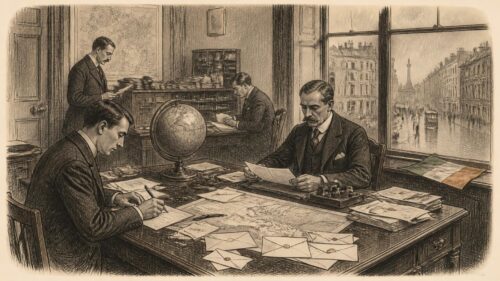
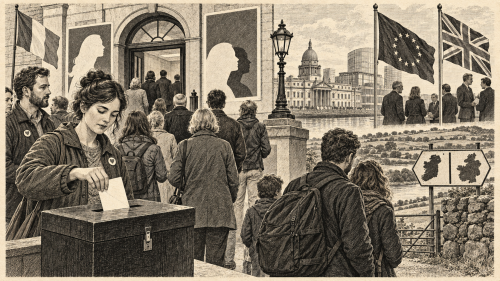

The article’s treatment of plantation and subsequent political change usefully complicates the assumption that ancestry alone determines Irishness. It shows how communities formed durable local attachments while retaining British, Protestant, Gaelic, Catholic, regional or constitutional loyalties, often simultaneously. Equally striking is the distinction between folklore as evidence of remembered meaning and documentary material as evidence for particular events. This invites reflection on how historical memory shapes present identities without mechanically dictating them. How should historians and communities balance inherited memories of dispossession, settlement and conflict with evidence of cultural exchange and overlapping allegiance when interpreting Irish identity today in practice?