

Distant Republics
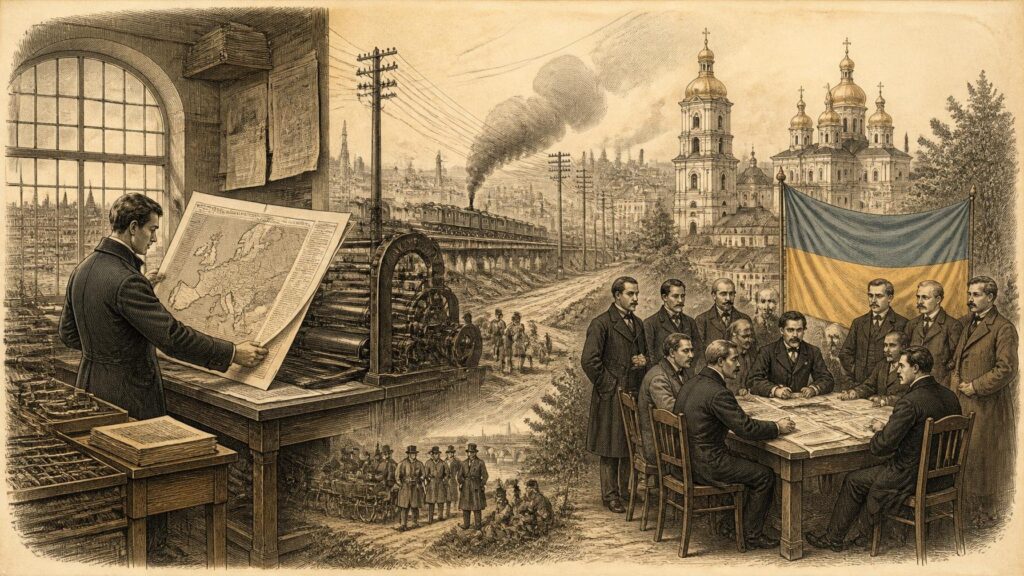
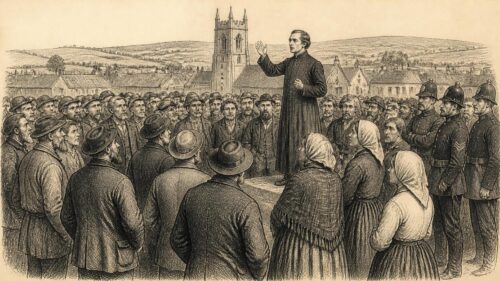
AI generated historical illustration, not a contemporary photograph.
At a Glance
Ireland and Ukraine lie at opposite edges of Europe, yet their histories have repeatedly been brought into conversation by empire, revolution, famine, national self-definition and migration. That conversation is neither ancient nor continuous. It rests chiefly on documented exchanges in the twentieth century, on the political language of small nations, and, since 2022, on the lives of Ukrainians who have made temporary or longer-term homes across Ireland. Its value lies not in treating two distinct histories as identical, but in understanding why Irish observers found Ukraine meaningful at particular moments.
Uneven Connections
Ukraine is not, in itself, an Irish historical subject. Its past belongs first to the peoples, territories and political traditions of eastern and central Europe. Yet it has acquired a clear place within Irish historical experience. That place was initially intellectual and political: Irish nationalists, especially during the revolutionary decade from 1912 to 1923, watched the disintegration of the Russian, German, Habsburg and Ottoman empires and asked what it might mean for Ireland. Ukrainian politicians and writers, meanwhile, encountered Ireland as an example of a European nation seeking separation from a larger imperial state. The connections were seldom direct state-to-state relations. More often they were comparisons made in newspapers, speeches, private correspondence and the arguments of national movements.
Such comparisons are historically revealing, but they must be handled carefully. Ireland was governed from London within the United Kingdom, while Ukrainian lands had long been divided between the Russian and Habsburg empires and later became the chief territory of the Ukrainian Soviet Socialist Republic. Ireland had a relatively compact island geography, a Catholic majority and an established parliamentary nationalist tradition before armed revolution. Ukraine was much larger, linguistically and confessionally varied, and exposed to overlapping Polish, Russian, Austrian, German, Ottoman, Romanian and Soviet ambitions. Neither country’s history can be reduced to a simple story of an oppressed nation confronting a single foreign power.
The Irish interest in Ukraine nevertheless illuminates a neglected dimension of Irish internationalism. Irish nationalists did not think only in terms of Britain and Ireland. They followed the fate of other peoples whom they believed had been denied political agency, and they looked for arguments that might persuade foreign audiences that the Irish claim to independence formed part of a wider reordering of Europe. Ukraine entered this field of vision most sharply when the First World War destroyed old imperial certainties.
In the twenty-first century the connection has become more material. Diplomatic relations, opened after Ukrainian independence in 1991, developed gradually. Ireland opened an embassy in Kyiv in 2021. The Russian full-scale invasion of Ukraine on 24 February 2022 transformed the relationship: Irish governmental policy, voluntary action, local schools, employers, host households and communities were all shaped by the arrival of people fleeing the war. The resulting Ukrainian presence is part of the social history of contemporary Ireland, not merely a chapter in foreign policy.
Borderland Histories
To understand why Ireland and Ukraine were compared, it is necessary to begin with the different political landscapes from which the comparison emerged. Ukrainian history cannot be treated as a straightforward march towards the modern state. Its territories have been ruled by successive polities, including Kyivan Rus’, the Grand Duchy of Lithuania, the Polish–Lithuanian Commonwealth, Cossack and Hetman formations, the Habsburg monarchy, the Russian Empire, the Soviet Union and independent Ukraine. The boundaries of modern Ukraine were not fixed in earlier centuries, and identities within its territories were multiple and changing.
By the nineteenth century, most Ukrainian-speaking lands lay in the Russian Empire. Galicia, centred on Lviv, belonged to the Habsburg Empire. This division mattered profoundly. Imperial policies towards language, religion, education and political association differed. In the Russian Empire, official restrictions on Ukrainian publishing and education encouraged cultural activists to defend language and historical memory. In Habsburg Galicia, political life was constrained but could at times be more open, allowing organisations, newspapers and cultural institutions to develop. The term ‘Ukrainian’ itself gained wider political and cultural force over time; older terms such as ‘Ruthenian’ continued to be used in various settings.
Ireland, too, had experienced constitutional incorporation into a larger state through the Act of Union of 1800. But the analogy stops there. The United Kingdom was a parliamentary state in which Irish representatives sat at Westminster, however unequal and limited Irish influence might be. Irish politics was also shaped by land agitation, Catholic emancipation, the memory of rebellion, the Irish language revival, unionism in the north-east and the long campaign for Home Rule. These differences did not prevent comparison. On the contrary, nationalists often made comparisons precisely because they sought examples beyond their own circumstances.
Both Irish and Ukrainian political thinkers lived beside powerful imperial centres that treated their territories as strategically important. British governments feared Ireland’s use by hostile European powers. Russian rulers regarded the Ukrainian borderlands, the Black Sea region and the agricultural wealth of Ukraine as integral to imperial security and prosperity. These strategic calculations helped ensure that political autonomy was viewed not merely as a domestic constitutional question but as a potential threat to state power.
There was also a shared problem of historical description. Imperial narratives commonly portrayed smaller peoples as incomplete nations, regional populations or branches of a larger civilisation. Irish nationalists challenged ideas that Ireland’s political future should be decided in London. Ukrainian activists challenged claims that Ukrainians were simply a regional variety of Russians or that Ukrainian language and culture lacked the standing of a national tradition. This did not mean that the two movements had identical goals or methods. It does explain why Irish writers could recognise something familiar in Ukrainian arguments for linguistic and political dignity.
National Revival
During the nineteenth century, cultural work provided foundations for modern national politics in both countries. In Ireland, organisations devoted to Irish language, sport, folklore, literature and history helped create a public culture in which national distinctiveness could be asserted. The Gaelic League, founded in 1893, became especially important as a school of activism, even though not all nationalists shared the same political outlook. Writers of the Irish Literary Revival transformed local stories, landscapes and speech into material for a modern national imagination.
In Ukrainian lands, intellectuals, writers, teachers, clergy and publishers similarly debated language, literature and the relationship between popular culture and political nationhood. Taras Shevchenko became a central cultural figure, not because he created a modern nation alone, but because his poetry furnished later generations with a powerful language of memory, suffering and aspiration. Associations and reading rooms in Galicia, as well as publishing ventures and scholarly work, offered institutional forms through which culture could be preserved and enlarged.
It is tempting to make a neat parallel between the Irish language revival and Ukrainian cultural revival. There are genuine similarities: both involved the defence of a language disadvantaged by political power; both linked cultural activity to a wider claim of national existence; and both developed under circumstances in which official institutions could be indifferent or hostile. But the social position of the languages differed. Irish had suffered major decline, particularly after the Great Famine and mass emigration, while Ukrainian was spoken by millions across a far larger territory. Ukrainian linguistic politics also unfolded under two empires and amid competing Polish, Russian, German, Yiddish, Romanian and other cultural worlds.
The comparison was therefore best understood as political rhetoric rather than a full sociological description. Activists frequently use foreign examples to make a domestic case. An Irish nationalist could point to Ukrainian language restrictions as evidence of a general imperial pattern; a Ukrainian observer could cite Ireland to show that a stateless people might create durable institutions and a compelling national culture. In both cases, the foreign example was selected, simplified and made useful.
Folklore played a related but different role. Irish and Ukrainian traditions contain rich bodies of story, song, customary practice and local memory, but no credible historical method permits one to infer an ancient ethnic kinship between the two peoples from these resemblances. General similarities in rural storytelling, Christian observance or heroic legend are not evidence of direct descent or prehistoric contact. The relationship considered here is modern, documented and political, rather than an inherited connection from remote antiquity.
Imperial Collapse
The First World War made the Irish-Ukrainian comparison urgent. The conflict placed both national questions within a wider crisis of empire. Ireland remained part of the United Kingdom, but the Home Rule settlement had been postponed by war, the Easter Rising took place in 1916, and Irish politics was transformed by the British response to rebellion, conscription and the electoral victory of Sinn Féin in 1918. In Ukraine, the collapse of the Romanov Empire in 1917 opened a contested path towards self-government and then independence.
The Ukrainian Central Rada, a representative political body formed in Kyiv after the February Revolution, initially sought autonomy within a reformed Russian framework. The rapidly changing revolutionary and military situation made that position difficult to sustain. The Ukrainian National Republic was proclaimed in 1917 and declared full independence in January 1918. It obtained recognition from the Central Powers at Brest-Litovsk, but its existence was soon endangered by German intervention, internal conflict, Bolshevik military pressure, changing governments and the wider war.
For Irish nationalists, the appearance of a Ukrainian republic was not an obscure eastern event. It demonstrated that the collapse of empire might make previously subordinated national claims visible on the international stage. The Irish republican leadership also hoped to secure recognition for the Irish Republic declared by Dáil Éireann in January 1919. The Paris Peace Conference, where the victors sought to redraw Europe, became the imagined arena in which national self-determination might be applied.
In practice, neither Irish nor Ukrainian hopes were easily fulfilled. The great powers did not treat self-determination as a universal rule. They applied it selectively, balancing strategic interests, military realities, domestic politics and assumptions about national viability. Ireland was excluded from the peace conference as Britain insisted it was an internal matter of the United Kingdom. Ukraine’s representatives faced the difficulty that control of territory changed repeatedly, while rival governments and armies claimed authority. The principle of national self-determination proved powerful as language but unreliable as a guarantee.
This shared disappointment helps explain the intensity of later comparisons. Both national movements learned that international sympathy mattered, but that sympathy alone did not establish sovereignty. In each setting, advocates had to construct a case for nationhood before foreign publics while confronting military and diplomatic powers that preferred stability, influence or territorial settlement to abstract consistency.
Revolutionary Mirrors
The documented meeting point between Irish and Ukrainian politics was clearest in nationalist journalism. Donnacha Ó Beacháin’s research on Irish engagement with Ukrainian anti-imperial struggles shows that Irish writers followed events in Ukraine closely during the revolutionary years. Arthur Griffith’s newspaper Nationality, a leading Sinn Féin voice, wrote about Russian rule in Ukrainian territories and drew pointed comparisons with British policy in Ireland. Its writers argued that methods of conquest included repression of language, culture, schools and political expression.
Such writing must be read as partisan journalism. It was not detached scholarship, and it did not aim to provide a comprehensive history of Ukraine. Its function was argumentative. By representing Russia as an imperial power in Ukraine, nationalist journalists could challenge British claims to moral leadership in the war. Britain and Russia had been allies against Germany; Irish republicans could portray the alliance as hypocritical if both powers denied the aspirations of smaller peoples within their own spheres.
The phrase ‘the Irishmen of Russia’, applied to Ukrainians in an English-language description later cited approvingly in Irish nationalist circles, was especially revealing. It offered a flattering resemblance: Ukrainians were presented as educated, courteous, brave, patriotic and oppressed by an overbearing neighbour. Yet the phrase was also patronising. It measured Ukrainians through an Irish analogy rather than allowing them their own complex history. Analogies can build sympathy, but they can also make one people legible only by turning them into a version of another.
Irish interest was not uniform. Political attitudes towards Russia and the Bolsheviks varied greatly. Some Irish radicals saw the Russian Revolution chiefly as an overthrow of tsarist despotism and were prepared to view the new Soviet power with hope. Others were more alert to the danger that Bolshevik centralism might replace one form of imperial domination with another. The position taken towards Ukraine could therefore depend on wider attitudes to socialism, republicanism, anti-imperialism and the international balance of power.
For Ukrainians, Ireland offered a similarly useful but incomplete mirror. Ireland’s campaign for independence had international visibility, a recognisable parliamentary and revolutionary leadership, and a diaspora that could communicate its case abroad. But the Irish settlement of 1921 produced partition as well as the Irish Free State, followed by civil war. It was neither a simple triumph nor a ready-made model for Ukraine. The most responsible historical reading sees the connection as reciprocal observation: two national movements studied one another while pursuing distinct objectives in perilous circumstances.
Failed Recognition
The years from 1918 to 1921 were decisive and tragic in Ukrainian history. The Ukrainian National Republic, the Ukrainian State under Hetman Pavlo Skoropadsky, the Western Ukrainian National Republic and other political forces attempted to establish authority amid invasion, civil war, social conflict and international intervention. Poland and Ukrainian forces fought over eastern Galicia; Bolshevik armies advanced; the White movement opposed Bolshevism while often rejecting Ukrainian independence; and foreign powers made calculations based on their own strategic interests.
By 1920 the Ukrainian National Republic’s government had gone into exile. The Peace of Riga in 1921 divided contested territories between Poland and Soviet Russia, while Soviet Ukraine became a constituent republic of the emerging Soviet Union. This was not the fulfilment of the national programme envisaged by Ukrainian independence advocates. Yet the existence of the Ukrainian Soviet Socialist Republic later had consequences. It preserved a territorial and administrative framework called Ukraine, although real sovereignty lay in Moscow and the relationship between Ukrainian culture and Soviet power remained fraught.
Irish republican diplomacy encountered a different, though comparably frustrating, international order. The Dáil’s representatives sought recognition abroad, promoted Ireland’s claim in the United States and Europe, and tried to make British rule an international issue. The effort achieved publicity and sympathy but not recognition by the major powers. The Anglo-Irish Treaty of December 1921 created the Irish Free State as a self-governing dominion rather than the fully independent republic demanded by many republicans, and confirmed the separate position of Northern Ireland.
The similarity lies in the harsh limits imposed by international power, not in an identical outcome. The Irish Free State secured institutions of government, international personality and a path towards fuller constitutional independence. Ukrainian statehood was extinguished on its territory for decades. An Irish reader should resist the comforting notion that Ireland’s revolutionary experience provides a complete interpretative key to Ukraine. The contrast between the two outcomes is as important as the comparison.
There was no lasting formal alliance between the Irish Republic and the Ukrainian National Republic. The available evidence supports an exchange of attention, sympathy and political analogy rather than a developed bilateral relationship. This distinction matters because later memory can enlarge fleeting moments of contact into a friendship more substantial than the record permits. Historical connections need not be continuous to be meaningful, but they should be described in proportion to the evidence.
Soviet Shadows
After the consolidation of Soviet power, Ukraine became less visible in Irish public discussion as a distinct political subject. The Soviet Union was often perceived abroad through Moscow, communism, diplomacy and great-power politics. Ukraine’s separate history could be obscured by the language of a single Soviet people or by the assumption that the USSR was simply Russia under another name. Both descriptions concealed important distinctions.
The interwar period contained some of the gravest episodes in Ukraine’s modern history. Soviet collectivisation and grain procurement policies, implemented through coercion and accompanied by measures that prevented or obstructed escape and relief, contributed to the famine of 1932–33 now widely known as the Holodomor. Demographic estimates differ, and historians continue to debate aspects of causation, intent and classification. The scale of death was catastrophic. The history is documented through official records, demographic research, survivor testimony and subsequent scholarship; it is not a matter of folklore.
Irish people could understandably recognise famine as a moral and historical reference point. The Great Famine of the 1840s had left Ireland with a deep memory of hunger, eviction, emigration, disease, unequal power and official failure. Comparisons between the Great Famine and the Holodomor have therefore appeared in scholarship and public commemoration. They can illuminate questions of state responsibility, rural vulnerability, demographic loss and historical memory. They must not flatten differences. The Irish catastrophe took place under British rule amid potato blight, market structures and relief policies; the Holodomor emerged from Stalinist collectivisation, coercive procurement and the repressive machinery of a one-party Soviet state.
Equating the two events without qualification risks obscuring both. The purpose of comparison should be clarification, not competition over suffering. The Irish famine cannot prove a particular interpretation of the Holodomor, and the Holodomor cannot be used simply as an eastern European duplicate of Ireland’s tragedy. What the two histories can share is a warning about the human cost when political authority, ideology and economic policy place vulnerable populations in conditions of hunger.
The Second World War brought further devastation to Ukraine: occupation by Nazi Germany, mass murder of Jews, forced labour, combat, reprisals, population displacement and renewed Soviet domination. Ireland’s wartime experience was entirely different. The State remained neutral, though affected by economic scarcity, intelligence pressures and the wider conflict; Northern Ireland, by contrast, was directly involved in the British war effort and suffered the Belfast Blitz. Again, the analogy has clear limits. Ukrainian losses and destruction occurred on a scale unmatched in Ireland.
Memory Politics
For much of the Cold War, Ukrainian history was filtered through competing ideological accounts. Soviet official narratives stressed the multinational unity of the USSR, the victory over Nazism and socialist development. Ukrainian émigré communities in North America and western Europe preserved alternative accounts of the famine, political repression, wartime experience and the lost independence movements of 1917–21. These memory traditions were not always politically neutral, and some questions, especially concerning wartime nationalism and violence, remain difficult and contested.
Ireland’s own historical culture had comparable, though not identical, tensions between official commemoration, family memory and politically engaged storytelling. The revolutionary period, partition, civil war and the Northern Ireland conflict all generated narratives that could legitimise particular political positions. This provides one modest point of interpretative contact with Ukraine: historical memory is not merely a record of what happened. It is also a field in which communities decide what to mourn, celebrate, explain or forget.
That observation should not lead to relativism. Some facts are firmly established even where their meanings are contested. Soviet repression occurred. Famine killed millions in Ukraine. Nazi occupation involved genocide and terror. Ukrainian independence was overwhelmingly endorsed in the referendum of December 1991. Russia’s seizure of Crimea in 2014 and its full-scale invasion in 2022 breached Ukraine’s territorial integrity. Interpretation may differ around causes, responsibility and consequence; evidence does not permit the denial of the underlying events.
In Ireland, awareness of Ukrainian history expanded slowly through academic work, journalism, diaspora activity, cultural events and the country’s increasing integration into European institutions. But before 2022, Ukraine rarely occupied the central place in public attention that it has since acquired. The survival of Ukraine as an independent state after 1991 created a framework for relations, yet geographical distance and limited trade meant that contact remained comparatively modest.
New Statehood
The collapse of the Soviet Union restored Ukraine to the map of sovereign European states. On 24 August 1991, Ukraine declared independence; on 1 December, voters endorsed that decision in a referendum. Ireland formally recognised Ukraine on 31 December 1991, and bilateral diplomatic relations were established on 1 April 1992. These dates mark a genuine institutional beginning, even if they did not immediately create an intense relationship.
The timing had symbolic importance. Ireland, a state that had itself emerged through a difficult twentieth-century process of revolution, treaty, partition and gradual constitutional change, now recognised a state whose leaders were attempting to secure independence after decades of Soviet rule. Yet official recognition did not imply that the two historical experiences were equivalent. It reflected ordinary diplomatic practice as well as a recognition of Ukraine’s sovereignty.
Ukraine’s early independence was shaped by economic disruption, inherited Soviet institutions, energy dependence, language politics, regional variation and difficult relations with Russia. Ireland’s own 1990s transformation, associated with European Union membership, economic growth and a peace process in Northern Ireland, offered no simple model for Ukraine. Still, Irish policymakers and commentators increasingly understood EU membership as relevant to the security and prosperity of smaller European states. That outlook later informed Irish support for Ukraine’s European aspirations.
The relationship widened gradually through trade, education, cultural contacts and European institutions. Ireland became a participant in the European Union’s relations with Ukraine, including the wider policy frameworks that linked economic cooperation, reform and political dialogue. Ireland’s role was usually one part of a collective European position, not an independent great-power strategy. This is significant: for a smaller state, multilateral institutions have often been the principal means through which foreign policy influence can be exercised.
Ireland’s embassy in Kyiv opened in June 2021. Its creation, before the full-scale invasion, indicated that Ukraine had acquired greater importance in Irish diplomacy. The embassy’s opening also coincided with the aftermath of Russia’s 2014 annexation of Crimea and the conflict in eastern Ukraine, events that had already made Ukrainian sovereignty a major European security issue.
Renewed Invasion
Russia’s full-scale invasion of Ukraine on 24 February 2022 altered the relationship between the two countries more rapidly than any previous event. Ireland condemned the invasion and took part in European Union sanctions and humanitarian measures. Its military neutrality did not mean political indifference. Irish policy combined diplomatic support for Ukraine’s sovereignty with humanitarian assistance, reception of people displaced by war and non-lethal forms of support.
The invasion also forced Irish public life to confront Ukraine not as a distant geopolitical subject but as the source of neighbours, classmates, colleagues and tenants. The scale of displacement was exceptional in modern Irish experience. Under the European Union’s Temporary Protection Directive, activated for the first time in March 2022, people fleeing Ukraine could obtain immediate residence-related protection and access to work, education, social welfare and other supports. This route differed from the ordinary international protection system and reflected the emergency character of the displacement.
The Government response in March 2022 involved a rapid search for accommodation in hotels, guesthouses, pledged homes, religious properties and other available sites. Voluntary organisations, local authorities, schools and ordinary households became crucial to the practical response. Initial public solidarity was extensive, but the operation unfolded amid an existing Irish housing shortage and intense pressure on rental accommodation, emergency provision and public services. Good intentions could not remove these structural constraints.
The history of this response should not be told as either a simple success or a simple failure. It included generosity, organisational improvisation, real assistance and many local acts of welcome. It also involved uncertainty, moves between accommodation centres, unequal access to services, language barriers and growing public controversy over migration and housing. Historical judgement requires both parts of the record. The presence of Ukrainians exposed pre-existing weaknesses in Irish accommodation policy; it did not create them alone.
The words used in public debate matter. ‘Refugee’, ‘temporary protection beneficiary’, ‘arrival from Ukraine’ and ‘Ukrainian’ do not always describe the same group. Some people arriving from Ukraine were Ukrainian nationals; others had different nationalities but had been living in Ukraine and were eligible for protection. Some later returned to Ukraine or moved elsewhere. Administrative totals therefore record permissions, personal public service numbers or activity in systems, not an unchanging count of permanent residents.
Irish Reception
Central Statistics Office releases make clear both the size and the complexity of the movement. By 29 September 2024, more than 109,000 personal public service numbers had been issued to beneficiaries of temporary protection arriving from Ukraine. The figure was cumulative, and the CSO explicitly cautioned that it should not be treated as a simple measure of everyone currently resident in the State. Nonetheless, it demonstrates the remarkable scale of the episode for a country of Ireland’s population.
The profile of arrivals also challenges stereotypes. The CSO recorded adults, children, families, people entering education, workers and jobseekers. Many adults had substantial educational qualifications, while English-language proficiency remained a major obstacle for those seeking work. Ukrainian people were distributed throughout the country rather than confined to Dublin. This geographical dispersal made the experience national in scope. Small towns and rural areas, as well as cities, became places where Irish residents encountered Ukrainian families in everyday life.
Schools were among the most important settings of contact. Children entered classrooms while carrying experiences of abrupt departure, family separation and uncertainty about return. Teachers and school communities had to address language needs, places, transport and emotional support. The historical significance of this should not be understated. Education has long been central to Irish debates about identity, language and integration; the arrival of Ukrainian pupils gave those themes an immediate human form.
Host arrangements created another layer of social history. Some households offered rooms or homes through formal schemes or private networks. Such arrangements could be generous and life-changing, but they were inherently fragile when based on temporary space, changing family circumstances or rising living costs. Accommodation was therefore not only an administrative issue. It shaped privacy, independence, employment choices, schooling and the ability to establish a sense of ordinary routine.
By late 2023 and 2024, the Irish Government modified aspects of the support system for newly arriving beneficiaries, including the duration of State-provided accommodation. These decisions reflected pressure on resources and an effort to align Irish arrangements more closely with those elsewhere in Europe. They also provoked debate about fairness, capacity and the relationship between humanitarian obligation and domestic housing policy. A future historian will need to distinguish between formal policy, local implementation and the experiences reported by those who lived through the system.
Community Encounters
The Ukrainian presence in Ireland after 2022 did not begin from nothing. There had been Ukrainians living, studying and working in Ireland before the invasion, and community organisations already existed. But the arrival of so many more people altered the scale and visibility of Ukrainian cultural life. Churches, voluntary groups, language classes, musicians, artists, sports clubs and online networks became points of connection and support.
Such activity should not be romanticised as effortless integration. Communities formed under conditions of war and displacement often carry burdens that are not visible in public celebration. People may be supporting relatives in danger, following news from home, sending money and supplies, grieving losses, or deciding whether it is safe to return. The ordinary acts of learning English, finding work or joining a local association can therefore coexist with deep insecurity.
Irish communities also brought their own memories to encounters with Ukraine. Some people invoked the Great Famine, emigration or the experience of partition as reasons for empathy. These analogies can help create moral attention. They become misleading when they claim too much. An Irish family history of emigration to Britain or America is not the same as flight from an active war zone; partition on the island of Ireland is not the same as the changing front lines of Russia’s war against Ukraine. Responsible solidarity does not require historical sameness.
Folklore and symbolic gestures have had a place in this new relationship. Blue and yellow displays, Irish-Ukrainian cultural evenings, music, food and public ceremonies express welcome and remembrance. They are valuable as communal acts, but they are not substitutes for documentary history or policy analysis. The historian’s task is to recognise their emotional importance while distinguishing them from evidence about diplomatic decisions, migration numbers, accommodation provision or the earlier revolutionary relationship.
The most durable Irish-Ukrainian connection may ultimately be made not by state ceremony but by these ordinary encounters. Children who attended school together, neighbours who shared transport or meals, employers who recognised qualifications, and local volunteers who helped people navigate institutions have all created a record that is dispersed and often undocumented. Oral-history projects, local archives and community collections will be essential if later generations are to understand the period fully.
Neutrality Debates
Ukraine has also intensified long-running Irish arguments about neutrality. Irish neutrality has never meant isolation from international affairs. During the Cold War and after, the State participated in the United Nations, European institutions, peacekeeping and international development while remaining outside military alliances such as NATO. The invasion of Ukraine raised difficult questions about whether traditional forms of neutrality were adequate in a Europe confronting interstate aggression on a large scale.
Support for Ukraine did not erase disagreement. Some Irish voices argued that neutrality required restraint in military matters and a stronger emphasis on negotiation. Others contended that neutrality could not mean moral equivalence between an invading state and the state it had invaded, and that non-lethal assistance, sanctions and European cooperation were compatible with Irish principles. These arguments are part of Irish political history in their own right, shaped by memories of independence, non-alignment and international law.
The historical connection with Ukraine gives the debate a particular resonance. Irish nationalists once criticised larger powers for deciding the future of smaller peoples. Contemporary Irish support for Ukrainian sovereignty often draws, implicitly or explicitly, on the belief that states should not be denied independence or territorial integrity by force. This is an interpretation of Irish history applied to present circumstances, not an automatic policy rule. History can inform ethical language, but it does not remove the need for practical judgement.
Irish governmental statements have repeatedly framed support for Ukraine through the United Nations Charter, sovereignty and the right of a people to determine its political future. That language recalls the internationalism of the revolutionary era, when Irish republicans sought recognition for their own claim. The circumstances differ profoundly, yet the continuity in vocabulary is notable: small states appeal to rules because rules offer at least some protection against the dominance of larger powers.
Careful Comparisons
The comparison between Ireland and Ukraine is strongest when it is specific. Both experienced the pressure of neighbouring imperial powers. Both produced national movements in which language, culture, historical memory and political representation mattered. Both faced the discrepancy between declared principles of self-determination and the selective practice of international diplomacy. Both have seen famine become central to national remembrance, though in radically different historical circumstances. These are meaningful points of contact.
The comparison becomes weak when it turns into identity. Ireland is not Ukraine on the Atlantic, and Ukraine is not Ireland on the Black Sea. Ukraine’s size, social diversity, geographical position, religious traditions, industrial regions, agricultural systems and experience of Soviet rule set it apart. Ireland’s relationship with Britain, the role of unionism, partition, the diaspora and the constitutional evolution of the State produced another distinct pattern. A comparison that ignores difference is not solidarity; it is simplification.
The phrase ‘colonialism’ requires special care. It is used by many scholars and activists to describe aspects of both British rule in Ireland and Russian or Soviet rule in Ukraine, particularly where conquest, economic subordination, cultural hierarchy and political domination are concerned. Other historians prefer more qualified language, emphasising constitutional forms, regional variation or the differences between overseas colonial empires and contiguous land empires. The term can be analytically useful, but it should be defined rather than used as a slogan.
Evidence supports the conclusion that Irish and Ukrainian activists themselves made anti-imperial comparisons, especially around 1914–21. It also supports the conclusion that modern Irish policy has treated Ukraine’s sovereignty as a matter of international law and European security. What evidence cannot support is the claim of an unbroken, ancient or uniquely intimate bond between the peoples. The relationship has been episodic, shaped by moments when events in Ukraine became important to Ireland’s understanding of Europe and of itself.
Living Archive
Ukraine’s place in Irish history is still being made. The diplomatic history can be dated: recognition at the end of 1991, formal relations from April 1992, the opening of an embassy in Kyiv in 2021, and the extraordinary response to the war after February 2022. The social history is less settled. It is present in school registers, local newspapers, community-group messages, employment records, aid collections, personal photographs and the memories of those who arrived and those who received them.
Some people who came to Ireland will return to Ukraine. Some will move elsewhere. Some will remain and become part of the long, changing history of migration into Ireland. None of these outcomes should be presumed. Temporary protection was designed for emergency displacement, not as a simple prediction of permanent settlement. Yet temporary experiences can leave permanent marks: friendships, skills, family ties, businesses, cultural institutions and altered understandings of Europe.
The older record offers a final caution. In 1919, Irish nationalists could see in Ukraine a fellow claimant to the promises of a new international order. Their interest was sincere, but it was also shaped by their own struggle and political needs. Modern Ireland likewise views Ukraine through its own commitments, memories and debates. This is unavoidable. The obligation of history is not to pretend that observers have no standpoint, but to make that standpoint visible.
For Emerald Archives, the subject is therefore suitable not because Ukraine can be absorbed into an Irish national story, but because the encounter reveals Ireland’s changing relationship with empire, Europe, migration and international responsibility. The connection began as a distant political analogy. It has become a lived relationship across Irish towns and cities. Its archive is still open.
The article shows that Irish and Ukrainian comparisons during the revolutionary era could create solidarity while also obscuring major differences in geography, political structures and imperial experience. This tension seems especially important now that Ukrainian refugees and longer-term residents have made the connection part of everyday life in Ireland. Rather than treating historical analogy as a ready-made guide, the article invites attention to how sympathy is constructed and used. How can Irish communities, educators and policymakers acknowledge meaningful resonances with Ukraine’s struggle for sovereignty while ensuring that Ukrainian voices, histories and priorities shape the ways those resonances are understood today?