

Northern Overture
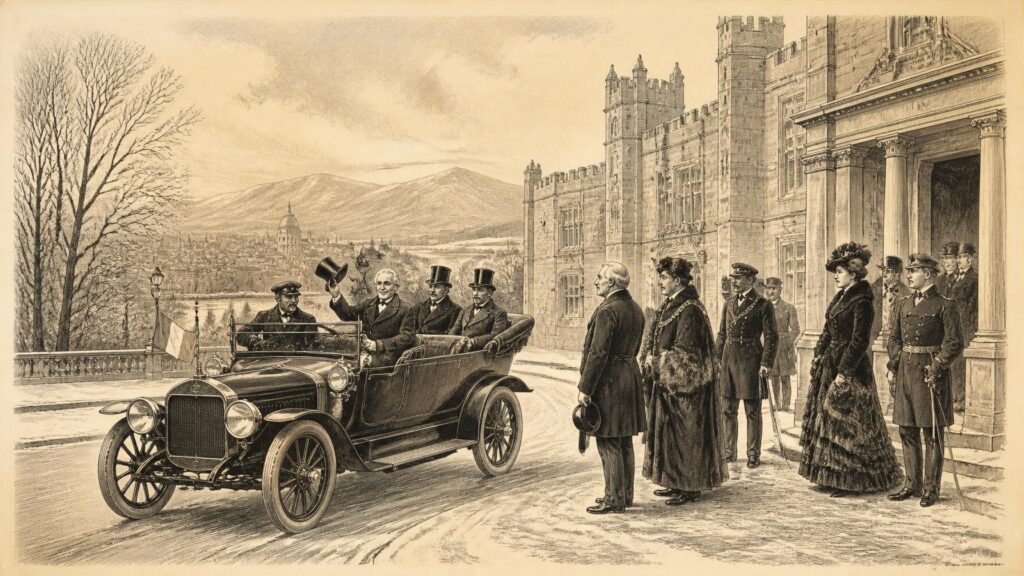
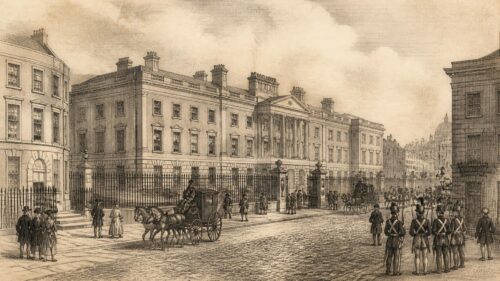
AI generated historical illustration, not a contemporary photograph.
At a Glance
President Catherine Connolly’s official visit to Northern Ireland, undertaken from 4 to 6 February 2026, was a contemporary event shaped at every turn by history. It was the first official visit of her presidency, but it was also an encounter with the enduring consequences of partition, the memory of the Troubles, the constitutional imagination of the Republic, and the practical work of reconciliation in Belfast and Derry. Its significance did not lie in any alteration of sovereignty or law. Rather, it lay in the careful public performance of recognition: an Irish president meeting the joint leaders at Stormont, speaking of consent and differing aspirations, and visiting institutions which preserve sharply different accounts of the past.
First Journey
Catherine Connolly’s visit was announced by the Office of the President as a three-day official journey to Northern Ireland. It began on Wednesday 4 February 2026, continued in Derry on 5 February, and concluded there the following day. The choice of destination had been foreshadowed in her inauguration address of 11 November 2025, when she stated that her first official visit would be to the North. That promise gave the journey an importance beyond the normal programme of presidential engagements. It made Northern Ireland not an incidental destination but the opening external setting of her presidency.
The word “official” requires some care. Northern Ireland is part of the United Kingdom; the President of Ireland has no executive authority there. The journey was not a state visit, a diplomatic negotiation, or an exercise of governmental power. It was a representative visit by the head of the Irish State, undertaken within an island whose constitutional and political arrangements are deliberately complex. The Irish presidency is principally a constitutional office, while foreign relations and policy are conducted by the Government. Yet presidents have long had a capacity to give public form to values, memory and connection. In Northern Ireland especially, symbolism can be consequential without being coercive.
Connolly’s itinerary was therefore a statement in itself. Her programme included Stormont Castle, Ulster University, community initiatives in Belfast, Derry Guildhall, the Siege Museum, An Cultúrlann, the Museum of Free Derry, the Nerve Centre and youth organisations. These were not interchangeable venues. Some represented devolved institutions and civic authority; others preserved unionist, nationalist, Irish-language, victims’ or cross-community traditions. Taken together, they placed the President among communities that do not share one settled interpretation of Irish or British history.
That was appropriate to the political culture created since 1998. The Belfast Agreement did not ask people in Northern Ireland to surrender their identities or to agree upon a single past. Instead, it created arrangements through which people identifying as British, Irish or both could participate in public life, while the constitutional status of Northern Ireland rested upon the principle of consent. A presidential visit to the region could therefore not be historically innocent. Even the vocabulary of place, nationality and tradition carried meanings accumulated over generations.
Constitutional Ground
The immediate constitutional context of the visit lay in the changes brought about by the Belfast Agreement, also widely called the Good Friday Agreement, signed on 10 April 1998. That agreement was not merely a peace accord in the narrow sense. It reshaped relationships within Northern Ireland, between Northern Ireland and the Republic, and between Ireland and Britain. Its interlocking institutions recognised that durable peace required more than the cessation of violence. They required power sharing, cross-border co-operation, formal recognition of equal legitimacy and a constitutional method for deciding the territory’s future.
For the Republic of Ireland, the agreement was accompanied by the Nineteenth Amendment of the Constitution. The earlier constitutional claim over the whole island was replaced by Articles 2 and 3 in their present form. Article 2 affirms the entitlement and birthright of persons born on the island to be part of the Irish nation, subject to legal provisions concerning citizenship. Article 3 expresses the aspiration to unite the people who share the island’s territory, but explicitly ties that aspiration to harmony, friendship, peaceful means and the democratically expressed consent of majorities in both jurisdictions.
This language matters because it creates a distinction sometimes blurred in political speech. Irish unity remains constitutionally envisaged by the Republic, but it is not constitutionally authorised through unilateral action. Nor does the Constitution deny the legitimacy of British identity or the existing constitutional position of Northern Ireland. The aspiration is framed around plural identity and consent. Connolly cited this constitutional language in substance during her Ulster University address. Her choice was significant: she did not abandon a constitutional objective, but presented it through the vocabulary that the post-1998 settlement requires.
The Belfast Agreement likewise recognises the right of the people of Northern Ireland to identify and be accepted as Irish, British or both, and to hold British or Irish citizenship or both. Its constitutional architecture was designed to remove the presumption that identity should determine exclusion. This did not make identity uncomplicated. It did, however, change the official terms on which governments and institutions were expected to address it. A visit by an Irish president to Northern Ireland takes place inside that framework, not outside it.
Connolly’s remarks in Belfast made this setting explicit. She referred to the agreement as a watershed and stressed its multiple elements: devolved power sharing, cross-border institutions, peaceful methods of dispute resolution, cross-community consent, demilitarisation, decommissioning and recognition of British and Irish identities. Such a list was more than ceremonial recitation. It located her visit within the settlement’s language of mutual guarantees rather than within an older language of rival territorial claims.
There is an important historical restraint here. The visit did not represent a new agreement between Dublin and Northern Ireland, nor could it settle contemporary arguments about constitutional change. Its value was representational. By invoking Articles 2 and 3 alongside the Belfast Agreement, the President placed an Irish constitutional aspiration and unionist constitutional security in the same public frame. Whether every listener found that formulation convincing is another question. The achievement, if it can be called one, was to make the tension visible without treating it as irresolvable.
Partition Legacy
The political meanings present in February 2026 cannot be understood without partition. The Government of Ireland Act 1920 provided for separate parliaments in Northern and Southern Ireland. Following the Anglo-Irish Treaty and the establishment of the Irish Free State in 1922, Northern Ireland remained within the United Kingdom. The border did not divide a previously uniform society. It divided territory in which political allegiance, religion, class, language and national identification had long been contested. Yet its creation institutionalised a new constitutional separation and produced enduring minorities on both sides of it.
In Northern Ireland, a unionist majority controlled the devolved government at Stormont for decades. Nationalists and civil-rights campaigners challenged discrimination and unequal treatment in housing, electoral arrangements, employment and policing. The later Troubles did not arise from one single cause, and no responsible history should reduce them to a simple contest between two communities. They emerged from the interaction of constitutional conflict, sectarian division, unequal power, policing crises, paramilitarism, state action and international as well as British-Irish political developments.
The conflict affected every part of the island and Britain, though its heaviest concentration was in Northern Ireland. Thousands were killed, many more were injured, bereaved, displaced or traumatised, and the effects extended far beyond those directly caught in violence. The word “Troubles” can be useful as a conventional label, but it should not soften the scale of human loss. It is also insufficiently precise when discussing particular events. The histories of Bloody Sunday, the bombing campaigns, internment, collusion allegations, prison protest, security policy, loyalist and republican paramilitarism, and political negotiation must each be approached on their own evidence.
That is why a visit combining Belfast and Derry carried a particular weight. Belfast was the administrative centre of Northern Ireland and, during the conflict, a city marked by neighbourhood division, contested streets, industrial change and political mobilisation. Derry was central to the civil-rights movement, the Battle of the Bogside, Bloody Sunday and the political development of John Hume. Both cities became places where large historical processes were experienced in intimate local terms.
The post-1998 era has not erased those histories. It has made possible forms of co-operation, mobility and political participation that would have been difficult to imagine during the worst years of violence. But peace agreements do not mechanically produce shared memory. The past continues to be encountered in family stories, marches, memorials, museums, language, neighbourhood geography, court cases, inquests, public inquiries and arguments over commemoration. Connolly’s visit entered this landscape of living memory rather than a completed chapter of history.
Stormont Meeting
The formal beginning of the visit was Connolly’s meeting at Stormont Castle with First Minister Michelle O’Neill and Deputy First Minister Emma Little-Pengelly. The setting mattered. Stormont is a symbol of devolved government, but it is also a place whose political history includes the old Northern Ireland Parliament, suspended institutions, direct rule and the repeatedly tested structures created after 1998. Meeting the First Minister and Deputy First Minister together reflected the joint nature of the current office, itself a product of power-sharing arrangements.
The presence of O’Neill and Little-Pengelly carried a wider significance. O’Neill, of Sinn Féin, comes from an Irish republican political tradition. Little-Pengelly, of the Democratic Unionist Party, represents a unionist tradition committed to Northern Ireland’s place in the United Kingdom. Their shared offices do not dissolve those political differences; the institutional design assumes their persistence. A presidential meeting with both was therefore a recognition that Northern Ireland’s public authority cannot be represented honestly by only one tradition.
Photographs and brief official reporting can make ceremonial meetings appear effortless. Their historical importance is often found in their very ordinariness. For most of the twentieth century, formal encounters across the constitutional divide were rarer and more politically fraught. In the decades after the Belfast Agreement, high-level contact between Irish representatives and Northern Ireland’s political institutions has become part of public life, though it remains sensitive. The routine act of welcoming an Irish president at Stormont is itself evidence of a changed political environment.
That should not be mistaken for unanimity. The visit received different readings among nationalists, unionists and people who identify in other ways. Some regarded Connolly’s pledge to visit the North first as an affirmation of all-island connection. Others approached her visit cautiously because of her political associations and her stated view of Irish unity. Such reactions belong to the history of the occasion. Reconciliation does not require people to feel the same about constitutional questions. Its more demanding purpose is to permit disagreement without exclusion or violence.
The meeting did not produce a jointly announced initiative, and it would be misleading to imply otherwise. Its documentary importance lies in the fact that it happened at the outset of the visit, in a public and constitutional setting. Connolly’s later language about listening to all backgrounds can be read as an effort to extend that initial gesture beyond executive politics to community life.
Belfast Voices
At Ulster University’s Belfast campus, Connolly delivered the central public speech of the journey. The university setting was appropriate to her theme. Universities are places where historical narratives are researched and disputed, but they are also institutions in which younger generations meet across social and geographical boundaries. Ulster University has campuses and connections across Northern Ireland, and its Belfast campus has been part of the city’s physical and educational renewal. The presidential address therefore joined symbolic politics to an institution concerned with learning, civic life and regional development.
Connolly described Northern Ireland as a lesson that conflict can be resolved and reconciliation fostered. The wording was hopeful, yet it did not deny the depth of injury. She acknowledged that decades of conflict left deep marks and that families continue to live with grief and pain. She also spoke of truth, accountability and justice. This was an important qualification. Peace is sometimes celebrated as though it were simply the absence of armed conflict; victims and survivors have repeatedly insisted that peace must also address the unresolved consequences of violence.
Her address placed particular emphasis on cultural variety. Games, music and languages, she said, should not divide people but should be understood as shared cultural wealth. This formulation echoed a wider post-agreement effort to move culture away from exclusive political ownership. In practice, culture can be among the most difficult fields of reconciliation. Irish language, Ulster Scots, sporting affiliation, flags, parades, commemoration and place names can each become sites of contention. To call them shared treasures is an aspiration, not a description of universal agreement.
Yet the aspiration has historical roots. The Belfast Agreement included commitments connected with cultural rights and parity of esteem. Subsequent debates have shown how difficult implementation can be, but the settlement’s basic premise is that the cultural life of one tradition should not require the diminution of another. Connolly’s stress on multiple histories and identities followed this logic. She did not suggest that cultural distinctions had disappeared; rather, she argued that a society made of different inheritances is richer when none is removed from the account.
The President also referred to Belfast’s forthcoming hosting of Fleadh Cheoil na hÉireann. The event was notable because it would bring a major Irish traditional-music gathering to Belfast. This could be viewed simply as a cultural occasion, but in Northern Ireland cultural events are often read politically. Connolly’s mention of the Fleadh treated Irish traditional culture as part of the city’s public life without asserting that it belonged only to one community. Such framing is consistent with an inclusive reading of the island’s heritage, though audiences may reasonably differ in how they assess its success.
Her Belfast programme included an encounter with PeacePlayers, a cross-community sports organisation. Sport has often been used in Northern Ireland as a means of bringing young people together across sectarian boundaries. It should not be romanticised: a single shared activity cannot undo structural inequality, inherited prejudice or the trauma of loss. But programmes based on sustained contact can create settings in which participants meet people they might otherwise never know. In that limited but real sense, the inclusion of sport on a presidential itinerary complemented the language of reconciliation in the formal address.
Derry Memory
The second day moved to Derry, a city whose names alone disclose the layers of history surrounding the visit. “Derry” derives from the Irish Doire, while “Londonderry” reflects the seventeenth-century plantation and the involvement of London companies. Both names are used, often with political implications, and many people employ one or the other as an expression of identity, habit or local affiliation. It is therefore necessary to state that terminology is not neutral. This article uses Derry because that was the principal form used in the official Irish presidential material, while recognising that Londonderry remains the official name of the city in UK law and the preferred name for many unionists.
Connolly’s civic reception in the Guildhall connected the visit to the city’s civic history. The Guildhall is a prominent public building, but its importance extends beyond architecture. It has functioned as a venue for municipal life, public ceremony and political memory. The building displays John Hume’s Nobel Peace Prize, shared with David Trimble in 1998. Hume, the Social Democratic and Labour Party leader, was one of the principal architects of the peace process; Trimble, leader of the Ulster Unionist Party, was a central unionist figure in the negotiations. Their shared prize remains a powerful reminder that the agreement required leadership across constitutional division.
In her Guildhall address, Connolly described Derry’s movement from conflict towards peace and paid tribute not only to Hume and Trimble but to Martin McGuinness and others who contributed to the peace process. This was a broad framing, but it did not flatten the past into a story of elite achievement. She referred to the importance of projects and organisations working in the community. That was historically apt. Formal negotiations are indispensable in making agreements, but peace is made durable by thousands of less visible acts: youth work, education, arts practice, victim support, dialogue, local government and the daily decision to sustain ordinary relationships.
The Guildhall itself is close to sites associated with civil-rights history and later conflict. In October 1968, a civil-rights march in Derry was violently dispersed by the Royal Ulster Constabulary, an event broadcast internationally and often identified as a crucial moment in the escalation of Northern Ireland’s crisis. The city became a focal point for demands for equality and reform. These events form part of the background against which Connolly’s claim that Derry had shown a path from conflict to peace must be judged. It was an interpretation, but an interpretation grounded in the city’s undeniable role in the history of civil rights and peace-making.
The phrase “path to peace” should nevertheless be handled cautiously. It can suggest an orderly progression which the city’s experience does not support. Derry’s route included injustice, protest, violence, bereavement and decades of contested investigation. The future was not guaranteed at any stage. A more accurate understanding is that local people, organisations and political leaders repeatedly worked to create openings for change, while many families continued to seek acknowledgement and accountability for harms already done.
Siege Histories
The President’s visit to the Siege Museum was especially significant because it brought her into a museum devoted to a central event in Protestant and unionist historical memory: the siege of Derry in 1689. The siege followed the shutting of the city gates by apprentice boys against forces associated with the deposed Catholic King James II. The subsequent defence of the city, deprivation of its inhabitants and eventual relief became defining elements in the political and religious culture of Ulster Protestantism.
It would be a mistake to treat the siege simply as an old episode that has no bearing on contemporary life. Historical events become politically powerful when they are preserved through commemorations, organisations, family memory, songs, ritual and place. The siege’s place in unionist tradition has often been interpreted by outsiders only through caricature. Such treatment makes understanding more difficult. It is possible to recognise that siege commemoration has political meanings, and that its historical interpretation is contested, while also accepting that it constitutes a sincere and important inheritance for many people.
Connolly’s presence at the museum did not require her to endorse every interpretation associated with the siege. Nor did it require unionists to set aside their own convictions. The importance of the visit lay in her willingness to enter a space that represents a historical tradition not naturally associated with the presidency of Ireland. According to official reporting, she received a tour and met Lord Willie Hay. This was a modest event in formal terms, but it carried symbolic force because it acknowledged that no credible account of Derry can exclude the city’s Protestant and unionist past.
This should be distinguished from the idea of a single reconciled history. Reconciliation is sometimes wrongly imagined as requiring people to agree on every event, every victim or every symbol. The more realistic task is to accept that historical inheritance is plural and that public institutions must make room for it. Connolly’s later reference to intertwined and unfinished histories was particularly relevant here. The siege, plantation, civil-rights era, Troubles and peace process are not separate compartments. They are successive and overlapping layers in a city whose inhabitants inherit different memories of power, dispossession, security and belonging.
The visit also recalled the earlier example of President Mary McAleese, whose presidency was closely associated with bridge-building between traditions. McAleese, a Belfast-born president, made engagement with Northern Ireland an important feature of her public role. Historical comparison should not obscure differences in personality, moment or programme, but it helps explain why presidential appearances in Northern Ireland are read through a longer tradition of symbolic contact. Connolly’s journey belonged to that tradition while taking place in a new political and generational context.
Bloody Sunday
Later on 5 February, Connolly visited the Museum of Free Derry and met relatives of people killed and injured on Bloody Sunday. The museum stands in the Bogside, an area central to the city’s civil-rights history. It presents the experience of the Free Derry community between 1968 and 1972, including the Battle of the Bogside, internment, Operation Motorman and Bloody Sunday. Its perspective is explicit: it preserves a community narrative rooted in demands for civil rights, equality and justice.
Bloody Sunday occurred on 30 January 1972, when British soldiers shot civil-rights marchers in Derry. Fourteen unarmed people died, while others were wounded. The event became one of the most consequential and traumatic episodes of the Troubles. Its immediate impact was immense, deepening nationalist anger and distrust and affecting political life throughout Ireland and Britain. Its long afterlife included campaigns by families, investigations, public argument and the eventual Saville Inquiry, which reported in 2010. The inquiry found that none of those killed or seriously injured had posed a threat of causing death or serious injury.
For the President to meet Bloody Sunday families was therefore not a generic victims’ engagement. It was an acknowledgement of a particular history of bereavement and a particular struggle for truth. Such acknowledgement is not the same as the delivery of justice, and it would be insensitive to suggest that ceremonial recognition completes a family’s search for accountability. But public officeholders can contribute to the wider culture in which victims’ experiences are heard rather than ignored. Connolly’s Belfast speech had already referred to the collective responsibility to address families’ needs and questions with integrity. The Derry meeting gave that commitment a specific human setting.
The juxtaposition of the Siege Museum and the Museum of Free Derry on the same day was perhaps the clearest expression of the visit’s historical approach. The two institutions are not mirror images. They concern events separated by centuries, emerged from different communities and serve different memorial purposes. It would be false to make them symmetrical. Yet the decision to visit both acknowledged that Derry’s public history contains more than one story and that engagement must not be confined to an audience already predisposed to welcome the visitor.
There is also a limit to what such balance can mean. Balance is not achieved by pretending that all events were alike, that all historical claims have equal evidential support, or that every grievance can be measured against another. Historical evidence must be assessed on its merits. The stronger point is that respect for one community’s memory need not entail indifference to another’s. Connolly’s itinerary suggested that an Irish president could recognise the gravity of Bloody Sunday while also entering a site of unionist historical remembrance.
Living Culture
Connolly’s engagements at An Cultúrlann and the Nerve Centre broadened the visit beyond constitutional ceremony and conflict memory. An Cultúrlann is associated with Irish-language cultural life in Derry. The Irish language has a long and sometimes politically charged place in Northern Ireland. For many nationalists it is a vital expression of heritage and identity; for some unionists it has historically been viewed through suspicion, particularly where language policy has been connected with wider constitutional politics. Recent legal and institutional developments have sought to provide recognition while avoiding the assumption that Irish language belongs to one political party or religious community alone.
The President met people involved in language classes and a performance workshop for young people with special educational needs and disabilities. The details matter because they show cultural activity operating in social rather than merely symbolic terms. A language centre can be a site of learning, performance, accessibility and community care. To view it only as a marker in an identity dispute would miss much of its actual work. Conversely, to deny its political context would be equally incomplete. Good historical understanding requires both dimensions to be held together.
The Nerve Centre represented another kind of civic culture. Through music, digital creativity, coding, film and animation, it has long worked with young people in Derry and beyond. The President’s visit there brought attention to a post-conflict generation for whom the Troubles are inherited history rather than direct personal experience, though their consequences remain present in families and communities. Young people do not enter a neutral social landscape. They inherit local narratives, segregated spaces, economic pressures and commemorative habits. But they also create new forms of relationship and expression.
The final day’s youth engagement reinforced that point. Connolly met young people involved in cross-community and cross-border initiatives, including groups connected with peace and reconciliation work. Such meetings are often described in optimistic language, and optimism is understandable. However, their historical importance should not be exaggerated into proof that old divisions have disappeared. Youth work is not a substitute for political reform, economic investment, truth recovery or institutional fairness. It is one strand among many. Its value lies in making contact and cooperation possible where inherited assumptions might otherwise remain unchallenged.
In this respect the visit echoed a recurring lesson of the peace process: reconciliation is not only negotiated in conference rooms. It is practised in classrooms, sports halls, arts centres, museums, libraries and neighbourhood organisations. That proposition can sound familiar, but it remains important because public attention tends to focus on political crisis. A presidential itinerary which gives time to local organisations can make visible the quieter labour that sustains peace between moments of constitutional drama.
Careful Language
Words were among the most important features of Connolly’s visit. In Northern Ireland, vocabulary may signal recognition, allegiance, exclusion or respect. “North”, “Northern Ireland”, “Derry”, “Londonderry”, “these islands”, “our country”, “shared island”, “British”, “Irish” and “unionist” each carry contexts that cannot be ignored. The President’s address at Ulster University was notable for its effort to speak inclusively without concealing political difference.
She said that people would have different perspectives and aspirations for the future, and that all were legitimate. This was a carefully calibrated formulation. It did not ask unionists to embrace Irish unity, nor did it ask nationalists to renounce it. Instead, it placed both positions inside a civic framework founded on peaceful consent. Such language is not politically neutral in the sense of having no implications; it derives directly from the constitutional and agreement-based order created after 1998. But it is designed to be non-coercive.
Connolly’s description of the island’s past as intertwined and unfinished also deserves attention. It rejects the idea that communities lived wholly separate histories, sealed from one another. Historically, that claim is persuasive. Ireland and Britain have long shared migration, trade, war, religion, language, political institutions and family ties. Within Northern Ireland, communities have lived beside one another even where residential patterns, schooling and political institutions reinforced separation. Their histories are connected, though connection has often involved unequal power and conflict rather than harmony.
The term “unfinished” is equally important. It resists premature closure. The constitutional question is not settled in the sense that future change is impossible; the Belfast Agreement sets out a process by which change may occur if democratic consent is obtained. At the same time, the past is unfinished because many victims’ cases, historical investigations and collective arguments remain unresolved. The phrase can therefore encompass both future constitutional possibility and the continuing work of dealing with legacy.
There is a risk in language of this kind. Broad formulations can sound abstract to people whose lives have been marked by specific losses or by concrete political exclusion. They can also be heard as evasive where communities seek clear positions. But the presidency is not a party-political platform. Its distinctive contribution may lie precisely in articulating principles of recognition which are harder to sustain in adversarial debate. Connolly’s language was best understood as an attempt to occupy that role, not as a claim to have solved the disputes she named.
Public Reception
The reception of the visit showed that historical sensitivities remain active. Reporting noted moments of warmth, reserve and disagreement. The encounters were not uniformly dramatic, and that may itself be revealing. In a society emerging from prolonged conflict, the ability to conduct public disagreement within ordinary civic settings is a substantial achievement. It should not be taken for granted, particularly when constitutional identity remains deeply felt.
At the Guildhall, Connolly’s exchange with Democratic Unionist Party MP Gregory Campbell attracted attention after he challenged aspects of her language. The episode illustrated the difficulty of speaking in a city where nomenclature and historical acknowledgement are politically charged. It also demonstrated that disagreement need not prevent contact. A conversation in which a politician voices objection and a visiting president responds courteously is far removed from consensus, but it is also far removed from the violent political culture that once structured so much public life.
Interpretation of the visit varied. Supporters of Irish unity could see the President’s journey as a confident affirmation of the all-island dimensions of Irish public life. Unionists could reasonably scrutinise whether her language and itinerary adequately acknowledged their constitutional position and historical tradition. Others may have judged the event principally by its attention to victims, youth groups, culture or community organisations. No single response can stand for Northern Ireland, whose population includes people of many political, national, religious and ethnic backgrounds.
It would be unhistorical to claim that a three-day visit transformed those attitudes. Symbolic visits rarely do. Their effects are cumulative, uncertain and often visible only in retrospect. They can widen the range of who is publicly acknowledged, establish precedents for further contact, or provoke debate which clarifies unresolved tensions. They may also be forgotten rapidly if not followed by sustained institutional and community work. The most defensible conclusion is modest: Connolly’s programme created occasions for recognition across differing historical traditions and made her presidential priorities visible.
The visit’s official character also gave it archival value. Speeches, press releases, photographs and diary entries now record what was said and where the President went. Future historians will compare these materials with contemporary reporting, private recollection and later political developments. They will ask how far the language of inclusion reflected public attitudes, whether subsequent engagements built upon it, and how the visit was remembered by the organisations involved. For now, the evidence permits a narrower judgement: the journey was consciously designed as an encounter with the plural histories of Northern Ireland.
Historic Measure
Calling the visit historic does not mean declaring it monumental. The word should be used with discipline. It was not comparable in constitutional consequence to the Belfast Agreement, the referendums of 1998 or the major turning points of the peace process. It did not create institutions, amend law or resolve legacy cases. Its historical significance is of a different order. It marked the first official Northern Ireland visit of a new Irish president and placed that presidency publicly within the language of consent, equality of esteem and all-island relationship.
Its itinerary supplied the clearest measure. Stormont Castle represented devolved political authority. Ulster University represented public education and civic exchange. Derry Guildhall recalled the city’s civic life and the peace process. The Siege Museum represented a powerful unionist historical tradition. The Museum of Free Derry confronted one of the most painful episodes in nationalist memory. An Cultúrlann and the Nerve Centre pointed towards language, culture, creativity and young people. These places did not tell a single coherent story, because Northern Ireland does not possess one uncontested public narrative.
Connolly’s contribution was to move among them without claiming that their differences had vanished. Her speeches stressed both aspiration and constraint: Irish unity only by peaceful, democratic consent; differing aspirations as legitimate; reconciliation as continuing work; families’ needs for truth, accountability and justice; and shared heritage as something enriched, not diminished, by difference. This was a political language shaped by the constitutional settlement after 1998, but also by an awareness that settlement remains incomplete in practice.
Folklore and ceremonial optimism have often promised easy reconciliation in Ireland. The evidence offers a harder lesson. Peace was achieved through prolonged negotiation, public courage, institutional design and repeated compromise. It is maintained by daily labour, and it remains vulnerable to mistrust, inequality and unresolved memory. The appropriate interpretation of Connolly’s northern visit is therefore neither triumphalist nor cynical. It was a limited but meaningful act of public recognition, conducted in places where history remains intensely present.
For Emerald Archives, its enduring interest lies in that tension. The journey was contemporary, yet every stop drew upon deep historical strata: plantation and siege, partition and civil rights, bereavement and inquiry, language and culture, peace accords and constitutional aspiration. President Connolly did not arrive in a blank political landscape. She entered an unfinished story, and her visit became one further document within it.
Connolly’s itinerary suggests that representative politics can acknowledge competing memories without requiring a single agreed narrative. Her visits to Stormont, the Siege Museum, the Museum of Free Derry and cultural organisations placed constitutional consent, unionist heritage, nationalist experience and cross-community work within one presidential frame. Yet the article also notes that inclusive language is an aspiration rather than proof that audiences experience symbols equally. The visit therefore raises an interesting question about the limits and possibilities of ceremonial recognition in a society where places, names and commemorations remain politically charged. How might Irish presidential visits enable respectful disagreement across communities?