Dublittir’s Tara Congress780 CE
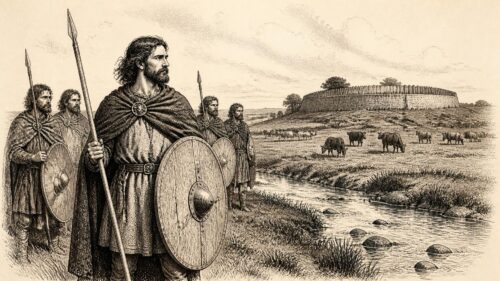
In 780, Donnchad Midi, king of Tara, campaigned against Ruaidrí of Leinster near Óchtar Ocha, driving him away and devastating territory and churches. At Tara, Dublittir, abbot of Finglas and Céli Dé leader, presided over a gathering of Uí Néill and Leinster synods, attended by anchorites and scribes, possibly seeking settlement after conflict. The third enforcement of the law of Comán and Aedán demonstrated church-backed legal authority. Annals also noted April snow, deaths among religious figures, Colgu’s victory over the Airthir, and burnings including Dumbarton Rock. Together, these notices reveal warfare, ecclesiastical mediation, law, learning, weather and Irish Sea connections.

Dateline
The surviving record for 780 is unusually revealing, not because it supplies a continuous narrative, but because its short notices bring royal coercion, ecclesiastical mediation, legislation and harsh weather into the same frame. Ireland remained a land of many kingdoms rather than a centrally governed state. Yet the year’s evidence shows how strongly the king of Tara, Donnchad Midi of Clann Cholmáin, could intervene beyond Mide, and how churchmen could assemble at Tara to address matters touching both the Uí Néill and Leinster.
A chronological caution is necessary. The principal cluster of notices is conventionally cited as Annals of Ulster 780, although the surviving annal’s calendrical calculation gives AD 779 beside that entry. Modern historians commonly connect Donnchad’s Leinster campaign and the Tara gathering with 780. The sources do not provide dates within the year for either event. The April snowfall is the rare exception: it is explicitly assigned to that month. Where the evidence is brief, the safest course is to preserve its limits.
Donnchad and Leinster
The most important political event was Donnchad Midi’s assertion of authority over Leinster. Donnchad was king of Tara and leader of the southern Uí Néill, based in Mide. His position did not make him a sovereign ruler of all Ireland in any modern sense, but it gave him an exceptional claim to precedence, backed by alliances, military followings and access to the symbolic landscape of Tara.
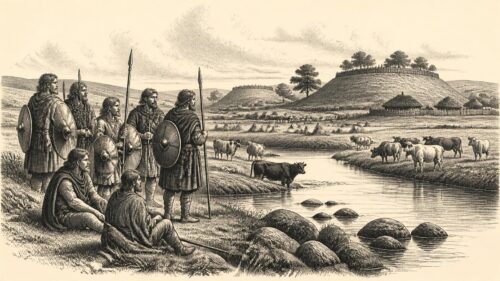
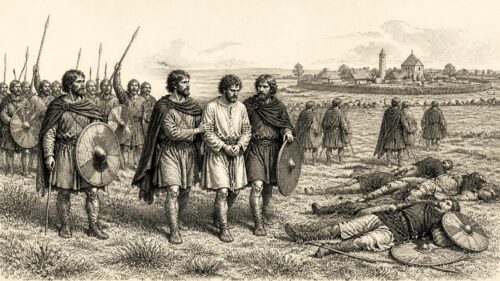
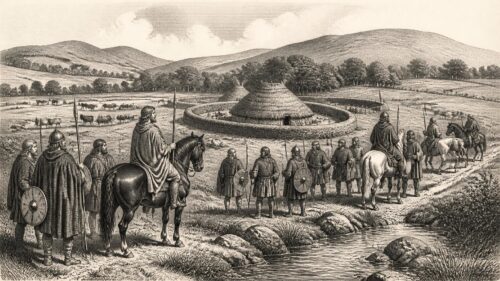
The annal records the flight of Ruaidrí from Óchtar Ocha, together with Cairpre son of Laidcnén and two Leinster kin-groups. Donnchad pursued them with his supporters, devastating and burning their territory and churches. A short verse attached to the notice celebrates the overthrow at Óchtar Ocha in grim, conventional language: hosts clash, blood flows and a company loses life. It does not name casualties, describe tactics or say that Ruaidrí himself was captured or killed. The essential fact is that he escaped while Donnchad’s force punished the district from which resistance had come.
Ruaidrí son of Fáelán was king of Leinster. Later historical reconstruction places the encounter near Kilcock, on the Kildare–Meath border, but the annal itself names Óchtar Ocha, not a modern town. That distinction matters. The episode should not be turned into a precisely mapped battle when the contemporary record does not allow it. What can be said is that it occurred on the contested approach between Mide and north Leinster, an area where a king of Tara could project force south-eastwards and where Leinster’s rulers had reason to resist.
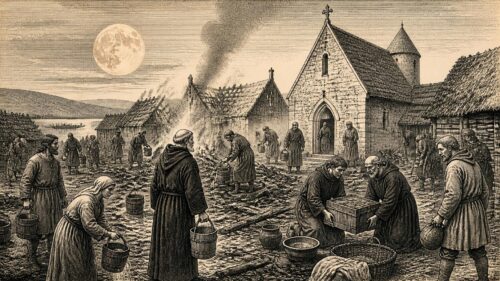
The burning of churches is particularly striking. It was not an accidental side-effect omitted from the record; it is explicitly included as part of the punitive campaign. Churches were religious places, but they were also local centres of landholding, agricultural production, hospitality, literacy and political connection. An attack upon them could damage a rival’s resources and standing as well as create a moral and legal offence. The notice therefore exposes a basic tension in early Irish politics: rulers relied on ecclesiastical institutions for legitimacy and administration, yet did not always spare them in war.
A Congress at Tara
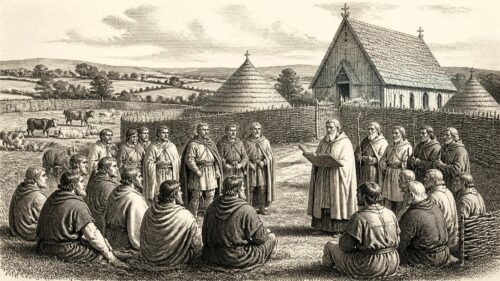
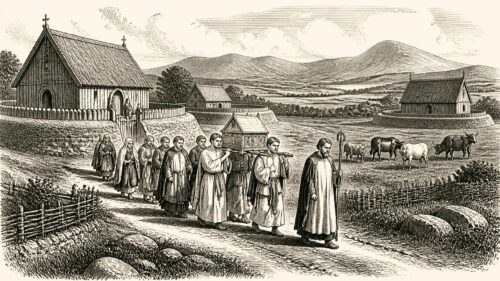
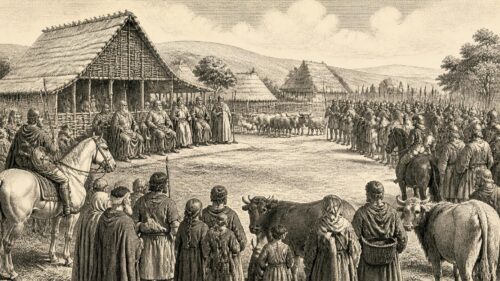
Against that violent background, the annal records a congressio senodorum at Temair, Tara: a gathering described in translation as a congress or meeting of the synods of the Uí Néill and the Leinster people. Many anchorites and scribes attended, and Dublittir was their leader. This is the year’s most remarkable ecclesiastical notice.
The wording does not preserve the decisions taken, nor does it explicitly state that Donnchad attended. Nevertheless, Tara lay within the political world over which he presided, and modern scholarship reasonably treats the meeting as one facilitated by his authority. The connection between the Leinster campaign and a gathering bringing together Uí Néill and Leinster representatives is compelling, but it remains an interpretation rather than a recorded resolution. The assembly may have sought peace, settlement, ecclesiastical protection, or an agreed response to the disorder between the two political blocs. Its agenda cannot be recovered word for word.
Dublittir gives the event a sharper character. He was abbot of Finglas, north of present-day Dublin, and one of the leading figures of the Céli Dé reform movement. The Céli Dé promoted more exacting religious observance and monastic discipline, while remaining deeply involved in the social world around their communities. His leadership of a gathering containing anchorites and scribes suggests a body with spiritual prestige and learned expertise, not merely an audience of royal retainers.
The terminology itself deserves care. Scholars have debated whether the Latin phrase should be understood straightforwardly as a meeting of synods or whether its language carries a more political sense of an assembly of leading men. Either way, the participants named in the annal make clear that religious specialists were central. Anchorites represented an ascetic ideal; scribes brought literacy, record-keeping and legal knowledge. Their presence at Tara shows that mediation in a conflict-ridden society could be conducted through networks of churches and learned communities as well as through armed negotiation.
Tara was an especially powerful setting for such a meeting. Its surviving earthworks belong to many periods and cannot be used to reconstruct the physical arrangements of the congress. No excavated hall can be identified as Dublittir’s meeting place. But the hill’s long-standing ceremonial and royal associations made it an apt location at which a king of Tara could display authority and churchmen could seek an island-wide moral hearing. In 780, its importance was as much political theatre and remembered sovereignty as permanent urban administration.
The Law of Comán and Aedán
The same annal entry states that the third enforcement of the law of Comán and Aedán began. This concise formula is important but frustrating. It names neither the territory covered nor the actual provisions. The text of this particular law has not survived. It would therefore be wrong to claim that it introduced a known list of rules in 780, or to describe it as a modern-style statute.
Still, the notice belongs to a recognisable early Irish practice. A cáin, or enacted law associated with saints and church institutions, could depend upon royal backing and public proclamation. Such measures drew authority from religion, learned legal culture and the capacity of rulers to enforce penalties. Earlier annals record a second enforcement of the law of Comán and Aedán in 772, specifically among the three Connachta. That earlier geographical detail cannot automatically be transferred to the 780 notice, but it suggests that the law had an established history and that its third enforcement was not a casual local observance.
The juxtaposition of this law with the Tara congress is revealing, even if the notices do not say that they were parts of one programme. In a landscape of competing petty kingdoms, law was not simply written down and imposed by an impersonal government. It had to be proclaimed, accepted and renewed through alliances among churchmen, learned men and secular rulers. The year thus preserves evidence of both the destruction caused by royal warfare and attempts to set moral or legal limits around society.
Snow, Death and Religious Communities
The annals record a great snowfall in April; the Annals of Inisfallen, independently though tersely, also note abnormal snowfall. This is firm evidence for an exceptional weather event, but not for a famine, failed harvest or national crisis. April snow could have troubled lambing, travel and spring work, especially in upland districts, yet the sources do not report those consequences. The responsible conclusion is narrower: contemporaries judged the snowfall memorable enough to enter in chronicles.
Several deaths recorded in the annual notices illuminate the density of religious and learned institutions. Ailill, abbot of Lothra, died according to the Annals of Inisfallen. Lothra, now Lorrha in north Tipperary, stood on an important route between Munster, Mide and Connacht. The Annals of Ulster also record the death of Mac Leinne, abbot of Inis Bairenn; Forblaith daughter of Connla, abbess of Cluain Brónaig; Maicnia son of Cellach, abbot of Dún Lethglaise; and figures associated with Bangor, including Augustin and the learned Nádarchú.
These notices should not be treated as a complete directory of Irish religious life. Annals select people who mattered to the communities preserving the record. Even so, they demonstrate that authority was not exclusively male or secular. Forblaith’s commemoration as abbess is evidence of a woman holding recognised institutional rank. The designation of Nádarchú as “the learned” likewise reminds us that scholarship itself was a public distinction. The personnel of monasteries, churches and associated schools were part of the political and cultural fabric of the island.
Another notice reports that Colgu son of Cellach defeated the Airthir, with many of the “lower orders” falling. The phrase is chillingly imprecise. It indicates substantial losses among people of lesser rank, but offers no names and no explanation of the dispute. Colgu’s victory belonged to the fractured politics of the north-east, where local rulers and peoples could be drawn into contests beyond the better-known rivalry of Tara and Leinster. It is a useful corrective to any picture of Donnchad’s kingship as uncontested control.
An Irish Sea Horizon
The annal dossier also records the burning of Ail Cluaithe, Dumbarton Rock on the Clyde, on 1 January, as well as burnings at Cluain Bairenn and Balna. Ail Cluaithe lay outside Ireland, but its fate belongs to the Irish Sea world in which Irish, British, Pictish and Gaelic-speaking communities were linked by sea travel, kinship, warfare and ecclesiastical contacts. The entry does not identify the attackers. Nothing in the record permits the event to be confidently assigned to Vikings, Irish raiders or any other specific force.
For Ireland, the significance is contextual rather than direct: the sea was not a frontier enclosing the island. News, people and violence moved across it. Yet 780 itself predates the first securely recorded Viking attacks on Irish monasteries in the annals. Its Irish story is consequently not one of Scandinavian raiding, but of native dynastic conflict, ecclesiastical activism and the continuing importance of learned religious communities.
Seen together, the notices from 780 show a society in which authority was continually made and remade. Donnchad could drive a Leinster king from a contested borderland and burn churches in the course of doing so. Dublittir could lead anchorites and scribes at Tara, where Uí Néill and Leinster interests met under ecclesiastical auspices. A saintly law could be proclaimed for a third time, while an extraordinary April snowfall interrupted the expected pattern of the seasons. The sources leave much unsaid, but they preserve a vivid truth: warfare, worship, law and the natural world were inseparable features of political life in early medieval Ireland.
Primary Sources
- The Annals of Ulster, Year U780
- The Annals of Ulster, Year U781
- The Annals of Ulster
- Annals of Inisfallen
- The Annals of Inisfallen (MS. Rawlinson B. 503)
- Donnchad Midi
- Dublittir
- Councils and Synods of the Gaelic Early and Central Middle Ages
- Irish Hagiography and Its Dating: A Study of the Ó Donohue Group of Irish Saints’ Lives
- The Céli Dé and Ecclesiastical Government in Ireland
- The Early Irish Law Text Senchas Már and the Question of Its Date
- The Annals of Ulster, Year U772
- Cáin Adomnáin and the Laws of War
- Irish Law in the Time of Adomnán
- Lex Innocentium (697 AD): Adomnán of Iona – Father of Western Jus in Bello
- Early Irish Law
- Donnchad mac Domnaill (733–797), High-King of Ireland
- The Annals of Tigernach
- List of Published Texts at CELT
- Hill of Tara
- Hill of Tara Highlights
- Early Christian Monasteries
- Christian Ireland, Fifth to Eighth Centuries
- Hill of Tara: Seat of the High Kings of Ireland