Caemgen’s Relics on Tour789 CE
Dateline
The Irish annal entered under AD 789 in the modern edition of the Annals of Ulster presents a country of intensely local politics, powerful churches and fragile material settlements. Its internal annal number is U790, a reminder that early Irish chronologies require care; nevertheless, the editor’s calendar heading places the cluster of notices considered here in 789 CE. The record does not describe one national event. Instead it preserves sharp glimpses from Connacht, Ulster, Leinster, Munster and the Dublin region: a battle at Áth Rois, deaths among kings and abbots, a major killing in the north-east, a church burned, and, most memorably, a circuit made with the relics of two saints.
Áth Rois and Connacht Rivalry
The clearest military event securely assigned to the year is the battle of Áth Rois. The Uí Ailella defeated the Luigni, and Dub da Tuath, described as chief of the “Three Septs”, was killed. The terse wording conceals more than it reveals. Neither the precise site of Áth Rois nor the immediate quarrel is explained by the annalist, and it would be unsafe to supply a campaign narrative or a body count. Yet the entry plainly records more than a minor affray. The death of a leader identified through several kindreds suggests that the encounter affected the balance of authority among peoples of north Connacht and the neighbouring districts.
This was not an isolated flash of violence. In the preceding annal section, the same broad region had seen fighting among the Connachta, the defeat and escape of Fogartach son of Cathal, and a slaughter of Luigni by the Uí Ailella at Achad Abla. Those notices belong to the immediately surrounding annalistic context, rather than being securely datable to a precise day in 789. Together with the battle of Áth Rois, however, they show that control of Connacht was contested below the level of provincial kingship. Kin-groups, subordinate rulers and military followings could shape affairs through raids, cattle-taking, alliances and sudden battles. Political geography was made from such local struggles as much as from the ambitions of famous overkings.
For households in the affected country, warfare had practical consequences. Armies needed food, animals, guides and transport; their movement endangered crops, herds and unfortified dwellings. The annals chiefly name elite casualties, but the killing of a leading man normally implied losses among his followers as well. This should not be mistaken for evidence that all Connacht was at war. Rather, 789 illustrates the unevenness of early medieval Irish politics: one district could be violently disputed while life elsewhere continued through seasonal farming, stock-rearing, craft production and religious observance.
Death and Division in the North
Ulster’s political world was also unsettled. Tomaltach son of Innrechtach, king of Dál nAraidi, died in the year. The annal separately records “a great slaughter of the Ulaid by the Dál nAraidi”. It does not state that Tomaltach’s death caused the slaughter, nor does it identify a battlefield, opposing commander or succession. These are two related notices from the same northern sphere, not proof of a single connected episode. Still, they reveal the intensity of rivalry within and around Ulaid.
“Ulaid” could refer to a wider regional political community, whereas Dál nAraidi was a major dynasty in north-east Ireland, often competing with the Dál Fiatach for pre-eminence. The distinction matters. The annalist’s wording does not depict an external invasion of Ulster, but a devastating conflict involving peoples of the region itself. Leadership changed hands through death, and claims to kingship rested not on a fixed state apparatus but on kinship, armed support, clientship and the ability to defend or extend rights over land and people.
The death notices make the island’s plurality especially visible. Cinaed son of Anmchad, king of Uí Liatháin in southern Munster, also died. He was a ruler of a comparatively small kingdom, yet his passing was worth recording alongside that of the northern king. Ireland in 789 was not a united kingdom in the modern sense. It was a landscape of overlapping lordships, ecclesiastical territories and regional peoples. The annals’ selection of deaths demonstrates who commanded attention within the networks that supplied information to monastic record-keepers.
Churches as Communities
The same year brought the deaths of Nóe, abbot of Cenn Garad; Dúngal son of Lóegaire, abbot of Dún Lethglaise; Máel Combaír, abbot of Glenn dá Locha; and Siadal, abbot of Duiblinn. These were not simply private bereavements. An abbot could direct a substantial religious household, oversee land and livestock, receive guests and pilgrims, maintain alliances with ruling families, and protect a saint’s inherited rights. The succession to an abbacy therefore mattered to surrounding communities as well as to resident clergy.
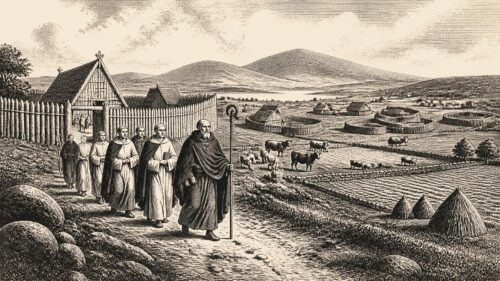
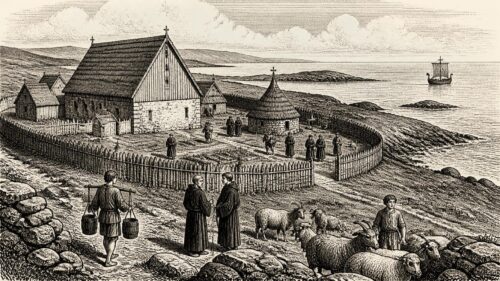
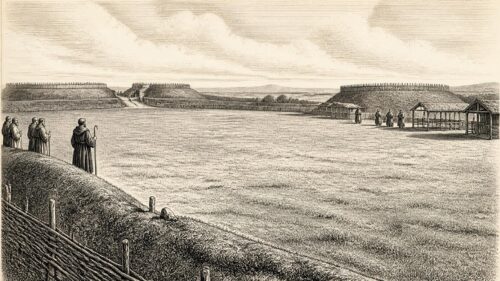
The places named span a striking range. Dún Lethglaise, later Downpatrick, stood in the north-east; Glenn dá Locha, Glendalough, lay in its Wicklow valley; and Duiblinn was an ecclesiastical settlement near the dark pool from which Dublin took its name. Their presence in a single annal shows connections across the island, although it does not mean that their communities were centrally governed. Early Irish monasteries were not remote, uniform cloisters. Many were enclosed settlements containing churches, dwellings, workshops, storage areas, cultivated ground and grazing animals. Clerics, tenants, dependants, visitors and lay workers all helped sustain them.
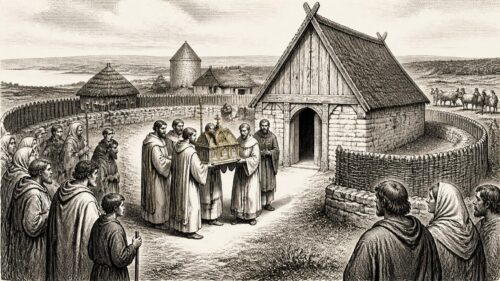
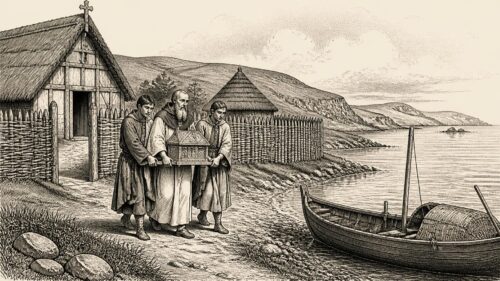
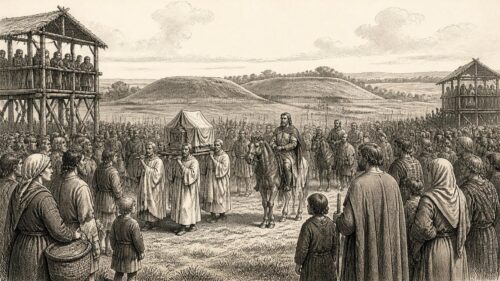
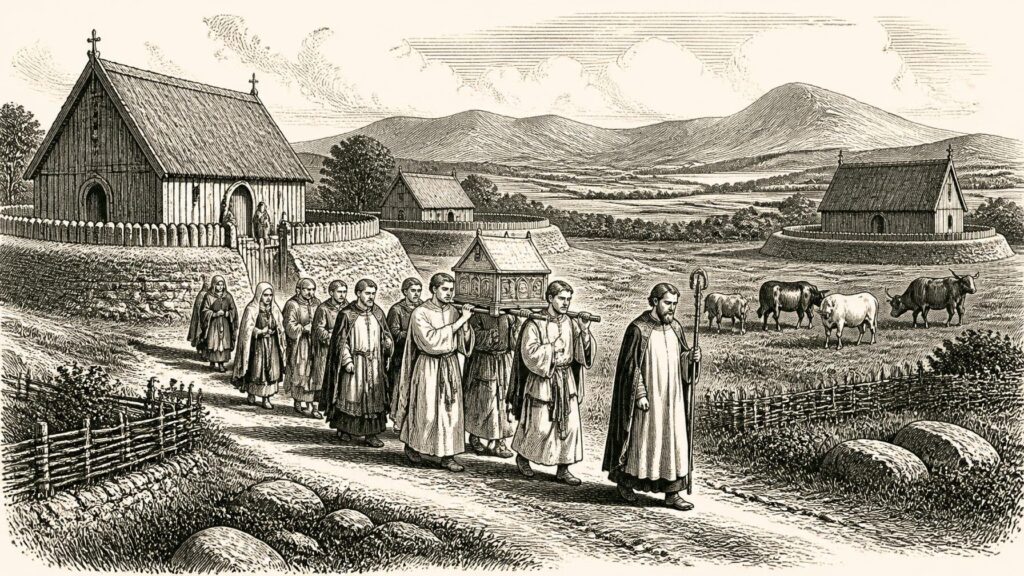
That setting gives proper weight to the year’s most distinctive religious notice: “the taking on tour of the relics of Caemgein and of Mo-Chua moccu Lugedon.” Caemgen, better known as Kevin, was the patron saint of Glendalough; Mo Chua was associated with Clondalkin. Both had long been dead. What moved in 789 were revered physical remains or objects connected with them, treated as tangible embodiments of saintly protection and authority.
A Circuit of Holy Things
The annal does not give the route, duration, organisers, audiences or stated purpose of this relic-tour. It should therefore not be imagined as a documented procession through every settlement between Glendalough and Clondalkin. Nor can it be safely called a response to famine, war or disease. What can be said is that such a journey made religious prestige mobile. Relics could be carried to assemblies, churches and client communities; they allowed a church to display the continuing power of its founder, to renew relationships and to make claims visible beyond its own enclosure.
The joint circuit is especially revealing because it brought together the cults of saints associated with two important Leinster churches. It points to cooperation, or at least coordinated ceremonial action, between ecclesiastical interests. A relic was not merely an object of devotion. It could validate oaths, attract offerings, mark a church’s jurisdiction and draw crowds. The movement of relics consequently linked belief with economy and politics. People might provide food, hospitality, animals or other dues to those accompanying them; local rulers could seek the prestige of association; and churches could reinforce their rights before a wide public.
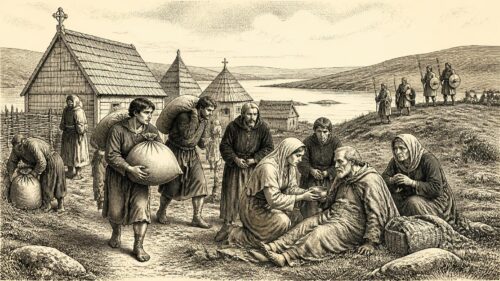
For ordinary participants, the circuit offered a rare communal occasion. It may have brought together farmers, craftspeople, dependants and clerics from dispersed rural settlements, though the annal does not allow their numbers to be recovered. Prayer, preaching, gift-giving and negotiation could take place in the same gathering. The relics’ journey makes visible a society in which sacred authority travelled along roads, tracks and river crossings, rather than remaining confined within church walls.
Fire, Vulnerability and Wider Seas
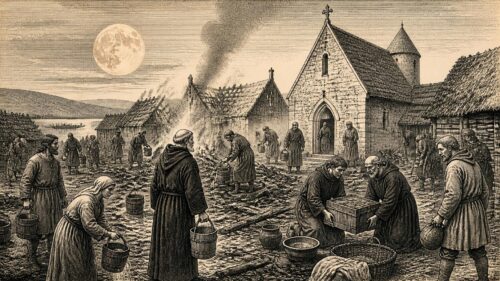
Another brief but sobering notice records the burning of Echdruim Mac nAeda. The source does not identify the perpetrators or cause. It must not automatically be labelled a raid, accident or political attack. Yet the fact that the burning was recorded shows the significance of the place, probably an ecclesiastical settlement. Early medieval Irish buildings were commonly constructed from timber, wattle and thatch, with even churches often made of wood. Fire could thus destroy housing, stores, workshops, books and liturgical equipment with alarming speed. Rebuilding required labour, timber and the goodwill of patrons.
The annal also notes that accounts elsewhere placed a battle between Conall and Custantín in the same year. This was a Pictish conflict in northern Britain, not an Irish event, but its appearance in an Irish chronicle reflects the connected world of the Irish Sea. Clerics, scholars and political families maintained contacts across the water, especially with Iona and western Scotland. It is important, however, not to read later Scandinavian attacks backwards into 789. The Irish annals’ famous notices of raids on Irish islands belong to later years. In this year’s evidence, the dominant dangers were internal conflict, local competition and the vulnerability of settlements to fire.
A Year of Moving Authority
In 789, authority moved in several senses. It moved militarily at Áth Rois, where a local leader fell and the Uí Ailella prevailed. It changed hands through the deaths of rulers and abbots from Uí Liatháin to Dál nAraidi, Down, Glendalough and Duiblinn. It travelled ceremonially when the relics of Kevin and Mo Chua were taken on tour. And it was imperilled when Echdruim Mac nAeda burned. The surviving notices are fragmentary, elite-centred and often frustratingly brief. Even so, they offer a coherent picture of Ireland as a densely connected island whose political, economic and spiritual life depended on local communities, rival dynasties and influential churches.
Primary Sources
- The Annals of Ulster, Year U790 (AD 789)
- The Annals of Ulster, Year U789
- The Annals of Ulster: CELT Project Edition
- The Annals of Ulster: Latin and Irish Text
- Annála Uladh: Annals of Ulster Otherwise Annala Senait
- Irish Texts at CELT
- Annals of Inisfallen, Annals 790–799
- Annals of Inisfallen: CELT Edition
- The Annals of Tigernach: CELT Edition
- Fragmentary Annals of Ireland: CELT Edition
- Chronological Synchronisation of the Irish Annals
- Daniel P. McCarthy, Research and Publications on Irish Annalistic Chronology
- Daniel P. McCarthy, Trinity College Dublin Research Profile
- The Chronology and Sources of the Early Irish Annals
- Clondalkin Round Tower
- Glendalough Monastic Site and Visitor Centre
- Life in Glendalough
- Early Christian Monasteries
- Patrician and Early Christian Architecture
- Early Irish Monasticism
- Early Monastic Churches
- Churches and Ecclesiastical Enclosures
- Built to Last: The Dál nAraidi and Early Medieval Ulster
- The Historical Development of Glendalough
- The Onomasticon Goedelicum