Gola and Umall786 CE
In 786, annalistic evidence depicts Ireland as politically fragmented but connected by ecclesiastical networks. In Connacht, the Uí Briúin were defeated at Gola, while the Uí Fhiachrach of Muirisc killed Flaithgal of Umall and his nobles; Tipraite of Connacht and Conall of Uí Maine also died. In the north, Máel Dúin of Cenél nEógain defeated and expelled Domnall of Cenél Conaill. Dub dá Bairenn, abbot of Clonard, visited Clonard’s Munster ecclesiastical sphere. Deaths among abbots, bishops, scholars and ascetics, notably at Kildare, underline church institutions’ importance. They nonetheless show clearly volatile local lordship, rural dependence, and durable religious authority throughout.
Dateline
The surviving record for 786 CE is terse, but it is far from empty. In its calibrated chronology, the Annals of Ulster places a sequence of deaths, battles and an ecclesiastical visitation in this calendar year. Taken together, they reveal an island of many political centres rather than a united kingdom: powerful dynastic kindreds contested districts in the north and west, while major churches linked local communities across provincial boundaries. The sharpest evidence comes from Connacht and the northern Uí Néill world, where defeat, flight and the killing of aristocrats marked a year of intense regional insecurity.
A Difficult Calendar
Medieval Irish annals were copied, continued and synchronised over centuries, so their year labels cannot simply be read as modern diary dates. The relevant section of the Annals of Ulster is headed U787 in the manuscript sequence but explicitly assigns its notices to AD 786; that is the basis for placing them here. Other annals organise some events differently. The Annals of Inisfallen, for example, records the death of Tipraite son of Tadg, king of Connacht, under 786, while Ulster places his death in its preceding annal. Such differences matter. They permit the death to be connected responsibly with the unsettled Connacht of this period, but they do not allow a claim that every ensuing clash followed immediately from it, or occurred on a known day.
The annals also preserve only what their compilers regarded as memorable: rulers, churchmen, battles and visits. They do not offer a complete national chronicle. A farmer in a ringfort, a craftworker, a boatman on an Atlantic inlet, or a household attached to a church is normally invisible unless a crisis touched the political and ecclesiastical institutions above them. Yet those institutions depended upon the labour, food renders and loyalties of many such people.
Defeat at Gola
One notice records the battle of Gola, where the Uí Briúin were defeated. The annalist names two men who “fell by one another”: Cathmug son of Donn Chothaid and Dub Díbeirg son of Cathal. The phrase preserves the mutual lethality of close fighting but gives neither a date within the year nor a secure modern location for Gola. It is therefore unwise to turn the entry into a mapped battlefield narrative. What can be said is that an Uí Briúin force suffered a recognised reverse and that high-status participants died there.
This mattered because the Uí Briúin was not a simple, unified state. It was a broad and changing political designation within Connacht, used by several kindreds and later adapted in genealogical claims. In the eighth century, powerful Uí Briúin groups were prominent in central Connacht, but authority still had to be made and defended among neighbouring peoples. The battle at Gola should be understood as evidence of this contested political landscape, not as proof that one side governed the whole province. Kingship in early medieval Ireland operated through personal rule, kinship, tribute, clientship and the ability to gather armed followers; a defeat could weaken a claimant or local branch without ending a dynasty.
The possible relevance of Tipraite’s death is clear, though the causal connection remains an inference. Inisfallen calls him king of Connacht, and the Ulster tradition also knows him as such. The loss of a recognised provincial king around this point would have created an opening for rival lineages and subordinate rulers. Gola belongs plausibly to that wider contest for position, but the annals do not explicitly say that it was fought over Tipraite’s succession. The distinction is important: the source records battle and death; it does not narrate motives.
The Slaughter in Umall
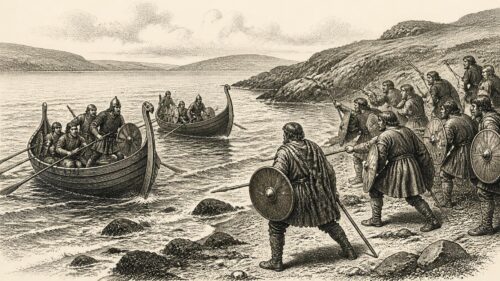
A second Connacht entry is more brutal in its wording. The Uí Fhiachrach of Muirisc inflicted a “slaughter” on the Uí Briúin of Umall, and, the annalist says, all the nobles around their king, Flaithgal son of Flannabra, fell. Umall lay on the Atlantic-facing western seaboard of what is now County Mayo, while Muirisc was another Connacht territory. The episode was thus not an abstract struggle among names in a genealogy: it was a conflict between neighbouring western interests with consequences for the lordship of coastal and inland communities.
The claim that every nobleman fell should not be mistaken for a modern casualty list. Annalists often used compressed, emphatic language to communicate the scale of an elite disaster. Nevertheless, the named death of Flaithgal and the reported destruction of his leading associates point to a major reversal. In a society where political authority rested heavily on kin groups and their retainers, the loss of a ruler together with his immediate aristocratic circle could disrupt the collection of dues, the protection of dependants, marriage alliances and control of pasture, routes and landing places. It may also have invited further intervention by rivals. What the record does not tell us is who succeeded Flaithgal, where survivors went, or how long the local balance of power remained altered.
Both western notices show the limitations of treating “Connacht” as a single actor. The province contained many small kingdoms and peoples, including Uí Briúin, Uí Fhiachrach and Uí Maine, whose relationships shifted between rivalry, subordination and alliance. The death of Conall son of Fidgal, described by Ulster as king of Uí Maine, belongs in the same year’s political horizon. It did not necessarily result from either Gola or Umall, but it underlines the frequency with which succession and territorial leadership changed hands in 786.
Rival Houses in the North
Far to the north, the annals report a battle between Cenél Conaill and Cenél nEógain. Máel Dúin son of Áed Allán was victorious, while Domnall son of Áed Muinderg was put to flight. These were two leading dynastic groupings of the northern Uí Néill, rooted principally in the north-west and north of Ireland. Their rivalry was longstanding, shaped by claims to regional pre-eminence, access to tribute and influence over important churches as well as by the immediate ambitions of particular rulers.
The annal does not name the battlefield, enumerate warriors or say what settlement followed. It is safer to say that Máel Dúin won a military encounter than that he permanently “conquered” Cenél Conaill. Flight was a serious humiliation and a victory could bring political advantage, but early Irish lordship was rarely settled by a single battle. Kin networks endured, rival branches regrouped, and the next alliance could alter the outcome. Still, the juxtaposition of the northern conflict with Connacht’s violence gives 786 a distinctive character: several regions experienced contests among established ruling houses at once.
Clonard’s Southern Circuit
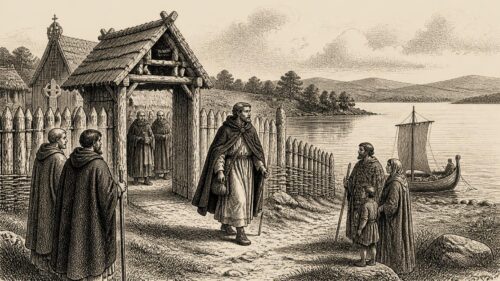
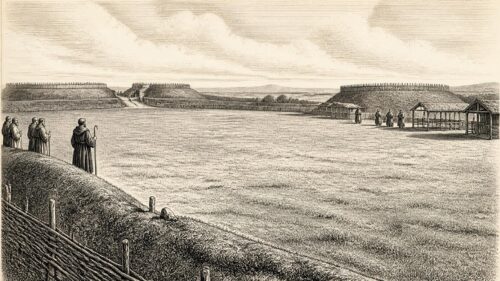
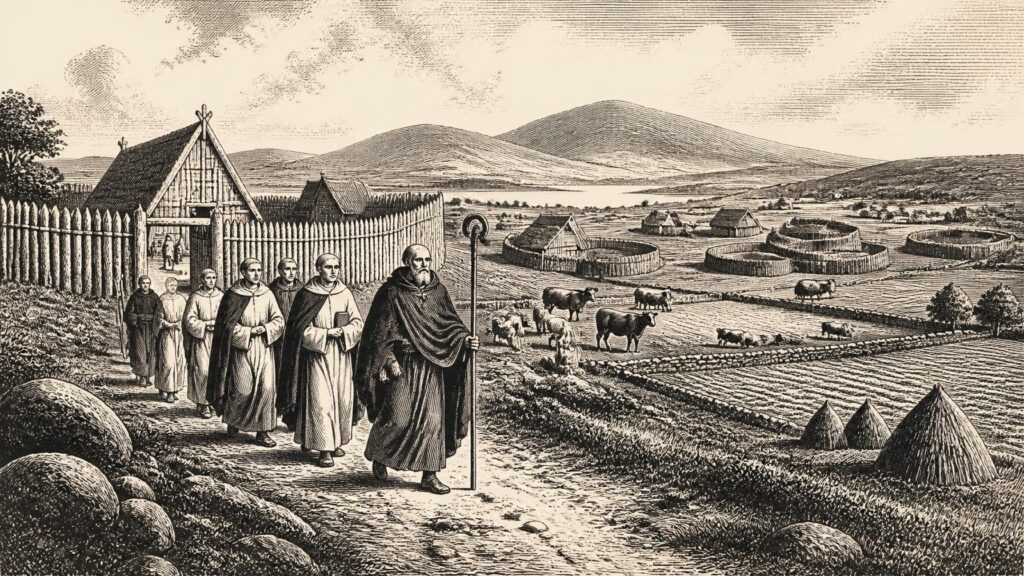
Against this background, the annals record movement of a different kind. Dub dá Bairenn, abbot of Cluain Iraird—Clonard in modern County Meath—visited the parochia in the territory of Mumu, or Munster. The Latin-derived term did not mean a modern parish. It referred to the wider ecclesiastical sphere associated with a major church: its dependent churches, lands, personnel, clients and spiritual claims. The entry is unusually revealing because it shows an abbot travelling beyond his immediate district to exercise or acknowledge such connections.
No itinerary, purpose or outcome is supplied. It would be speculation to call this a peace mission, a tax collection, or a relic procession. Yet the visit demonstrates that church authority could operate through networks crossing the political patchwork of Irish kingdoms. Clonard was remembered as a celebrated centre of learning, and its abbot’s journey indicates that major ecclesiastical communities possessed relationships substantial enough to require personal contact. Roads, river crossings, hospitality and local protection all made such travel possible. In practice, religious and secular power overlapped: churches were landholders and employers, while kings and aristocrats sought association with prestigious saints’ foundations.
Churches, Learning and Loss
The obituary list for 786 conveys the density of that ecclesiastical world. Colgu son of Crunnmael, abbot of Lusca; Robartach, steward of Sláine and abbot of Cell Fhoibrig; Muiredach, abbot of Cell Dara, or Kildare; two bishops of Kildare, Lomthuili and Snéidbran; and Aldchú, an anchorite of Ráith Aenbó, are all said to have died. So too did the learned Lergus grandson of Fidchain of Cell Maighnenn, Clemens son of Coirbéne, and Rechtabra son of Dub Comair, abbot of Echdruim.
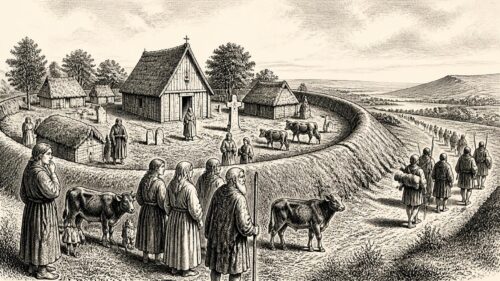
This is not evidence that Irish Christianity was a separate, cloistered sphere. The titles themselves disclose a varied hierarchy. An abbot might preside over a wealthy and politically connected community; a bishop could serve within the orbit of a major church; a steward managed resources; an anchorite represented an ascetic vocation; and a named sapiens, or learned man, points to the intellectual standing attached to study. Their deaths also remind us that religious houses were communities of people, dependent on succession, property and patronage. Several losses at Kildare did not mean the end of its importance, but would have required the replacement of office-holders in one of Ireland’s most eminent churches.
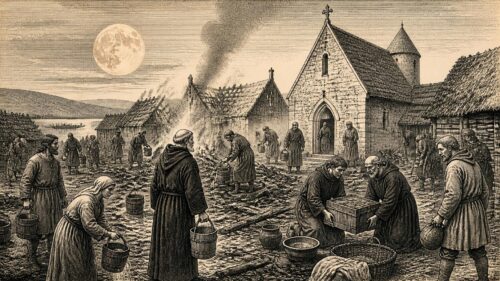
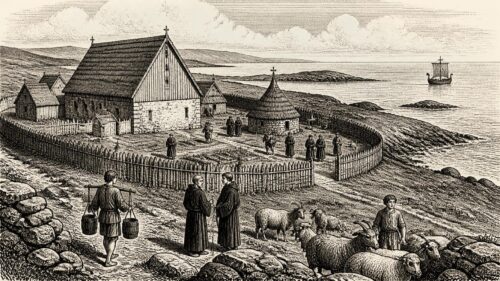
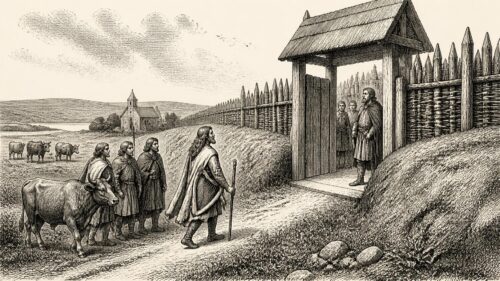
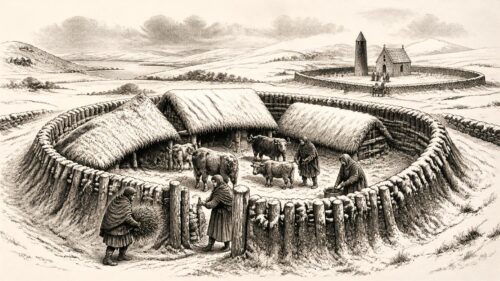
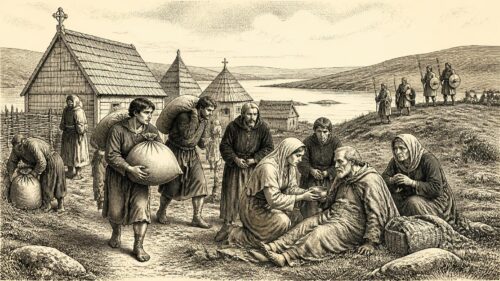
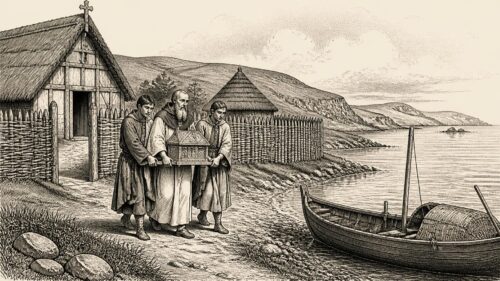
Beyond the annals’ elite focus, most people in 786 lived in a densely rural world of farmsteads, enclosed settlements, fields, grazing and small ecclesiastical sites. Cattle remained central to wealth and status, while cereal cultivation was becoming increasingly significant and could generate surplus. Monasteries and churches drew sustenance from the same agricultural economy, receiving labour and produce while providing ritual, literacy, legal influence and places of assembly. No surviving source describes an ordinary household’s experience of the battles at Gola or Umall. But the killing of rulers and nobles, the movement of an abbot, and the passing of church leaders would all have had consequences in the networks of dependence that joined households to local kings and churches.
A Year of Regional Reckoning
786 was not a year in which Ireland moved as one. Rather, its record catches a succession of regional reckonings: the Uí Briúin defeated at Gola; Flaithgal and the nobles around him killed in Umall; Cenél Conaill checked by Máel Dúin’s victory; a king of Uí Maine dead; and prominent churchmen gone from communities extending from Lusk and Slane to Kildare and Clonard. At the same time, Dub dá Bairenn’s southern visitation shows that ecclesiastical connections reached across provincial frontiers. The year’s evidence is fragmentary, but its pattern is clear enough: political power was vulnerable, local and violent, while the church provided durable institutions through which authority, learning and resources continued to circulate.
Primary Sources
- The Annals of Ulster: AD 786
- The Annals of Ulster
- The Annals of Ulster: Latin text for AD 786
- Annals of Inisfallen: Annals AI780–AI789
- Annals of Inisfallen
- Chronicon Scotorum
- The Annals of Tigernach
- Annals of Tigernach: manuscript record
- Chronological Synchronisation of the Irish Annals
- Irish Annals Edition Directory
- Exploring the Irish Annals
- Settlement Patterns and Socio-Economic Change in the Diocese of Tuam c. AD 400–1000
- The Economy of Early Medieval Ireland
- Agriculture, Settlement and Society in Early Medieval Ireland
- Early Medieval Ireland: Archaeological Excavations, 1930–2009
- Ecclesiastical Settlement in Ireland in the Early Medieval Period
- The Irish Church, 800–c.1050
- Literature and Learning in Early Medieval Meath
- Early Irish Hands: The Development of Writing in Early Ireland
- How Did Early Church Sites Differ from One Another? A Comparative Approach Within the Kingdom of Fir Maige, Ireland
- Uí Fiachrach in Connacht in Our Period
- The Donegal Kingdoms
- The History of the County of Mayo to the Close of the Sixteenth Century