Connacht Under a Red Moon787 CE
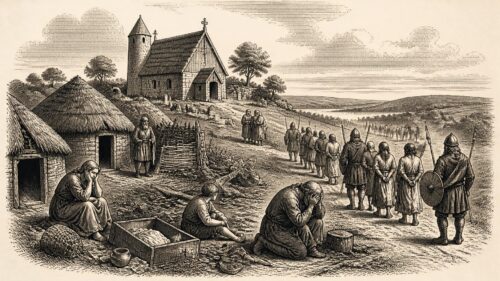
In 787, Irish annals record the death of Máel Dúin, king of In Fochla, creating a transition within the Cenél nÉogain dynasty rather than a national succession. In Connacht, Ciarán of Clonmacnoise’s law was proclaimed, extending ecclesiastical authority and protections with secular support after unrest. Deaths of abbots and bishops at several churches illustrate religious institutions managing land, learning and ritual. Daire Calgaid, probably Derry, suffered a fire of unknown cause. Annalists also noted a blood-red Moon on 18 February, preserving a celestial observation without establishing its explanation. These entries reveal intertwined political, religious and authority in early medieval Ireland.
Dateline
The Irish annals place a striking cluster of events in 787: the death of a northern ruler, the passing of churchmen in several provinces, the enforcement of a saint’s law in Connacht, a fire at Daire Calgaid, and a startling report that the Moon turned blood-red. These entries are brief, but together they reveal an island in which political authority, monastic influence and sacred reputation were closely intertwined. They also require careful handling. The surviving account is not a diary written on the spot, and Irish annalists sometimes used year systems that do not align perfectly with modern calendars. In the modern CELT edition of the Annals of Ulster, the relevant annal is assigned to AD 787; the individual events cannot safely be given more precise dates unless the text itself supplies one.
An Unsettled Northern Succession
The year’s foremost political death was that of Máel Dúin son of Áed Allán, described as king of In Fochla, “the North”. He belonged to Cenél nÉogain, a leading branch of the Northern Uí Néill whose power centred on Ailech and whose rulers had repeatedly competed for wider supremacy in Ireland. Máel Dúin’s father, Áed Allán, had been king of Tara before his death in battle in 743; his uncle Niall Frossach had also held that pre-eminent kingship. Máel Dúin did not inherit Tara, but his title indicates substantial standing across the northern world of the Uí Néill.
His death did not automatically produce a single, neat succession. In early medieval Ireland, kingship was normally confined to a royal kindred rather than passing by simple primogeniture. Eligible adult men of the dynasty competed, negotiated alliances and, when necessary, fought. The annals’ terse notice does not describe the immediate contest, so it would be wrong to invent one. Yet Máel Dúin’s removal certainly mattered: it ended one claimant’s authority in the north and left room for other branches of Cenél nÉogain, notably the line of his cousin Áed Oirdnide, to advance. The year should therefore be seen as a moment of transition within a powerful northern dynasty, not as evidence for a united Irish monarchy.
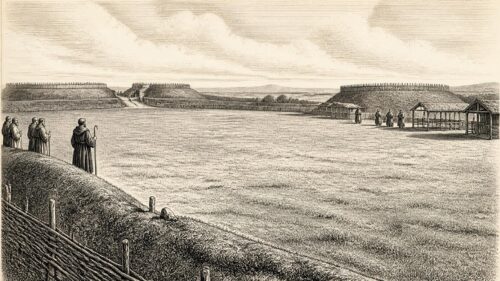
The scale of this political world is important. Ireland in 787 was not governed from a capital or by a national administration. It was a mosaic of kingdoms, lesser lordships and kin-groups, connected by fosterage, tribute, marriage, religious patronage and occasional armed force. Larger dynasties such as the Uí Néill could claim precedence over broad regions, but their authority rested on personal relationships and the capacity to command followers. The death of a regional king could alter those relationships well beyond his immediate territory.
A Law in Ciarán’s Name
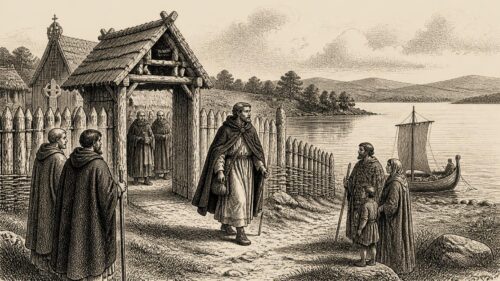
The most consequential institutional notice for 787 is equally compact: “Ciarán’s law” was in force in Connacht. This was not a parliamentary statute, and the annal does not preserve its provisions. It belongs instead to the Irish practice of proclaiming a saint’s cáin or law: an ecclesiastical ordinance, publicly backed by secular rulers, which could extend the protection, privileges and claims of a church and its patron saint across a defined territory.
The Ciarán intended is generally understood to be Ciarán of Clonmacnoise, whose church stood on the Shannon at a crucial crossing between Connacht and the midlands. Invoking his law in Connacht displayed more than devotion. A saint’s cult carried legal and economic force. Such a proclamation could help secure the safety of clerics, churches, dependants, travellers or church property; it could also legitimate the collection of dues and hospitality for the saint’s community. Precisely which of these effects applied in 787 is unknown. The responsible conclusion is that Ciarán’s ecclesiastical authority was formally recognised in Connacht, with the cooperation expected from the region’s political leadership.
This mattered because Connacht had recently suffered sharp dynastic violence. The preceding annalistic year records fighting among branches of the Uí Briúin and Uí Fhiachrach, including the destruction of the Uí Briúin of Umall’s leading men. That conflict belongs to the previous calendar year rather than to 787 itself, but it is essential immediate context for the proclamation. In a landscape where royal fortunes could be overturned quickly, a saint’s law offered a recognised language for ordering relationships between churches, rulers and communities. It could mark the reach of Clonmacnoise’s patronage into Connacht without implying that the monastery ruled the province.
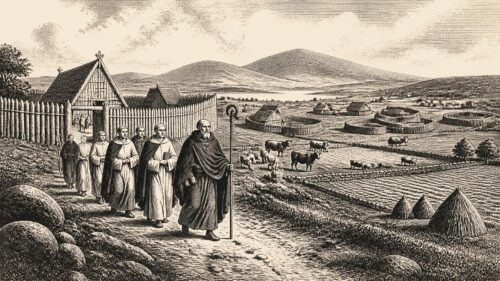
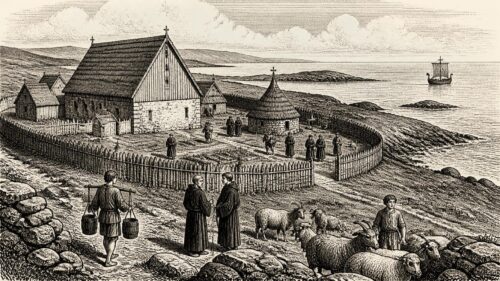
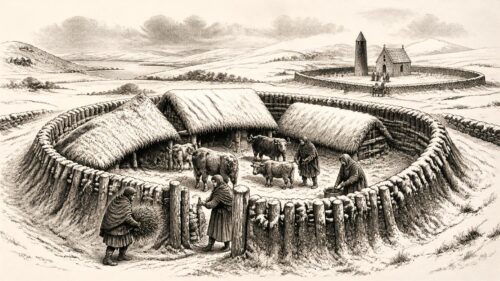
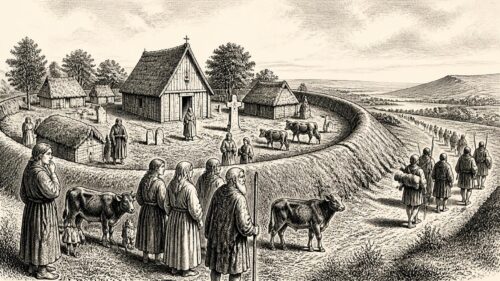
The entry also illuminates how religion worked in everyday public life. Monasteries were not isolated retreats. Their settlements held churches, dwellings, burial grounds, workshops, stores and cultivated land; their communities included not only clerics but craftsmen, labourers, tenants, guests and people seeking sanctuary. Cattle, food renders and rights of hospitality were central to their resources. A law proclaimed in a saint’s name therefore touched practical questions of protection and obligation as well as prayer. The surviving record does not let us reconstruct what an ordinary Connacht household did differently after Ciarán’s law came into force, but it shows that religious institutions were embedded in the province’s social and political fabric.
Churches, Offices and Mobility
Several deaths recorded in 787 show the geographical breadth of that ecclesiastical network. Mac Óc, abbot of Saiger in Munster, died; so did Colum son of Faelgus, bishop of Lothra, a church on the Shannon in what is now north Tipperary. Échtgal son of Báeth, abbot of Muicert, and Dub dá Tuath, bishop and abbot of Ráith Aeda, are also commemorated. Such notices do not tell us the size of their communities or the manner of their deaths. They do show that offices of abbot and bishop were recognised markers of status and that Irish religious life was organised through many locally rooted but interconnected churches rather than a simple hierarchy of territorial dioceses.
The combination of titles is revealing. An abbot could lead a major ecclesiastical community; a bishop had sacramental functions; one person might hold both dignities. In this period, churches were often tied to particular families and territories, while learned clergy travelled between them and monasteries cultivated long-distance ties. Books, liturgy, legal learning, relics and personnel moved along the same river and overland routes used by kings, merchants and herders. The year’s obituaries are therefore not merely a roll of pious names. They register changes in leadership at institutions that managed land, learning, ritual and social protection.
There is no securely dated major work of art, manuscript or building to assign to 787 itself. Nevertheless, the cultural setting was one of considerable accomplishment. Eighth-century Irish churches participated in the Insular world of Latin scholarship, manuscript production and sophisticated metalwork. That wider setting should not be mistaken for a claim that a named object was made in this year. What 787 securely provides is evidence of the institutional communities in which such learning and craftsmanship could be sustained: Saiger, Lothra, Ráith Aeda and the wider network reaching from Clonmacnoise into Connacht.
The Burning of Daire Calgaid
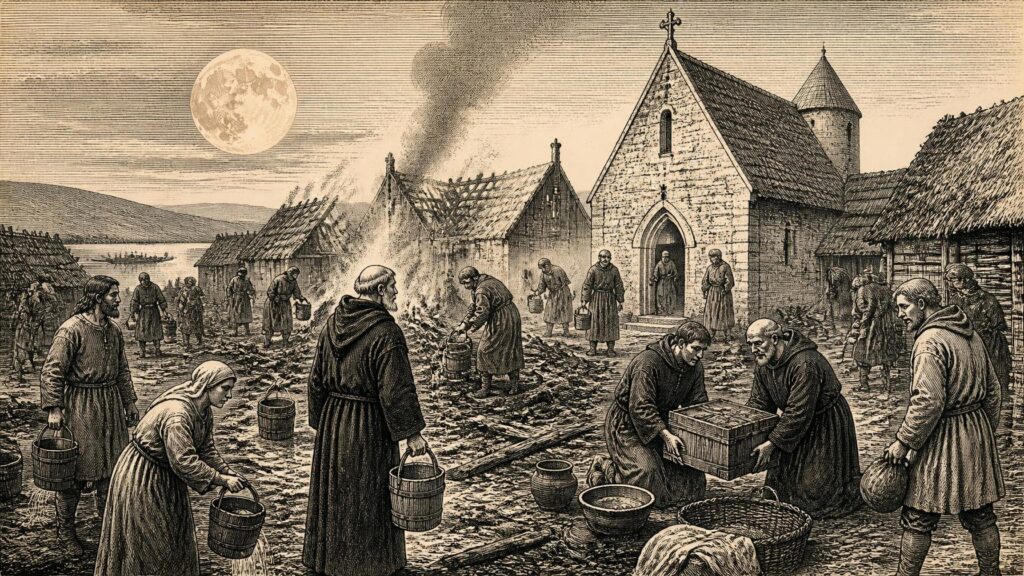
The annal closes with the burning of Daire Calgaid, the early Irish name generally associated with Derry. It is a grave notice, but its brevity sets limits. The source does not identify an attacker, state whether the fire was deliberate or accidental, list casualties, or specify which structures burned. It is tempting to turn the entry into a dramatic raid; the evidence does not permit that. Nor should the event be casually attributed to Scandinavian raiders, whose first recorded attacks on Irish monasteries belong to later years.
Even so, fire at a major ecclesiastical settlement was deeply disruptive. Much of the built environment of eighth-century Ireland was timber: houses, workshops, fences, stores and many church buildings. A blaze could destroy food reserves, tools, manuscripts and accommodation as well as places of worship. Rebuilding demanded timber, labour, patronage and security. Daire Calgaid’s prominence in the annals means that its burning was remembered as a matter of more than local concern, though not enough is known to measure its damage or recovery.
The Red Moon
One observation is unusually precise. The annalist states that the Moon became red like blood on the twelfth day before the Kalends of March, which converts to 18 February. The wording preserves what observers saw, not an explanation of why it happened. A reddened Moon can accompany an eclipse, but the annal does not use that term, and it could also reflect atmospheric conditions. It is best treated as a faithfully transmitted report of a memorable celestial appearance rather than as proof of a particular astronomical event or an omen accepted by everyone in Ireland.
For contemporaries, however, a dramatic sky was unlikely to be culturally neutral. Clerics trained in computus—the calculation of feast days and the study of calendrical time—watched the heavens closely. The Moon governed the dating of Easter, while unusual phenomena could be read through scriptural and moral frameworks. The annalist’s decision to preserve the sight alongside deaths, a legal proclamation and a fire suggests that it was judged worthy of record. It offers a rare glimpse of shared experience: whether seen from a royal enclosure, a monastic precinct or a farming settlement, the changed Moon was visible beyond the boundaries of individual kingdoms.
Thus 787 is not defined by a single battle or a single ruler. Its evidence instead captures the workings of early medieval Ireland: a northern dynasty losing a king; Connacht acknowledging the law of a major saint; churches changing leaders; Daire Calgaid suffering fire; and observers marking an extraordinary Moon. The annals leave many questions unanswered, but their silences are instructive. They remind us that the year can be recovered only through careful attention to what the sources say—and equal care about what they do not.
Primary Sources
- The Annals of Ulster, Year U788
- The Annals of Ulster
- CELT Project: The Annals of Ulster
- Annala Uladh: Annals of Ulster otherwise Annala Senait, Annals of Senat
- Annals of Inisfallen
- Annals of Inisfallen: Annal I787
- Annals of the Four Masters, Annal M787
- Annals of Tigernach
- Annals of Tigernach
- Edition Directory: Irish Annals Chronology
- Exploring the Irish Annals
- Annals of Ulster, folio 55r
- Áed Allán
- Niall Frossach
- Christian Ireland 5th–8th Centuries
- Early Christian Monasteries
- Early Monastic Churches
- Patrician and Early Christian Architecture
- Water-power as a Factor of Industrial Location in Early Medieval Ireland: The Environment of the Early Irish Water Mill
- Animals and the Economy of Medieval Ireland: A Zooarchaeological Analysis of the Faunal Remains from Caherconnell Cashel, Co. Clare
- Irish Kingship and its Development
- Viking Ireland: Afterthoughts
- General Vikings in Ireland
- Lunar Eclipse Basics
- Lunar Eclipse Computer