Kildare’s June Fire779 CE
In 779, Irish annals record converging environmental, ecclesiastical and political crises. A continuing cattle murrain, human deaths from want, widespread smallpox and an autumn windstorm placed severe pressure on rural communities and their pastoral economy. On 11 June, Kildare burned; fires also damaged Clonmore and Kildalkey, though causes and connections remain unknown. Several prominent clerics died, including Clonard’s bishop and Roscommon’s abbot. Donnchad Midi, king of Tara, secured hostages from northern king Domnall son of Áed Muinderg, demonstrating contested overlordship. In Munster, Breislén of Béirre killed Fergal of Desmumu in internal conflict. Fragmentary sources portray exceptional vulnerability and rivalry alike.
Dateline
For Ireland, 779 is remembered less for a single victory than for a convergence of hardship: disease among cattle, reported human mortality, destructive fires at important churches, political coercion in the north and a deadly contest within Munster. The evidence is chiefly annalistic, and it requires careful handling. Irish chronicles preserve events under differing year-numbers: the Annals of Ulster section conventionally cited as 779 includes calendrical material that points to 778, while the much later Annals of the Four Masters places several corresponding notices five years earlier. The sequence is nevertheless securely associated with the annalistic year 779. Only one day is stated precisely: the burning at Kildare occurred on 11 June. The rest should be read as events recorded for this year, not as securely dated modern calendar days.
A Year of Hunger and Disease
The gravest entry says that a murrain among cows “did not cease” and that people died from want. The wording implies continuation rather than a brief new calamity. Earlier annals had already reported severe weather, illness and bovine mortality. Inisfallen, independently, records both a cattle murrain and a “great mortality” in its annal for 779. The agreement does not tell us the pathogen, its route of spread or a numerical death toll. It does establish that contemporaries considered the losses exceptional enough to record at an island-wide scale.
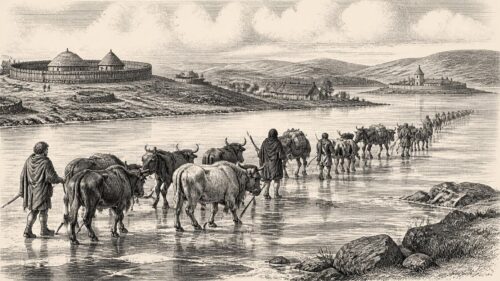
For an overwhelmingly rural society, the death of cattle could not be treated as a narrow agricultural misfortune. Cattle provided milk and dairy foods, manure, hides, draught power in some settings, and, crucially, a principal measure of movable wealth. They underpinned food rents, fosterage obligations, hospitality and compensation. Herds also made it possible for kings, churches and secular households to feed retainers and visitors. A prolonged cattle disease thus weakened both everyday subsistence and the political economy through which lords assembled followers. “Want” need not mean that every district suffered identical famine; it does mean that the annalist connected animal mortality with lethal human deprivation.
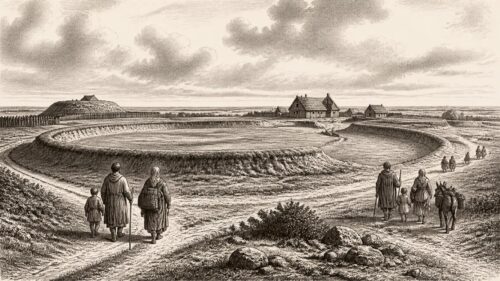
The same annal records smallpox throughout Ireland. This is a striking claim, but it must not be inflated into a modern epidemiological map. The chronicler did not provide symptoms, duration, regional incidence or mortality figures, and the Old Irish term behind the translation cannot yield a clinical case history. Still, the notice indicates that a recognisable and feared eruptive disease was sufficiently widespread to be described as affecting all Ireland. In a year when food reserves and dairy supplies were under pressure, sickness would have made labour, care and recovery still harder.
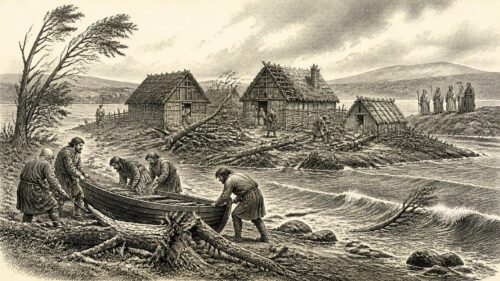
Nature offered no easy reprieve. A “great windstorm” arrived at the end of autumn, according to the Annals of Ulster. Such a report cannot be converted into a measured meteorological event, but its inclusion matters. Late autumn was the season when households were safeguarding winter fodder, repairing roofs and bringing livestock closer to protected grazing. Strong winds could damage lightweight timber buildings, disrupt travel and worsen the insecurity caused by a failing cattle economy. The annals’ terse order—murrain, want, smallpox, storm—creates a powerful impression of compounding shocks, although it does not prove that each was directly caused by another.
The Burning of Cell Dara
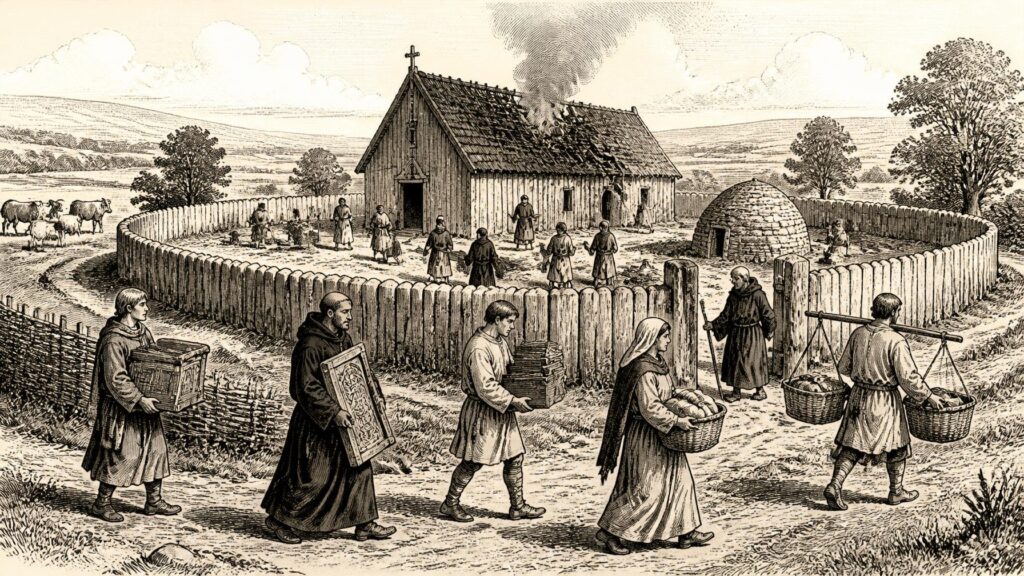
On 11 June, Cell Dara—Kildare—was burned. The notice is unusually exact about the day but silent about the cause. It should therefore not be called a raid, an accident, a lightning strike or an act of war. Fire was a recurring danger in complexes built largely of timber, where houses, workshops, store buildings and churches stood within a busy ecclesiastical enclosure. Yet Kildare was not an anonymous settlement. Associated with Brigit and one of Ireland’s leading churches, it was a place of worship, learning, craft production, landholding and hospitality. Its destruction, whatever its immediate cause, would have affected a substantial religious and economic community.
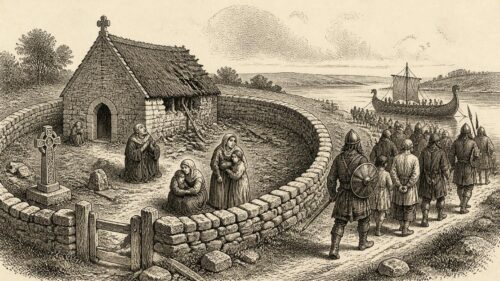
Two more churches were burned in the same annal: Cluain Mór Maedóc, usually identified with Clonmore in present-day County Carlow, and Cell Delge, Kildalkey in County Meath. The records do not say that the three fires formed one campaign or occurred on the same day. Nor do they name perpetrators. The responsible conclusion is more modest: several ecclesiastical sites, in Leinster and the midlands, suffered fire in the annalistic year. Their loss reminds us that churches were also settlements with people, livestock, food stores, books, metalwork and claims over land. A blaze could erase roofs and workshops rapidly while destroying assets accumulated over generations.
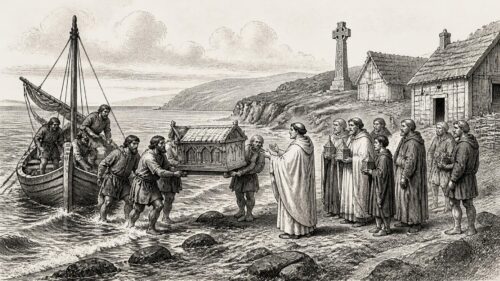
The fires also illuminate the standing of monasteries in eighth-century Ireland. Religious houses were not secluded institutions beyond politics. They received gifts, controlled estates, drew pilgrims and students, and maintained ties with regional dynasties. Their leaders appear in the annals alongside kings because ecclesiastical office carried material resources and public authority. In the same year Fulartach, bishop of Clonard, died, as did Conall of Letuba, Ainmere of Ráith Nua and Forbasach, abbot of Roscommon. Maenán, abbot of a monastery founded by Fursa in Frankish territory, also died. That last obituary is a small but valuable reminder that Irish ecclesiastical networks crossed the sea, even when the year’s most immediate anxieties were local.
Donnchad’s Northern Hostages
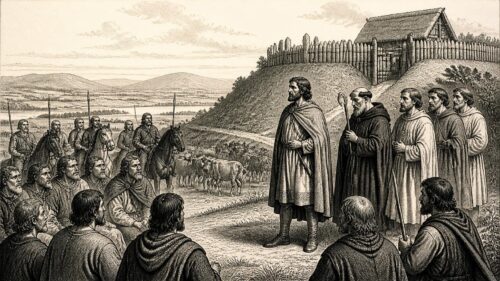
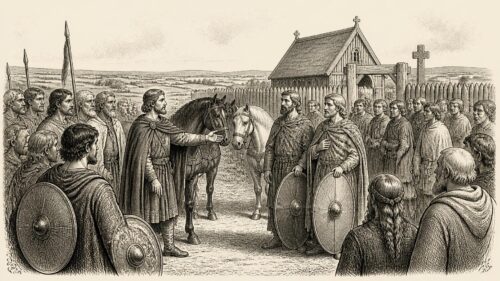
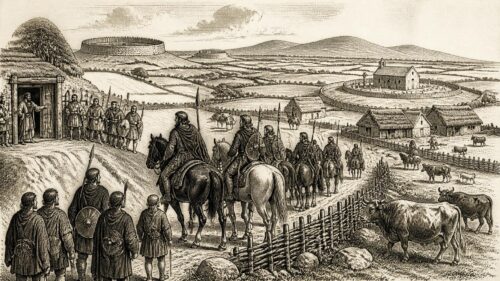
Amid famine and fire, Donnchad Midi, king of Tara and leading ruler of the Southern Uí Néill, led a hosting into In Fochla, a northern region associated with the territory of Cenél nÉogain. There he took hostages from Domnall son of Áed Muinderg, described as king of the North. The annal records submission, not a battle. Hostages were a recognised instrument of overlordship: people of high standing were surrendered as sureties for agreements and obedience. Their taking proclaimed that Donnchad could project force beyond Mide and compel a northern rival to acknowledge his advantage, at least for the moment.
This was not the rule of a centralised Irish state. Kingship operated through layered relationships among many peoples and dynasties, sustained by military followings, tribute, alliance and ritual status. Donnchad’s authority was formidable, but it was continually made and remade through actions such as host-taking. His march northwards belonged to a longer period in which he had asserted influence in Leinster, Brega, Munster and among the Northern Uí Néill. The annal offers no terms of settlement and no indication of how long Domnall’s submission endured. Its significance lies in the public demonstration of hierarchy at a time when scarcity may have sharpened the value of dependable resources and dependable allies.
Elsewhere, status was resolved by violence. Muiredach son of Óengus, king of Ard Cianachta, was killed. Ard Cianachta lay in the northern part of the Boyne region, close to the contested political landscape of Brega and Mide. The record gives neither killer nor motive. It is tempting to attach his death to Donnchad’s wider consolidation, especially since Donnchad’s mother came from Ard Cianachta, but the annal does not permit that conclusion. What can be said is that the removal of a local king was consequential in a society where rulership, land and kinship were closely interwoven.
A Munster King Falls
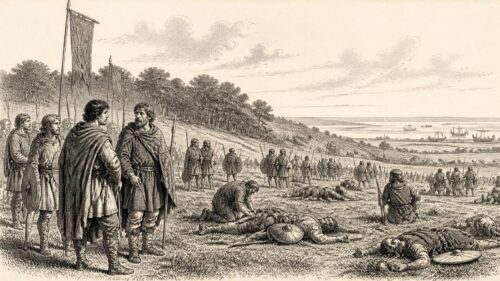
In Munster, a battle “between the Munstermen themselves” killed Fergal son of Éladach, king of Desmumu, or West Munster. Breislén of Béirre was the victor. This was plainly an internal struggle, not an invasion by Donnchad or another outside ruler. Béirre, the Beara peninsula, lay at Munster’s south-western edge; the victory suggests that political initiative could come from regions far from Cashel and the province’s better-known eastern centres. Yet the brevity of the notice prevents a reconstruction of armies, battlefield or immediate succession.
Fergal’s death is important precisely because it shows the limits of provincial labels. “Munster” was not a unitary kingdom acting with one will. It contained rival dynasties and regional kings, whose fortunes could turn on local coalitions. A king’s fall could redistribute cattle, clients, church patronage and access to routes through a region. In 779, therefore, Ireland’s political map was being changed not only by Donnchad’s northern expedition but also by conflict among Munstermen themselves.
What the Record Preserves
The annals leave ordinary voices unnamed, but their notices allow a responsible glimpse of lived experience. Herd-keepers confronted losses that touched diet and wealth; households faced sickness and hunger; communities at Kildare, Clonmore and Kildalkey confronted the aftermath of fire; clerics marked the deaths of bishops and abbots; and royal families negotiated power under the threat embodied by hostages. The year’s sources are concise and selective, preserving disasters and elite actions rather than continuous narrative. They do not prove a single national catastrophe, nor do they describe every locality. They do, however, show an Ireland in which environmental pressure, pastoral economy, ecclesiastical wealth and dynastic competition were inseparable.
That is why Kildare’s dated June fire deserves to stand at the centre of the year, though not alone. It occurred during a season remembered for cattle disease, human mortality and smallpox, and before an autumn storm. Around it, great churches remained active enough for their losses and leaders to be recorded, Donnchad Midi compelled northern hostages, and a Munster king died at the hands of fellow Munstermen. The surviving evidence is fragmentary, but its pattern is unmistakable: 779 was a year in which the vulnerabilities of early medieval Irish life were exposed with unusual force.
Primary Sources
- The Annals of Ulster, Year U779
- The Annals of Ulster, Year U780
- The Annals of Ulster, Year U775
- The Annals of Ulster, Year U710
- Annals of Inisfallen, Part 33
- Annals of the Four Masters
- The Annals of Tigernach
- Chronicon Scotorum
- CELT Project: Annals of Inisfallen
- Exploring the Irish Annals
- Chronological Synchronisation of the Irish Annals
- The Chronology and Sources of the Early Irish Annals
- The Dating of the Irish Annals
- Donnchad Midi
- Changing Human-Cattle Relationships in Ireland: A 6000-Year Isotopic Perspective
- Kingship, Society, and Sacrality: Rank, Power, and Ideology in Early Medieval Ireland
- County Kildare Urban Archaeology Survey 1986
- Early Christian Monasteries
- Patrician and Early Christian Architecture
- Early Irish Monasticism