Fothad’s Clerical Immunity803 CE
Recorded under Annals of Ulster U804, conventionally AD 803, the year saw Áed Oirdnide devastate Leinster twice, compelling Fínshnechtae Cetharderc’s submission. At Dún Cuair, an Uí Néill assembly presided over by Armagh’s abbot Connmach linked royal and ecclesiastical authority. At Fothad na Canóine’s urging, Áed exempted Irish clerics from military hostings, establishing an influential ideal of clerical immunity. Notices also record deaths of regional rulers and church officers, a local northern battle, and a destructive storm in Corcu Baiscinn. Cenannas, later Kells, was granted without conflict to Colum Cille’s Columban community, strengthening its religious importance in Meath for subsequent centuries.
Dateline
The surviving Annals of Ulster place a remarkable cluster of Irish events under their year U804, which the modern CELT edition labels AD 803. Modern historical works often refer to the same episode as 804, reflecting difficulties in reconciling annalistic year-numbering with calendar years. For a year-by-year account of 803, the safest course is therefore to treat these as events recorded for this point in the chronicle, while being candid that their precise modern dating is debated. What is beyond doubt is their importance: the record joins royal war in Leinster, an Uí Néill assembly at Dún Cuair, a landmark protection for clerics, a destructive Atlantic storm and the elevation of Cenannas, later Kells.
Áed’s Pressure on Leinster
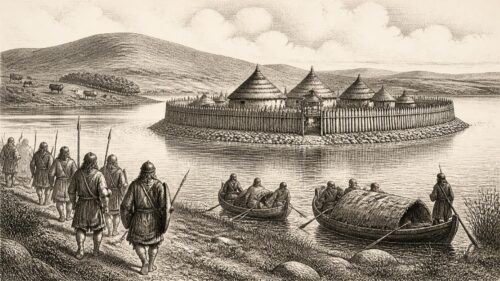
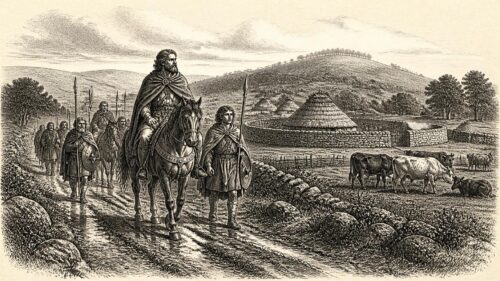
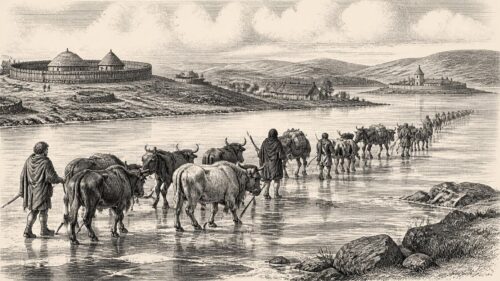
Áed Oirdnide, king of Tara and leading ruler of the northern Uí Néill, dominates the year’s political record. The annalist says simply that “the son of Niall” devastated Laigin, or Leinster, twice within a single month. Such a formulation is terse, but its implications are substantial. A royal devastation was not merely a battlefield encounter. It could involve a mobile host crossing a provincial frontier, taking cattle and food, burning or stripping vulnerable settlements, and compelling local rulers to acknowledge a superior power.
The target was Fínshnechtae Cetharderc, overking of Leinster. He belonged to the Uí Dúnchada branch of the powerful Uí Dúnlainge dynasty and had consolidated authority in northern Leinster. Áed’s attacks were followed, the annals report, by a hosting into Leinster and Fínshnechtae’s submission. The source does not state where the two rulers met, what tribute was promised, or whether hostages changed hands. It should not be inflated into a permanent conquest. Yet submission mattered in a political order built from personal lordship, tribute, military service and public recognition. For Áed, it advertised that the king at Tara could project force southwards; for Fínshnechtae, it was an accommodation made under acute pressure rather than the end of Leinster’s separate kingship.
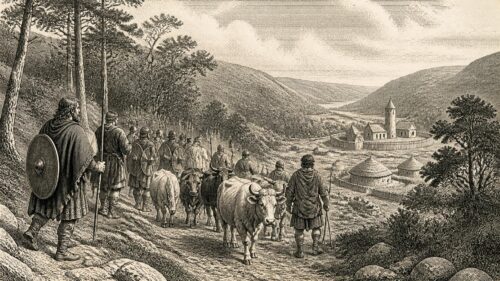
These operations also show the practical burden of high politics. An army did not travel on abstractions such as “national” unity. It depended on food, livestock, roads and river crossings, and on the labour and military obligations owed by lesser kings and free men. The people of Leinster encountered Áed’s ambition in immediate ways: herds driven away, grain stores exposed, local leaders forced into negotiations, and communities required to provision or evade passing forces. The annals give no named villages or casualty total for the devastation, so the human scale cannot be reconstructed precisely. Nevertheless, two incursions in one month were intended to be felt.
An Assembly at Dún Cuair
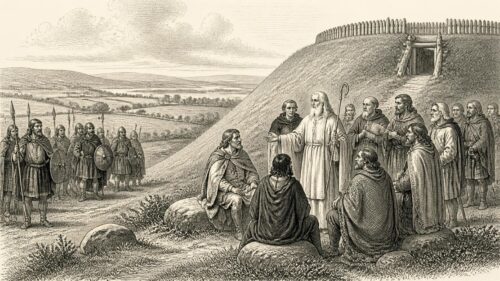
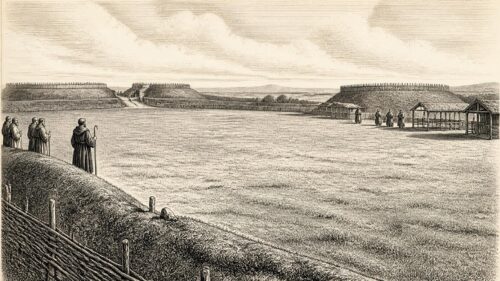
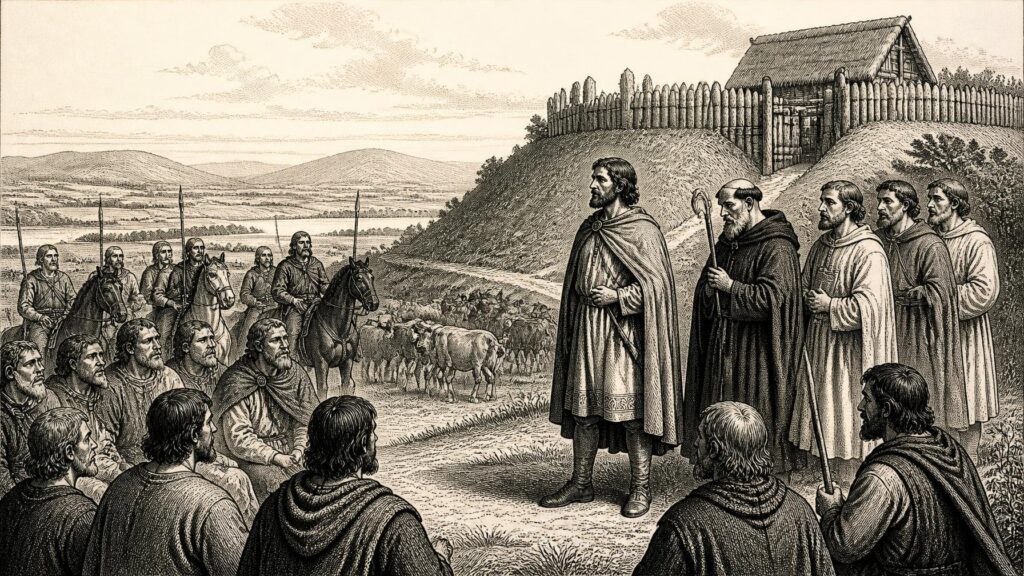
The political centre of the year was Dún Cuair, probably at Rathcore near Enfield in modern County Meath, though the identification is not entirely certain. Here the annals record a gathering of the Uí Néill under the presidency of Connmach, abbot of Armagh. Older English renderings describe it as a “meeting of synods”; the Latin wording is also capable of meaning an assembly of Uí Néill leading men. That ambiguity is revealing. This was not a modern parliament, nor can it safely be imagined as a purely ecclesiastical council. It was an occasion at which secular power and church authority visibly met.
Dún Cuair stood in the wider landscape of Meath, the core territory from which kings of Tara sought pre-eminence. An assembly there could bring together royal kindreds, churchmen, clients, attendants and armed followers. Its location and ceremonial character helped turn political decisions into public facts. The surrounding Leinster campaign makes it very likely that warfare and the regulation of power were close to the gathering’s purpose, even if the annals do not preserve speeches, agreements or ritual.
Connmach’s role was significant. Armagh was not simply a religious site; its church wielded claims connected with Patrick, learning, property and jurisdiction across Ireland. Its abbot could serve as a figure of moral and institutional authority in dealings among kings. Yet Connmach did not stand outside politics. Ecclesiastical centres possessed land, dependent households, craftsmen, livestock and hereditary links with ruling families. Their protection was a matter of both principle and material interest.
Fothad’s Judgement
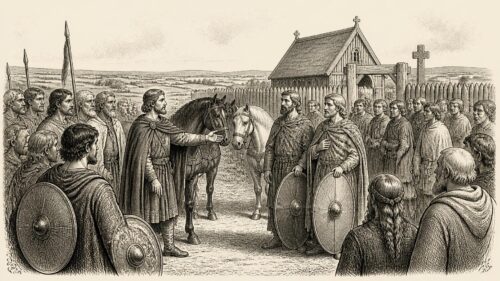
The most consequential notice attached to the assembly says that Áed Oirdnide, at the urging of Fothad na Canóine, freed the clerics of Ireland from attendance on expeditions and hostings. In the surviving manuscript tradition this appears as a marginal addition rather than part of the main run of entries, a reason to handle its exact transmission with care. Even so, it is an unusually clear statement of a major ideal: churchmen were to be released from the obligation to accompany royal military forces.
A hosting, slógad, was a royal muster. Early Irish legal materials assume that free men could owe military service when their king summoned them. Clerics were embedded in the same society and could be vulnerable to demands for labour, transport, provisioning and personal attendance. The ruling attributed to Fothad did not make Irish churches apolitical, defenceless or economically detached from kings. Nor does the annal tell us how uniformly the exemption was observed in every kingdom. It did, however, articulate a boundary: religious personnel should not be treated as ordinary participants in secular warfare.
Fothad’s byname, “of the Canon”, identifies him as a figure associated with canon law. The episode demonstrates that legal learning could become a practical force in public life. Churchmen did not merely pray for rulers or record their deeds; they could press claims about how rulers ought to use power. Áed may have gained prestige by presenting himself as protector of the church, while the churches gained a principle that could be invoked against future demands. The arrangement was thus spiritual, legal and political at once.
Deaths and a Northern Battle
Other notices sketch the island’s fragmented political map. Domnall son of Áed Muinderg, called “king of the North”, died, as did Fiachra son of Tuathal, king of Uí Téig. Cernach son of Dúnchad, king of Mugdorna, also died. Their obits remind us that no king of Tara governed a unified state. Ireland contained many overlapping kingdoms, peoples and dynastic branches, whose rulers could be subordinate, allied or hostile according to circumstance.
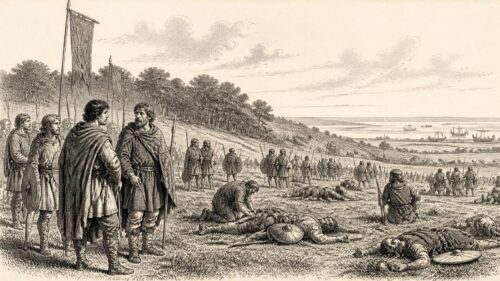
A battle within Uí Chremthainn, in the north-east Midlands and Ulster borderlands, underlines this reality. Echu son of Cathal, Domnall son of Echaid, Dub Rois and many others were killed; Donn Clochair son of Artrí was victorious. The annalist does not give a cause, a precise battlefield or the political outcome. It is therefore unsafe to make it an episode in Áed’s Leinster war. It was instead a local dynastic conflict, deadly enough to enter the record, occurring alongside the far larger assertion of Tara’s authority.
The church’s personnel also changed. Caratbran, abbot of Birr, died; so did Faelán son of Cellach, superior of Cell Dara, or Kildare, and Cormac son of Conall, steward of Lusca, modern Lusk. The titles matter. An abbot or superior managed a community’s religious life but also its estates, dependants and resources; a steward handled the practical administration on which such institutions depended. Obits are brief, but they preserve the names of people whose work linked worship, landholding, hospitality and local influence.
Storm, Shore and Island
The annals place a violent storm on the night before the feast of St Patrick, 17 March. Thunder, wind and “fire” – perhaps lightning, perhaps an annalist’s dramatic description of the storm – allegedly killed 1,010 people in Corcu Baiscinn, in the region of modern west County Clare. The same notice says that the sea split an island called Fita into three and buried enough of its land beneath sand to support twelve cows. Fita cannot be identified with confidence from the evidence now available.
The number of dead is too exact-looking to accept uncritically, and it cannot be independently verified. The event nonetheless records a real early medieval awareness of environmental violence: storm surge, shifting sand and coastal change could erase productive ground and threaten lives. For communities dependent on livestock, small fields, fishing grounds and sea routes, even a modest loss of grazing land could have serious consequences. The annal’s unusual detail about land measured by its carrying capacity makes the agricultural cost especially vivid.
Cenannas and Columban Memory
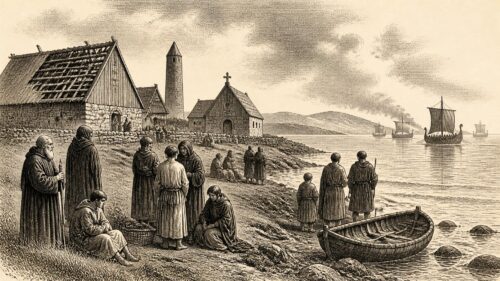
Finally, the annals say that Cenannas was given “without battle” to the “melodious” Colum Cille. Cenannas is Kells in County Meath. The phrase should not be read as a literal gift to the saint, who had died more than two centuries earlier, but as a transfer to his ecclesiastical familia or Columban community. It signals that a place of strategic and religious value was being placed under the protection and prestige of Colum Cille’s cult.
This entry should not be used to claim that the Book of Kells was made, completed or brought to Kells in 803. Those questions remain difficult and the manuscript’s history cannot be fixed so neatly. Nor does the entry prove the construction of a particular surviving building. What it securely shows is that Columban identity mattered in Meath at this moment. The later development of Kells as a major Columban centre was rooted in such transfers of patronage, land and sacred association.
Thus the year’s record is not a simple tale of royal conquest. Áed Oirdnide’s pressure on Leinster displayed formidable military reach, but the assembly at Dún Cuair also made room for Connmach and Fothad to assert ecclesiastical claims. A storm exposed the insecurity of the coast; local kings and church officers died; and Cenannas entered a new phase in the institutional world of Colum Cille. In 803’s difficult annalistic dating, Ireland appears as it was: rural and regional, heavily armed yet legally argued over, and bound together as much by churches and cults as by kings.
Primary Sources
- The Annals of Ulster, Year U804 (AD 803)
- The Annals of Ulster: CELT Project and Manuscript Witnesses
- Áed Oirdnide
- Fínshnechtae Cetharderc
- Colum Cille (Columba)
- Dating Félire Óengusso: A Review of the Historical Evidence
- Atd-īus dūib a n-aicned fīr: A poem about tears of repentance
- About Óengus
- Kells: Irish Historic Towns Atlas Text
- Colm Cille's Spiral: The Object
- The Annals of Inisfallen
- Annals of Inisfallen, Annals AI790–AI799
- The Architectural Setting of the Cult of Relics in Early Medieval Ireland
- The Architectural Setting of the Mass in Early-Medieval Ireland
- The Archaeology of Ecclesiastical Estates in Early Medieval Ireland: A Case Study of the Kingdom of Fir Maige
- Land Tenure and Farming in Early Medieval Kerry: A Survey of Field Systems in the Lough Currane Basin
- The Archaeology of Early Medieval Borderscapes: A Case Study of South-West Osraige
- The Vikings in Ninth-Century Ireland: Sources and Settlements
- Rathbeagh Ringfort, Co Kilkenny
- Cultural Heritage Component of the Waterway Corridor Study: Meelick to Limerick City