

Secure Homes
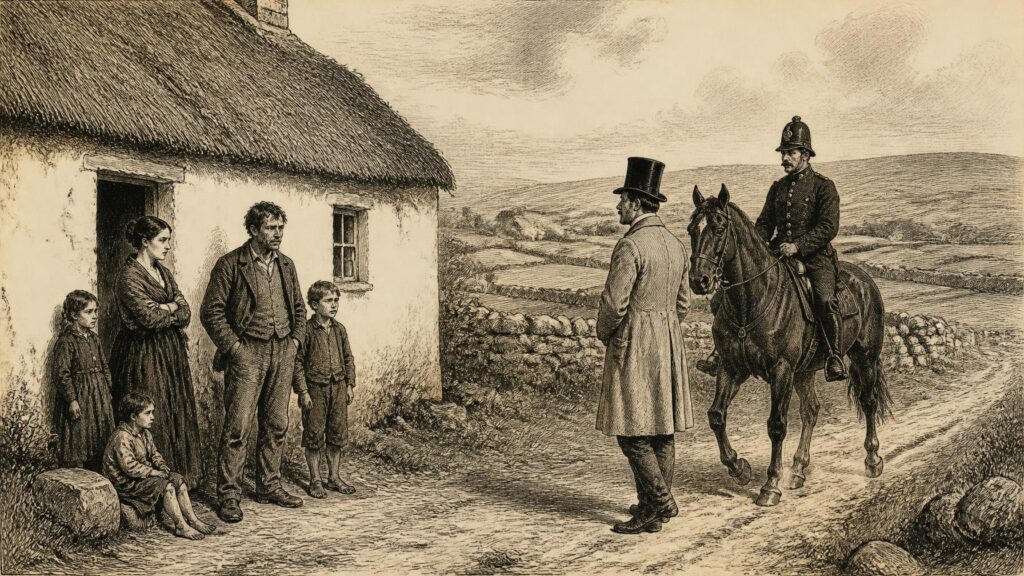
AI generated historical illustration, not a contemporary photograph.
At a Glance
Housing and tenant security occupy a central place in Irish history because the question of who could remain securely in a home, at what rent, and on what terms, shaped rural politics, urban life and the formation of the State. In Ireland, the history of tenancy is not a single story of gradual improvement. It is a record of conflicting interests: landlords and tenants, owners and occupiers, town councils and central government, private profit and public obligation. It also concerns two distinct settings which were often connected but never identical: the agricultural holding and the dwelling house.
Meaning Security
Tenant security means more than a roof over one’s head. At its most basic, it is protection against arbitrary removal. Yet, historically, a tenant could be secure in one respect and insecure in another. A farmer might possess a long lease but face an unsustainable rent. An urban family might have a regulated rent yet live in a dangerously overcrowded building. A council tenant could have a comparatively stable home but little prospect of choosing where to live. An owner occupier could be free from a landlord while still vulnerable to debt, unemployment or the loss of a farm.
The language used in Ireland has changed with the period. Nineteenth-century rural campaigners spoke of tenant right, fair rent, fixity of tenure and free sale. These phrases were not merely slogans. Together they described an alternative to a system in which the person who worked the land might improve it, pay for it and depend upon it, but could nevertheless be dispossessed or charged a higher rent because the improvement had made the holding more valuable. In twentieth-century towns and cities, discussion more often concerned slum clearance, rent restriction, municipal provision and the rights of the householder. By the twenty-first century, security of tenure had become a statutory term in residential-tenancy law.
It is important not to turn this history into a simple national morality play. Landlords were not all alike; some provided long leases, invested in estates or negotiated sales, while others were severe or absentee. Tenants too were divided by wealth, religion, region, gender, occupation and access to political influence. The experiences of a substantial farmer in east Ulster, a smallholder in Connemara, a Dublin tenement family, a rural labourer in a cottage, and a Belfast factory worker cannot be compressed into one experience. What links them is the recurring importance of security in a society where property and occupation carried unusually high political weight.
Rural Foundations
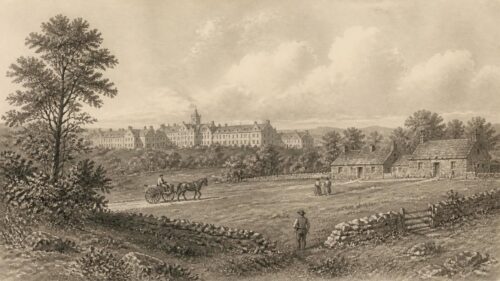
Before the great nineteenth-century land reforms, much of Ireland was organised through a hierarchy of landed property. Estates might be owned by aristocratic families, churches, colleges, commercial interests or smaller proprietors. Land was then let through a variety of arrangements. Some occupiers held direct leases; others were cottiers, labourers, subtenants or tenants of middlemen. The practical position of a household depended not only on written law but also on estate custom, local bargaining power, the fertility of land, the availability of work and the threat of eviction.
In much of Ulster, a set of practices commonly called the Ulster Custom offered an important, though uneven, precedent for later demands. Broadly stated, it recognised that a tenant who had created value through labour and improvement possessed an interest that could be sold, subject to conditions. It could also restrain arbitrary rent increases and provide compensation when a tenant left. The Custom was neither universal nor a complete legal shield. Its contents varied, its enforcement could be disputed, and it sat uneasily beside orthodox ideas of landlords’ property rights. Nevertheless, it supplied a concrete example which tenant-right advocates could contrast with more insecure conditions elsewhere.
The difference between a legal rule and a local practice matters. Family stories and later political memory sometimes describe the Ulster Custom as though it guaranteed every industrious tenant a secure home. The evidence is more complicated. It did provide leverage in many places, but leverage was not the same as equality, and the strength of any customary claim depended upon recognition by landlords, agents and courts. Its historical importance lies partly in its limitations: it demonstrated that occupiers’ claims could be acknowledged, while also exposing the insecurity of a system reliant upon contested custom rather than clear national protection.
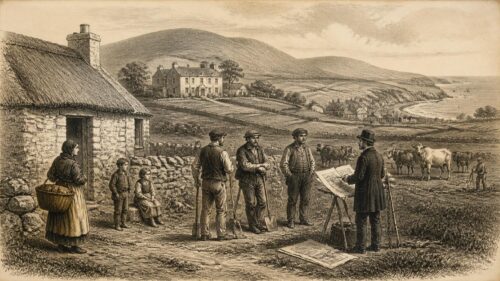
During the eighteenth and early nineteenth centuries, population growth and subdivision intensified pressure on land. In many districts, a small patch of ground was inseparable from survival. Cottages and cabins could be built or occupied without giving their inhabitants a durable stake in the soil beneath them. Improvements made by tenants, including drainage, fencing, buildings and reclamation, could increase the value of an estate. Where rent was revised after improvement, tenants believed they were being made to pay for the fruits of their own work. This was a material grievance, but it was also a grievance about dignity and recognition.
Famine Pressures
The Great Famine transformed the context in which tenancy was debated. The catastrophe arose from potato failure, but its human consequences were shaped by poverty, landholding patterns, inadequate relief and official policy. It would be inaccurate to say that all evictions caused the Famine, or that every landlord behaved alike. It is equally inaccurate to treat eviction as a marginal matter. In a society with little alternative accommodation, losing a holding or cottage could bring a household into the workhouse system, migration, illness or homelessness.
The Devon Commission, appointed before the Famine and reporting in 1845, investigated Irish occupation and heard extensive evidence about tenure, improvements and the Ulster Custom. Its conclusions were cautious. It acknowledged that tenants could benefit from protection for their improvements, yet it did not endorse the full programme later encapsulated in fair rent, fixity of tenure and free sale. That restraint reflected a wider political difficulty: British governments could recognise hardship while remaining reluctant to alter the underlying balance between landlord ownership and tenant occupation.
Famine-era clearances and consolidations have remained morally charged subjects. Documentary evidence shows that evictions occurred, including for rent arrears, and that some estates sought to reduce the number of small occupiers or assist emigration. But motives and outcomes differed greatly from estate to estate. A landlord who financed passages might claim to be preventing destitution; those removed could experience the action as coercive displacement. Historical judgement should retain both the paper record and the human reality. Administrative language about improvement or consolidation could conceal the destruction of a household’s place in a community.
The Famine also revealed the inadequacy of treating a house solely as a private bargain between owner and occupier. Under the Poor Law, relief was tied to institutions and local rates, while the workhouse became the grim alternative for many without land or lodging. The relationship between tenure and welfare was therefore already visible. If people lacked secure access to a dwelling, the burden did not vanish; it shifted to kin, neighbours, charitable bodies or public institutions. This insight would later inform municipal housing, though not without long delay.
Tenant Campaigns
After the Famine, tenant-right agitation gained renewed force. Campaigners such as William Sharman Crawford and William Conner argued, in different ways, that the tenant’s investment in land deserved protection. The Tenant League, active in the early 1850s, sought reforms often described through the three Fs: fair rent, fixity of tenure and free sale. Fair rent meant an independently assessed charge rather than whatever a landlord could demand; fixity meant security while obligations were met; free sale meant the ability to transfer the beneficial interest in a holding.
These demands were politically radical because they challenged an absolute reading of ownership. Advocates did not necessarily deny that landlords had property rights. Rather, they argued that the tenant’s work, capital and occupation created a proprietary interest of its own. Opponents feared that such measures would confiscate or weaken landed property. The resulting argument was not merely economic. It raised a constitutional question: whether law should treat land as an asset controlled principally by its owner, or as the basis of a settled community whose occupiers had enforceable claims.
The Landlord and Tenant (Ireland) Act 1870 was an important but incomplete response. It gave statutory recognition to the Ulster Custom where it could be shown to exist, and it provided compensation in certain circumstances for disturbance and improvements. It also contained provisions enabling agreed sales from landlord to tenant. Yet the Act did not establish the three Fs across Ireland. A tenant could still be exposed to rent pressure, and the compensation provisions could not substitute for a dependable right to remain. Its significance was therefore transitional: the State had accepted that tenants’ interests mattered, but had not yet remade the system.
Political agitation did not proceed only through Parliament. Meetings, newspapers, clergy, local organisers and informal networks spread ideas about rents, evictions and collective action. Such organisation could protect particular families and make estate management more difficult. It could also generate intimidation and violence. A responsible history must recognise both. The popular memory of the tenant movement rightly preserves courage and hardship, but it should not erase the coercive acts committed in the wider agrarian conflict. Security for some was sometimes pursued through insecurity for others.
Land War
The agricultural depression of the later 1870s created the conditions for the Land League and the conflict known as the Land War. Falling agricultural prices, poor harvests and chronic indebtedness left many tenants unable to meet rents fixed in more favourable times. The Irish National Land League connected economic distress to a sweeping political programme. Its leaders differed in strategy and ultimate aims, but tenant protection was central to its popular appeal. The movement publicised evictions, supported distressed households and used collective pressure to challenge landlords and agents.
Boycotting became one of the best-known forms of pressure. The term itself came from the case of Captain Charles Boycott in County Mayo, whose social and economic isolation in 1880 gave a name to a practice already rooted in collective sanctions. Later folklore can make the episode seem tidily emblematic of all agrarian struggle. In reality, the Land War involved a shifting mixture of organised non-payment, resistance to eviction, political negotiation, legal proceedings and intimidation. Its local form depended on land quality, estate structure and the strength of local organisation.
The Land Law (Ireland) Act 1881 was a decisive statutory turning point. It established a system through which judicial rents could be fixed, confirmed rights of sale in many holdings, and created statutory conditions that gave tenants a measure of continued occupation. The Land Commission became central to the new order. The Act did not make tenants owners, and it retained exceptions and complex procedures. Nor did it end conflict, since a fair rent determined by a court might still prove difficult to pay. Yet it fundamentally changed the legal assumption that the landlord alone determined the terms of occupation.
The conventional description of the 1881 settlement as the triumph of the three Fs is useful but should be handled carefully. It captures the direction of reform, rather than a flawless reality. Fair rent depended on valuations and legal process. Fixity depended on compliance, statutory conditions and the scope of the Act. Free sale was regulated and not unlimited. Still, the legislation gave legal force to a proposition for which campaigners had struggled for decades: occupation, labour and improvement created claims which the State could protect against the owner’s unilateral power.
Purchase Settlement
Security through regulated tenancy did not settle the land question. Many politicians, landlords and tenant leaders came to believe that ownership by occupiers offered a more durable solution. Land purchase had appeared in limited form in the 1870 Act and was expanded through later measures. The logic was attractive to different interests. Tenants could replace rent with an annuity and acquire a transferable asset. Landlords could receive capital and withdraw from difficult management. Governments hoped to reduce conflict by transforming the social basis of rural Ireland.
The Ashbourne Acts of the 1880s provided state-backed advances for voluntary purchases. They were significant but did not move quickly enough to resolve the problem on a national scale. The later Balfour measures added protection for some tenants under threat and extended purchase finance. The largest breakthrough came with the Wyndham Land Act of 1903, shaped by the Land Conference of landlord and tenant representatives. It offered generous state-supported finance and incentives which made voluntary transfer far more practicable.
Purchase is sometimes presented as a complete liberation. It unquestionably altered Irish rural society on a vast scale, transferring much land from landlords to former tenants. But the process had limits. Some tenants remained outside it for years; congested districts faced distinctive difficulties; labourers without viable holdings could not gain security simply by purchasing farms; and the debt owed through annuities was real. The settlement redistributed ownership more than it redistributed all forms of rural opportunity. It did not automatically resolve poverty, underemployment or the scarcity of decent cottages.
The story also crosses the constitutional divide created after 1921. In the Irish Free State and later the Republic, land purchase and land division continued under new institutions. Northern Ireland followed its own political and administrative path, though the inheritance of pre-partition land law and landlordism remained important. It is therefore misleading to speak as if one post-1922 housing system existed throughout the island. The rural land revolution was shared history, but later public housing and tenancy rules developed under separate jurisdictions.
Urban Poverty
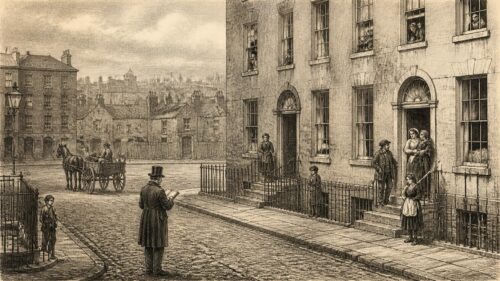
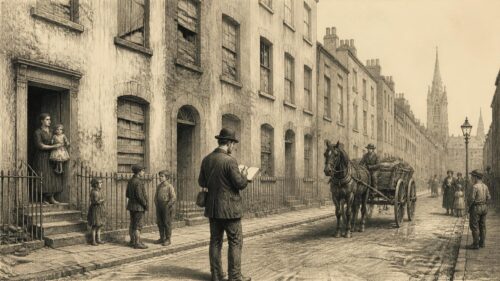
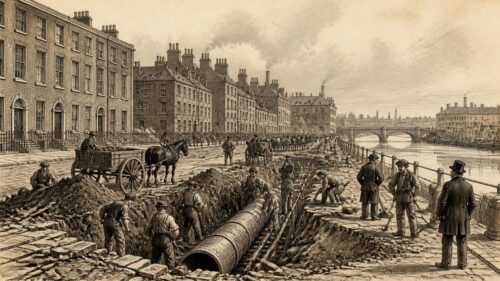
While rural tenure dominated national politics, urban housing presented another crisis. Dublin’s late nineteenth- and early twentieth-century tenements became notorious for overcrowding, poor sanitation and high mortality. The word tenement can obscure the diversity of buildings involved. Many were formerly respectable Georgian houses subdivided repeatedly for rental. Others were purpose-built or converted dwellings of varying quality. What united the worst cases was not architecture alone but the combination of poverty, weak regulation, absentee ownership, inadequate services and a shortage of alternatives.
The collapse of two tenement houses in Church Street, Dublin, in September 1913 exposed the consequences with terrible clarity. Seven people died, and the disaster intensified public scrutiny of housing conditions. It did not reveal a problem unknown to residents, reformers or officials; rather, it made it impossible to disregard. Public health reports, philanthropic investigation and local campaigning had long documented unhealthy conditions. The collapse became a symbol because it demonstrated that insecure, neglected housing was not an abstract social concern but an immediate danger.
Urban tenants faced a different relationship to property from agricultural tenants. They generally had no claim comparable to an improvement in a farm, no route to purchase a share in the dwelling, and little leverage over distant owners. Their security could be curtailed by arrears, sale, redevelopment or the expiry of a letting. The household might rent one room rather than a whole house. Lodgers and subtenants occupied especially precarious positions. Women often carried the daily work of maintaining homes and negotiating with landlords or rent collectors, yet their role is less visible in official records than the names of male owners and administrators.
There was no single “Dublin tenement experience”. Some families lived for long periods in particular rooms or buildings, creating networks of mutual support. Others moved frequently. Some landlords were resident and attentive; some were not. Memories of neighbourliness are historically valuable, but they should not be used to romanticise overcrowding or disease. Community solidarity often existed because people had to compensate for the absence of reliable housing provision. It was a resource, not proof that the conditions were acceptable.
Municipal Response
Local authorities slowly assumed a larger role in housing. The Housing of the Working Classes legislation provided powers for clearance and construction, although finance, land acquisition and political will limited results. Dublin Corporation built early schemes, including housing at places such as Chancery Park and St Michan’s, while other towns developed their own, usually smaller, programmes. Such projects demonstrated that public bodies could act as landlords and builders, but they did not immediately meet the scale of need.
The First World War, revolutionary period and Civil War complicated building and administration. In the new Free State, housing became a practical test of state capacity. The need included urban slums, overcrowded cottages, rural labourers’ homes and the accommodation of families affected by political upheaval. Local authorities, backed by central legislation and loans, became the principal providers of social housing for much of the twentieth century. This was a structural change: the State did not merely regulate private property but increasingly supplied dwellings itself.
Council housing offered a distinctive form of security. Tenants did not own their dwellings, but they usually had more predictable rents, clearer rules and a public landlord subject to electoral and administrative pressure. The security was never absolute. Rent arrears, breaches of tenancy conditions and changing allocation policies mattered. Nor were all estates equally well designed or served. Nonetheless, for many households moving from overcrowded private rooms or dilapidated cottages, a council house with indoor sanitation, a garden and separate bedrooms represented a profound improvement in health, privacy and stability.
The local-authority model also had an ideological dimension. It treated adequate housing as part of civic provision, akin to sanitation, roads or water supply. Yet public housing was not simply a benevolent gift from above. Tenants, trade unionists, local representatives, women’s organisations and community campaigners repeatedly pressed authorities to build, repair and allocate fairly. The history of council housing is thus also a history of demands made upon the State by those who understood housing as a public responsibility.
Labourer Cottages
Rural labourers occupied a position easily overlooked in narratives centred on farm purchase. Many did not hold enough land to benefit from the transfer of estates. Their security depended on wages, seasonal work, cottages and often very small plots. The Labourers Acts, beginning in the late nineteenth century, enabled rural district councils to provide cottages and plots for agricultural labourers. These schemes were uneven and sometimes resisted, but they acknowledged that the land question could not be solved solely by creating peasant proprietors.
The cottage was both a home and an instrument of social policy. A decent dwelling could reduce dependence upon a farmer or landlord for accommodation and could give a labouring family some independence. A plot offered the possibility of food production, though not necessarily a sufficient livelihood. The architecture of labourers’ cottages has since attracted affection, and photographs can make them appear idyllic. That retrospective image needs qualification. Conditions varied, rents mattered, maintenance could be inadequate and rural isolation brought its own burdens.
After independence, policy increasingly favoured tenant purchase for rural social housing. The Labourers Act 1936 gave many rural local-authority tenants an opportunity to purchase, a policy later made more attractive through reductions in annuities. This linked the twentieth-century council cottage to the older political ideal of ownership as security. For households able to complete purchase, the result could be a durable family asset. For public housing supply, however, sales reduced the number of dwellings available for future tenants unless construction kept pace.
Rent Controls
Private urban renting remained important long after the worst tenement era. During the First World War, rent restrictions were introduced in response to wartime inflation and pressure on households. Variations of rent control continued for decades. Such measures could protect sitting tenants from sudden increases and contribute to stability, especially where incomes were low and alternative accommodation scarce. Their persistence indicates how politically sensitive rent became in a country where ownership was increasingly promoted but was not available to everyone.
Rent control had consequences that remain debated. Supporters regarded it as an essential restraint on landlords’ power and a safeguard against displacement. Critics argued that strict controls discouraged investment, repair and the supply of privately rented homes. Both propositions can contain truth in particular circumstances. A badly designed control can leave landlords unable or unwilling to maintain properties; an unregulated market can expose tenants to unaffordable increases. Historical analysis should resist the temptation to use either conclusion as a timeless rule. The effect of regulation depends upon enforcement, housing supply, subsidies, standards and the wider economy.
By the later twentieth century, Ireland had become strongly associated with owner occupation. This resulted from several forces: the legacy of land purchase, subsidies for buyers, local-authority tenant-purchase schemes, family transfers of land and housing, and a cultural preference for owning a home. It did not mean that tenancy had disappeared. Rather, renting was often treated as a temporary stage or a residual tenure for those unable to buy. That assumption carried consequences. A sector imagined as temporary was less likely to be designed around long-term stability for families.
Tenant Purchase
Urban council tenants sought the purchase opportunities already available to many rural tenants. The Housing Act 1966 removed the earlier legal distinction that had restricted this right, extending purchase more broadly. Subsequent schemes offered discounts and encouraged substantial sales. For many working-class households, buying a council house converted a secure tenancy into ownership and created wealth that could be passed to children. It also changed the social geography of estates as owners invested in, altered and sometimes sold their homes.
There is no need to deny the personal importance of these purchases in order to see the policy dilemma. Each sale reduced the stock held for letting, unless the proceeds were effectively used to replace homes. In a society with a persistent shortage of affordable rental housing, large-scale sales could benefit individual purchasers while constraining future applicants. The issue is not whether one generation deserved the opportunity to buy; it is how a public system balances security for present tenants with provision for those who will need homes later.
By the 1980s and 1990s, the role of local authorities was changing. New construction declined at times, and support for low-income renters increasingly included payments that helped households rent from private landlords. Approved housing bodies also became more significant providers. These developments broadened the means through which the State supported housing, but they also made security more dependent on a complex relationship between a tenant, a private owner, welfare supports and regulation. The public obligation remained, while the direct public ownership of housing became less dominant.
Modern Tenancies
The Residential Tenancies Act 2004 marked a major modern attempt to give private renters a clearer framework of rights. It established the Private Residential Tenancies Board, later the Residential Tenancies Board, introduced registration and created a statutory form of security known as Part 4 protection. In broad terms, after an initial qualifying period a tenant acquired the right to remain, subject to specified grounds on which a landlord could terminate the tenancy. The legislation also provided a dispute-resolution route intended to be more accessible than ordinary court proceedings.
The Act should be understood as an important reform rather than a complete answer. It made the private rented sector more legible to the State by requiring registration, and it codified rights and duties that had often been unclear in practice. But law works through notice, evidence, enforcement and access to remedies. A tenant may possess a right on paper yet struggle to challenge an invalid notice, find alternative accommodation or bear the disruption of a dispute. Likewise, landlords may face real costs and obligations which are not solved merely by writing rules into legislation.
Security rules have since been amended repeatedly. Tenancies beginning on or after 11 June 2022 generally acquired an entitlement of unlimited duration once the qualifying conditions were met, while lawful termination grounds remained. Further changes took effect for new tenancies from 1 March 2026, with different rules depending on when a tenancy began and, in some cases, the scale of the landlord’s holdings. This changing framework is a reminder that tenant security is not a settled inheritance. It is continually recalibrated by legislation in response to supply, affordability and political debate.
Modern tenancy law also differs from the nineteenth-century land settlement in a fundamental way. The old rural demand aimed ultimately to move many occupiers from tenancy to ownership. Contemporary policy must serve a more diverse population, including students, migrants, older people, single adults and families who may rent for short or long periods. The historical lesson is not that every tenant must become an owner. It is that renting cannot be treated as inherently insecure or socially inferior if it is to function as a genuine home rather than a precarious waiting room.
Historical Balance
Ireland’s long argument about housing security has repeatedly moved between three remedies: regulating the tenancy, transferring ownership and supplying public homes. None has been sufficient on its own. Regulation can restrain arbitrary action but requires enforcement and available dwellings. Ownership can give households independence but cannot meet every need and may deepen exclusion where prices are high. Public provision can establish secure homes at scale but depends upon sustained funding, land, management and democratic accountability.
The rural land reforms demonstrate the power of organised tenants to alter legal assumptions about property. The history of urban tenements demonstrates the danger of leaving basic housing to an inadequately regulated market. Council housing demonstrates what public building can achieve, while tenant purchase demonstrates the tension between individual advancement and collective supply. Modern tenancy legislation shows that security is still being defined in law rather than inherited automatically from the past.
Folklore, family memory and local commemoration remain valuable parts of this history. They preserve the names of evicted families, the pride attached to a first council house, and the remembered hardship of rooms shared by several people. But memory should be read alongside statutes, housing records, public-health reports, census evidence and the surviving files of local government. The strongest account is neither coldly administrative nor romantically selective. It recognises that homes are intimate places, while housing policy is a field in which law and power become visible in everyday life.
Tenant security in Ireland has therefore never meant immobility or the abolition of all conflict. It has meant an effort to make occupation dependable enough for a household to plan, care, work, educate children and belong to a place. From the tenant right campaigns to contemporary residential tenancies, that effort has repeatedly required the State to decide that a dwelling is more than an investment and that a tenant is more than a temporary user of another person’s property.
Renewed Protections
The unfinished character of the 2004 settlement became clearer as housing supply and affordability again became central political questions. Registration, notice requirements and access to the Residential Tenancies Board made private renting more formal than it had been in earlier decades, but formalisation did not by itself create homes that tenants could afford or remain in for long periods. Security depended upon the interaction of rent, availability, landlord decisions and the practical ability to enforce a right. A household facing the loss of a tenancy could not take much comfort from a remedy that arrived only after it had been forced to search for another dwelling.
This difficulty must also be placed beside the changing role of social housing. For much of the mid-twentieth century, local-authority housing was a major component of Irish housing output and provided income-related rents for lower-income households. From the 1980s, provision increasingly involved both local authorities and not-for-profit housing associations. Over the following decades, however, the relationship between public provision and the private market changed substantially. The severe fall in public funding and output after the property boom and financial crash demonstrated the risk of relying on the market to supply housing while public construction contracted at the same time. The result was not simply a shortage of buildings; it was a weakening of the alternatives available to people whose private tenancies ended.
That history helps explain why contemporary law has returned to questions that echo older disputes. The vocabulary is different from the nineteenth-century language of fair rent and fixity of tenure, but the underlying issue remains familiar: how far may an owner alter the conditions on which another person can continue to make a home? Modern legislation does not give tenants an interest in a dwelling equivalent to the proprietary claims once asserted by farming occupiers. It does, however, accept that residential occupation deserves protection beyond a purely private contract.
New rules effective from 1 March 2026 illustrate both the expansion and the limits of that protection. They apply to new tenancies created on or after that date, while existing tenancies remain governed by the earlier rules. A tenant gains security of tenure after six continuous months if no valid notice of termination has been served. For tenancies beginning from 1 March 2026, landlords with four or more tenancies, and companies, may generally end a tenancy after that point only where the tenant breaches obligations or the dwelling no longer suits the tenant’s needs. Smaller landlords retain additional grounds in defined circumstances, including hardship sales and occupation by the landlord or a close family member.
The distinction is significant. It seeks to give stronger continuity to tenants while recognising that a person letting a small number of homes may depend upon a property in ways that differ from a larger landlord or company. Yet it also means that security varies according to the kind of owner and the date on which the tenancy began. Older tenancies may still be ended on wider grounds, including sale, renovation, change of use or a landlord’s family need. Law can therefore reduce arbitrary removal without making every rented home permanently secure.
The March 2026 changes also establish a national approach to rent control for private tenancies and student-specific accommodation. In general, rent may increase once each year by 2 per cent or by inflation where inflation is lower. Existing private tenancies may not be reset to market rent. Newer tenancies have limited circumstances in which a reset may occur, including at the end of a six-year tenancy cycle. There are separate rules for newer apartments and student accommodation, while approved housing body and cost-rental tenancies do not fall within this national system.
These distinctions show why secure homes cannot be measured by a single legal label. Predictable rent may be as important as protection from a notice to quit; a right to stay has limited value if a household cannot meet the rent, while a rent limit cannot guarantee a dwelling will be available. Ireland’s long history of land, cottages, council estates and private lettings suggests a broader conclusion. Durable tenant security requires enforceable rules, but it also requires a sufficient supply of decent homes outside the reach of short-term market pressures. The continuing challenge is to make a home a stable basis for family and community life without ignoring the varied forms of ownership and need that have always shaped Irish housing.
The article’s broad definition of security is revealing: rural tenants might gain legal protection or ownership, while urban households could still endure overcrowding, dangerous buildings and limited choice. This suggests that security cannot be measured solely by protection from eviction, but must include affordability, conditions, dignity and control over one’s home. The contrast between contested customs such as the Ulster Custom and later statutory tenancy rights also raises questions about whether law always improves lived security equally. How should historians assess the importance of legal rights, material housing conditions and community support when comparing rural and urban experiences of home?