Eóthigern’s Kildare Crisis762 CE
In the annalistic dossier conventionally dated 762, Ireland experienced exceptional snow and a darkened moon, perhaps linked to an eclipse dated elsewhere to December 763. Bishop Eóthigern was killed by a priest in Kildare’s wooden oratory, demonstrating violence within a prestigious ecclesiastical centre, although motives remain unknown. Cenél Cairpri defeated the Luigne at Caill Tuidbig, illustrating local warfare amid Domnall Midi’s overlordship. Deaths included Cormac, abbot of Clonmacnoise, and Fer Fio of Comrair, a noted scholar; Tigernach also records Fogartach of Éile and Suibne of Clonfert. These notices reveal dispersed authority, church influence, learning, and vulnerability to weather and conflict.
Dateline
For Ireland in 762, the surviving annals offer a compact but unusually revealing sequence: severe weather and a darkened moon; the killing of a bishop within the religious enclosure at Kildare; a battle in which the Luigne were defeated by Cenél Cairpri; and the deaths of prominent churchmen. These are not the materials of a continuous narrative. They are brief notices, preserved in later manuscripts from a much older annalistic tradition, and they seldom supply motives, exact locations or dates within the year. Yet together they show an island in which political power, local warfare, farming conditions and ecclesiastical authority were tightly connected.
Dating a Difficult Year
There is an important caution before treating any entry as a firmly dated event of the calendar year. The Annals of Ulster and Annals of Tigernach place this cluster under their annal for 762, and this is the conventional date used for the episode. But early Irish chronicles have known chronological irregularities, especially where their year-headings, later editorial dates and the actual sequence of observations do not align perfectly. The opening report of “great snow and a dark moon” may preserve the memory of a winter event whose exact modern date is debated. Astronomical analysis has associated the dark moon with a lunar eclipse visible on 25 December 763. That possibility does not make the notice worthless; rather, it warns against turning an annal-heading into a precise modern date that the evidence cannot guarantee.
The other notices are best treated in the same spirit. They belong securely to the annalistic dossier conventionally labelled 762, but only the broad placement, not a day or month, can responsibly be asserted. This is particularly important in a society whose record-keepers measured time through Kalends, Easter calculations, rulers’ reigns and religious feasts as well as through the sequence of solar years familiar today.
A Killing at Kildare
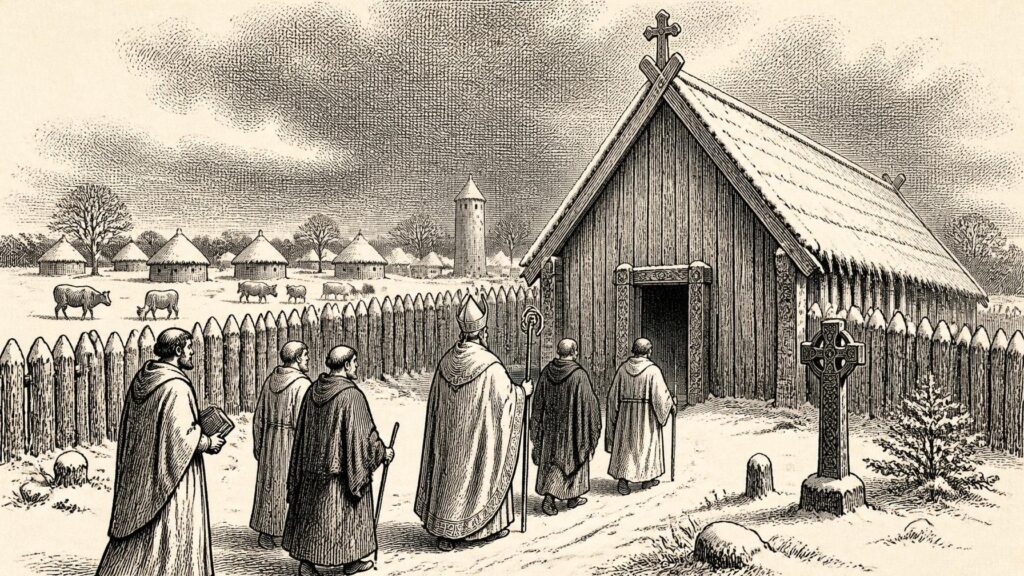
The most striking entry is brutally concise: Bishop Eóthigern was killed by a priest in the dertech, or oratory, of Cell Dara, modern Kildare. The annals do not name the killer, describe the weapon, or explain the dispute. Nor do they say whether Eóthigern held the principal episcopal office of Kildare or was a bishop attached to its wider religious community. It would therefore be unsafe to present the death as an assassination ordered by a king, or as proof of a particular doctrinal quarrel. What can be said is already significant: a bishop was slain by another cleric in one of Ireland’s foremost religious centres.
Kildare was no isolated chapel. It stood within Leinster and was associated with Brigit, whose cult gave the church exceptional prestige. Earlier writings presented the foundation as a major ecclesiastical community with both women and men, headed in different ways by abbesses, abbots and bishops. Its claims to authority had long been entangled with the interests of Leinster dynasties. The killing of Eóthigern thus occurred in a place where sacred standing, landed resources, patronage and regional politics met. The annal tells us nothing certain about its cause, but its preservation itself suggests that contemporaries considered the breach of clerical order memorable.
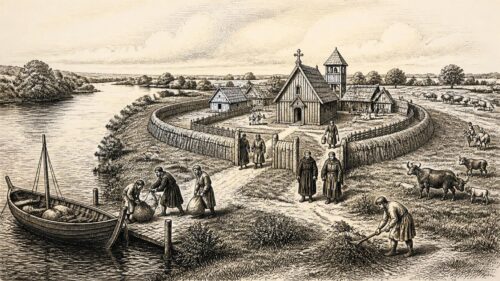
The word used for the building also offers a rare glimpse of material surroundings. A dertech normally denotes a timber church or wooden oratory. Timber was the usual structural material for many early medieval Irish ecclesiastical buildings, however important their communities might be. Kildare’s religious landscape would have included enclosed space, churches and dwellings, workshops, burial ground and agricultural land rather than a stone-built cathedral precinct of the later medieval kind. The bishop’s death was therefore not merely a private crime: it took place at the ritual heart of a well-connected ecclesiastical settlement.
Conflict Among Smaller Peoples
The same annal records the battle of Caill Tuidbig, “the wood of Tuidbig”, in which the Luigne were overthrown and Cenél Cairpri gained victory. Neither side is presented as a kingdom of all Ireland. Both names instead point to kin-groups and territorial populations within the dense patchwork of early Irish lordship. Their struggle is a useful corrective to any picture of eighth-century Ireland ruled from a single centre. Most armed conflict occurred between neighbouring or rival groups competing for land, tribute, cattle, clients and precedence.
The annalist provides no casualty total, commander or explanation, and the location of Caill Tuidbig cannot be identified securely. It is tempting to attach the battle to a particular modern county or to make it an episode in a wider royal campaign, but the evidence does not permit that confidence. The core fact is narrower: Cenél Cairpri defeated the Luigne in a battle remembered strongly enough to enter the chronicle. A separate entry simply notes a battle at Sliab Truim. Since no participants or result are supplied, it cannot safely be joined to the fighting at Caill Tuidbig, even if the repetition of a familiar place-name has encouraged later speculation.
Such local warfare unfolded during the later rule of Domnall Midi of Clann Cholmáin, king of Tara and leading figure among the Southern Uí Néill. He was still alive during the annalistic year and would die at Durrow on 20 November 763. Domnall’s authority did not turn Ireland into a unified kingdom in the modern sense. It rested on seniority, alliances, military capacity and the ability to command acknowledgement from subordinate rulers. The battle between the Luigne and Cenél Cairpri shows that local contests could continue beneath, beside or beyond the reach of an overking’s power.
Churches, Learning and Leadership
Death notices make up much of the year’s surviving record. Cormac, abbot of Clonmacnoise, “rested”, in the annalists’ conventional Christian language for death. Clonmacnoise occupied a strategic position beside the Shannon and was already one of the island’s important religious and intellectual centres. An abbot there was far more than the supervisor of worship. He was responsible for a community with estates, dependants, visitors, books, craftsmen and political connections. The notice gives neither Cormac’s achievements nor the circumstances of his death, but it marks a consequential vacancy in a major institution.
Fer Fio son of Faibre, described as a learned man and abbot of Comrair in Mide, also died. The explicit designation sapiens, “learned”, is revealing. Literacy, biblical study, legal and historical knowledge, Latin learning and the calculation of the Christian calendar were valued forms of authority. Monasteries and churches were not identical with schools in a modern sense, but clerical communities cultivated the skills through which law, genealogy, liturgy and annals could be maintained. The annal’s choice to remember Fer Fio’s learning indicates that intellectual standing could be part of a churchman’s public identity.
The Annals of Tigernach, though not the parallel Ulster entry, additionally records the death of Fogartach, king of Éile, and Suibne, abbot of Clonfert. These notices should be kept distinct from the shared core of the two annals. They nevertheless reinforce the year’s impression of changing leadership in both secular and ecclesiastical communities. Annalists did not record every death. The people selected were those whose loss mattered to networks of rule, religious patronage or local memory.
Snow, Fields and Household Survival
The report of great snow belongs to the year’s most evocative evidence, even if its exact calendar placement is uncertain. For rural households, prolonged or heavy snowfall could obstruct movement along tracks and river crossings, make herding harder, reduce access to fuel and fodder, and isolate farms from churches and neighbours. Ireland’s population remained overwhelmingly rural. Most people lived in dispersed farmsteads and worked a mixed economy centred on cattle, with crops including cereals increasingly important by the eighth century. Winter was a season when stored grain, dairy produce, salted meat and fodder mattered intensely.
It would be wrong to infer a nationwide famine from a single brief weather notice: the annals do not say that people starved, that livestock died, or that crops failed. But the decision to record exceptional snow suggests conditions beyond ordinary winter hardship. The accompanying “dark moon” was likely understood as an ominous heavenly occurrence as well as a natural one. Monastic observers possessed sophisticated traditions of computus and astronomy, yet celestial signs could still carry moral and providential meaning. The annal preserves observation without telling us how all viewers interpreted it.
A Year of Fractured Authority
The surviving evidence for 762 is therefore thin, but not slight. At Kildare, violence entered a sacred enclosure and killed a bishop. At Caill Tuidbig, one local people defeated another. At Clonmacnoise and Comrair, the deaths of abbots removed experienced institutional leaders. Snow and a darkened moon impressed themselves on the record. None of these notices proves a general Irish crisis, and no source permits a detailed reconstruction of motive or popular feeling. Together, however, they show the practical texture of early medieval life: authority dispersed among kings and kin-groups; religious centres embedded in politics and property; learning sustained by clerical institutions; and ordinary communities exposed to the uncertainty of weather, conflict and the changing fortunes of their leaders.
Primary Sources
- The Annals of Ulster: Year U762
- The Annals of Tigernach: Annal T762
- The Annals of the Four Masters, Part 1
- Chronicon Scotorum
- Domnall Midi
- Áed Dub
- The Primate Claims of Armagh, Kildare and Canterbury
- St. Brigid’s Cathedral Before the Normans
- The Annals of Kildare
- On the Life of Saint Brigit
- Agriculture, Settlement and Society in Early Medieval Ireland
- The Economy of Early Medieval Ireland
- The Archaeology of Livestock and Cereal Production in Early Medieval Ireland, AD 400–1100
- Early Medieval Archaeology Project: Report 1
- Early Medieval Archaeology Project: The Early Medieval Church
- Early Medieval Ireland: Archaeological Excavations, 1930–2009
- The Chronology and Sources of the Early Irish Annals
- Chronological Synchronisation of the Irish Annals
- An Evaluation of Astronomical Observations in the Irish Annals
- Climate Change During and After the Roman Empire: Reconstructing the Past from Scientific and Historical Evidence
- Early Medieval Ireland, AD 400–1100: The Evidence from Archaeological Excavations
- The Medieval World