Domnall Midi at Durrow763 CE
In 763, Domnall Midi of Clann Cholmáin, king of Tara, died at Durrow on 20 November, ending a southern Uí Néill ascendancy. Niall Frossach of Cenél nÉogain then began to rule, restoring the leading overkingship to the northern Uí Néill amid a contested political order rather than a unified monarchy. Annals also record Connacht’s severe but unexplained defeat at Cuilnech Mór and fighting between Munster peoples. Deaths of abbots and clerics at several major churches reveal an extensive ecclesiastical network. A daytime darkening of the sun was noted, though its cause and meaning remain unknown. Kingship, warfare and church intertwined.
Dateline
A King’s Death
The most consequential Irish event recorded for 763 was the death of Domnall Midi, king of Tara, on 20 November. The annals give him an unusually full pedigree: Domnall son of Murchad, descended through the Clann Cholmáin branch of the southern Uí Néill. The Annals of Tigernach add a pointed judgement, calling him the first king of Ireland from Clann Cholmáin. That phrase should not be mistaken for rule over a unified state in the modern sense. Ireland remained a patchwork of overkingdoms, local peoples and ecclesiastical jurisdictions. Yet the kingship of Tara was the most prestigious secular claim available, and Domnall’s death removed a ruler who had held it for roughly two decades.
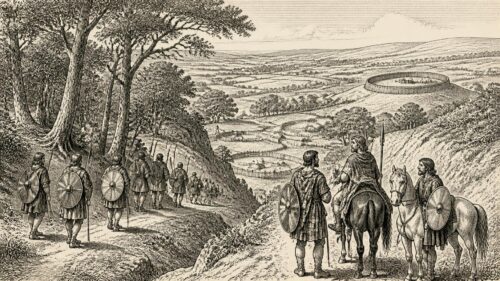
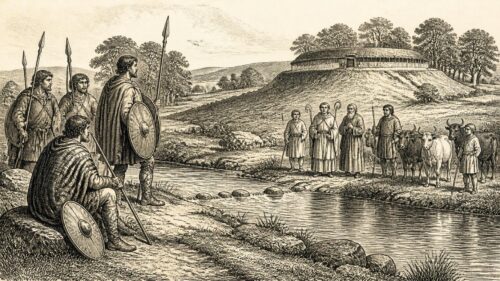
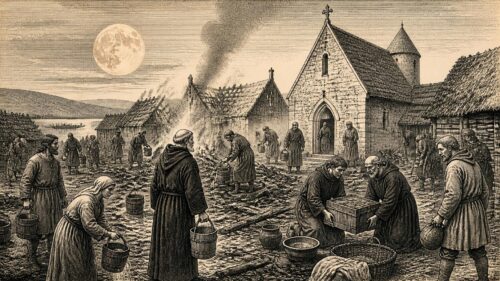
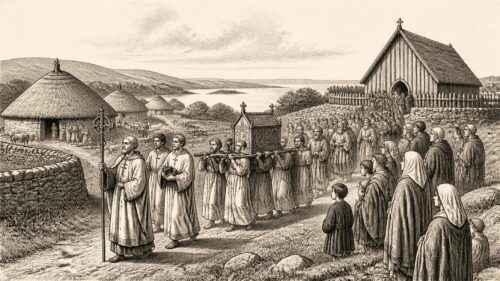
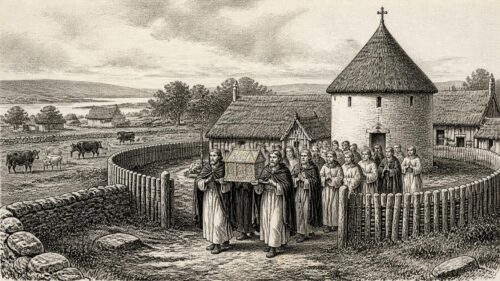
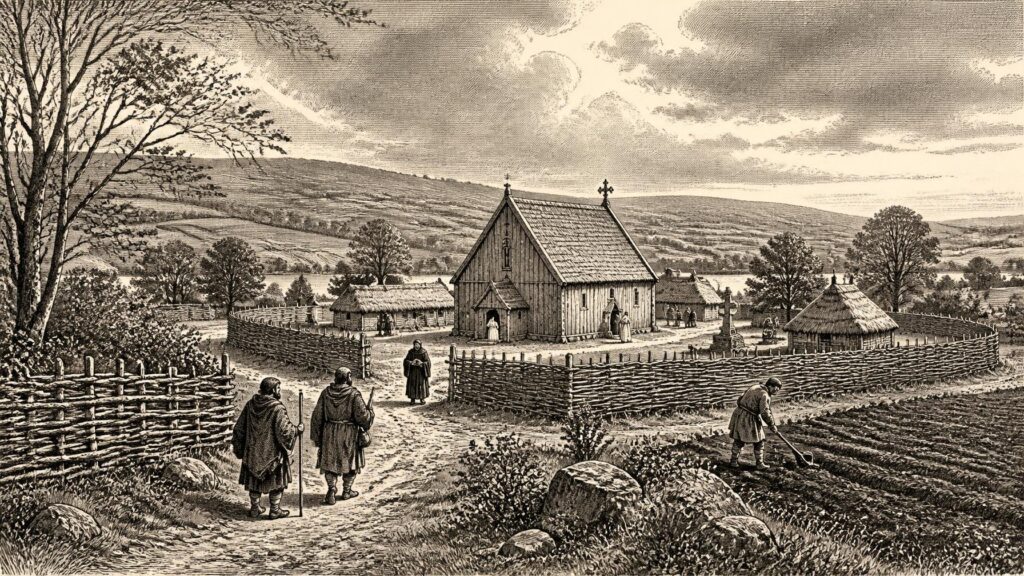
Later scholarly tradition places his death at Durrow, in what is now County Offaly, on that same 20 November. Durrow was no accidental setting. Its Columban foundation was already an old and influential ecclesiastical centre, associated with learning, manuscript culture and powerful patrons. Domnall’s reign had been marked by close links between the southern Uí Néill and Columban churches, including his support for the Law of Colum Cille a decade earlier. His death at Durrow therefore joined royal succession to a place whose religious standing gave political acts added weight. But the surviving notices are brief: they do not describe a deathbed, funeral, assembly or inauguration. Those details cannot be recovered responsibly.
The date itself is firmer than most details available for the year. The annalists rendered it in Roman calendrical form as the twelfth day before the Kalends of December, equivalent to 20 November. Their record is nonetheless a medieval compilation, preserved in manuscripts written long after 763, rather than a diary made at Durrow on the day. The agreement of closely related annalistic traditions gives the death considerable chronological authority, but it does not turn their terse formula into a full narrative.
Niall Frossach Begins to Rule
In the same annalistic year, Niall Frossach “began to rule” as king of Ireland. Niall belonged to Cenél nÉogain, the principal northern Uí Néill dynasty. His accession returned the leading overkingship to the north after Domnall’s southern Clann Cholmáin reign. This was not simply a change of individual rulers: it shifted the balance within the wider Uí Néill federation, whose major kindreds competed for precedence while relying on kinship, military following, client peoples, tribute and church alliances.
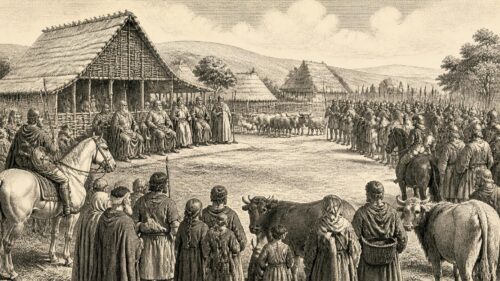
Niall was not an unknown newcomer in 763. He had already established himself among Cenél nÉogain, and Domnall had previously campaigned against him without decisive result. Domnall’s death created the moment in which Niall could press a broader claim. The annals provide no date, place or ceremonial description for that transition, and there is no basis for imagining a single island-wide coronation. “Began to rule” records recognition of a new overking, not the machinery by which every regional ruler accepted him. His authority would have depended on continuing negotiation and, where necessary, the capacity to demand submission.
Niall’s byname, Frossach, usually translated “showery”, acquired later stories of showers of grain, silver, honey or blood at his birth. Such tales belong to retrospective royal memory, not to evidence for weather in 763. They may preserve an idealised association between his kingship and prosperity or recovery, but they should not be treated as a report of miraculous abundance. What can be said is that the accession followed a long period in which Domnall had strengthened his own dynasty’s position in the midlands. Niall inherited not a settled national monarchy, but a contested hierarchy in which the title king of Tara had to be made effective through relationships across Ireland.
Defeat and Warfare Beyond Tara
Two conflict notices underline the limits of any king’s reach. One records the “overthrow” or slaughter of Cuilnech Mór, where the Connachta were “prostrated”. The wording identifies a severe defeat suffered by people of Connacht, but it does not name their opponents, leader, casualties or precise location. Cuilnech Mór has not been securely identified. It is therefore unsafe to connect the encounter directly to Niall’s accession, to assign it to a named Connacht dynasty, or to describe it as a battle for the high kingship. Its importance lies partly in what its stark silence reveals: a major loss could enter the historical record without the explanatory detail modern readers would expect.
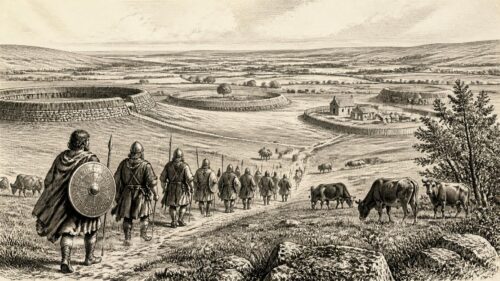
A second battle set the Uí Fidgenti against Corco Mruad and Corco Baiscinn. These were Munster peoples: the Uí Fidgenti were based in the region later associated with parts of Limerick, while Corco Mruad and Corco Baiscinn belonged to the north and west of present-day County Clare. The entry offers neither victor nor cause. It nevertheless shows that regional conflict was active far from Tara. Warfare in early medieval Ireland often concerned cattle, territory, clientship, honour and control of routes as much as territorial conquest in the later state sense. In this instance, however, the annals do not specify the immediate stakes, so none should be invented.
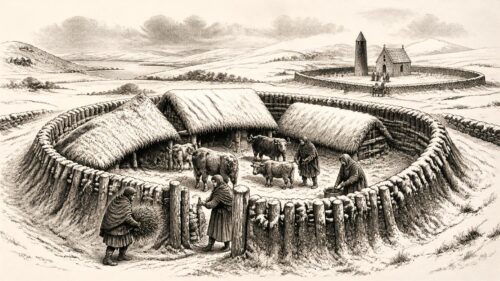
For ordinary households, such clashes mattered even when no individual farmer or herder was named. A fighting force needed food, animals, boats, weapons, guides and labour; defeat could bring loss of people, livestock and security. Yet 763 has left no trustworthy record of a harvest, market, epidemic or general famine in Ireland. The evidence does not permit a detailed reconstruction of everyday conditions that year. Its omissions are important: the annals privileged rulers, church leaders, conflict and prodigies, rather than the routine work of cultivation, dairying, craft production and local exchange on which society depended.
Churches Marked by Loss
The year’s ecclesiastical obituaries form a striking map of Irish Christian institutions. Becc-Laitne, abbot of Clonard, died, as did Faelchú of Finglas and Fidairle grandson of Suanach, abbot of Rahan. Reódaide, abbot of Ferns, and Anfadán, abbot of Linn Duachaill, were also recorded as dead. The notices extend from the central plain and the Dublin area to Leinster and the east-coast region around Linn Duachaill. They show the annalists following a network of communities rather than treating religious life as confined to one metropolitan centre.
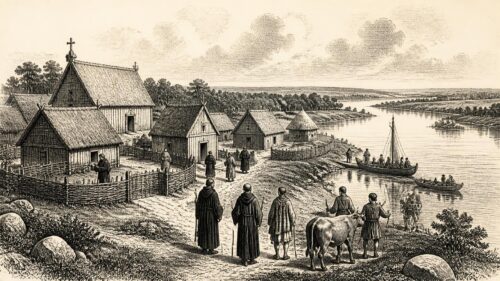
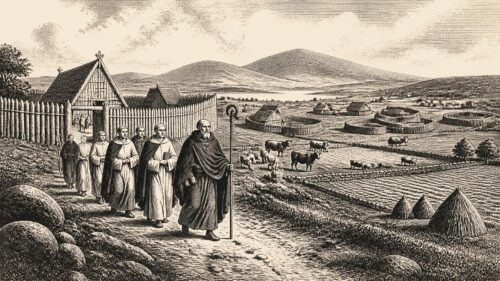
Titles such as abbot indicate more than a purely devotional role. Major Irish churches were communities of prayer, learning, hospitality, landholding and production, tied to clerical and lay families alike. Their leaders could have influence in local politics and in the preservation of memory. Clonard and Rahan were particularly significant midland foundations; Ferns was a leading Leinster church; Finglas was an important ecclesiastical settlement near the later city of Dublin; and Linn Duachaill stood in a strategic coastal district. Still, an obituary establishes that a named cleric died, not that his community immediately changed policy or fell into crisis. The careful conclusion is that 763 brought several vacancies in a wide-ranging ecclesiastical landscape.
Durrow provides a further reminder that religious institutions were also centres of culture. The monastery had a celebrated association with the Book of Durrow, produced more than a century before Domnall’s death, and with the wider Insular world of Latin books, vernacular learning and skilled craftsmanship. No surviving source says that a manuscript was made there in 763, nor should its famous book be used to decorate the year with invented scribes or ceremonies. But the annal’s elaborate genealogy for Domnall shows how writing, dynastic memory and political authority could meet: recording ancestry helped make a king’s claim intelligible across generations.
A Shadowed Sun
Among the year’s shortest and most evocative notices is the report that the sun was dark or shadowy in the third hour of the day. The wording may describe an eclipse or another striking dimming of daylight, but the annals do not provide a calendar day, duration, place of observation or explanation. It should therefore be treated first as a securely recorded perception: observers in Ireland, or information reaching the annalist, marked an abnormal darkening of the sun during daytime. It cannot safely be expanded into an exact astronomical event without independent demonstration.
Such a phenomenon would have been memorable in a society attuned to the religious calendar and to signs in the heavens, but the 763 entry does not say how people interpreted it. It does not explicitly link the shadowed sun to Domnall’s death, Niall’s succession or the battles recorded nearby. Medieval annals often place events together under a year without claiming that one caused another. The temptation to turn the dark sun into an omen of dynastic change is understandable, but it is a modern narrative choice rather than a statement made by the source.
A Sparse but Pivotal Record
Thus 763 stands as a year of transition rather than a year of one demonstrable island-wide upheaval. Domnall Midi’s firmly dated death at Durrow ended a major Clann Cholmáin tenure of Tara; Niall Frossach’s recorded accession elevated a northern Uí Néill ruler; Connacht suffered an otherwise opaque defeat; Munster peoples fought one another; and several important churchmen died across the island. Above these developments, the annalists set the image of a darkened sun. The surviving evidence is thin, but it is enough to show an Ireland in which kingship, regional violence and ecclesiastical authority were deeply interwoven, while much of daily life remained beyond the written record.
Primary Sources
- The Annals of Ulster: Year U763
- The Annals of Tigernach: Annals T751–T766
- Domnall Midi | Dictionary of Irish Biography
- Niall Frossach | Dictionary of Irish Biography
- The Annals in Cotton MS. Titus A. XXV: Part 3
- Chronicon Scotorum
- The Annals of Ulster AD 431–1201
- The Annals of Tigernach
- Annals of Inisfallen
- Annals of the Four Masters: Volume 1
- Fragmentary Annals of Ireland
- CELT: List of Published Texts
- Exploring the Irish Annals
- Durrow Church and High Cross | Heritage Ireland
- Irish School of Illumination, c. 650–1100 | Heritage Ireland
- Clonmacnoise Monastic Site Highlights | Heritage Ireland
- Clonmacnoise Monastic Site | Heritage Ireland
- Monasteries and Abbeys | Heritage Ireland
- High Crosses | Heritage Ireland
- National Monuments in State Care: Offaly
- Lismore Urban Archaeology Survey | National Monuments Service