
Osséne of Clonmacnoise1706 CE
In 706, Irish annals recorded deaths rather than events, revealing ecclesiastical and political transitions amid uncertain chronology. Osséne son of Gallust, abbot of Clonmacnoise, died, affecting a Shannon monastery sustained by rural production, river movement and communities. Flann Febla, abbot of Armagh, also died, marking change at Ireland’s Patrician church. Conchobor, king of Cenél Cairpri, died or was killed, though sources conflict. Notices of Bruide son of Derile suggest Irish Sea connections, while Cellan son of Sechnusach, the learned, reflects valued scholarship despite disputed dating. The sparse record depicts rural, plural, Christian Ireland structured by kinship, churches and regional power.
Dateline
A Year Recorded Through Deaths
The evidence for Ireland in 706 CE is unusually compact. No surviving Irish source describes a great battle, a royal assembly, a harvest, or a new law for this calendar year. Instead, the annals preserve a sequence of deaths: men connected with a major monastery, a leading church at Armagh, a regional kingship, learning, and—more uncertainly—the political world across the North Channel. The apparent thinness of the record is itself revealing. Early Irish annalists did not attempt a full chronicle of ordinary life. They selected deaths, killings, successions, ecclesiastical notices and exceptional events which mattered to their religious and political communities.
There is also a chronological warning. The Annals of Tigernach place the principal notices under 706. The Annals of Ulster head comparable entries ‘U706’, but their modern edition notes a discrepancy of one year: ‘AD 705 alias 706’. The later Annals of the Four Masters distributes some of the same material differently. It is therefore responsible to connect these people closely with 706, but not to claim dates within the year or to pretend that every annalistic heading is beyond dispute. This was a year defined in the surviving record by transitions of office and status rather than by one dramatic, securely dated event.
Osséne and the Shannon Community
The most substantial Irish notice concerns Osséne son of Gallust, abbot of Clonmacnoise. The Annals of Tigernach identify him further as being from Fremainn, among the Calraige of Tethba, and record that he ‘rested’—the customary Christian euphemism for death. This unusually full identification suggests that his origins mattered to the annalist, not merely his office. In a society where kinship, clientship and regional attachment shaped authority, an abbot’s family and people could be politically meaningful.
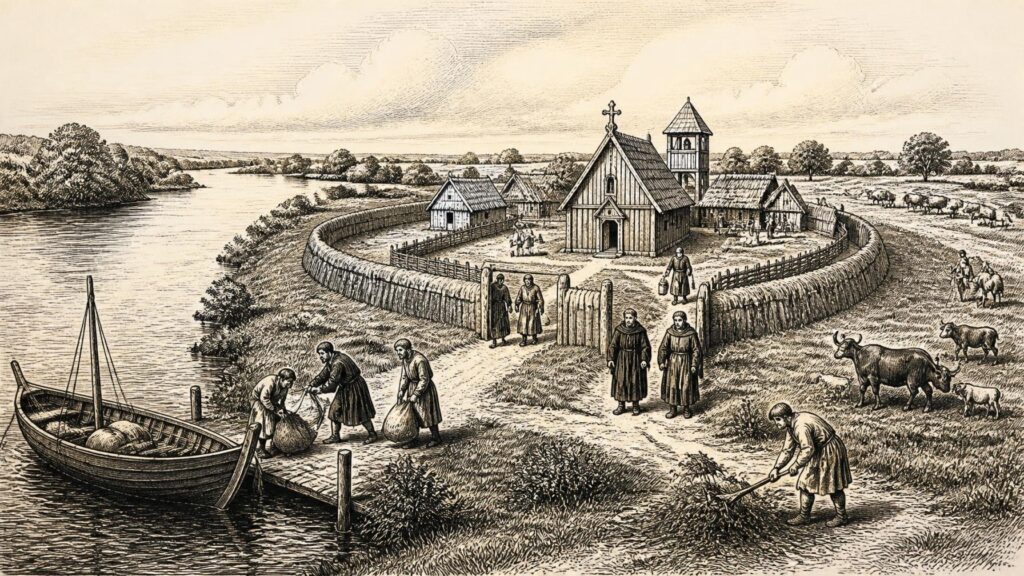
Clonmacnoise stood on the River Shannon in the midlands, near the crossing of the river route with east–west communications along the eskers. It was already an important religious community by the early eighth century. Yet the familiar stone churches, round towers and high crosses visible today mostly belong to later centuries. In Osséne’s lifetime the settlement was principally a timber-built enclosure of churches, dwellings, workshops, storage spaces and burial ground, with a substantial lay population living around the ecclesiastical core. The death of its abbot therefore mattered not only to monks and clergy. It affected a community of dependants, craftspeople, tenants, visitors and families whose livelihoods were entwined with the monastery.
An abbot was not simply a spiritual superior in the later medieval sense. Irish churches were embedded in the networks of powerful kindreds and local rulers. They held land, received food-renders and gifts, offered pastoral and burial services, preserved relics, educated clerics and could provide a setting for negotiation. An abbatial vacancy at Clonmacnoise would have required the selection or recognition of a successor, though the sources do not name one for 706. We should not invent the procedure, but the office was too important for its holder’s death to have been a private matter.
Food, Work and Monastic Resources
The annals say nothing about the weather or harvest of 706, so no particular abundance or scarcity can be assigned to it. Archaeology nevertheless helps establish the conditions in which Osséne’s community operated. Early medieval Ireland was overwhelmingly rural. Cattle were central to wealth, status and livestock husbandry, while cereal cultivation, dairying, pigs, sheep, woodland resources and seasonal labour supported households. A monastery such as Clonmacnoise depended on these productive landscapes as much as on prayer and books. Food had to be grown, gathered, rendered, stored, prepared and redistributed; boats had to move people and goods on the Shannon; and timber was needed continually for buildings, fences, vessels, tools and fuel.
That does not make Clonmacnoise a town in the modern sense, nor does it permit a detailed reconstruction of its market in 706. But its location gave it advantages in movement and exchange. Travellers on the Shannon, pilgrims seeking the grave and cult of Ciarán, clerics travelling between churches, and rulers or their agents could meet there. The practical life surrounding the monastery was therefore one of fields and livestock, river traffic, craft work, hospitality and religious observance. Osséne’s death occurred within an institution that joined all those activities together.
Armagh Loses an Abbot
The same annalistic year records the death of Flann Febla son of Scanlán, abbot of Armagh. Armagh’s association with Patrick made it a pre-eminent church in Ireland, but its authority was expressed through people, communities, claims, patronage and mobility rather than through a later-style diocesan bureaucracy. The title ‘abbot of Armagh’ is therefore significant. It indicates leadership of a powerful ecclesiastical household and of a place whose religious standing reached far beyond its immediate territory.
Flann Febla’s death cannot be turned into evidence of a specific dispute or reform in 706; none is reported. It does, however, show how the annals measured Ireland’s religious geography. In one entry they noticed the leader of Clonmacnoise in the Shannon basin; in another, the abbot of Armagh in the north-east. These were centres of worship and learning, but also hubs through which land, prestige, hospitality, legal influence and political relationships could be organised. Their leadership changes were national news in the annalistic sense, even in an island without a single central government.
A Regional King’s Uncertain End
The death of Conchobor son of Máel Dúin, king of Cenél Cairpri, gives the year a sharper political edge. The Annals of Tigernach say that he died. The corresponding entry in the Annals of Ulster says he was killed. This is an important difference. It would be unsafe to write that Conchobor was assassinated or slain in battle when the sources do not agree. What is firm is that a ruler of Cenél Cairpri disappeared from the record in or very close to 706.
Early medieval Irish kingship was layered. A king ruled a people and territory, but his position depended on relatives, subordinate groups, allies, clients, church connections and military followers. Overkings could demand hostages, tribute, service or submission from lesser rulers; those arrangements were neither automatic nor permanent. Conchobor’s death thus represented more than a change in one household. It opened a question of succession in Cenél Cairpri and may have altered wider balances of obligation. The annals do not tell us who succeeded him, how his position passed, or whether violence lay behind the transition. Their restraint should govern ours.
At the broader level, Congal Cenn Magair of Fanad was the leading northern ruler presented in the annalistic tradition as king of Tara or Ireland during this period. Such a title did not mean that he governed Ireland as a unitary kingdom. It expressed pre-eminence achieved through alliances, military capacity and recognition among competing dynasties. In 706, local kingship remained the immediate political reality for most people, while more ambitious claims to island-wide supremacy rested on constantly negotiated relationships.
Bruide and the Sea-Lanes
The Annals of Tigernach also note the death of Bruide son of Derile. Unlike the entries for Osséne, Flann Febla and Conchobor, the notice supplies no title or location. The name Bruide belongs recognisably to the Pictish political world in northern Britain, but this entry alone does not justify a confident identification, nor can it support a narrative of Irish intervention in Pictland. Its inclusion is best treated as a reminder of the interconnected world around Ireland’s coasts.
Irish ecclesiastical and dynastic links crossed the North Channel. Iona, Dál Riata, Pictish territories and Irish kingdoms belonged to overlapping seaways of travel, kinship, warfare and religious communication. Events in Scotland could be relevant enough to enter an Irish chronicle, just as Irish rulers and churchmen mattered beyond the island. The sea was not a barrier at the edge of Irish affairs; it was a route through which people, news and influence moved.
Learning Remembered, Dating Questioned
The Annals of Ulster additionally record the death of Cellan son of Sechnusach, described as ‘the learned’. This is a rare and valuable description, but its date illustrates the hazards of the material. The entry occurs under U706 in that annal, whereas the Annals of the Four Masters puts Cellan’s death earlier. He should therefore be regarded as a learned figure remembered in the annalistic sequence around 706, not as a man whose death can be fixed securely to this one year.
Even so, the epithet matters. Learning was a recognised form of distinction in early Irish society. It could involve Scripture, Latin literacy, computus or calendrical calculation, grammar, genealogy, law, poetry and historical memory. Monastic centres sustained much of that intellectual culture, but learning was not confined to secluded cloisters. It served churches, kings and kindreds alike, helping to preserve claims, manage religious observance and frame the past in forms that later generations could inherit.
What 706 Can—and Cannot—Show
For Ireland, 706 is not a year of spectacular action in the surviving sources. It is a year in which deaths make institutional life visible. Osséne’s passing shows Clonmacnoise as an established and socially extensive Shannon community. Flann Febla’s death points to Armagh’s continuing prominence. Conchobor’s removal reveals the vulnerability and importance of regional kingship. The notice of Bruide gestures towards the Irish Sea world, while Cellan’s epithet preserves respect for scholarship even where exact dating is uncertain.
The silence about most inhabitants remains profound. We do not know the names of the farmers, boatmen, servants, women religious, artisans, children or dependants who lived through 706. But the institutions and rulers named by the annals depended upon their work. Read carefully, this sparse year offers a precise glimpse of early medieval Ireland: rural and politically plural, Christian but not separate from kinship and power, connected by river and sea, and organised around ecclesiastical settlements whose leaders could be remembered for centuries.
Primary Sources
- The Annals of Ulster, Year U706
- The Annals of Tigernach
- Chronological Synchonisation of the Irish Annals, 488–722
- Annals of the Four Masters
- List of Published Texts at CELT
- Irish Texts at CELT
- Clonmacnoise Monastic Site
- Clonmacnoise Visitor Guide
- Clonmacnoise Monastic Site: Highlights
- High Crosses
- Irish School of Illumination, c. 650–1100
- The Economy of Early Medieval Ireland
- Agriculture, Settlement and Society in Early Medieval Ireland
- Early Medieval Farming and Food Production: A Review of the Archaeobotanical Evidence from Archaeological Excavations in Ireland
- The Archaeology of Early Medieval Ireland, c.400–1169: Settlement and Economy
- Making Hay While the Sun Shines? Socio-economic Change, Cereal Production and Climatic Deterioration in Early Medieval Ireland
- Early Medieval Ireland, AD 400–1100: The Evidence from Archaeological Excavations
- Early Medieval Settlement Enclosures in Ireland: Dwellings, Daily Life and Social Identity
- Medieval Irish Chronicles Reveal Persistent Volcanic Forcing of Severe Winter Cold Events, 431–1649 CE
- Corpus of Electronic Texts, University College Cork
- Corpas: Historical Dictionary of Irish