The Great Snow1047 CE
In 1047, Ireland endured exceptional winter weather, remembered as the Great Snow, which persisted into March and killed people, livestock and wildlife. Resulting scarcity devastated Ulster, prompting hungry Ulaid groups to seek refuge in Leinster. Political conflict continued: Áed Ua Conchobair killed Niall Ua Ruairc in Corann, strengthening his Connacht kingship amid a longer dynastic feud; northern forces raided Brega; and Muirchertach of Uí Bresail was treacherously slain at Armagh. Ecclesiastical obits recorded leaders, lectors and a Kildare female coarb, while a bishop died on pilgrimage at Iona. The year clearly reveals regional rule, warfare, religious networks and rural vulnerability.
Dateline
The surviving Irish chronicles remember this year above all for exceptional cold, political violence and hardship in Ulster. Their notices are brief, and several were copied or expanded centuries later, but comparison between the Annals of Ulster, Inisfallen, Tigernach, Loch Cé and the Four Masters reveals a consistent core. A prolonged snowfall caused severe losses; Áed Ua Conchobair strengthened his new position in Connacht by killing Niall Ua Ruairc; armed forces moved through Brega; and a regional ruler was treacherously killed at Armagh. Alongside these events, the recorded deaths of bishops, lectors and senior church officials offer a glimpse of Ireland’s interconnected religious and learned communities.
A Winter Remembered
The most firmly attested natural event was the “great snow”. The Annals of Inisfallen place it between the feast of Brigit on 1 February and the feast of Patrick on 17 March. The Annals of Ulster give an earlier beginning, referring to the feast of Mary in winter, interpreted by their modern editors as 8 December. This may describe snow beginning in December 1046 and continuing into the spring of 1047, or reflect variation within the annalistic tradition. It is therefore safest to say that exceptionally severe winter weather persisted into March 1047, rather than to claim an undisputed starting date.
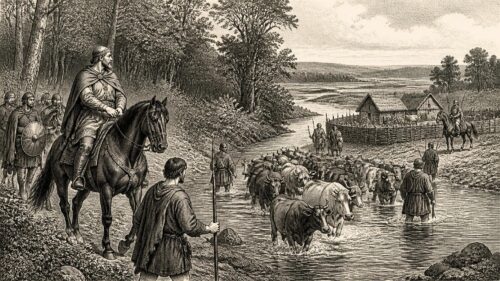
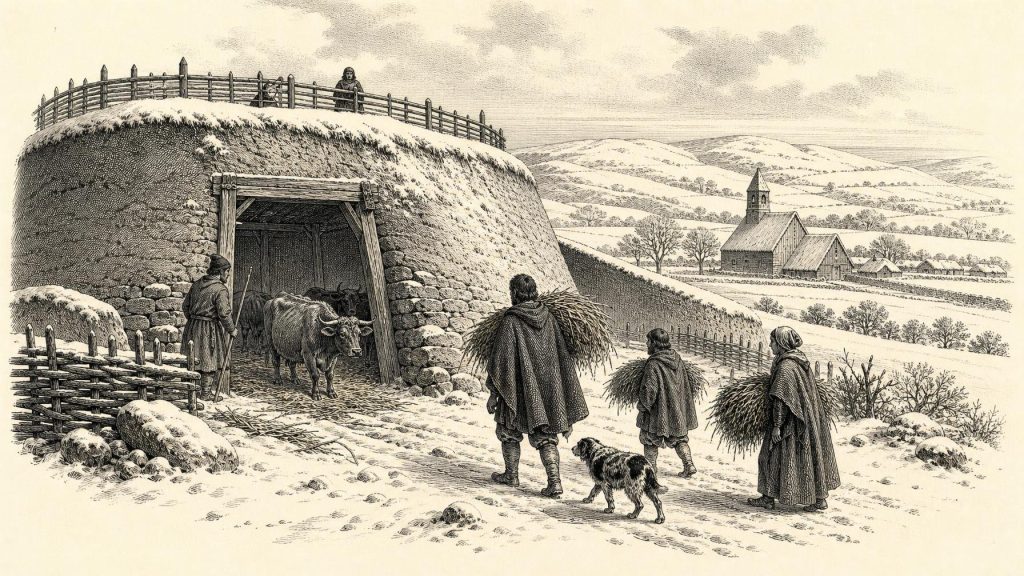
The chroniclers considered the episode unprecedented. The Ulster annalist reported deaths among people, cattle, birds and “sea-beasts”, while the Four Masters also mentioned wild animals and creatures of the sea. Such language may contain rhetorical exaggeration, but the agreement of independent annalistic traditions strongly supports a genuinely destructive weather event. Snow lying for weeks would have buried pasture, obstructed roads and tracks, delayed journeys and made it difficult to move cattle to usable grazing. Stored fodder was limited by modern standards, and prolonged cold threatened both livestock and the human communities dependent upon them.
The consequences extended beyond immediate mortality. Cattle supplied milk, meat, hides and social wealth, while oxen provided traction for cultivation. The loss of breeding animals or draught beasts could damage a household for years. Sheep, pigs and grain also contributed to the rural economy, but cattle remained particularly important in tribute, hospitality and political exchange. The great snow was therefore not merely a memorable spectacle. It struck at food reserves, transport, status and the ability of rulers and churches to collect renders from dependent lands.
Famine and Flight from Ulster
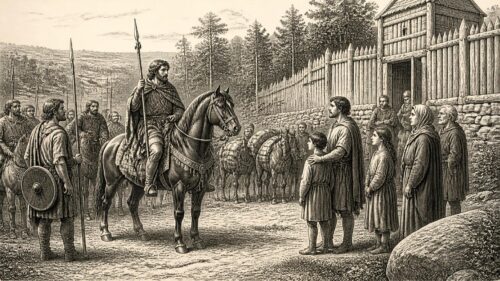
The Annals of Tigernach state that Ulster was almost wholly devastated and that its people went into Leinster. The Four Masters describe a great famine among the Ulaid, compelling them to abandon their territory and seek relief farther south. The precise scale of this movement cannot be recovered. The phrase need not mean that the entire population migrated; it more plausibly indicates a serious displacement involving hungry groups crossing political boundaries in search of food, protection or temporary settlement.
The Four Masters connect the famine with the betrayal of Murchad and Cellach, two sons of Máel Mórda, after they had entered the protection of the son of Eochaid and the leading men of Ulaid. The killing was allegedly intended as an affront to Diarmait mac Máel na mBó, the increasingly powerful king of Leinster. This moral explanation—that famine followed a broken covenant—reflects a Christian and legal understanding of disaster as punishment for violated protection. It should not be treated as a material cause of food shortage. Weather, loss of livestock and disrupted production provide more direct explanations, while the story reveals how seriously guarantees of safety were regarded.
A Killing in Connacht
In Connacht, Niall Ua Ruairc was killed by Áed Ua Conchobair in Corann, a territory centred in what is now County Sligo. Inisfallen calls Niall king of Bréifne, while Tigernach describes him more expansively as king of Bréifne and eastern Connacht. He was a son of Art Uallach Ua Ruairc, the overking of Connacht killed in 1046. His death was therefore part of an immediate struggle over the provincial succession.
Áed Ua Conchobair, known as Áed in Gaí Bernaig, or “of the gapped spear”, had taken the kingship of Connacht after Art’s death. By killing Niall in 1047 he removed a prominent member of the rival Uí Briúin Bréifne line and asserted the ascendancy of his own Síl Muiredaig kindred. The victory was important but not final. Niall’s brother Áed Ua Ruairc survived, and in 1067 would defeat and kill Áed Ua Conchobair. Seen in that longer sequence, the killing at Corann was one stage in a dynastic contest that shaped Connacht for two decades.
War in Brega and Armagh
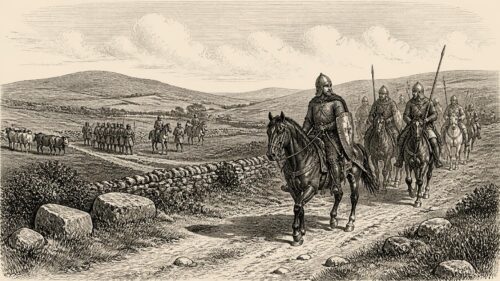
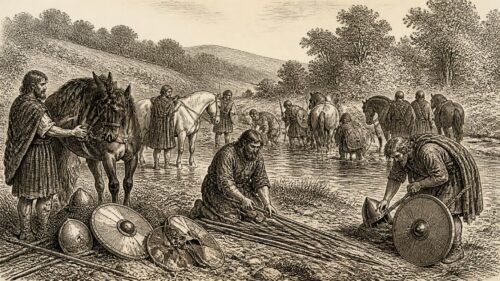
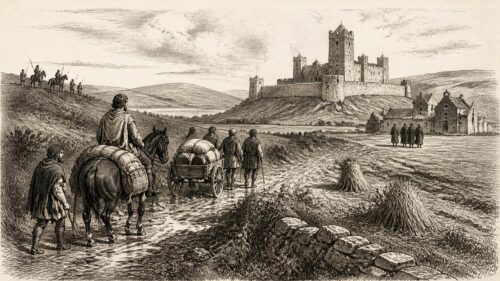
A separate expedition carried northern forces into Brega, the rich east-midland region stretching towards the Boyne and Dublin. Niall son of Máel Sechnaill led Cenél nEógain and Airgialla into the territory and killed Ua hIfernáin, identified by the Four Masters as Madadán Ua hIfernáin, chief of Clann Creccáin. The sources call the operation a hosting or predatory expedition. Such campaigns could combine political coercion with the seizure of cattle, captives and provisions. They were also demonstrations of a ruler’s ability to summon allied peoples and operate beyond his immediate homeland.
At Armagh, Muirchertach, ruler of Uí Bresail, was treacherously killed by Matudán Ua Céilecáin; Tigernach adds the involvement of the Uí Nialláin. Armagh was one of Ireland’s foremost ecclesiastical centres, but sacred places were not isolated from secular rivalries. Rulers visited them, maintained residences nearby, sought church support and sometimes fought within their orbit. The annalists’ emphasis on treachery condemns the manner of the killing, although the surviving entries do not provide enough detail to reconstruct its immediate cause.
Kingship Without Unity
No single king exercised uncontested authority over the island. Donnchad mac Briain, son of Brian Bóruma, ruled Munster and advanced a claim to wider kingship. A shrine associated with the Stowe Missal styles him “king of Ireland”, although the object cannot be dated specifically to 1047 and the title expressed political aspiration rather than universally recognised government. In Leinster, Diarmait mac Máel na mBó was consolidating a power that would later extend over Dublin and across the Irish Sea. Dublin itself was ruled by the Hiberno-Norse king Echmarcach mac Ragnaill, restored in 1046 after an earlier expulsion.
These rulers belonged to an intensely competitive political order of provincial kings, regional kings and local dynasts. Authority depended upon hostages, tribute, fosterage, marriage, church patronage and the ability to lead expeditions. The events recorded in Connacht, Brega, Ulaid and Armagh show that politics in 1047 was chiefly regional. Wider ambitions existed, but they rested upon shifting coalitions rather than a permanent national administration.
Churches, Learning and Pilgrimage
The annals record several important ecclesiastical deaths. Lann, daughter of Selbachán, the successor or coarb of Brigit, died in peace. She headed the institutional inheritance associated with St Brigit, almost certainly at Kildare, and her notice preserves evidence for the continuing authority of women within that celebrated church. Although Irish ecclesiastical leadership was overwhelmingly male, Kildare retained a distinguished tradition of female office-holders whose standing rested on succession to the patron saint.
Other obits illuminate a network of schools and churches. Gilla Mo Laise, lector of Louth, Máel Mo-Chéirge, lector of Clonard, and Ua Baillén, lector of Roscrea, died during the year. A lector was responsible for advanced teaching and the transmission of Latin and Irish learning. Cú Duilig, deputy superior of Kells, also died. The Four Masters additionally record that Cethernach, a bishop associated with Tech Colláin, died while on pilgrimage at Iona. His journey shows that the old Columban island remained part of an Irish religious world connected by sea routes, hospitality and devotion.
The Annals of Ulster also place in this year the birth of Domnall son of Amalgaid, later successor of Patrick at Armagh. A birth notice is unusual and was probably entered retrospectively because of Domnall’s later importance. It reminds us that annals were not diaries preserving every event equally: they selected matters significant to particular churches and dynasties.
Life Beyond the Annals
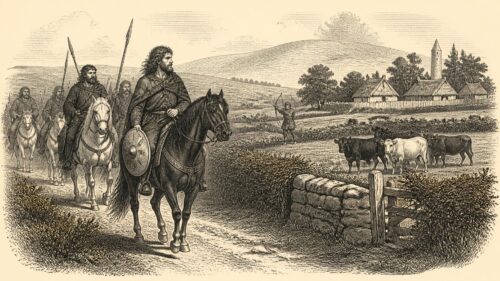
Most people left no individual trace in the written record. They lived in dispersed farmsteads, ringforts, open settlements, crannogs and communities attached to churches. Mixed farming sustained the countryside, with households tending cattle and sheep, raising pigs, growing cereals and producing cloth, leatherwork and wooden utensils. During the great snow, ordinary survival would have centred on conserving grain, protecting animals, maintaining fires and drawing upon obligations of hospitality and kinship.
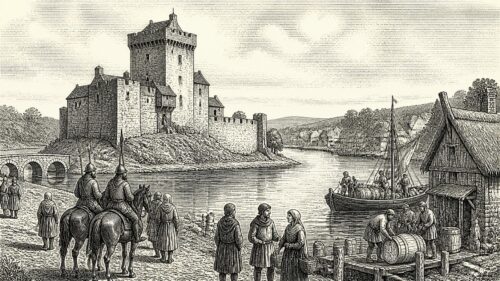
Ireland also possessed established coastal towns, including Dublin, Waterford, Wexford, Cork and Limerick. Dublin was a major centre of shipping, craft production and commerce, connected with Britain, Scandinavia and continental Europe. Silver pennies had been minted there since the reign of Sitriuc Silkbeard, although cattle, goods and weighed silver remained important forms of value. Archaeology reveals carpenters, smiths, textile workers, merchants and mariners operating in closely built urban neighbourhoods. Nothing securely dated to 1047 records a major commercial change, but these activities formed the economic background against which kings competed for ports, tribute and imported wealth.
The year emerges most clearly as one of environmental crisis and regional realignment. Its snowfall was remembered for generations, while famine drove at least some of the Ulaid towards Leinster. In Connacht, the death of Niall Ua Ruairc strengthened a new king but prolonged a family feud. Elsewhere, hostings, betrayal and ecclesiastical obits reveal a society in which warfare, law, religion and learning remained inseparably connected.
Primary Sources
- The Annals of Ulster
- Annals of Inisfallen, Part 60
- The Annals of Tigernach, Part 17
- Annals of the Four Masters, Part 15
- Annals of the Four Masters, Irish Text, Part 15
- Annals of Loch Cé
- Chronological Synchronisation of the Irish Annals
- The Chronology and Sources of the Early Irish Annals
- Donnchad
- Diarmait (Diarmait mac Maíl (Máel) na Mbó)
- Echmarcach
- Ua Ruairc, Áed
- Ua Conchobair, Ruaidrí na Saide Buide
- Brigit (Brighid, Bríd, Bride, Bridget)
- Irish Script on Screen: MS D ii 3, The Stowe Missal and Bookshrine
- Viking Collection
- Early Medieval Collection
- 950–1450: Vikings, Normans and Medieval Mints
- Guide to the National Museum of Ireland
- Land Tenure and Farming in Early Medieval Kerry: A Survey of Field Systems in the Lough Currane Basin
- Animals and the Economy of Medieval Ireland
- Medieval Ireland: Territorial, Political and Economic Divisions
- The Other Brigids: Meet the Forgotten Mighty Women of Medieval Ireland
- The Early to High Medieval Period in South Kildare