Donngal at Belach Gabráin761 CE
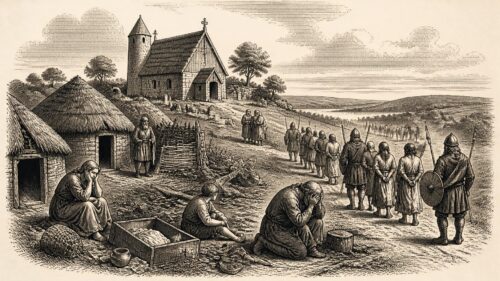
In 761, Irish annals record localised dynastic conflicts rather than an island-wide crisis. At Belach Gabráin, probably near Gowran, Osraige under Anmchad son of Con Cú Cerca defeated a Leinster force; Donngal son of Laidcnén, king of Uí Chennselaig, was killed. The repeated fighting there, also noted in 759, reflected competition for frontier routes and resources. At Áth Duma, Ulaid fought Uí Echach and Ailill son of Fíelmid died, amid north-eastern rivalries. Annals also note Pictish king Óengus’s death, illustrating Irish interest in interconnected British politics. Sources reveal changing political relationships but omit causes, numbers, civilian effects and battlefield detail.
Dateline
For Ireland, 761 is a year best approached through a handful of terse annalistic notices rather than a continuous narrative. The surviving records place two battles within the island’s political landscape: one in Ulaid, in the north-east, and another at Belach Gabráin on the contested approach between Leinster and Osraige. Both resulted in the death of a named ruler or leader. The annals also record the death of Óengus son of Fergus, king of the Picts, a development outside Ireland but directly relevant to an Irish Sea world in which dynasties, churchmen and armed forces moved between Ireland and northern Britain.
These notices do not justify claims about a single national government, a united Irish army or an island-wide crisis. Ireland was instead divided among many overlapping kingdoms and dynastic kindreds. Kingship was personal, territorial and competitive: authority depended on the ability to command followers, defend clients, exact dues and make alliances. The conflicts recorded for 761 reveal that political life could turn on control of borderlands and routes between neighbouring peoples.
A Year Preserved in Annals
The principal contemporary-derived evidence is preserved in the Annals of Ulster and the Annals of Tigernach. Their year-numbers and modern calendar equivalents require care: early Irish annals were compiled and copied long after many of the events they record, and their chronological systems can be offset. Nonetheless, the entries conventionally assigned to 761 agree on the central facts. Fínnechta, son of Fogartach and grandson of Cernach, died; a battle was fought at Áth Duma between the Ulaid and the Uí Echach; a further battle was fought at Belach Gabráin; and Óengus, king of the Picts, died.
The sources are especially valuable because they name people and political groups, but they are frustratingly brief. They do not state why the armies fought, how many people took part, how long the engagements lasted, or what settlements were damaged. Modern readers should resist supplying such details from imagination. A battle notice tells us that a confrontation mattered to annalists because prominent men died and a balance of power changed; it does not offer a battlefield report.
Belach Gabráin and South Leinster
The most consequential Irish event recorded for the year was the battle of Belach Gabráin. The Annals of Tigernach describe it as a fight between the men of Leinster and Osraige, adding that the son of Cú Cerca won and that Donngal son of Laidcnén, king of Uí Chennselaig, fell along with others. The Annals of Ulster likewise records the death of Donngal, calling him king of Uí Chennselaig, and notes the fall of other kings. A later king-list in the Book of Leinster identifies the victor more fully as Anmchad son of Con Cú Cerca, king of Osraige.
Donngal’s title matters. Uí Chennselaig was a leading south-Leinster dynasty, associated broadly with territory in the south-east and with ambitions that extended beyond its immediate core. Yet he was not simply “king of Leinster” in the sense of ruling a stable province. Leinster contained several powerful kindreds, and leadership within it could be divided or contested. The annal’s phrase “men of Leinster” probably reflects an armed following or coalition rather than a modern territorial army. Donngal’s death was therefore a severe blow to one ruling line, but it did not mean that Leinster ceased to exist or that Osraige conquered the whole province.
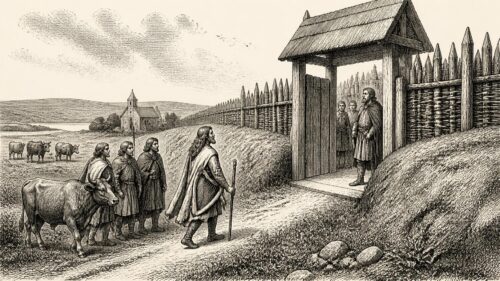
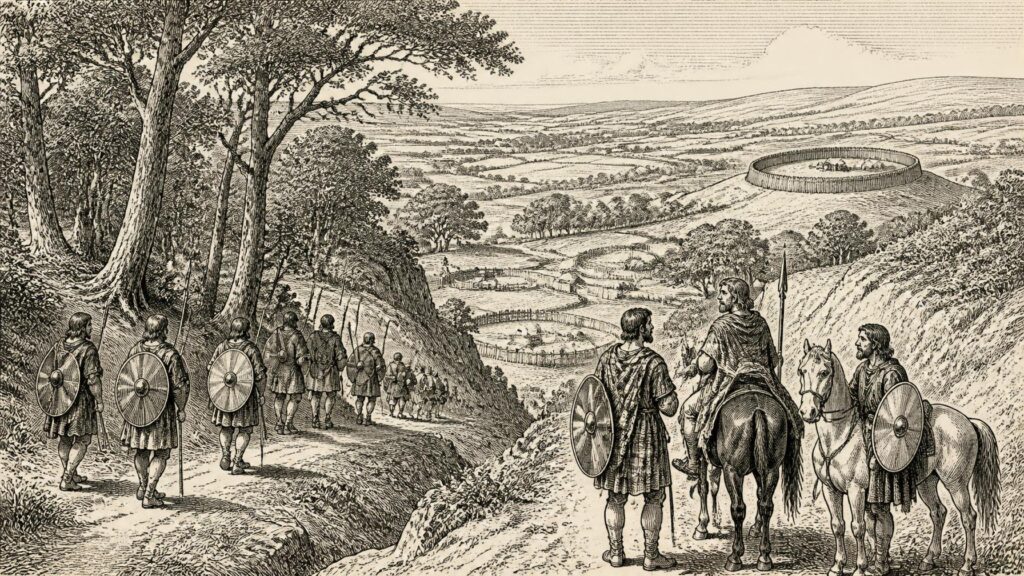
Belach Gabráin was a strategically important passage on the Leinster–Osraige frontier, conventionally located in the Gowran area of modern County Kilkenny. Its precise battlefield cannot be recovered. Even so, the setting explains why the clash was significant. Movement between the Barrow valley and Osraige required access through particular crossings, tracks and upland passages. To hold or deny such a route was to shape the movement of war-bands, livestock, messengers and tribute. The battle was not an isolated encounter in empty country: it was a contest at a political and economic threshold.
There was also a recent history behind it. An entry for 759 records a battle at the same place, in which the Osraige defeated Leinster. The recurrence strongly suggests an enduring rivalry rather than a chance collision. In 761 Anmchad’s success proved more decisive because Donngal was killed. The Book of Leinster, compiled centuries later but drawing upon king-list traditions, gives Donngal a two-year reign and names his brother Dub Calgaid as successor. Such retrospective evidence should not be treated as a contemporary chronicle, but it supports the annals’ picture of a dynastic succession disrupted by battlefield loss.
Violence Within Ulaid
The other battle belonged to the north-east. At Áth Duma, the Ulaid fought the Uí Echach, and Ailill son of Fíelmid fell. The annals do not give a full explanation, nor do they name a victor in so many words. Later historical interpretation identifies the Uí Echach here as Uí Echach Cobo, a branch connected with the wider Dál nAraide interest in the region, and sees the opposing Ulaid force in the orbit of Fiachnae son of Áed Rón, overking of Ulaid and a member of Dál Fiatach.
This was not a simple war between an imagined province of Ulster and an external enemy. “Ulaid” could denote both a wider political region and particular peoples within it. Dál Fiatach, Dál nAraide and their associated groups competed for influence, while ecclesiastical centres and neighbouring dynasties could become entangled in their disputes. Fiachnae had already emerged as an energetic ruler in the late 750s, involved in both warfare and the contested affairs of Armagh. The death of Ailill at Áth Duma accordingly fits a pattern of pressure on rival power within, or immediately beside, the Ulaid political sphere.
For local communities, the consequence of such fighting was unlikely to have been confined to the moment of combat. Kings drew military support from client populations and dependent lordships. A defeated ruler’s followers could face renewed demands for food-renders, livestock, labour, hostages or allegiance. Yet the evidence does not permit a claim that a particular settlement was burned, that a harvest failed, or that civilians suffered a specified loss in 761. What it does show is that the political security of north-eastern communities depended on rival dynasties whose fortunes could change abruptly.
Settlement, Wealth and Routeways
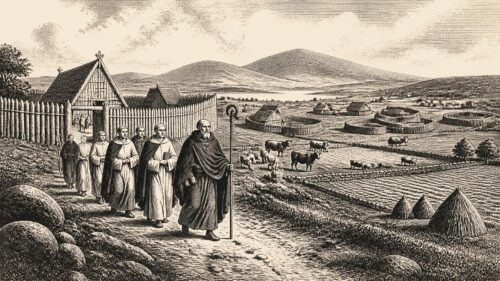
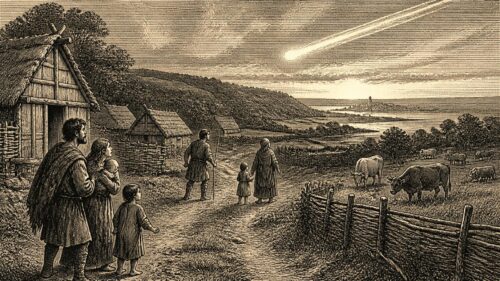
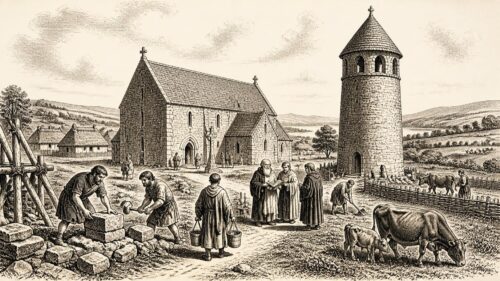
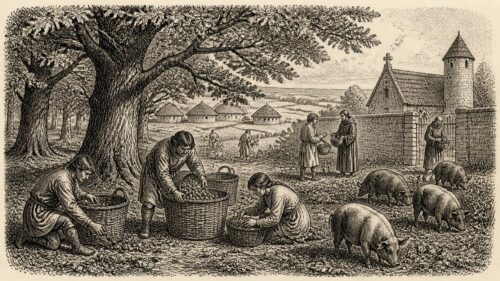
The material setting of these conflicts was an early medieval countryside of dispersed farmsteads, enclosed residences and ecclesiastical settlements rather than towns in the later medieval sense. Archaeology shows that ringforts and other enclosed sites were widely used in this period, while mixed farming combined cattle with cereal cultivation. Cattle were especially important as mobile wealth and as a medium in obligations, compensation and status. An army’s passage through a borderland therefore had practical consequences even when the annals did not record them: maintaining armed followers required supplies, and the control of cattle-rich districts and routes was politically valuable.
This broader context should not be mistaken for a specific report from 761. No annal for this year describes weather, harvests, prices, a fair, a church foundation or overseas trade in Ireland. Nor is there evidence for Viking raids in the island at this date; the first securely recorded Viking attack on Ireland belongs to 795. The year’s surviving record is dominated instead by dynastic violence. That emphasis reflects what annalists chose to preserve, not the whole texture of ordinary life, which continued in farms, churches, households and seasonal labour beyond their short entries.
The Death of a Pictish King
The annals also report the death of Óengus son of Fergus, king of the Picts. This was an event in northern Britain, but Irish chroniclers considered it worth recording. Óengus had been a dominant figure in Pictish politics for roughly three decades and had intervened forcefully in Dál Riata, the Gaelic kingdom spanning Argyll and linked by sea to north-east Ireland. His death therefore mattered to the connected political world around the North Channel and the Hebrides.
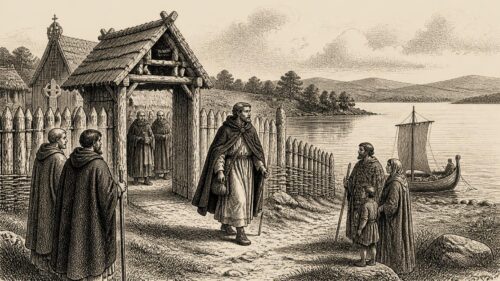
It would be unsafe to claim that Óengus’s death immediately altered Irish policy or caused either of the Irish battles recorded in 761. The sources establish no such connection. Its importance lies elsewhere: the notice demonstrates the outward horizon of Irish annalists. Their history was not confined to the island. Political changes in Pictland, Dál Riata, Northumbria and Britain could be relevant to Irish rulers, church communities and seaborne networks, particularly in the north.
A Narrow but Revealing Record
Thus 761 was not a year for which the evidence supports a grand all-Ireland story. It was a year of sharply localised but meaningful contests. At Belach Gabráin, Osraige overcame a Leinster force and Donngal of Uí Chennselaig was killed, demonstrating the vulnerability of even a leading dynast on a contested frontier. At Áth Duma, the fall of Ailill marked another violent adjustment among the powers of Ulaid. Beyond Ireland, the death of Pictish king Óengus closed a major northern reign watched by Irish record-keepers.
The annals leave much unknown, but their restraint is instructive. They preserve the names of those whose deaths altered political relationships, the places where those relationships were fought over, and the wider sea-connected world in which Ireland belonged. In 761, power was not abstract. It was exercised along passes, at crossings and through the survival—or loss—of particular kings.
Primary Sources
- The Annals of Ulster
- Part 331 of The Annals of Ulster
- The Annals of Tigernach
- Part 14 of The Annals of Tigernach
- Chronicon Scotorum
- Annals of the Four Masters
- Book of Leinster, formerly Lebar na Núachongbála, section 27
- Lebor na Cert
- Fiachnae
- Oengus [Angus] mac Forgusso [Onuist son of Uurguist]: (d. 761), king of Picts
- Picts, kings of the (act. c. 300–c. 900)
- ‘When Óengus Took Alba’: Despot, Butcher and King (728–61)
- Twilight of the Picts
- Gasaitear na hÉireann / Gazetteer of Ireland
- Early Irish Population-Groups: Their Nomenclature, Classification, and Chronology
- Landscapes of kingship in early medieval Ireland, AD 400–1150
- Farming and Archaeology
- Traditional Buildings in the Irish Farm Landscape
- Excavation and Archaeological Buildings Survey at the Robing Room, Bishop’s Palace, Kilkenny
- Ireland To 1170 (with Andrew Woods)
- Exploring the Irish Annals
- Chronological Synchronisation of the Irish Annals