

Atlantic Statecraft
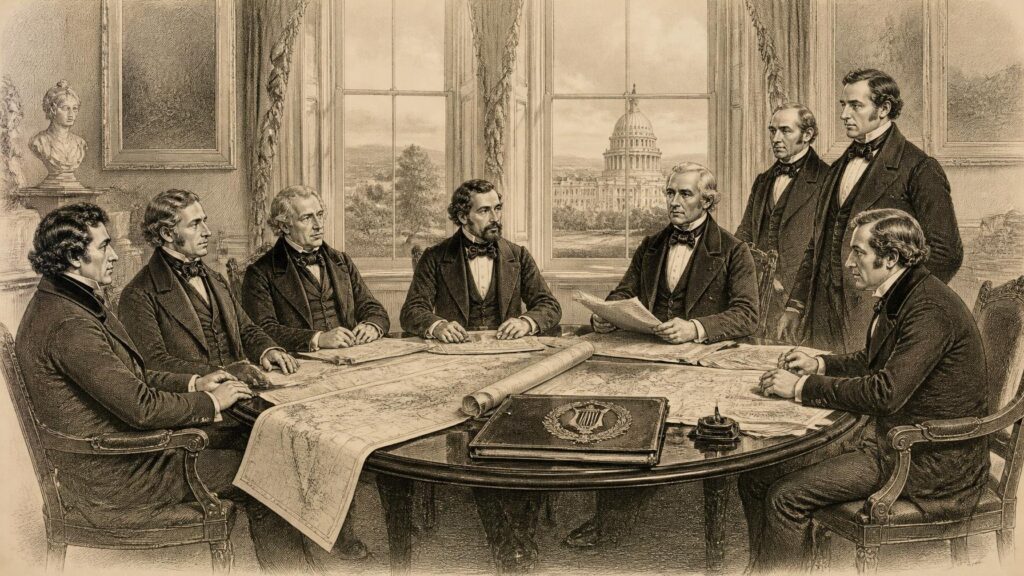
AI generated historical illustration, not a contemporary photograph.
At a Glance
Irish diplomacy in the United States was never simply the official intercourse of two governments. It began before the Irish state possessed accepted international standing, drew unusual force from migration and memory, and repeatedly had to distinguish the emotional claims of Irish America from the practical interests of Washington, Dublin and London. Its history therefore illuminates both the making of modern Ireland and the limits of diaspora influence.
Diaspora Foundations
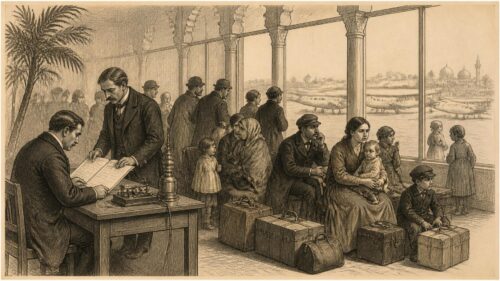
The phrase “Irish US diplomacy” can mislead if it is taken to mean that Ireland and the United States had a conventional bilateral relationship throughout the nineteenth century. They did not. Until the creation of the Irish Free State, Ireland had no separate internationally recognised government capable of exchanging ambassadors with Washington. Irish affairs were constitutionally embedded in the United Kingdom, while the United States dealt formally with the British state. Yet the absence of a formal Irish diplomatic channel did not mean an absence of political contact. On the contrary, emigration created a transatlantic public sphere in which Irish questions could be discussed, financed and pressed upon American politicians with an intensity unusual for the affairs of a European dependency.
Mass emigration made the United States central to Irish political imagination. Families were divided by the Atlantic; remittances supported households at home; clerical, commercial and associational networks moved news and opinion in both directions. Irish-born migrants and their descendants became citizens, voters, journalists, trade unionists, office holders and donors in the republic. That position gave Irish causes access to an audience which was at once sympathetic, electorally significant and independent of the British government. The connection was real, but it should not be romanticised. Irish America was never politically uniform. Nationalists, constitutional reformers, republicans, unionists, Catholics, Protestants, recent migrants and established families held differing views on Ireland and on the obligations of American citizenship.
Before 1919, much transatlantic activity was advocacy rather than diplomacy. Organisations supporting land reform, Home Rule or physical-force nationalism cultivated American support, collected subscriptions and used the language of liberty familiar in the United States. Such work mattered because it could make Irish affairs visible. It could also unsettle British diplomats. But visibility was not recognition, and political enthusiasm did not compel an American administration to revise its relationship with Britain. This distinction became decisive after the First World War.
The language of the American Revolution held obvious attractions for Irish nationalists. It supplied comparisons between colonial rule and self-government, and it allowed Irish speakers to frame their cause as part of a wider democratic tradition. Those analogies were persuasive to many audiences, but they also obscured differences of constitutional circumstance and international power. American governments, even when their citizens were moved by Irish appeals, had to consider relations with Britain, the stability of post-war Europe and their own domestic priorities. The central drama of Irish diplomacy in America was therefore the attempt to turn affinity into official action.
Republican Appeal
The First Dáil, which first assembled in January 1919, brought that attempt into sharper institutional form. Its declaration of independence and its appeal to the free nations of the world asserted that Ireland was entitled to a place among states. The revolutionary government created a foreign-affairs function because military struggle alone could not secure international legitimacy. Recognition by other governments would have strengthened the claim that the conflict in Ireland was not merely an internal British disturbance but a struggle between states.
America became the most important arena for that campaign. Éamon de Valera travelled to the United States in 1919 and remained there until late 1920. His purpose was broader than a speaking tour. He sought moral support, money, political access and, above all, recognition of the Irish Republic. The surviving catalogue of the de Valera papers records a demanding itinerary of meetings and public appearances, alongside the establishment of the Republican Bond Drive and the American Association for the Recognition of the Irish Republic. The Library of Congress preserves the Irish Diplomatic Mission’s substantial 1920 case for recognition, a reminder that the campaign produced not merely rhetoric but a considered legal and political brief aimed at American officialdom.
The mission had notable achievements. It gave the Dáil a public presence in the United States; it helped to raise funds for the republican administration; and it encouraged resolutions, receptions and sympathetic interventions in state legislatures and Congress. It also showed that an unrecognised government could behave in some respects like a state: appointing representatives, issuing publications, gathering information and presenting claims. Harry Boland, who represented Dáil Éireann in America from 1920 until early 1922, was part of this improvised diplomatic service. Such representatives were diplomats in aspiration and function, though not in the accepted legal sense enjoyed by accredited ministers.
The limitations were equally important. President Woodrow Wilson’s public language of self-determination raised nationalist expectations, especially in the atmosphere of the Paris Peace Conference. But Wilson did not treat Ireland as a case to be detached from the British Empire at the conference. The American Senate could show sympathy without conferring recognition. In June 1919, the Senate Foreign Relations Committee supported a proposal urging that Irish delegates receive a hearing at the peace conference, but removed wording that would have referred to an Irish republic because that might imply recognition. The episode displayed the precise boundary that Washington was unwilling to cross.
There were reasons for this restraint beyond indifference. The United States had fought the First World War alongside Britain and was negotiating a wider European settlement. American policymakers did not regard recognition of the Dáil as costless, nor did they accept that public meetings or congressional resolutions could determine executive recognition policy. In diplomatic terms, the Irish republican case confronted a great-power calculation. The administration’s concern for British relations outweighed the political advantages of embracing the separatist claim.
The campaign also exposed fractures within Irish America. De Valera clashed with influential figures including John Devoy and Judge Daniel F. Cohalan over tactics, leadership and the proper relation between American organisations and the Dublin government. The disagreements were not trivial personality disputes. They concerned whether a movement rooted in an emigrant community should direct the policy of an Irish revolutionary government, and whether funds raised in America would be controlled from Ireland or by organisations in the United States. The existence of those disputes is a useful corrective to later accounts that treat “Irish America” as a single diplomatic actor.
Recognition Delayed
The Anglo-Irish Treaty of December 1921 altered the diplomatic problem without instantly resolving it. It provided for the Irish Free State, but the new polity emerged within the Commonwealth and possessed an evolving rather than wholly settled external status. Civil war then made representation abroad still more complicated. Republican opponents of the Treaty continued to invoke the unfulfilled ideal of a sovereign republic, while the Provisional Government and later Free State administration had to demonstrate order, creditworthiness and the capacity to conduct public business.
This was a transition from insurgent diplomacy to state diplomacy. The distinction matters. The earlier mission had asked the United States to recognise a republic whose authority Britain denied. The Free State’s representatives sought a practical working relationship with Washington on matters including immigration, finance, trade and the standing of Irish citizens. They did so while negotiating the constitutional realities of Commonwealth membership and while facing a politically active republican opposition in the United States.
Timothy A. Smiddy stood at the centre of this shift. An economist and public servant, he represented the Free State in Washington before he possessed formal diplomatic credentials. Documents on Irish Foreign Policy reveal the awkwardness of his position. In a 1923 letter to Desmond FitzGerald, Smiddy argued that recognition was urgently needed both to establish the Free State’s international sovereignty and to blunt the claim of its opponents that Ireland was not truly a sovereign power. He did not merely seek ceremonial status. He understood that recognition would affect confidence, commerce and the ability of Irish officials to transact business with American departments.
Smiddy’s February 1924 analysis was still more concrete. Relations with the American government and the British embassy were informal; assistance received from either could be treated as a favour rather than a right. He considered it undignified for the Free State repeatedly to depend upon personal and social influence in matters of public importance. His attention to the Johnson Immigration Act was revealing. Separate treatment of the Irish Free State in immigration law offered a test of whether Ireland was becoming administratively distinct in American eyes. Immigration was no abstract issue: continuing emigration, family reunion and economic prospects gave it immediate weight in Ireland.
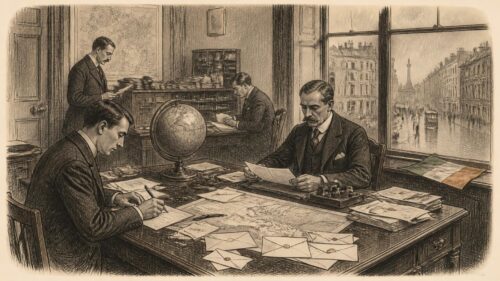
Irish officials also judged that formal representation could influence American perceptions after the Civil War. In March 1924, the Free State government stressed that its financial and commercial interests in the United States were considerable, that emigration required urgent attention, and that an accredited minister would promote more cordial relations among Irish people in America. Smiddy’s correspondence likewise urged organised publicity. He believed that adverse newspaper coverage could injure the Free State’s credit, trade and standing more seriously than a number of favourable reports could repair. This was early public diplomacy in a recognisably modern sense: the deliberate management of press, reputation and investment confidence as components of national power.
There is no need to suppose that American recognition arose from Irish lobbying alone. It resulted from constitutional developments within the Commonwealth, British agreement to the arrangement and American willingness to receive an Irish representative. The Free State needed the consent of London for the particular mechanism by which credentials would be issued. That fact did not make the achievement meaningless; rather, it defined the constrained sovereignty with which the new state began its external life.
Smiddy Arrives
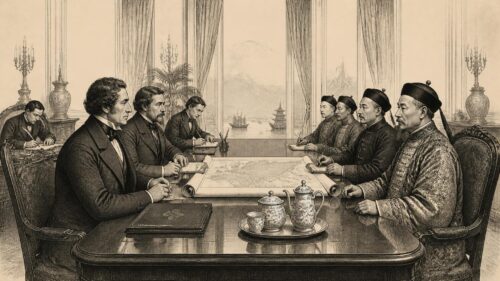
The breakthrough came in 1924. On 28 June, Secretary of State Charles Evans Hughes informed the British ambassador that the President would be pleased to receive a duly accredited minister plenipotentiary of the Irish Free State. The United States Office of the Historian describes this as recognition of the Free State as a state with autonomous control over its foreign relations. On 7 October, Smiddy presented his credentials in Washington, formally establishing diplomatic relations. The dates deserve emphasis because later commemorative language can blur a hard distinction: republican appeals had not won United States recognition in 1919 or 1920; the recognised bilateral relationship began in 1924.
The form of recognition was carefully calibrated. A June instruction from Desmond FitzGerald told Smiddy that the Free State minister would be the official channel for issues exclusively affecting the Free State, while not purporting to deal with matters affecting the Commonwealth as a whole. This arrangement gave Dublin a direct voice in Washington while preserving the constitutional limits then associated with dominion status. It also made clear that Irish sovereignty was developing through practice. Representation was not an all-or-nothing prize but a widening field of competence, expressed in who could speak, on which subjects, and to whom.
Smiddy’s arrival did not magically settle all questions. A minister required staff, premises, relationships with the State Department, contacts in Congress and credibility among American newspapers and business interests. Nor could an Irish mission monopolise the Irish-American story. Anti-Treaty activists remained present, and the political divisions created by the Civil War left marks abroad. Yet a resident accredited minister changed the terms of debate. Washington now had an official Irish channel through which it could address Irish concerns, while Dublin had a lawful and continuing means to make its case.
American representation in Dublin followed in 1927, when Frederick A. Sterling presented credentials as American envoy extraordinary and minister plenipotentiary. Reciprocity mattered. It created a working framework for routine consular, commercial and political business, and it signified that relations had become more than an Irish mission’s campaign for acknowledgement. The relationship remained unequal in material power, but it had acquired the ordinary institutional features of interstate diplomacy.
Interpretation should be cautious here. It is tempting to describe 1924 as the end of Irish dependence or the completion of national freedom. The archival record suggests something subtler. Recognition was a major gain, but it was secured within an inherited constitutional framework and alongside the continuing partition of the island. It did not answer the question of Northern Ireland, and it did not remove the importance of Britain from Irish external affairs. What it did provide was an essential instrument: a state could now represent itself directly in the capital of a powerful republic shaped by a large Irish diaspora.
Neutrality Tested
The Second World War tested whether the new relationship rested upon sentiment or upon respect for separate interests. Ireland’s policy of neutrality, usually known domestically as the Emergency, was central to its assertion of sovereignty. For Éamon de Valera’s government, remaining outside the war was bound up with military vulnerability, the unfinished national question and the desire not to make Ireland subordinate to British strategic requirements. For American officials after the United States entered the war, neutrality could appear difficult to reconcile with the struggle against the Axis and with the security of Atlantic sea lanes.
The disagreement was genuine, but the diplomatic correspondence demonstrates that it was not a simple rupture between friends. In May 1941, the Irish legation told the Department of State that Ireland appreciated the frank American recognition of its right and determination to preserve neutrality, even while objecting strongly to language which seemed to question Irish policy. The exchange concerned offers connected with desperately needed ships and food supplies. Ireland feared that material assistance was being linked, explicitly or implicitly, to political pressure. Washington replied that its offer to help transport essential food supplies had been unconditional and founded on traditional friendship, while also insisting that it had no wish to dictate Irish national policy.
This episode shows diplomacy operating beneath public rhetoric. Ireland could neither ignore dependence on imports nor concede that survival assistance entitled another government to determine its foreign policy. The United States could sympathise with civilian hardship while judging Ireland’s stance through the lens of a global war. Neither side fully accepted the other’s assumptions. The point was not that friendship prevented disagreement; rather, diplomatic channels allowed disagreement to be recorded, contained and negotiated without abandoning the relationship.
Neutrality also demonstrated the gap between diaspora expectation and state interest. Many Irish Americans felt deep attachment to Ireland, but the American government’s decisions followed American strategy. Conversely, Irish officials knew that emotional connection might make an appeal more audible, but it could not substitute for a defensible national position. The wartime record is therefore a strong warning against the folklore that an Irish surname, a St Patrick’s Day speech or a sentimental family connection automatically translated into diplomatic leverage.
Cold War
After 1945, Irish American relations entered a new strategic setting. Ireland pursued membership of the United Nations and sought wider recognition of its independent international personality. The United States generally wished to encourage Ireland’s participation in international affairs, but also viewed the island through the strategic map of the North Atlantic. The two aims could coexist, though they sometimes pulled in different directions.
American policy papers from 1950 are unusually frank. They identify the desire to maintain friendly relations, encourage Irish involvement in international institutions and secure, where possible, Irish cooperation with the western powers. They also describe partition as the principal issue in Irish domestic and foreign policy, and they recognise that Ireland’s refusal to enter the North Atlantic Treaty Organisation was linked to partition. Dublin considered it impossible to join while Northern Ireland remained under British jurisdiction; American officials believed that the alliance could not become a forum for settling a dispute between Britain and Ireland.
These papers should be read critically. They were internal American assessments, not neutral descriptions of Irish political life, and their language can be patronising. Nevertheless, they reveal a central reality: Washington regarded Ireland’s strategic location as valuable, but did not wish to offer a bilateral security guarantee or pressure Britain over partition in a manner that would disturb NATO solidarity. In October 1950, the National Security Council recommended maintaining readiness to welcome Ireland into NATO while leaving the initiative to Ireland and avoiding military-assistance arrangements outside the alliance.
Ireland’s position was not mere isolationism, as some American documents suggested. It represented a deliberate judgement about sovereignty, military alignment and the political consequences of accepting a treaty that appeared to leave partition untouched. The disagreement also underscored the structural hierarchy of the relationship. Ireland could articulate a principled objection, mobilise sympathy and cultivate congressional friends, but it could not determine American policy towards Britain or the Atlantic alliance.
Economic matters nevertheless offered productive ground. A Treaty of Friendship, Commerce and Navigation was signed in Dublin in January 1950, intended to strengthen peaceful and commercial relations. Earlier disputes concerning aviation and the required stop at Shannon showed that even apparently technical negotiations could bear political and regional significance. Such issues demonstrate that diplomacy was not conducted only in dramatic crises. Air routes, taxation, migration, trade balances and consular arrangements often shaped the daily substance of bilateral relations more durably than speeches about ancestral friendship.
Partition Politics
Partition remained the most sensitive subject in Irish dealings with the United States for decades. Irish governments hoped that American opinion, congressional influence and the moral authority of a country founded on self-government might assist their case. American administrations, however, consistently had to balance their relations with Dublin against their alliance with London and their concern not to internationalise a dispute they treated as principally British-Irish.
That tension appeared clearly in 1951, when the State Department considered a Senate resolution declaring that the Republic of Ireland should embrace the whole territory of Ireland. The Department acknowledged the importance of the question to relations with both Ireland and the United Kingdom, but did not endorse intervention. A briefing prepared for Secretary of State Dean Acheson before a meeting with Seán MacBride similarly noted Ireland’s refusal to join NATO because of partition and the American view that the treaty framework was not appropriate for resolving a long-standing territorial dispute.
Irish-American advocacy was therefore influential but constrained. It ensured that Northern Ireland could not be ignored in American political life. It could bring hearings, resolutions, visitors and pressure. Yet it did not overturn the executive branch’s fundamental calculation that Britain was a principal ally. The lesson is not that diaspora politics failed. Its more limited achievement was to preserve attention, create access and make American disengagement politically difficult. In diplomacy, maintaining a question on the agenda can matter greatly, even when it does not produce the desired settlement.
The violence that intensified from the late 1960s changed the nature of American involvement. Concerns about fundraising, public order and terrorism complicated the older nationalist narrative. At the same time, constitutional nationalism, civil-rights arguments and the efforts of figures such as John Hume helped create a basis for American engagement that was less about endorsing a territorial claim and more about supporting peaceful, democratic agreement. This transition was gradual, contested and dependent above all on decisions made by people in Ireland and Northern Ireland themselves.
Peace Brokerage
The United States became more visibly involved in the Northern Ireland peace process during the 1990s, but it did not impose a settlement. The indispensable negotiating parties were the British and Irish governments and the political representatives on the island. American influence was most effective when it reinforced those actors, supplied trusted mediation, widened economic prospects and used presidential attention to reward movement towards peaceful politics.
In 1994, the Clinton administration stated that its close historical, cultural and traditional bonds with both Ireland and the United Kingdom gave it a distinctive capacity to assist peace and reconciliation. The wording was significant: the United States did not claim a right to decide Ireland’s constitutional future. Its approach linked support for political progress with practical measures, including investment promotion, conflict-resolution programmes and engagement with the International Fund for Ireland. The administration sought to make peace economically tangible rather than merely rhetorically desirable.
The American role worked in concert with diplomatic initiatives already under way. The Joint Framework Document of February 1995 emerged from work by the Irish and British governments; President Bill Clinton welcomed it as a basis for inclusive discussion rather than something to be imposed on any party. In December 1995, Senator George Mitchell chaired the International Body on arms decommissioning. He later chaired the multi-party talks whose work culminated in the Good Friday Agreement of 10 April 1998. His patience, procedural authority and perceived independence became important assets, but mediation could succeed only because local and governmental participants accepted negotiation as preferable to violence.
It would be misleading to present the Good Friday Agreement as an American achievement. It was an agreement made by the elected and governmental actors involved, approved in referendums and grounded in carefully balanced principles of consent, power sharing, North-South cooperation and British-Irish relations. Yet it would be equally misleading to reduce the United States to a spectator. American diplomacy helped sustain momentum, provided an influential channel of communication and connected political progress to international investment and civic support. The Irish government’s own historical account notes Mitchell’s role and the progression from the 1993 joint declaration through ceasefires, negotiations and the 1998 settlement.
The peace process changed the character of Irish US diplomacy. Earlier generations had often asked Washington to recognise Irish sovereignty or intervene against partition. By the 1990s, Dublin increasingly sought American partnership in supporting an agreed process involving both traditions in Northern Ireland and both sovereign governments. That was a profound strategic adjustment. It did not abandon nationalist aspirations; rather, it accepted that durable constitutional change had to be founded upon consent and reciprocal legitimacy.
Diplomatic Legacy
The history of Irish diplomacy in the United States is best understood as a movement from mobilisation to institution, and from institution to partnership. The republican mission of 1919–21 showed that diaspora networks could furnish money, audiences and a language of international legitimacy. Its failure to obtain American recognition showed the limits of moral appeal when it collided with executive power and great-power priorities. The recognition of 1924 and Smiddy’s accreditation then created the machinery through which a new Irish state could conduct ordinary business and represent its interests directly.
Later episodes confirmed that the relationship was not a simple story of affection. Ireland and the United States disagreed over wartime neutrality, military alignment and partition. Their officials often interpreted the same events through very different assumptions. American strategic interests did not disappear because of Irish-American sentiment, and Irish governments did not abandon neutrality or constitutional principles merely to please Washington. The durability of the relationship lay partly in its capacity to survive those differences.
The most useful interpretation is therefore neither celebratory nor cynical. Sentiment was valuable, but only when joined to organisation, political credibility and realistic objectives. Irish diplomatic representatives learned to work with a diaspora without surrendering state policy to it. American policymakers learned that historical connection could supply influence but could not erase the need for balance between Dublin, London and the communities of Northern Ireland. In the peace process, that balance helped make outside involvement constructive.
Folklore has often given this history a simpler shape: America rescued Ireland, or Ireland possessed an automatic claim upon America because of blood and memory. The documentary record supports neither proposition. It instead reveals persistent effort, disappointment, adaptation and negotiation. Irish diplomats used family connection, public opinion, commerce and moral argument, but they also relied on memoranda, credentials, immigration files, treaties and painstaking personal contact. That more prosaic history is also the more impressive one. It shows a small state learning how to make itself heard in a great republic, while recognising that friendship in international affairs is strongest when it is matched by institutions, interests and an honest understanding of limits.



The article’s account of the 1924 Washington mission highlights a transition: Irish influence in America became durable when diaspora enthusiasm was translated into accredited representation, economic credibility and diplomatic work. This complicates the assumption that shared heritage alone determined outcomes. It also suggests that sovereignty developed gradually through practical authority over issues, rather than arriving as a decisive achievement. The contrast between republican recognition campaigns, wartime neutrality and later peace diplomacy raises a question about political influence across borders. To what extent do diaspora communities still require formal institutions and credible statecraft to convert cultural affinity into sustained diplomatic influence?