

Delany Endures
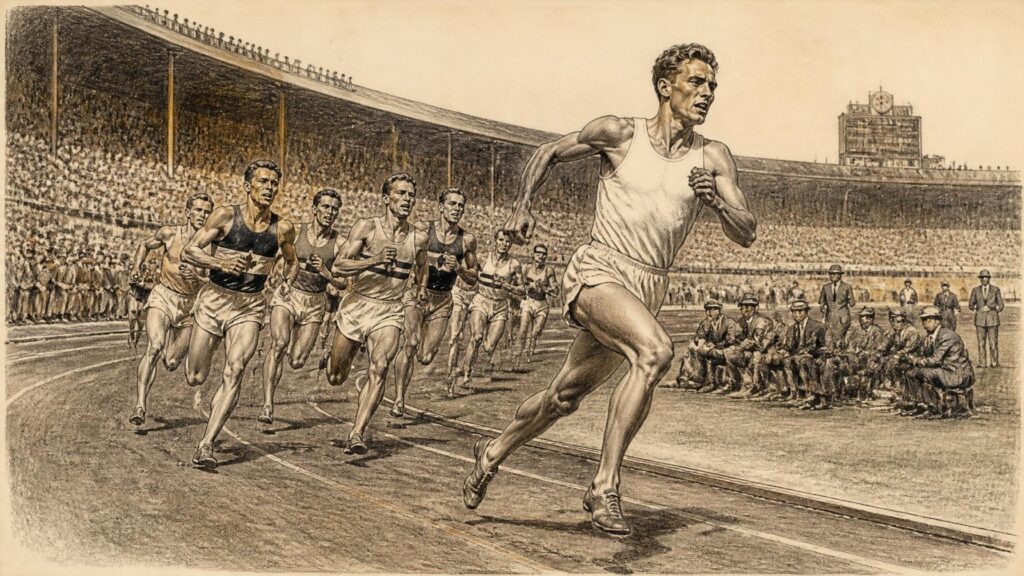
AI generated historical illustration, not a contemporary photograph.
At a Glance
Ronnie Delany’s victory in the Olympic 1,500 metres at Melbourne on 1 December 1956 was not merely an exceptional Irish sporting result. It became a durable public memory: a young runner, born in Arklow and raised in Dublin, defeating the celebrated middle-distance men of his age with a finish that seemed to condense preparation, nerve and ambition into one lap. The race is securely documented; the larger meanings later attached to it require more care. Delany’s legacy rests first upon athletic achievement, but it has endured because subsequent generations found in that achievement a model of Irish confidence, international connection and competitive purpose.
Arklow Beginnings
Ronald Michael Delany was born at Ferrybank, Arklow, County Wicklow, on 6 March 1935. His family moved to Sandymount, Dublin, when he was six. Those two places have remained central to accounts of his life: Arklow as the town of his birth and later civic commemoration, Sandymount and Dublin as the environment in which his sporting promise took clearer shape. It is tempting to read a complete destiny into such origins, but the historical record suggests something more ordinary and more useful. Delany’s early life was not a tale of a solitary prodigy emerging fully formed. It was shaped by school, club, teachers, family movement and the availability of athletic opportunities.
At Catholic University School in Dublin, Delany came under the influence of Jack Sweeney, a teacher and athletics coach. The importance of this relationship is unusually well attested in Irish memory. Archive material concerning Delany’s return to the school after Melbourne records that he sent Sweeney a telegram saying, “We did it Jack.” The phrase has survived because it offers an appealing corrective to sporting individualism. An Olympic race has only one winner, yet the preparation behind it is shared. In Delany’s case, the school coach was not retrospectively inserted into the story; he was publicly recognised by the athlete himself.
Delany’s youth also included sports other than running. Accounts of his early years mention hockey, cricket, lawn bowls and rugby. That breadth should not be exaggerated into a theory of athletic development, but it reminds us that the specialist culture of modern elite sport was not the only route open to a Dublin schoolboy in the post-war years. Running became his principal vocation through training and opportunity rather than through an immediately exclusive identity.
His early club association with Crusaders Athletic Club also mattered. Irish athletics was sustained by clubs, schools, voluntary officials and local meetings, not by the highly professional structures familiar in the twenty-first century. Delany’s rise occurred within that landscape. It was an era when gifted Irish athletes could gain international notice, but when access to coaching, facilities, travel and competition remained uneven. The later legend of the lone Irishman conquering a global field can obscure these local foundations. His achievement was international, but its first supports were unmistakably Irish.
Schoolroom Training
In the 1950s, athletics could provide a route from Dublin’s schools to a wider world, though it could not guarantee security. Delany’s progress illustrated both the possibilities and constraints of amateur-era sport. A promising runner required instruction, regular opposition and a setting in which ambition did not appear absurd. Sweeney offered expertise and encouragement at Catholic University School, while Crusaders gave Delany contact with competitive athletics beyond the classroom.
Contemporary archival evidence shows that Delany was attracting notice before his Olympic triumph. RTÉ holds footage of him winning an 880-yard race at Trinity College in 1954 in a meeting promoted by Crusaders and involving the American national team. Such material is valuable because it restores chronology. Melbourne did not produce a previously unknown athlete. Delany had been competing in visible Irish meetings, testing himself over middle distances and becoming part of a sporting public long before he became a national figure.
The language surrounding these formative years must nevertheless be disciplined. It is reasonable to say that Sweeney was an important coach and that the school recognised Delany’s success. It is less secure to claim that one teacher “made” an Olympian or that the young runner’s ascent was inevitable. Athletic careers are contingent: selection, health, finance, opportunity and timing all intervene. What can be said with confidence is that Delany acknowledged his school coach, that his club environment nurtured competition, and that these institutions later regarded his success as part of their own history.
This local pride became visible immediately after the Games. In December 1956, the Catholic University School past pupils’ union made Delany an honorary life member and presented him with an illuminated scroll at a Shelbourne Hotel dinner. The honour was ceremonial rather than athletic, but it showed how quickly the victory was absorbed into civic and educational memory. Schools often treasure famous former pupils; in Delany’s case the connection was especially potent because the teacher-pupil story could be told in the athlete’s own words.
American Passage
The decisive enlargement of Delany’s athletic horizon came with a scholarship to Villanova University in Pennsylvania. There he studied commerce and finance and trained under James “Jumbo” Elliott, one of the foremost American collegiate coaches of the period. The move was significant not because Ireland lacked runners of quality, but because American collegiate athletics offered a scale of organised competition and coaching that could sharpen an already serious talent.
Villanova was part of a wider transatlantic story. Irish athletes had travelled to American universities before Delany, and Irish runners continued to do so after him. Yet his success gave the connection exceptional visibility. In later Villanova accounts, Delany appears as an early and defining figure in an “Irish pipeline” of student-athletes. That description is institutional language, but it identifies a real legacy: his career made the possibility of combining an American education with high-level athletics more imaginable for later Irish runners.
There is a tendency, especially in retrospective celebrations, to make the American scholarship seem like an uncomplicated rescue from provincial limitation. The evidence supports a more balanced conclusion. Delany was already an accomplished runner in Ireland; Villanova supplied a demanding collegiate framework, formidable coaching and frequent racing. The relationship was reciprocal. The university gained a runner who would bring Olympic distinction to its name, while Delany gained conditions in which his competitive instincts could be developed against outstanding opposition.
His collegiate record was formidable. Villanova credits him with four individual NCAA outdoor titles and ten individual IC4A titles, at a time when the IC4A championships carried immense status in American track and field. He also contributed to successful Penn Relays teams. These achievements establish that his Olympic gold was not an isolated surprise produced by one fortunate race. He belonged among the leading collegiate middle-distance athletes of his generation.
That context also helps explain the texture of his later reputation. Irish audiences remembered Melbourne, naturally enough, but American athletics remembered a competitor of sustained achievement: a champion in individual races, a relay runner and an athlete who helped establish Villanova’s enduring middle-distance tradition. Delany’s historical importance therefore belongs to two sporting cultures. Ireland claimed the Olympic champion; Villanova claimed a foundational sporting figure. Neither claim cancels the other.
Four Minute
On 1 June 1956, Delany ran a mile in 3 minutes 59 seconds in California, becoming the seventh man recorded as breaking the four-minute barrier. The mark placed him within the most celebrated frontier of middle-distance running. Roger Bannister’s four-minute mile in 1954 had turned a round number into a global symbol of athletic possibility, and every runner who crossed that threshold soon afterwards entered a select international company.
The four-minute mile has always attracted mythmaking. It can imply that an athlete’s value is contained in one dramatic numerical barrier. Delany’s achievement was certainly important, but its place in his career should be understood precisely. It confirmed that he was capable of world-class pace and it added to his standing before Melbourne. It did not, by itself, guarantee Olympic success. The mile and 1,500 metres are related but different events, and championship racing involves tactics, position and the willingness to withstand uncertainty rather than merely the pursuit of a time.
Still, the sub-four performance altered expectations. Delany arrived at the Olympics not as an obscure entrant but as a member of a rapidly advancing cohort of milers. His contemporaries included runners whose names already carried weight: Australia’s John Landy, Hungary’s László Tábori, Britain’s Brian Hewson and others from an era when the mile was one of athletics’ most compelling public contests. The Olympic final gathered them at a moment when middle-distance standards were changing swiftly.
His four-minute mile also later served as a bridge between different memories of his career. For Irish audiences, it was evidence that the Melbourne win belonged within a larger body of excellence. For American collegiate athletics, it linked him to a tradition in which performances, records and the cultural aura of the mile mattered deeply. For later runners, it offered a benchmark whose symbolic force exceeded the mere statistics. Yet the enduring point is simpler: Delany was not defined only by a barrier. He could race to win.
Melbourne Contest
The 1956 Olympic 1,500-metre final was held at the Melbourne Cricket Ground on 1 December. It is often described as one of the strongest Olympic races at the distance, a judgement supported by the quality and reputation of the field, though such superlatives remain interpretative rather than measurable facts. Landy, competing before an Australian public, was the prominent favourite. He had held the world record and was one of the great milers of the age. Delany faced competitors with formidable international credentials.
The official result is beyond dispute. Delany won in 3:41.2, an Olympic record. Klaus Richtzenhain of Germany took silver in 3:42.0 and Landy won bronze, also recorded at 3:42.0. The times convey the closeness of the contest, but not the full drama of its shape. Delany was positioned towards the rear for much of the race. In the closing stages he moved through the field and accelerated clear in the final straight.
Later accounts commonly emphasise the last lap, and rightly so, but they should not make it appear spontaneous. A finish of that authority was the product of fitness, judgement and restraint. Delany had to remain composed when runners were ahead of him, to avoid expending himself too early, and to recognise the moment at which the race could be seized. In a championship final, tactical intelligence is as much part of the result as raw speed.
A famous story has attached itself to the race: the official responsible for signalling the final lap was said to have become so absorbed by the action that he forgot to ring the bell. Delany himself recounted this memory in a later Olympic interview. It is an attractive detail and may fairly be described as a remembered participant account. It should not carry the same evidential weight as the official finish and timings, but neither should it be dismissed merely because it is vivid. Sporting history is partly preserved through such recollections, provided the distinction between official record and personal memory remains clear.
The final’s broader significance was immediate. Delany became Ireland’s first Olympic track-and-field gold medallist, and the third Irish athlete to win Olympic gold in athletics after hammer thrower Pat O’Callaghan and 400-metre hurdler Bob Tisdall. His victory was Ireland’s first Olympic medal in the men’s 1,500 metres. These are concrete distinctions, and they explain why the race assumed such prominence in Irish sporting memory.
National Moment
It is easy to declare the Melbourne victory a national turning point. The evidence supports a more modest, but still substantial, claim. It gave Ireland a sporting triumph of unusual clarity at an international event of immense prestige. It was celebrated at home, recognised by schools and clubs, and repeated in newspaper, broadcast and family memory. That does not prove that one race transformed Irish society or dissolved the economic and cultural anxieties of the 1950s.
Post-war Ireland was a country marked by emigration, limited economic opportunity and a sense, expressed by many later commentators, of constraint in public life. In that setting, an Irish athlete defeating celebrated rivals on the Olympic stage could acquire meaning beyond sport. It offered a spectacle of competence and self-belief before a global audience. This is interpretation, not a directly measurable social effect, but it is a persuasive interpretation because it helps explain the emotional durability of the memory.
Delany’s victory also arrived on a remarkable day for Ireland at the Melbourne Games. The Irish team collected medals in boxing as well as athletics, and Fred Tiedt reached the welterweight final. The wider delegation’s performance ensured that Delany’s race belonged to a moment of wider Olympic accomplishment rather than to a wholly isolated success. Yet the 1,500 metres possessed a particular symbolic power. It was a foot race, immediately intelligible, and the finish lent itself to retelling: the Irishman came from behind and ran away from the field.
That retelling should not erase the athlete’s own complexity. Delany was an Irish representative and a Villanova student; he was a product of Dublin schooling and American collegiate training; he was celebrated in Arklow and recognised across international athletics. National memory can flatten such layered identities into a simple emblem. A historical account should restore the layers without reducing the significance of the emblem itself.
Measured Success
Delany did not vanish after Melbourne. He won bronze in the 1,500 metres at the 1958 European Championships in Stockholm, finishing in 3:42.3 behind Britain’s Brian Hewson and Sweden’s Dan Waern. The medal demonstrated continued international class, even if it did not reproduce the singular drama of an Olympic gold. He also remained prominent in mile racing, recording a best of 3:57.5 in Dublin in 1958 according to World Athletics.
His American competitive record continued to add depth to his reputation. Villanova records note a long indoor winning sequence and repeated success in major relay competition. Such claims are most useful when they illuminate the character of his athletic career rather than when they become a numerical catalogue. Delany was not merely a championship runner who found one great day; he was an athlete capable of repeated winning under varied conditions.
In 1960 he returned to the Olympics in Rome. The result was sobering. He did not advance beyond the 800-metre quarter-final and withdrew from the 1,500 metres. That disappointment is part of the record and should not be disguised by the grandeur of Melbourne. It reveals the fragility of an athletic prime and the risks of expecting every Olympian to reproduce an earlier peak.
Delany’s final major international title came in the 800 metres at the 1961 World University Games in Sofia. The victory showed both range and resilience. He had been renowned above all for the mile and 1,500 metres, yet he could succeed at the shorter middle distance. Injuries, however, increasingly restricted him, and he retired from top-level racing at only twenty-six. A later generation could reasonably wonder what further championships he might have won. That question is speculation. The documented fact is that injury curtailed a career whose highest achievements had come remarkably early.
Injury Limits
A legacy built around a climactic win can make early retirement appear almost artistically neat: the champion rises, wins, then departs before decline. Real sporting lives are less tidy. Delany’s injuries were consequential. They narrowed the competitive future available to him and contributed to his retirement in 1961. The fact that he was still young makes the ending more striking, but not mysterious. Middle-distance running imposes extraordinary repetitive demands upon the body, and even a runner of exceptional ability was not immune.
His career therefore invites restraint in counterfactual claims. It is reasonable to observe that he had already achieved enough to be remembered among Ireland’s greatest athletes. It is not possible to know whether a fully healthy Delany would have won further Olympic or European medals, broken additional records or extended his dominance into the 1960s. Historians should acknowledge possibility without converting it into achievement.
There is another lesson in the injuries. Sporting legacy is not only composed of longevity. Delany’s elite career was relatively brief, but its peak was of the highest order. His example challenges the assumption that a long list of appearances necessarily outweighs the force of a few exceptional seasons. Melbourne, the four-minute mile, NCAA success, European bronze and the Universiade title form a compact but substantial record.
The end of his racing career did not mean withdrawal from public life. Rather, it required a different identity. Delany’s later decades matter because they show how an athlete whose fame rested on youth and speed could carry authority into business, sporting administration and public commemoration.
Later Service
After competition, Delany worked with Aer Lingus in the United States and subsequently with B&I Line in Dublin. He later established a marketing and sports consultancy. These careers should not be treated as a footnote simply because they lacked the visibility of Olympic sport. They demonstrate the professional adaptability of someone whose university education had run alongside athletic training.
He also retained a place within Irish sporting life. His continued association with the Irish Olympians Association and his willingness to meet, advise and encourage younger athletes gave practical form to a reputation that could otherwise have become purely commemorative. Later Irish runners, notably Eamonn Coghlan, spoke of Delany as a pathfinder and mentor. Such testimony is personal and cannot establish a universal influence, but it is strong evidence that Delany’s example operated through direct human contact as well as public legend.
Coghlan’s recollection of Delany’s advice is especially revealing: learn to win races rather than simply chase times. The maxim accords with the record of Melbourne. Delany did not win because he produced a detached exhibition of speed; he won because he judged a championship contest and finished it decisively. Whether every athlete could apply the same approach is another matter. As an expression of Delany’s competitive philosophy, however, it is highly credible.
His influence on later Irish athletics should not be overstated into sole authorship of a tradition. Ireland’s subsequent middle-distance successes came through many coaches, clubs, families, institutions and athletes. Still, Delany supplied a precedent of rare authority. He had shown that an Irish runner could use a transatlantic collegiate pathway, contend with the best in the world and win the event that mattered most. Precedents matter because they make aspiration less abstract.
Civic Memory
Public honours confirmed the lasting place Delany occupied in Irish civic memory. In 2006 he received the Freedom of the City of Dublin. Arklow marked his connection to the town with a birthplace plaque, and Delany Park was opened there in 2019, featuring a statue of the runner. These are not merely decorative gestures. They are choices about local history: decisions to put an athlete into the visible landscape and to offer residents a tangible link with an event that took place on the far side of the world decades earlier.
Monuments can simplify. A statue cannot show the uncertainty of selection, the exertion of training, the disappointment of injury or the complicated exchange between Irish and American institutions. But commemoration does something else well: it preserves the claim that achievement belongs within a community’s story. In Arklow, Delany’s name is attached not only to an individual memory but to a public space. The effect is to locate Olympic history in an Irish townscape.
RTÉ’s archival holdings serve a related purpose. Footage of Delany at his old school, recordings of interviews and later profiles allow the public to encounter him in more than a single finish-line image. Archives cannot remove the selectivity of remembrance, but they can complicate it. They show an athlete returning to school, speaking about racing and occupying the ordinary social world from which the legend had emerged.
Delany died in Dublin on 11 March 2026, five days after his ninety-first birthday. His death prompted tributes from Athletics Ireland, World Athletics, Team Ireland, Villanova and former athletes. Such tributes understandably used the language of greatness. Historical judgement need not repeat every accolade to recognise the foundation for it. The measurable core remains unusually strong: Olympic gold, an Olympic record, a four-minute mile, major collegiate championships, European bronze and an international university title.
Lasting Example
Ronnie Delany’s place in Irish history does not depend on the claim that he single-handedly changed the nation. That would ask too much of sport and too little of the many people who built Irish athletics before and after him. His importance lies in a more convincing combination of facts and meanings.
First, he achieved something exact and permanent. On 1 December 1956, he won the Olympic 1,500 metres in 3:41.2. That result remains Ireland’s most recent Olympic gold in athletics. Second, his career linked Irish local institutions to international networks: a Wicklow birthplace, a Dublin school and club, an American university, European championships and the Olympic Games. Third, he became a usable example for later athletes—not a mythical figure beyond reach, but a competitor whose method could be discussed: prepare thoroughly, trust the finish, and race to win.
Folklore will continue to gather around Melbourne. The forgotten bell, the surge from the back, the ecstatic reception and the apparent certainty of his final kick all possess the shape of legend. Some elements are supported by official results, some by film and some by later recollection. Their endurance is itself historically meaningful, provided they are not confused with evidence of wider claims that cannot be proved.
Delany endures because the legend has a hard factual centre. The runner was real; the race was won; the record was set; the influence was acknowledged by people who followed him. In Irish sporting memory, that is enough to make the story both inspiring and historically secure.
Delany’s Melbourne victory appears compelling when viewed not as an isolated national miracle, but as the outcome of Irish school and club support combined with Villanova’s collegiate environment. The article also suggests that later memory has turned one measured performance into a flexible symbol of confidence, international connection and ambition, while injuries curtailed the career that might have complicated that image. This raises an intriguing question about sporting legacy: should Delany primarily be understood as an Irish national icon, a transatlantic collegiate pioneer, or an example of how local institutions and overseas opportunities jointly shape elite athletes’ achievements and remembrance?