Ó Ceallaigh Enters Áras1945 CE
In 1945, Ireland emerged cautiously from wartime neutrality, retaining rationing, shortages and emergency powers despite Europe’s liberation. De Valera’s condolences on Hitler’s death provoked international condemnation, while VE Day renewed disputes over neutrality, partition and Allied relations. Censorship ended, but wartime administration unwound gradually. Seán T. Ó Ceallaigh became the second President after defeating Seán MacEoin, symbolising continuity and change. Legislation addressed drainage, tuberculosis and mental treatment, while supply functions returned to Industry and Commerce. Northern Ireland elections confirmed Unionist dominance, though Labour and nationalist representation exposed political divisions. Ireland entered peace facing economic constraint, institutional transition and diplomatic isolation.
Dateline
In 1945, Ireland moved from the tensions of the Second World War towards an uncertain peace without experiencing a clean or immediate return to ordinary life. The State had remained neutral throughout the conflict, but neutrality had required mobilisation, censorship, shortages, rationing and exceptionally extensive executive powers. When the European war ended in May, the political and moral consequences of that policy came sharply into view. The year also brought a presidential election, important social legislation, a reorganisation of the wartime machinery of supply, and elections in Northern Ireland that revealed both the persistence of Unionist rule and new currents of labour politics.
A Neutral State at War’s End
Events abroad set the rhythm of the opening months. On 13 April, Éamon de Valera, Taoiseach and Minister for External Affairs, sent condolences to Harry S. Truman after the death of President Franklin D. Roosevelt. His message expressed sorrow on behalf of the Government, Dáil Éireann and the Irish people, calling Roosevelt a “great man and a noble leader”. It was a conventional diplomatic act, but it demonstrated that Ireland’s neutral government remained engaged with the major powers even while carefully guarding its formal position outside the war.
That insistence on neutrality became far more contentious after Adolf Hitler’s death. On 2 May, before Germany’s formal surrender, de Valera visited Eduard Hempel, Germany’s minister in Dublin, and signed the book of condolence at the German Legation. The immediate setting was a dispute with David Gray, the United States minister: the American side wanted the German Legation and its papers placed in Allied hands before hostilities formally ceased, while de Valera maintained that a neutral state could not do so in advance of Germany’s surrender. De Valera later privately presented his visit as a matter of diplomatic protocol and personal courtesy towards Hempel, not approval of Hitler or Nazism. Yet the gesture produced international condemnation and was widely regarded as gravely insensitive at the moment Europe was confronting the scale of Nazi crimes. Irish diplomatic records make clear that Dublin had received substantial wartime information about deportation, incarceration and exterminatory policies directed against European Jews, even if the full extent of the camps’ operations was not then known.
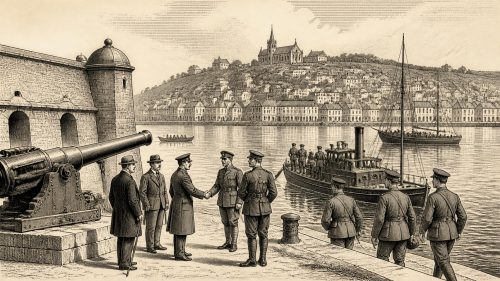
Germany’s unconditional surrender was signed on 7 May and took effect in Europe on 8 May. In Dublin, the ending of the war did not bring uncomplicated celebration. Documents assembled by Documents on Irish Foreign Policy record small pro- and anti-Allied disturbances on VE Day, including flag-burning and broken windows at the British Representative’s office and the United States Consulate General. Winston Churchill’s VE Day address, in turn, criticised Irish neutrality. The bitter exchange showed that the war’s end reopened arguments about sovereignty, partition, Allied pressure and Ireland’s place in the English-speaking world rather than resolving them.
One definite domestic change came on 11 May, when emergency censorship was lifted. During the war, the Controller of Censorship had supervised newspapers, publications, correspondence and broadcasts under the emergency system. Its removal widened the space for public discussion precisely when Irish policy during the war was becoming a matter of intense domestic and international scrutiny. The ending of censorship did not, however, mean that the legal architecture of emergency government disappeared.
Peace Without Plenty
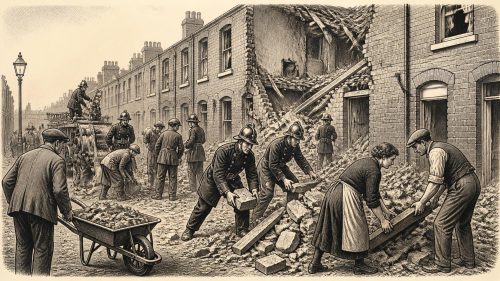
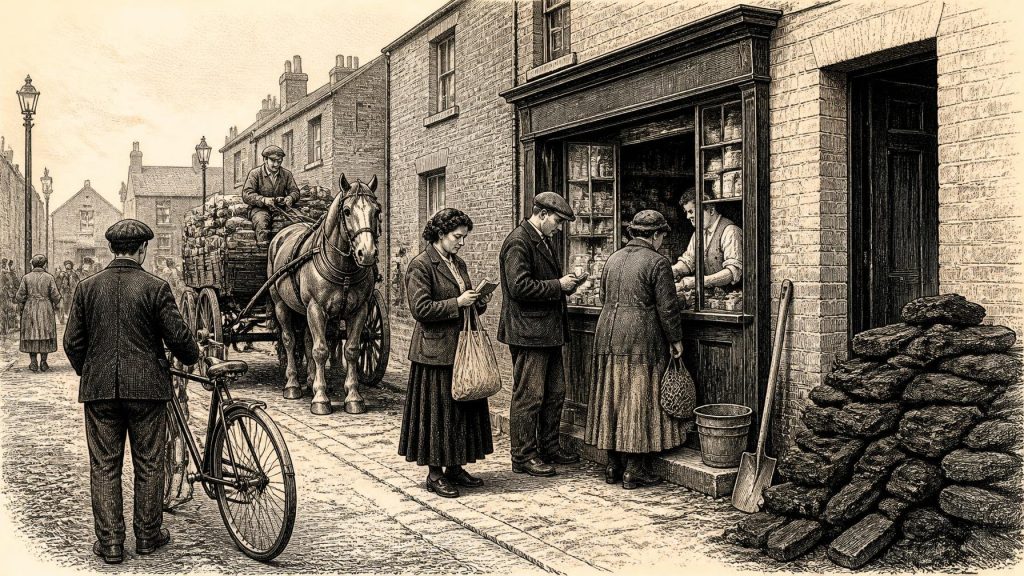
For many households, 1945 remained a year of restricted consumption. Ration books and coupons still regulated access to essential goods. Tea and sugar allowances, limited cloth, scarce petrol and unreliable fuel supplies had reshaped domestic routines during the war, while bicycles, horses and carts commonly substituted for private motor transport. Coal shortages had encouraged cutting turf and felling timber; electricity could be available for only part of the day. Such conditions did not cease merely because fighting in Europe had ended.
A striking measure of the wartime agricultural shift was the wheat harvest. Production in the State rose from about 250,000 tonnes in 1939 to 660,000 tonnes in 1945, reflecting official pressure for tillage and programmes supporting seed and fertiliser supplies. This was not a simple success story of self-sufficiency. Ireland remained vulnerable to disrupted shipping and to its dependence on British-controlled coal allocations. But the expanded acreage mattered: it represented a practical adaptation by farmers and labourers to the island’s isolation from normal markets and imports.
The Oireachtas acknowledged that the peace created obligations beyond Ireland’s shores. On 18 May, Deputies debated the provision of humanitarian relief to countries devastated by nearly six years of war. The discussion is significant because it placed a poor, still-rationed neutral state within the larger European emergency of hunger, displacement and reconstruction. It also challenged any assumption that neutrality meant indifference to suffering abroad.
Administrative demobilisation was cautious. The Emergency Powers (Continuance and Amendment) Act 1945 became law on 29 July, preserving a modified legislative framework after the shooting war had finished in Europe. Emergency powers legislation was ultimately allowed to expire on 2 September 1946, not in 1945. Meanwhile, the Minister for Supplies (Transfer of Functions) Act, enacted on 11 July, abolished the wartime Office of the Minister for Supplies and transferred its functions and departmental business to the Minister for Industry and Commerce. The change recognised that the special ministry created for shortages and controls in 1939 was no longer appropriate in its wartime form, while also preserving its licences, contracts, property and ongoing work.
Ó Ceallaigh’s Election
The year’s principal constitutional event came on 14 June, when Seán T. Ó Ceallaigh was elected Ireland’s second President. The office had been created by the 1937 Constitution, and the election followed the end of Douglas Hyde’s single seven-year term. Ó Ceallaigh, the Fianna Fáil candidate and a veteran of the revolutionary period, faced Seán MacEoin, the Fine Gael-supported former IRA commander, and Patrick McCartan, an independent republican.
The contest was competitive. Ó Ceallaigh received 537,965 first-preference votes, short of the quota, against MacEoin’s 335,539 and McCartan’s 212,834. After the transfer of McCartan’s votes, Ó Ceallaigh won with 565,165 votes to MacEoin’s 453,425; 67,748 ballot papers did not transfer effectively. Turnout was 63 per cent of an electorate of 1,803,463. Ó Ceallaigh was inaugurated on 25 June. His victory gave Fianna Fáil the presidency, but the need for transfers and the sizeable vote for MacEoin disclosed the limits of the governing party’s dominance after the strains of the Emergency.
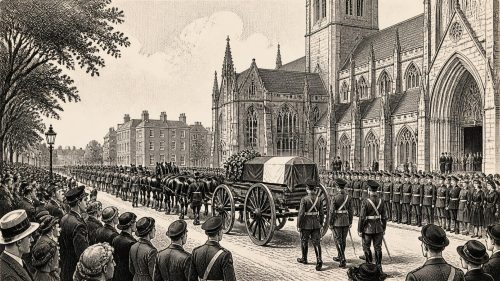
The presidency was deliberately non-executive, yet it had considerable symbolic weight. Hyde had embodied a cultural and non-party ideal in the new constitutional office; Ó Ceallaigh’s inauguration instead linked the office more visibly to the political generation that had made the independent State. His move into Áras an Uachtaráin therefore marked both constitutional continuity and a changing public face for the State at the opening of the post-war era.
Health, Land and Public Institutions
Several Acts passed in 1945 reveal concerns that outlasted the war. The Arterial Drainage Act empowered the Commissioners of Public Works to prepare schemes for catchment areas where works could prevent or substantially reduce periodic flooding, or improve land through drainage. It was enabling legislation rather than proof that every river valley was immediately transformed, but it created a durable national mechanism for surveys, engineering works and the management of drainage infrastructure.
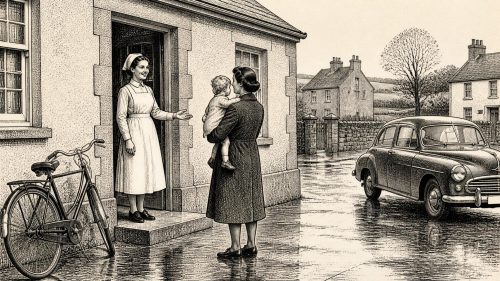
Public health also received legislative attention. The Tuberculosis (Establishment of Sanatoria) Act addressed a disease that remained a grave social and medical problem, while the Mental Treatment Act reorganised aspects of inspection, mental-hospital districts and institutional administration. It is important not to project later reforms backwards: the Mental Treatment Act did not come into operation until 1 January 1947. Nevertheless, its passage in 1945 indicates that the State was legislating for long-term institutional needs even while emergency controls and shortages endured.
Partitioned Politics
Political life north of the border followed a different constitutional track. In the Northern Ireland general election held in June, Sir Basil Brooke’s Ulster Unionists retained a clear Stormont majority, winning 33 seats. Nationalists held nine seats in the election-results classification used by ARK, while smaller Labour, independent, socialist-republican and other candidacies gained representation. Twenty of the fifty-two seats were uncontested, a reminder that electoral competition was highly uneven. Labour advances in Belfast constituencies nevertheless suggested that class and workplace politics could disturb the apparent solidity of Unionist control.
At the Westminster election of 5 July, the wider British Labour landslide replaced Churchill with Clement Attlee. In Northern Ireland the Ulster Unionists returned nine of the thirteen MPs, their lowest Westminster tally since the region’s creation. Nationalists retained both Fermanagh and Tyrone seats, and Independent Labour’s Jack Beattie held West Belfast. These results did not alter partition, but they demonstrated that neither Unionist electoral authority nor political allegiance within Northern Ireland was wholly uniform.
By December, Ireland stood between war and reconstruction. The State had protected its formal neutrality but paid a price in scarcity, controls and diplomatic isolation. The arrival of President Ó Ceallaigh, the lifting of censorship, the dismantling of one wartime ministry and the survival of emergency powers captured that unsettled condition. Peace had arrived in Europe; in Ireland, its economic, institutional and political consequences were only beginning.
Primary Sources
- 14 June 1945 Presidential Election
- Volume 7 – Documents on Irish Foreign Policy
- Telegram from Eamon de Valera to President Harry S. Truman
- Memorandum by Eamon de Valera, 30 April 1945
- Memorandum, Department of the Taoiseach: Preservation of the State in Time of National Emergency
- Office of the Controller of Censorship
- Emergency Powers (Continuance and Amendment) Act 1945
- Minister for Supplies (Transfer of Functions) Act, 1945
- Chronological Table of the Statutes (1945)
- Arterial Drainage Act, 1945
- Arterial Drainage Act 1945
- Mental Treatment Act, 1945
- Mental Treatment Act 1945: Commencement and Effects
- Tuberculosis (Establishment of Sanatoria) Act 1945
- How Ireland's Emergency Introduced Restrictions on Daily Life
- Rationing and Smuggling
- Official Report, Vol. 97, No. 7, 18 May 1945
- Arterial Drainage Act, 1945 – Bill History
- 1945 Westminster Elections in Northern Ireland
- Northern Ireland House of Commons, 1921–1972
- The Minister in Ireland (Gray) to the Secretary of State, 2 August 1945
- The Minister in Ireland (Gray) to the Secretary of State, 19 November 1945
- Surrender of Germany (1945)
- Finance Act, 1945