

Presidential Counsel
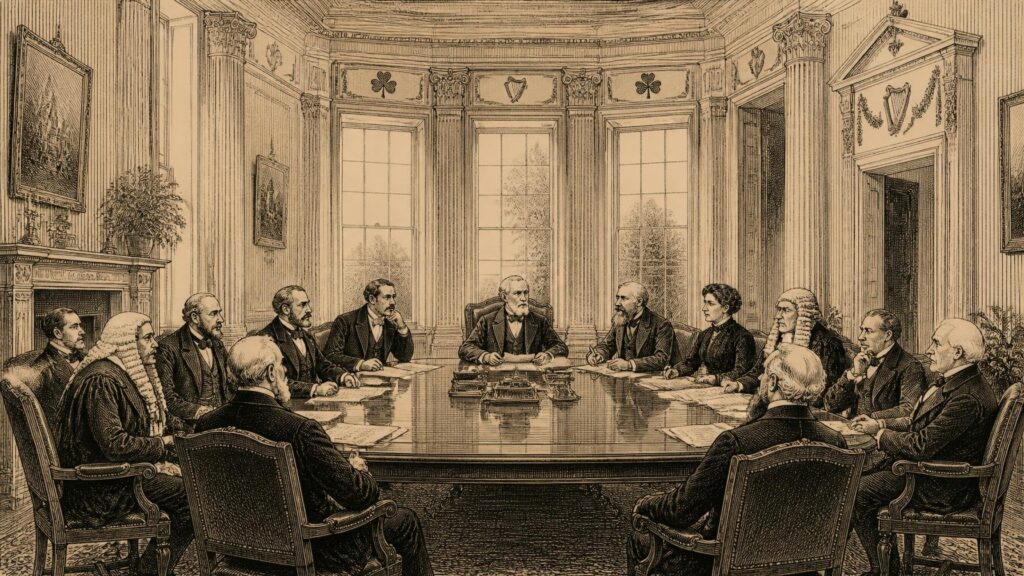
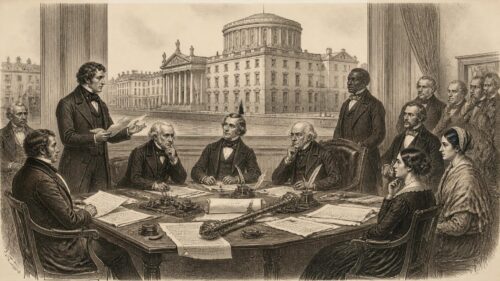
AI generated historical illustration, not a contemporary photograph.
At a Glance
Appointments to Ireland’s Council of State are a small but revealing part of the constitutional settlement made in 1937. They allow the President of Ireland, independently of the Government, to add up to seven chosen figures to a body designed to offer counsel at moments when the Constitution gives the Presidency an exceptional and potentially consequential role.
Constitutional Origins
The Irish Council of State belongs to the constitutional architecture created by Bunreacht na hÉireann, approved by referendum in July 1937 and brought into operation on 29 December of that year. Its name can sound ancient, even monarchical, but the institution is neither a surviving Privy Council nor a chamber of government. It is a republican constitutional body, established to assist an elected President whose ordinary functions are largely formal yet whose limited discretionary functions may carry considerable constitutional importance.
The Constitution’s drafters had to define a head of state for a country emerging from the constitutional arrangements of the Irish Free State. The office of Governor General had disappeared in December 1936, during the constitutional changes that followed the abdication crisis in Britain. The new Constitution therefore required a presidency that could represent the State, perform necessary formal acts and, in certain narrowly defined circumstances, exercise an independent judgment. The Council of State was devised as part of the machinery surrounding that office.
Article 31 declares that there shall be a Council of State to aid and counsel the President on matters on which the President may consult it in relation to powers and functions exercisable after consultation. It may also perform other functions assigned by the Constitution. The wording is important. The Council exists to advise; it does not govern. It does not replace the Cabinet, supervise the Oireachtas, decide litigation or issue binding directions to the President.
That distinction has shaped its history. Irish political discussion sometimes treats the Council as a gathering of national notables, which it certainly can be. Yet its constitutional purpose is more precise than ceremonial prestige. It is a means by which a President, before taking particular exceptional steps, hears a formally constituted body containing office holders from the executive, legislature and judiciary, experienced former office holders and a limited number of personal appointees.
The Council should therefore be understood in the context of the 1937 Constitution’s balance between parliamentary government and a directly elected head of state. The President is not an executive president. Governmental authority is exercised by or on the authority of the Government, responsible to Dáil Éireann. But the President has certain reserve or protective functions. In those areas, consultation with the Council of State provides deliberation without turning the Council into a rival executive.
Council Design
The Constitution gives the Council a deliberately mixed composition. Its first category is made up of ex officio members: the Taoiseach, Tánaiste, Chief Justice, President of the Court of Appeal, President of the High Court, Ceann Comhairle of Dáil Éireann, Cathaoirleach of Seanad Éireann and Attorney General. These places follow offices rather than personalities. A change of Government, a judicial appointment or a change in either House alters membership automatically.
The President of the Court of Appeal is now listed among the ex officio members because of the Thirty-third Amendment of the Constitution, approved in 2013, which facilitated the establishment of that court. Earlier constitutional texts named the Taoiseach, Tánaiste, Chief Justice, President of the High Court, presiding officers of the two Houses and Attorney General. This adjustment illustrates a modest but telling fact: the Council is embedded in the living Constitution and has changed where the wider institutional structure has changed.
The second category comprises persons able and willing to serve who previously held office as President, Taoiseach, Chief Justice, or President of the Executive Council of the Irish Free State. The inclusion of former Presidents of the Executive Council linked the new constitutional order to the earlier State without pretending that the two constitutions were identical. It also ensured that experience acquired at the highest levels of public life could remain available to the President.
The third category consists of persons appointed by the President under Article 31. It is here that the phrase “Council of State appointments” has its clearest meaning. The Constitution permits no more than seven such members at any one time. Unlike the ex officio members, they do not sit because they hold a specified office. Unlike former office holders, they do not enter automatically through a past constitutional position. They are selected by the President personally, through a warrant under the President’s hand and seal.
This three-part structure produces a body that is neither wholly political nor wholly judicial, neither entirely institutional nor wholly personal. A Council meeting may include the Taoiseach and Attorney General, the leaders of both Houses, senior judges, former heads of government and nominees whose principal experience lies in law, education, public service, civil society, cultural life, community work or human rights. That combination is intentional, although the Constitution leaves the exact character of presidential appointments to presidential judgment.
It would be mistaken to regard the seven places as seats allocated to interest groups, political parties, counties, religious communities or professions. No constitutional quota applies. Nor is there a statutory selection competition equivalent to recruitment for a public-service post. The President may decide whom to appoint, whether to appoint fewer than seven people and, within the constitutional limit, when to make appointments. The power is broad, but its breadth exists within a sharply defined constitutional office.
Appointment Power
Article 31.3 provides that the President may appoint such persons as the President, in absolute discretion, thinks fit to be members of the Council of State. The phrase “absolute discretion” is unusually direct. It marks this power as one of the President’s own rather than a function ordinarily exercised on the advice of Government. The constitutional language does not require nomination by Ministers, approval by either House of the Oireachtas, consultation with party leaders or public advertisement of vacancies.
That does not mean that the power is unstructured in every practical sense. The constitutional limit of seven is exact. The appointee must be a person capable of assuming the duties of membership. Each member must, at the first Council meeting attended, make and subscribe the declaration prescribed by Article 31. The terms of appointment are also fixed by the Constitution. Yet the choice of person rests with the President, and the President’s selection can reveal how an office holder understands the purpose of counsel.
Presidential appointments have often been read as statements about the kind of experience the President values. A President may choose former judges or constitutional lawyers, but need not confine appointments to the legal world. Appointees have included figures associated with civil liberties, disability rights, history, education, social policy, community activism and public administration. Such choices can broaden the perspectives available in confidential deliberation, particularly when constitutional questions touch social consequences as well as legal form.
The power is also capable of creating a Council that reflects different strands of experience on the island of Ireland. President Michael D. Higgins’s appointments in January 2012, for example, included people with backgrounds in human rights, law, disability advocacy, historical scholarship and Northern Irish public life. The list included Professor Deirdre Heenan of the University of Ulster, solicitor and civil-rights campaigner Michael Farrell, former Supreme Court judge Catherine McGuinness, historian Gearóid Ó Tuathaigh and disability-law scholar Gerard Quinn.
In March 2026, President Catherine Connolly appointed Fionnuala Ní Aoláin, Linda Ervine, Colin Harvey, Kathleen Lynch, Donncha O’Connell, Conor O’Mahony and Ciarán Ó hÓgartaigh. The published biographies pointed to expertise in international law, peacebuilding, human rights, politics, constitutional law, education and university leadership. The appointments were a contemporary exercise of a power created almost ninety years earlier, but they also demonstrated that the Constitution does not envisage the Council merely as a retirement chamber for former politicians.
The published explanation of appointments is politically and historically useful, though it should not be exaggerated into a binding constitutional convention. Presidents commonly give public reasons or biographical information, especially when announcing all seven nominations. This contributes to public understanding. However, the Constitution itself does not prescribe a rationale, a formal shortlist, a disclosure process or a particular representational balance. The authority lies in the warrant of appointment, not in a published job description.
Terms Tenure
One of the most distinctive features of presidential nominees is that their tenure is tied to the President who appointed them. Unless they die, resign, become permanently incapacitated or are removed, appointed members remain in office until the successor of that President enters office. Their appointments do not ordinarily end with a general election, a change of Taoiseach or a reshuffle of the Cabinet.
This arrangement gives the appointing President a Council whose discretionary members are linked to that presidential term. Since a President serves seven years and may serve no more than two terms, a nominee’s possible period of service can be substantial, but it is not permanent. The accession of a new President brings the previous President’s appointed memberships to an end. The incoming President may appoint an entirely new group, reappoint a former member if constitutionally eligible, or leave one or more of the seven places vacant.
The rule has constitutional significance. It prevents an outgoing President from shaping the discretionary component indefinitely. It also distinguishes the appointees from former Presidents, former Taoisigh and former Chief Justices, whose membership derives from their former offices rather than presidential nomination. The Council therefore combines continuity through institutional and former-office-holder members with renewal through the incoming President’s choices.
An appointee may resign by placing a resignation in the hands of the President. The President may also terminate an appointment by an order under hand and seal, for reasons that seem sufficient to the President. This is another instance of the Constitution giving substantial control over appointed membership to the President. There is no prescribed tribunal, legislative hearing or statutory removal process within Article 31 itself.
Such provisions are not evidence that nominees are subordinate political agents. They instead recognise the personal constitutional relationship created by appointment. The Council’s nominated members are not elected representatives, public servants employed by the President, or holders of a statutory office with independent executive functions. They are advisers invited into a defined constitutional forum for the duration, broadly speaking, of the appointing President’s time in office.
The declaration made at a member’s first Council meeting is equally revealing. The wording requires a promise to fulfil the duties of membership faithfully and conscientiously. It does not require a pledge to support a Government programme, to defend a President’s opinions or to preserve collective secrecy in language comparable to a Cabinet oath. The declaration instead emphasises conscientious constitutional service. Its religious form reflects the 1937 text, while the duty it expresses is institutional rather than partisan.
Required Consultation
The Council’s most visible role arises when the Constitution requires the President to consult it before exercising particular powers. The best-known instance is Article 26. Before referring a Bill to the Supreme Court for a decision on its constitutionality, the President must consult the Council of State. A successful reference produces a decision of exceptional consequence: where the Supreme Court upholds the Bill, its constitutionality cannot later be challenged in the courts on the grounds considered through the Article 26 procedure.
That procedure explains why the Council is more than a ceremonial advisory gathering. When a Bill raises a difficult constitutional question, the President must decide whether to sign it in the ordinary course or refer it. Consultation does not transfer the decision to the Council. Members are heard by the President, but the President decides whether a reference will be made. Nor does the Council itself determine constitutionality; that is the Supreme Court’s task.
The Constitution also requires consultation before the President may decline a Taoiseach’s request to dissolve Dáil Éireann where the Taoiseach has ceased to retain majority support. This is one of the clearest reserve powers possessed by the Irish President. It is designed for an unusual parliamentary crisis, not for ordinary disagreement between a President and a Government. The requirement of consultation adds collective constitutional reflection before a step that could affect who has the opportunity to form a Government without a general election.
Other provisions also call for consultation in specified circumstances. Before addressing either or both Houses of the Oireachtas on a matter of national or public importance, the President must consult the Council, although the text of the address must be approved by Government. Before sending a message to the Houses, the President must similarly consult the Council. The President must consult it before convening a meeting of either House, and before communicating with either House or both Houses. These safeguards emphasise that presidential interventions into parliamentary life are constitutionally bounded.
Article 27 provides another significant function. Where a majority of Seanad Éireann and at least one-third of Dáil Éireann petition the President on the ground that a Bill contains a proposal of national importance, the President must consult the Council before deciding whether the Bill should be referred to the people or whether a general election should occur before it is signed. The provision has rarely, if ever, become a practical instrument of legislation, but its inclusion shows how the Council was imagined as part of a wider set of constitutional safeguards.
Article 32 gives the Council a contingent role if the office of President becomes vacant or the President becomes unable to act, and no Presidential Commission can be constituted under the preceding provisions. In that highly exceptional circumstance, the Council may make provision for the exercise of presidential powers and functions. This is an emergency continuity mechanism. It should not be confused with ordinary government, and its very obscurity is evidence that it belongs to constitutional contingency rather than daily politics.
Discretionary Counsel
Article 31 also permits consultation beyond occasions where it is compulsory. The President may seek the Council’s advice on matters connected with powers and functions expressed to be exercisable after consultation. This does not create a general roving commission to advise on all political controversies. The Council is not an alternative Cabinet, a policy think tank or a forum for debating the Government’s legislative agenda.
Nonetheless, its discretionary advisory character matters. Constitutional problems do not always arrive in neat categories. A President considering a serious institutional question may benefit from hearing people who occupy, or have occupied, distinct constitutional roles. Senior judicial experience, parliamentary knowledge, executive experience and independent appointments can be brought into one room without creating a public political contest.
Meetings are convened by the President at times and places determined by the President. The Constitution says that members present must be heard on each occasion where prior consultation is required. It does not demand unanimity, a recorded vote or the publication of advice. Indeed, the Council’s value may partly lie in allowing frank discussion without requiring members to issue a collective public verdict.
For historians, this can make the Council difficult to interpret. Its most important work may occur in private, while public records frequently reveal only the fact that a meeting occurred, the constitutional question involved and the President’s eventual decision. That is not necessarily a defect. The Council was never designed as a publicly deliberating parliamentary committee. But it means that confident claims about the influence of individual members should be avoided unless supported by reliable documentary evidence.
It is possible to say, however, that nomination affects the range of expertise and life experience present when a Council is convened. A Council comprising only office holders would be constitutionally legitimate, but presidential appointments permit a wider field of counsel. The seven places may therefore be understood as a carefully limited opening through which the President can supplement institutional experience with voices not automatically represented by high office.
Historical Precedents
The title “Council of State” has older associations in Irish history, but those associations must be handled carefully. Under English rule in Ireland, the Dublin administration had a Lord Deputy or Lord Lieutenant assisted by a Council, often described as a Council of State. Early modern accounts describe councillors appointed by royal letters and serving within the structures of Crown government. Such bodies were instruments of colonial administration and royal authority.
Fynes Moryson’s early seventeenth-century account of Ireland described a resident Council of State at Dublin, including senior legal, financial, military and ecclesiastical figures. The resemblance in name should not obscure the constitutional distance between that body and the modern Council. The earlier council operated in a kingdom governed under the English Crown and was connected with military administration, colonial governance and the Lord Deputy’s authority. The Council established in 1937 serves an elected republican President within a democratic constitution.
There is no reason to present the modern Council as the direct institutional descendant of the earlier Dublin council. The better historical interpretation is that both belong to a broad European vocabulary of state counsel, while serving radically different regimes. The modern Irish Council is defined not by inherited ceremonial continuity but by the specific text of Articles 31 and 32 of Bunreacht na hÉireann.
Nor should the Irish Council be equated with France’s Conseil d’État. The French institution has major administrative-law and governmental advisory functions, a professional administrative tradition and a role far larger than that of the Irish Council. Ireland’s Council does not decide administrative cases, draft governmental regulations as a routine function or constitute a standing legal service for the executive.
The closest relevant background lies in the problem faced by the framers of the Irish Constitution: how to give a non-executive President a constitutional role without creating either an ornamental irrelevance or a competing centre of political power. The Council was part of the answer. It attached advice to the Presidency at points where independent action might be contemplated, while preserving ministerial government and parliamentary responsibility.
Changing Membership
The constitutional categories of membership have produced both stability and change. Stability arises because the serving office holders are plainly identified and because former holders of the highest offices may participate if able and willing. Change arises whenever elections, judicial appointments, retirements, deaths, resignations or presidential transitions alter the membership.
The discretionary members are especially useful for tracing changing understandings of public authority. Earlier decades often saw nominations of people whose standing derived from public administration, the professions, the judiciary, political experience or established cultural life. Later appointments have increasingly made visible forms of expertise that once stood farther from the traditional centre of the State: civil-liberties advocacy, equality work, disability rights, academic research, community leadership and peacebuilding.
This should not be reduced to a simplistic story in which an old elite was replaced by a new one. Presidents have always had freedom of choice, and the documentary record of every selection process is not public. More cautiously, the published lists of appointees show that Presidents have used the seven places to recognise a wider range of public experience than the ex officio category alone could supply.
The appointment of Dr Sindy Joyce by President Higgins was particularly notable. Joyce, a Traveller scholar and activist, was described by the President in 2020 as the first member of the Traveller community appointed to the Council of State. The appointment did not change the constitutional function of the Council, but it demonstrated how the appointment power can make the advisory body more reflective of constituencies and experiences historically underrepresented in elite Irish institutions.
Appointees associated with Northern Ireland have also underscored the all-island dimensions of modern Irish public life. Such appointments do not alter the jurisdiction of the Irish Constitution or give the Council any role in Northern Ireland’s devolved institutions. They do, however, recognise that constitutional counsel may benefit from experience of the island’s varied political, legal and communal traditions.
Public biographies accompanying appointments provide valuable evidence of what Presidents wished citizens to understand about their choices. They are not neutral archival catalogues, and they should be read as official presentations. Yet they show that appointments are commonly explained by reference to professional achievement, public service and a capacity to bring distinct knowledge to constitutional deliberation.
Public Character
The Council occupies an unusual public position. Its membership is public, its constitutional basis is public and some of the circumstances requiring consultation are highly visible. But its advice is not normally published as a report, and its discussions are not conducted as parliamentary debates. This mixture of transparency and confidentiality is central to its character.
The public can know who has been appointed and can assess, in broad terms, the experience brought into the Council. Citizens can also know when a President has referred a Bill to the Supreme Court or exercised another constitutional power following consultation. What remains largely private is the content of the advice given by individual members and the precise dynamics of deliberation.
That privacy is sometimes frustrating to historians and commentators, especially when constitutional decisions have lasting effect. Yet publication of individual views could transform the Council into a forum of political positioning, particularly where serving Ministers, judicial figures and former political leaders sit together. The Constitution’s design appears to favour advice offered to the President rather than a public competition of constitutional opinions.
Secrecy should not be romanticised as proof of wisdom. Confidentiality cannot itself demonstrate that advice was sound, representative or influential. Nor can one infer agreement merely because no disagreement is publicly recorded. The proper historical position is more modest: the Council is a confidential advisory institution whose composition, convening and constitutional context are visible, while much of its internal deliberation is not.
This places particular weight on appointments. Because the public generally cannot inspect transcripts of advice, the identity and experience of nominated members become a principal visible indicator of how a President has chosen to equip the Council. A nomination is therefore both constitutional and symbolic. It creates no separate democratic mandate, but it makes a judgment about the kinds of counsel worthy of inclusion.
Constitutional Limits
Several misunderstandings should be set aside. First, the Council does not veto Bills. In an Article 26 case, it advises the President; the President decides whether to refer; the Supreme Court decides the constitutional question. Secondly, the Council does not appoint judges, Ministers or office holders merely because some of its members are themselves senior office holders. Thirdly, presidential nominees do not possess executive authority by virtue of membership.
Fourthly, the Council does not provide a constitutional mechanism for a President to oppose the Government in ordinary policy disputes. Ireland’s President is not empowered to govern through advisers. The Council’s constitutional significance arises because the Constitution identifies particular moments where consultation is required or permitted, not because it supplies an independent political programme.
Fifthly, appointment is not evidence of a legal qualification to determine constitutional issues. Some nominees have been eminent lawyers and judges; others have brought expertise from outside law. The Constitution does not require the seven appointees to be barristers, academics, politicians or representatives of any particular field. Their task is counsel, not adjudication.
Finally, the Council should not be treated as a dependable measure of national consensus. Its members may have varied views, and the President is not constitutionally compelled to follow a collective recommendation. The Council supplies an occasion for hearing counsel. It does not transform difficult constitutional judgment into an opinion poll among distinguished citizens.
Enduring Purpose
The endurance of the Council of State reflects the endurance of the constitutional problem it addresses. A parliamentary republic requires a head of state who can act independently in limited circumstances without becoming an alternative government. Ireland’s solution has been to combine a directly elected President with carefully restricted powers, formal consultation and judicial review where appropriate.
Presidential appointments are essential to that design because they prevent the Council from being composed only of those who already hold, or once held, the highest formal offices. The President may add perspectives grounded in scholarship, legal practice, social advocacy, public administration, reconciliation, culture or other forms of public service. At its best, this makes constitutional counsel more searching without making it politically competitive.
The historical evidence supports a restrained conclusion. The Council has not become an everyday centre of power, and the President’s seven nominations have not created a second political establishment with authority to rule. Instead, appointments have given successive Presidents a limited means of shaping the advisory environment around rare but serious constitutional decisions.
Its importance therefore lies partly in reserve. The Council waits in the background of ordinary public life, but when the Constitution requires it, it brings together the State’s institutional leadership, the memory of former office holders and the additional experience selected by the President. That is a modest constitutional mechanism, yet it embodies a significant principle: even an independently elected President should exercise exceptional powers only after hearing counsel.
The article highlights tension in the Council of State’s design: presidential nominees can bring expertise from civil society, rights advocacy and education, yet their advice is confidential and non-binding. This preserves presidential constitutional responsibility, while making it difficult for the public to judge how diverse experience influences decisions on Article 26 references or parliamentary interventions. Term-linked appointments also let each President reshape the advisory element without creating a permanent rival institution. How should we interpret the balance between confidential counsel and public confidence: as a strength of Ireland’s restrained presidency, or as a case for explanation of appointments and consultations?