

Cráeb Telcha
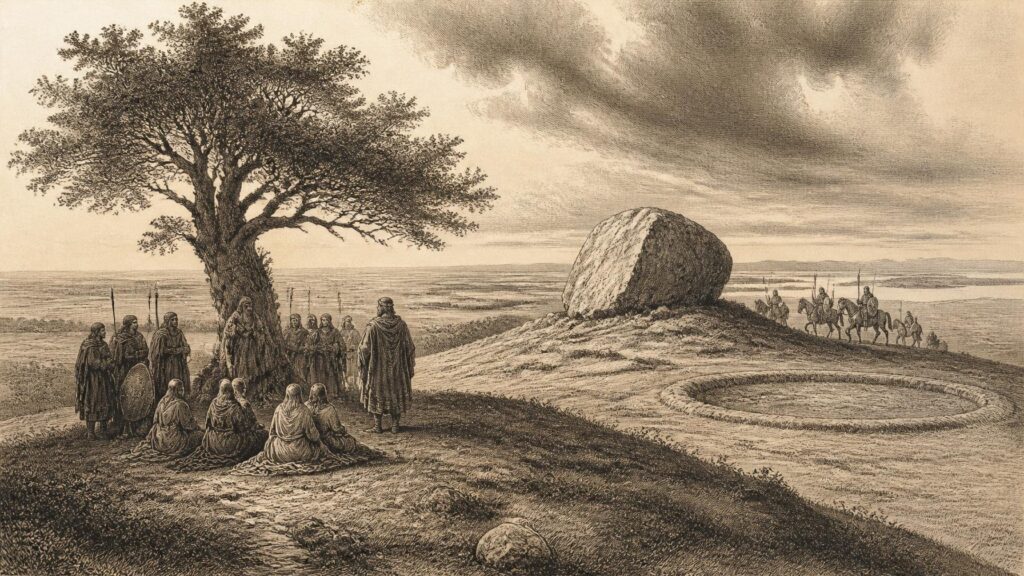
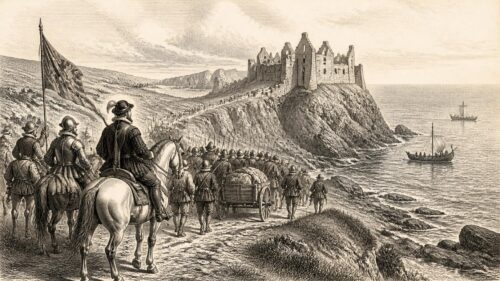
AI generated historical illustration, not a contemporary photograph.
At a Glance
Crew Hill, rising near Glenavy in County Antrim, is a modest eminence with an unusually large historical afterlife. It is probably the Cráeb Telcha of Irish literary and annalistic record: a place where the political geography of Ulaid, warfare, kingship, sacred landscape and local memory meet. The evidence does not permit a simple claim that every king of Ulaid was crowned there, nor does it identify every visible stone or earthwork as ancient ceremonial furniture. Yet the hill’s name, its documented role as an assembly place, the record of battles and encampments, and the survival of inauguration traditions make it one of the most suggestive royal landscapes in Ulster.
Hill Setting
Crew Hill stands in the townland of Crew, within the historic parish of Glenavy and the barony of Upper Massereene. It rises above the surrounding country to a little over 630 feet, commanding broad views across the lowlands around Lough Neagh. Such a position did not automatically make it a royal place: prominent ground is plentiful in Ireland. But elevation, visibility and accessibility could make a hill useful for gatherings, negotiations, displays of power and military encampment. In a society where lordship was enacted publicly, a meeting place needed not merely space but recognisability. A hill known over generations could carry authority before any particular assembly had begun.
The modern landscape has altered the setting. Farming, quarrying, roads, water infrastructure and repeated attention to reputed antiquities have all left their mark. The summit contains the large boulder customarily called the Crew Stone; the southern slopes include a bivallate rath and a stone known locally as the stone chair. These features encouraged antiquarian and popular descriptions of a coronation ground. They must, however, be approached with care. The archaeological record is partial, and the topography has been disturbed. The value of Crew Hill lies partly in the fact that its material remains and its historical reputation are not identical things. The latter may preserve a real memory of political importance, even where the former cannot demonstrate a particular rite.
The hill’s historical significance rests above all on its probable identification with Cráeb Telcha, a name found in medieval Irish sources. That identification was not always accepted without question. Earlier writers proposed other locations or treated the matter tentatively. The place-name scholar Deirdre Flanagan examined the documentary and cartographic evidence in detail and supplied the strongest case for connecting Cráeb Telcha with Crew Hill. Later archaeological assessment at the site accepted that conclusion while retaining an appropriately cautious vocabulary concerning the precise use of the hill.
Names Evidence
The Irish name is conventionally written Cráeb Telcha, with variant spellings in medieval and later sources. Its exact nuance is not wholly straightforward. Cráeb literally means a branch, but in some contexts it is associated with a tree, including a significant or sacred tree. Telcha is the genitive of tulach, a word capable of referring to a hill, hillock or mound. Translations have consequently varied between such forms as “the spreading tree of the hill”, “the tree of the mound” and “the branch of the hill”. The differences matter because they warn against turning a linguistic clue into a fixed architectural description.
Nevertheless, the name does something more important than provide picturesque imagery. It joins the medieval place in the texts to the modern English name Crew. The phonetic and cartographic trail examined by Flanagan provides a route from medieval forms to later map forms such as Crew and Crow. The Queen’s University Belfast evaluation accordingly concluded that the onomastic evidence demonstrated the identity of Cráeb Telcha and Crew Hill. This is a stronger proposition than saying the identification is a romantic local guess, although it does not mean that every tradition attached to the modern hill can be projected unchanged backwards into the early Middle Ages.
The tree in the name is particularly significant. In Irish royal ideology, trees could serve as markers of territory, dynastic legitimacy and protected authority. The medieval word bile, often translated as sacred tree, occurs in traditions connected with important places and rulers. A tree could be literal, but it was never merely botanical in political language. To cut one down was capable of being an act of domination. The annalistic record of 1099, in which the forces of Cenél nEógain burned the Ulaid camp at Cráeb Telcha and cut down Cráeb Telcha itself, therefore has a force greater than the destruction of timber. It suggests an assault on the identity of the place and, by implication, upon those who claimed it.
Ulaid Kingdom
To understand Crew Hill, it is necessary to distinguish Ulaid from the later province of Ulster. In early medieval political usage, Ulaid denoted a kingdom and a people whose centre of gravity lay chiefly in what is now eastern Ulster. Their leading dynasty in the period most relevant to Crew Hill was Dál Fiatach. Other dynasties, notably Dál nAraidi, competed within the wider region, while powerful neighbours such as Cenél nEógain to the north and west repeatedly intervened in Ulaid affairs. The map of lordship was therefore neither stable nor equivalent to modern county boundaries.
Royal power in Gaelic Ireland was not exercised from a single permanent capital in the modern sense. Kings and overkings moved with their households, followers and resources; they governed through personal allegiance, hostages, assemblies, military expeditions, tribute and reciprocal gift-giving. Places nonetheless mattered deeply. A recognised assembly site could be where a ruler met subjects, displayed hospitality, made alliances, received submission, settled disputes, or was acclaimed. Such places linked people to inherited claims. They also provided targets when enemies wished to humiliate a rival polity.
Crew Hill belongs to this political world. The documentary evidence does not furnish a detailed account of a ceremonial sequence conducted there. No medieval annal says, in unambiguous terms, that a named king was inaugurated on the Crew Stone. The evidence is instead cumulative. Cráeb Telcha appears in a literary topographical sequence and in accounts of warfare and royal movement. It was important enough to be the place where the Ulaid were in camp in 1099; it was associated with a tree important enough for hostile chroniclers to notice its destruction; and it remained conceivable, to later historical interpreters, that it had served as an inauguration venue. These facts justify the designation of a probable royal assembly and inauguration landscape, not an invented certainty about individual ceremonies.
Battle Memory
The most dramatic early record is the battle of Cráeb Telcha. The Annals of Ulster place it under the year 1004, though other chronicle traditions use neighbouring chronological reckonings. The entry records a conflict between the Ulaid and Cenél nEógain in which the Ulaid were defeated. Eochaid son of Ardgar, king of Ulaid, fell, together with members of his kindred and other named figures. The annalist also reports that the fighting extended as far as Dún Echdach and Druim Bó, indicating a wider military action rather than a confined encounter on a hilltop.
This is one reason why Crew Hill cannot be treated only as a quiet ritual sanctuary. It was embedded in active political conflict. The death of Eochaid was a grave dynastic blow. The annal also records the fall of Aed son of Domnall ua Néill, king of Ailech, while noting a claim by Cenél nEógain that he had been killed by his own side. Such details show how annals preserve not only events but competing political memories. Even an apparent victory carried losses, ambiguities and the need to control the story afterwards.
It would be tempting to call the battle a decisive end to Crew Hill’s importance, but the later evidence rules that out. The place still appears in connection with Brian Boru and in the campaign of 1099. Rather, the battle demonstrates why a recognised assembly place mattered. An enemy who met the Ulaid near Cráeb Telcha was confronting them in a landscape weighted by authority. The hill’s role could make it symbolically valuable in precisely the same way that it made it militarily exposed.
Popular accounts sometimes date the battle to 1003. This is not necessarily a straightforward factual error: medieval Irish annals frequently present chronological complications, and later compilations can differ in their year headings. For historical writing, the safest formulation is that the Annals of Ulster record the battle under 1004, while acknowledging that alternative annalistic dating occurs. What is beyond reasonable doubt is the event’s placement in the opening years of the eleventh century and its connection with a major defeat of the Ulaid.
Brian Visit
Cráeb Telcha appears again in the saga history known as Cogadh Gáedhel re Gallaibh, usually translated as The War of the Gaedhil with the Gaill. In its narrative, Brian Boru came to Cráeb Telcha during his circuit of Ireland in 1006. The Ulaid supplied provisions in extravagant quantities, while Brian bestowed horses, gold, silver and clothing. The passage presents the encounter as an exchange of hospitality and royal generosity: provisions flow to the high king, gifts flow outward to the provincial people.
The account must be read critically. The work was composed after the events it describes and is shaped by a strongly favourable attitude towards Brian. Its figures and rhetorical abundance belong to a heroic literary mode rather than a treasury ledger. It cannot prove that precisely twelve hundred cattle, twelve hundred hogs, twelve hundred wethers and twelve hundred horses changed hands at Crew Hill. Nor should the passage be used as unqualified evidence that Brian received complete submission from Ulaid there.
Yet scepticism need not require dismissal. Even if its particulars are embellished, the account is historically revealing. It assumes that Cráeb Telcha was a plausible setting for Brian’s encounter with the Ulaid. A twelfth-century audience could understand the site as a place suitable for royal provisioning, political theatre and exchange. That memory is itself evidence of stature. If a lost contemporary source underlies the passage, it may preserve an earlier recollection; if not, it still shows that the place retained recognised royal associations when the text was composed.
Brian’s visit also illustrates a larger truth about medieval kingship. Rulership was not only battle. It involved food, animals, treasure, clothing and the visible ability to reward. At a site such as Crew Hill, exchange could make hierarchy tangible. A visiting overking received sustenance from a regional people and responded with gifts designed to create obligation and display superiority. Whether the Cogadh’s numbers are literal or literary, the scene conveys the political language in which the hill was remembered.
Sacred Tree
The entry for 1099 in the Annals of Ulster gives the clearest evidence for Crew Hill as a charged political landscape. Domnall ua Lochlainn and the forces of the north entered Ulaid. The Ulaid were camped at Cráeb Telcha. Their mounted forces met; the Ulaid were defeated; and, after they abandoned the camp, Cenél nEógain burned it and cut down Cráeb Telcha. Hostages followed. The sequence combines battlefield defeat, destruction of a settlement or encampment, the felling of the named tree, and the imposition of political guarantees.
The wording makes it unsafe to state absolutely that the tree was used in inauguration. The annal does not say so. But the action accords closely with the symbolic logic of Irish kingship. Trees associated with important groups and territories could embody continuity, sovereignty and the rootedness of a lineage. The destruction of a rival’s tree was therefore an intelligible gesture of conquest. The Queen’s University report rightly observes that the symbolic significance of this episode should not be underestimated, while avoiding the stronger claim that it proves the exact form of a rite at the hill.
The 1099 episode also explains why the name Cráeb Telcha was remembered with such force. The phrase may have designated the locality, the tree, or both through a deliberate overlap. When the annal says that the invaders cut down Cráeb Telcha, the ambiguity is meaningful rather than inconvenient. It presents the tree as inseparable from the place. The attack did not happen at an anonymous camp; it happened at the named focus of Ulaid authority.
Later tradition treated this event as the cutting of a sacred inauguration tree. That interpretation is credible as a reading of the political symbolism, but it should remain labelled interpretation. The primary record gives the event; the fuller ceremonial explanation is reconstructed from comparative evidence about Irish royal sites and sacred trees. Such distinctions protect the history of Crew Hill from both credulous legend and needless reductionism.
Inaugural Claims
The claim that Crew Hill was an inauguration place has deep roots in local historical writing. It rests on a conjunction of factors: the name’s association with a tree and hill of assembly; the hill’s royal and military documentary record; the Crew Stone; the stone chair; the nearby rath; and traditions that kings of Ulaid were proclaimed there. In Gaelic Ireland, inauguration was not necessarily a single uniform action. Rituals varied between regions and periods, but they often bound a ruler to a people, territory and inherited place. A stone, mound, tree, fort or assembly hill could acquire a role within that framework.
There is an important difference between saying that Crew Hill probably formed part of an inaugural landscape and saying that its surviving boulder is certainly a coronation stone. The first is a historically reasoned assessment; the second goes beyond what excavation can now establish. The 2007 evaluation at Crew Hill concluded that the literary evidence identifies Cráeb Telcha as a royal assembly place probably used for inauguration. It also concluded that the stone, chair and rath are consistent with that use but are not definitive proof of it.
This cautious conclusion is valuable. Historical landscapes often survive through a mixture of text, name, physical survival and communal memory. Each strand has weaknesses. Annals name events but seldom describe topography in detail. Place-names preserve associations but change sound and meaning over centuries. Folklore may retain a distant truth, reshape an old memory, or attach prestige to a familiar feature. Archaeology can show disturbance, materials and structures, but cannot always recover acts that left little trace. Crew Hill becomes intelligible only when these evidences are considered together without allowing one to pretend it can answer every question.
The final medieval reference discussed by the investigators is an entry in the Annals of the Four Masters for 1149, describing an incursion into Ulidia as far as Cráeb Telcha in support of Cú Uladh. One historian proposed that the restored ruler may have been re-inaugurated there. The archaeological report judged this unlikely and certainly unproven, noting that the people said to have immediately expelled him would have been necessary participants in any meaningful acclamation. This is a model of sound historical restraint: proximity to an inauguration site does not itself demonstrate an inauguration.
Stone Evidence
The Crew Stone dominates modern discussion. It is a basalt glacial erratic, roughly one and a half metres in maximum dimension, standing near the summit. Local tradition has called it an inauguration or coronation stone. Such stories are not trivial simply because they are late in recorded form. They show how the hill was understood by people who lived around it. But tradition is not a substitute for secure dating, nor can a naturally transported boulder be assigned a ceremonial role merely because it is conspicuous.
Archaeological work revealed a serious difficulty. The boulder lay over a large rock-cut pit, interpreted as a comparatively recent excavation rapidly backfilled, probably by treasure seekers. Pottery from the primary fill suggested a seventeenth- or eighteenth-century date. The investigators concluded that this digging would have destroyed any archaeological horizons that might have related to ancient use of the stone. In other words, the very curiosity generated by the hill’s reputation may have made the question harder to answer.
The stone chair is more elusive still. It is a large monolith with a rough depression, now in a ditch beside Crew Road on the southeastern side of the hill. It was moved under supervision in January 1970, but the available record does not specify its former position precisely. A local story maintained that victors carrying it away after a battle were surprised and dropped it where it later lay. This is folklore, not documentary proof. The stone’s chair-like form may have encouraged an inauguration interpretation, especially because seats, stones and royal election are associated in Irish and European traditions. Yet its original location and prehistoric or medieval function are unknown.
The rath on the southern slope offers firmer archaeological language but no simple answer. A bivallate rath is an enclosed settlement or defended site defined by banks and ditches. Such monuments belong broadly to the settlement patterns of early medieval Ireland, though individual examples may be difficult to date precisely without excavation. Its presence near Crew Hill is compatible with a high-status or strategically valued locality. It cannot, by itself, prove that the enclosure housed kings or that it was directly part of inauguration ceremonies.
Excavation Results
The principal modern archaeological intervention was undertaken in 2007 by the Centre for Archaeological Fieldwork at Queen’s University Belfast, in advance of an expansion to water-service facilities. This was not a wholesale excavation of the hill. It was a targeted evaluation of selected features and anomalies, designed both to assess archaeological potential and to test elements of the supposed inaugural landscape. That limited scope is essential when judging what the results can and cannot say.
The project examined areas around the Crew Stone, linear anomalies identified by earlier geophysical survey, a summit quarry associated in local historical accounts with burials, and a low mound on the southern slope. It recovered artefacts including flint, burnt bone, pottery, charcoal and later material. Finds alone do not convert a hill into a royal sanctuary. Their contexts, dates and disturbance matter. The investigation was successful in producing stratigraphic information and in clarifying that some attractive interpretations were untenable.
Most notably, the southern mound previously regarded as a possible inauguration feature proved to be an upstanding portion of bedrock within an eighteenth- or nineteenth-century quarry. This is a salutary result. A feature can look ancient and ceremonial while being produced by relatively recent extraction. Similarly, trenches near the quarry thought to relate to reported stone-lined graves did not reveal undisturbed burials. Nineteenth-century accounts of burials may reflect genuine discoveries, but the modern investigation could not confirm their character at the examined locations.
The work did not disprove Crew Hill’s medieval importance. Archaeology rarely has the power to negate a well-supported documentary identification simply because a small excavation does not find a ceremonial installation. Rather, it removed some overconfident props from the old story. The investigators concluded that no fresh insight had been gained into the character of Crew Hill as a place of royal assembly and probable Gaelic inauguration. That apparent disappointment is historically productive. It directs attention back to the strongest evidence: name, texts, regional political context and the careful interpretation of a disturbed landscape.
Later Landscapes
After the twelfth century, Cráeb Telcha largely disappears from the surviving narratives that have made it famous. This silence need not mean abandonment. Most places in medieval Ireland were not continuously recorded, and even politically important localities could fade from national annals when the political order changed. Over time, the hill became part of an agricultural and parish landscape, its older meanings preserved intermittently in names, stories and antiquarian remarks.
Nineteenth-century writers gathered elements of the tradition: the great stone, the rath, the reported burials and the belief that the hill had been connected with kings of Ulster. Their work is important evidence for the survival of local memory, but it must be read in its own context. Victorian and later antiquaries were often eager to identify ancient royal sites, and they sometimes treated visual resemblance or local assertion as confirmation. Their observations can lead modern researchers to lost features and traditions, but their conclusions require independent testing.
Modern infrastructure created another layer of history. Reservoir development prompted geophysical survey and excavation; roads and field boundaries helped determine the present position and visibility of monuments; earlier quarrying reshaped slopes. Crew Hill is therefore not an untouched relic of a remote age. It is a palimpsest, in which early medieval political memory survives within a working modern landscape. Its historical dignity does not depend on being pristine. Indeed, its vulnerability to excavation, quarrying and treasure hunting helps explain why scholarly caution is so necessary.
Historical Judgement
The best-supported account of Crew Hill is neither a debunking nor a coronation-pageant certainty. Crew Hill is very probably Cráeb Telcha, an early medieval place of royal assembly associated with the Ulaid. The documentary record places it in major political and military episodes from the early eleventh century to the mid-twelfth century, with a literary reference potentially reaching earlier. The destruction of its named tree in 1099 gives compelling evidence that the place possessed a symbolic value which enemies understood and deliberately attacked.
It is reasonable to interpret Crew Hill as a probable inauguration site because royal assembly, sacred-tree symbolism, a suggestive place-name and surviving local tradition converge there. It is not reasonable to state as established fact that every ruler of Ulaid was inaugurated on the Crew Stone, that the stone chair was a royal throne, or that the excavated mound was a prehistoric ceremonial monument. The most prominent physical features do not yield that level of certainty, and in some cases modern disturbance has permanently removed the relevant evidence.
Folklore should not be discarded, but it must be identified for what it is. The chair carried from a battlefield, the coronation stone and the royal proclamations belong to the hill’s cultural history. They show how generations made sense of an imposing place whose name and reputation had outlived the political world that created them. Folklore becomes most useful when it is set beside annals, archaeology and place-name scholarship rather than asked to bear the entire weight of proof.
Crew Hill deserves attention precisely because it teaches this disciplined balance. Its story is not one of monumental ruins offering easy answers. It is a story of a named hill, a lost tree, recorded violence, remembered kingship and damaged evidence. At Cráeb Telcha, Ireland’s early medieval past is visible not as a finished tableau but as an argument between landscape, text and memory. That argument is the hill’s enduring historical importance.



Crew Hill illustrates how a royal landscape can retain political meaning even when archaeology cannot confirm every later ceremonial tradition. The 1099 destruction of the Ulaid camp and named tree seems especially revealing: felling Cráeb Telcha may have signalled conquest of authority as well as military victory. At the same time, the disturbed Crew Stone warns against treating surviving features as straightforward proof of inauguration rituals. This tension between textual memory, place-name evidence, folklore and damaged remains makes the site particularly compelling. How should historians weigh these forms of evidence when interpreting Crew Hill’s role in Ulaid kingship and inauguration?