
Molyneux’s Dublin Experiment1683 CE
In 1683, Restoration Ireland reflected vigilant government, Protestant consolidation, Catholic resilience and emerging scientific enquiry. Following England’s Rye House Plot, Lord Deputy Arran and Ormond monitored suspected dissenters, linking officeholding to Church of Ireland conformity; Richard Talbot’s return also signalled Catholic court influence. Randal MacDonnell’s death ended the Antrim marquessate amid indebted estate arrangements. William Molyneux convened Dublin’s first philosophical society, promoting observation and practical knowledge. Archbishop Boyle’s new Blessington church embodied Anglican landlord power, while Dominic Maguire’s selection as Catholic primate demonstrated ecclesiastical continuity. Trade remained pastoral, Greatrakes died, and the severe winter threatened livelihoods across the island’s communities.
Dateline
In 1683 Ireland was not marked by a single battle, parliament or change of monarch. Charles II remained king, and James Butler, duke of Ormond, remained lord lieutenant. Yet the year revealed the working character of Restoration Ireland: government vigilant after a conspiracy in England; Protestant authority expressed in new buildings and town-making; Catholic leadership maintained through international ecclesiastical connections; and a small Dublin circle beginning a remarkable experiment in organised scientific enquiry. It was a year whose most enduring event was quiet rather than dramatic: the first meeting of the Dublin Philosophical Society.
Government After the Rye House Alarm
Irish government was closely tied to political shocks across the Irish Sea. In June 1683 the Rye House Plot, an alleged plan to kill Charles II and his brother James, duke of York, was uncovered in England. Its discovery unleashed a royalist reaction against political opponents and Protestant dissenters. There is no responsible basis for treating Ireland as a principal theatre of the plot, but its consequences were felt there. The Dublin administration was expected to identify potentially disaffected people, especially those linked by religion, family or correspondence to English nonconformist networks.
Ormond’s son Richard Butler, earl of Arran, was acting as lord deputy in Ireland between 1682 and 1684. He spent the summer of 1683 in Dublin, while Ormond’s correspondence shows concern about the loyalty of officials, magistrates and army officers. The language of security was capacious: political opposition, Presbyterian or other dissenting worship, and old connections with English radicals could be interpreted through the same suspicious lens. This did not mean that every dissenter was arrested or that Ireland faced an imminent rising. It did mean that conformity to the established Church of Ireland became an especially important test of dependability in official eyes.
The case of Richard Lawrence illustrates the atmosphere. Lawrence, a former Cromwellian officer and a Protestant dissenter with contacts in England, had visited men later implicated in the Rye House affair. Ormond was not prepared simply to pronounce him guilty, but ordered him watched; Arran believed him compromised. Lawrence was eventually removed as a justice of the peace because he alone among Irish holders of that office was not a member of the Church of Ireland. The episode demonstrates the practical reach of Restoration government: surveillance, office-holding and religious conformity were entwined.
The crisis also formed the background to Richard Talbot’s return to Ireland in July. Talbot, a Catholic courtier and landowner, had lived abroad during the sharpest phase of the Popish Plot and exclusion controversies. His return after the Rye House discovery did not yet transform Irish government, and it would be misleading to project the later Jacobite era backwards into 1683. Nevertheless, the reappearance of a well-connected Catholic figure at court and in Irish affairs mattered in a kingdom where land, religion and access to royal favour remained inseparable questions.
Dunluce and a Vanishing Marquisate
On 3 February, Randal MacDonnell, first marquess of Antrim, died at his dwelling near Dunluce in County Antrim, aged seventy-four. His death closed the career of one of the great and most controversial Irish Catholic magnates of the seventeenth century. A descendant of the MacDonnell lords of the Glens, he had been deeply involved in the wars that linked Ireland and Scotland in the 1640s. By 1683, however, his days of intervention in high politics were over. He spent much of his later life managing family affairs, hunting, gaming, arranging marriages and confronting accumulated debts.
The detail of his estate explains why his death was more than a private aristocratic occasion. Shortly before it, Antrim had mortgaged his entire estate for thirty-one years to meet obligations owed to roughly 220 people. His body lay in state until 14 March, when he was buried with elaborate ceremony in the MacDonnell vault at the Franciscan friary of Bonamargy, near Ballycastle. He died without legitimate children. His brother Alexander inherited the earldom of Antrim, while the marquessate created during the civil-war period lapsed. In north-east Ulster, therefore, 1683 brought a conspicuous reminder that old Gaelic and Catholic lordship had survived conquest and confiscation, but only through complicated accommodations with debt, law and the restored crown.
A Society for Useful Knowledge
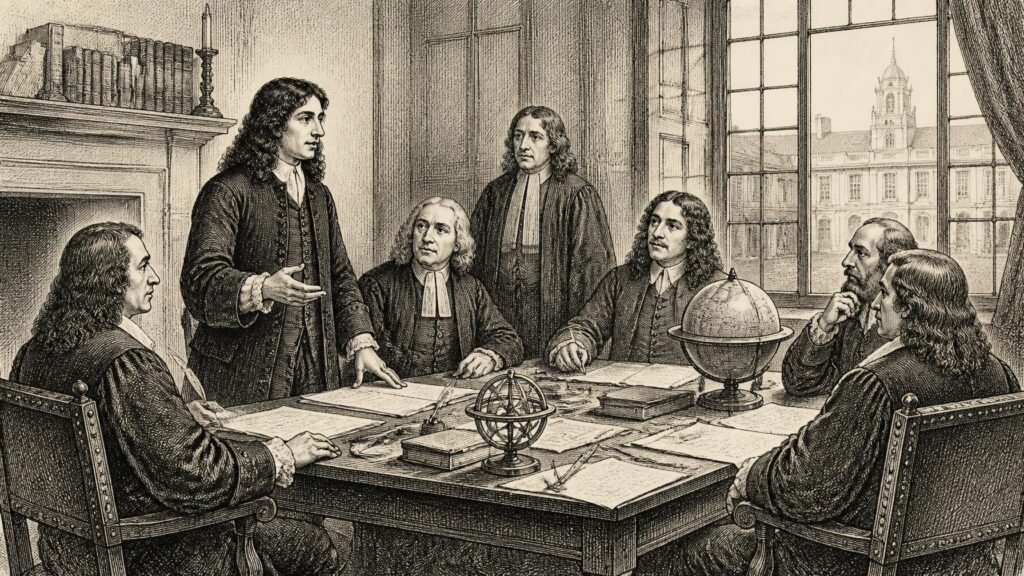
On 15 October a group assembled in the provost’s lodgings at Trinity College Dublin for the first recorded meeting of what became the Dublin Philosophical Society. William Molyneux, then twenty-seven, was the central organiser. With his brother Thomas and the clergyman and mathematician St George Ashe, he sought to create in Dublin a body modelled on the Royal Society in London: a place where observation, experiment, correspondence and practical enquiry might be shared rather than pursued in isolation.
It is important not to exaggerate the scale of this beginning. The society was a small, educated metropolitan circle, not a public academy or a modern research institution. Its more formal organisation, under the name Dublin Society for the Improving of Natural Knowledge, Mathematics and Mechanics, came in January 1684. Sir William Petty was then chosen president and Molyneux secretary. But the October meeting was the decisive opening gesture, and Molyneux’s biographer reasonably identifies the venture as Ireland’s first scientific society.
The society’s significance lay in its habits as much as in any single discovery. Members were encouraged to ask questions about weather, antiquities, minerals, plants, medicine, machinery, mathematics and the physical character of Ireland. They cultivated correspondence with learned people in Britain and continental Europe, and aimed to make local observation useful beyond Dublin. Such work belonged to the wider seventeenth-century “new learning”, but it also had an Irish dimension. The island’s soils, coastlines, natural resources, diseases, fossils and unusual phenomena could be recorded as subjects worthy of methodical attention rather than merely marvel or hearsay.
Molyneux’s project emerged from a city already becoming the kingdom’s principal administrative and commercial centre. Trinity provided rooms, books, educated men and a setting linked to both church and state. The society therefore represented neither a break from elite power nor an abstract pursuit detached from Ireland’s needs. It was an attempt by members of the Protestant governing world to understand, classify and improve the country in which they held authority. That limitation was real; so was the intellectual opening it created.
Blessington’s New Church
Another carefully dated event occurred in County Wicklow. St Mary’s Church at Blessington, newly built under the patronage of Michael Boyle, archbishop of Dublin, was dedicated on 17 September. The Bishop of Kildare had consecrated it on 24 August. Boyle had acquired the surrounding estate and secured a charter for the planned town; the church was part of an imposing new landscape that joined settlement, landlord power and the established religion. An avenue from Blessington House led towards its entrance, making the parish church a visual as well as devotional component of the estate.
The dedication was not a muted parish occasion. Clergy of the diocese attended in surplices and hoods, together with the rector John Sydall, vestrymen and parishioners. Heavy rain reportedly curtailed the outdoor procession, driving the company inside for the formal service and communion. Its bells, cast in London in 1682, carried Boyle’s arms. The episode offers a rare close view of the material culture of Anglican authority in 1683: imported craftsmanship, disciplined ceremony, parish organisation and a new town shaped around the ambitions of a powerful churchman-landowner.
Two Churches, Unequal Security
That security was not shared equally. The Church of Ireland was the legally established church, supported by state institutions, while most of the population remained Catholic and Protestant dissenters faced restrictions on public participation. Catholic worship and clerical organisation persisted, but the hierarchy’s operation depended heavily on overseas training, networks of religious orders and communication with Rome. The execution of Archbishop Oliver Plunkett in 1681 remained a recent and painful warning of how quickly the political climate could become lethal.
Against that background, the Sacred Congregation for the Propagation of the Faith selected the Dominican Dominic Maguire as Catholic archbishop of Armagh on 14 December 1683, to succeed Plunkett as primate of all Ireland. The formal papal steps continued into January 1684, so his active possession of the office should not be dated simply to December. Even so, the decision was important. Maguire was regarded by contemporaries as learned and exemplary, and his selection showed that the Catholic Church could renew its leadership despite legal insecurity and the loss of its most prominent martyr only two years earlier.
Trade, Healing and an Approaching Frost
Daily life was governed more by land, livestock, weather and markets than by the manoeuvres of Dublin Castle. The available evidence does not justify a precise national balance-sheet for 1683, but the broader conditions of the early 1680s are clear. Ireland’s external trade rested heavily on pastoral produce. Butter and wool were major supports of exports, while English restrictions on Irish cattle and provisions had encouraged adjustments in farming and commerce. Dublin’s growing predominance was visible in administration, building and learned life, although much of the island remained rural and regionally diverse. In Ulster, plantation, migration, markets and the growth of linen-related activity were reshaping local society, but not uniformly.
On 28 November, Valentine Greatrakes died at Affane, County Waterford. Known as “the Stroker”, he had become famous in the 1660s for claiming to cure illness by laying on hands. His career had drawn advocates, sceptics and patients in both Ireland and England. In later life he seems to have lived more quietly, treating people who came to him locally. His death is a small but revealing marker of the era’s medical culture: learned natural philosophy was being organised in Dublin, while popular and providential understandings of illness still commanded trust in households and neighbourhoods.
Finally, the winter beginning late in 1683 proved exceptionally severe. Later accounts of the Great Frost of 1683–84 reported prolonged freezing and claimed that the Shannon near Limerick became thick enough for carts and cattle to cross. Such retrospective descriptions should not be treated as a precise measurement for every part of Ireland. Yet they underline a sound conclusion: as 1683 ended, weather became an immediate economic and human concern. Transport, fuel, fodder, fishing and food supply could all be disrupted by a hard winter. The year thus closed with Ireland’s political authorities watching loyalty, its churches marking authority and continuity in different ways, and its newest learned society preparing to observe the natural world more systematically.
Primary Sources
- Molyneux (Molyneaux), William
- The Papers of William Molyneux and the Dublin Philosophical Society
- Memoir of the Dublin Philosophical Society of 1683
- The Dublin Philosophical Society and the New Learning in Ireland
- William Molyneux
- William Molyneux: Royal Society archive catalogue
- Talbot, Richard
- Butler, James
- BUTLER, Richard (1639–86)
- Skeffington, John
- Lawrence, Richard
- Ormond Papers
- MacDonnell, Randall
- The Blessington Estate
- St Mary’s Church, Tuneful Bells Pealing Since 1683
- Maguire, Dominic
- Greatrakes, Valentine
- A Short History of Extreme Weather Events at Christmas in Ireland
- Economic Trends, 1660–91
- The Early Modern Economy, 1600–1780
- History of the Commercial and Financial Relations Between England and Ireland from the Period of the Restoration
- Introduction: The Centrality of Law – Catholics and the Law in Restoration Ireland
- State Formation in Seventeenth-Century Ireland: The Restoration Financial Settlement, 1660–62