

Maguire’s Last Mass1503 CE
Ireland in 1503 was shaped by overlapping lordships, kin groups, towns and church jurisdictions rather than a national government. The death of Seán Mag Uidhir, lord of Fermanagh, at Enniskillen on 26 March provides the year’s most precisely dated event. Annalistic accounts also record Kildare’s northern campaign, conflict among O’Neill and O’Donnell rulers, warfare in Connacht and important deaths elsewhere. Castles, marriages, fosterage, military followings and control of routes underpinned political authority. The evidence reveals a landscape of regional bargaining and rivalry, where changing leadership could disturb alliances and alter relations between Gaelic rulers and the English crown’s limited administration.
Dateline
The surviving record for 1503 presents no single ‘national’ story. Ireland was governed through overlapping lordships, kin-groups, towns, church jurisdictions and the English crown’s limited administration. Yet the year’s annals illuminate a striking pattern: authority was secured and contested through fortified places, marriage, fosterage, military followings, church patronage and control of routes between regions. The most precisely dated event was the death of Seaán Mag Uidhir, lord of Fir Manach, at Enniskillen. Around it stand a northern campaign by the earl of Kildare, warfare among O’Neills and O’Donnells, conflict in Connacht, and deaths that altered political calculations from Fermanagh to Munster.
Death at Enniskillen
Seaán Mag Uidhir – John Maguire in the anglicised form – died at his principal stronghold at Enniskillen on Sunday, 26 March 1503. The Annals of Ulster are unusually exact: he had heard Mass and received unction and penance before dying. He was then buried, by his own choice, in the Franciscan friary at Donegal. The Annals of the Four Masters, compiled later from earlier materials, preserves the same essentials. This is firm evidence both for the date and for the importance of the religious institutions which framed elite life and death.
The annalists praised Maguire in extravagant but revealing terms: as humane, generous, a defender of his territory, and a man effective in both ‘church and state’. Such language is not an impartial assessment of a modern kind. It expresses the expectations placed upon a successful Gaelic lord: protection of dependants and lands, military capacity against neighbouring powers, hospitality, orderly lordship and patronage of religion and learning. In a lake-and-river landscape such as Fermanagh, the fortress at Enniskillen was more than a residence. It was a strategic point on the Erne system, a place from which a ruling family could receive followers, organise defence and direct access across its lordship.
Maguire’s death did not mean that Fermanagh became an empty or ungoverned space. Later genealogical reconstruction indicates that the senior Lisnaskea branch supplied Conchobhar Mór Mag Uidhir as lord after Seaán. But this succession should not be imagined as automatic inheritance in the later English sense. The wider Maguire kindred contained competing branches and claimants, while the neighbouring O’Donnells of Tír Chonaill and O’Neills of Tír Eógain each had reason to seek influence in Fermanagh. The exceptionally warm obituary is therefore also testimony to the political value of a lord who could maintain internal cohesion and defend a frontier territory.
Captivity and Rivalry in Ulster
Other notices from 1503 show how unstable that northern political world could be. Donnchadh ‘of the Thumbs’, a son of Aodh Ruaidh Ó Domhnaill, was captured by the sons of Conn Ó Néill, accompanied by Scots. He was brought to Aodh Ruaidh, but Donnall, Aodh Ruaidh’s son, mutilated him, and he subsequently died. The annals give no full explanation of the episode, nor a precise day. What can safely be said is that it involved rival branches and alliances within the broad O’Neill–O’Donnell political sphere, and that Scottish fighting men were active participants rather than distant observers in Ulster affairs.
A separate night encounter, dated only as the Tuesday after Easter, killed Edmund Maguire, a son of Eóghan Maguire, along with other members of local kindreds. Brian, son of Aodh Maguire, also died in the year. These entries are grim reminders that lordship rested not only on public ceremony but on vulnerable family networks. Raids, surprise attacks and retaliatory killings endangered men whose kinship claims could determine the balance within a territory. The annals record named elites, not the wider households around them; nevertheless, every such clash depended on retainers, food supplies, horses, intelligence and local communities exposed to the demands of armed parties.
Kildare’s English Journey
In Leinster, Gerald FitzGerald, eighth earl of Kildare and the crown’s justiciar or deputy, was summoned by Henry VII. The Annals of Ulster gives an unusually specific departure: Kildare embarked from Dublin on Sunday, 30 April, shortly before May Day. His journey demonstrates the double character of his position. He was the dominant magnate in much of Ireland, capable of raising Irish and English followers, but his office depended upon royal favour across the Irish Sea.
Kildare returned by the end of harvest, according to the same annal, ‘with great honour’ from the English king. Most importantly, he brought home his son Gerald, who had spent eight years in London as a pledge for his father’s loyalty. Hostage-taking in this setting was a political guarantee, not simply imprisonment: the young heir’s presence at court bound Kildare’s conduct to the Tudor regime. In July 1503 Gerald the younger married Elizabeth Zouche, a relative of Henry VII. The alliance confirmed that the FitzGerald dynasty could combine its immense Irish power with a place in the king’s wider political world. It did not make Ireland obediently governable from London; rather, it made Kildare an especially valuable intermediary.
March to Carrickfergus
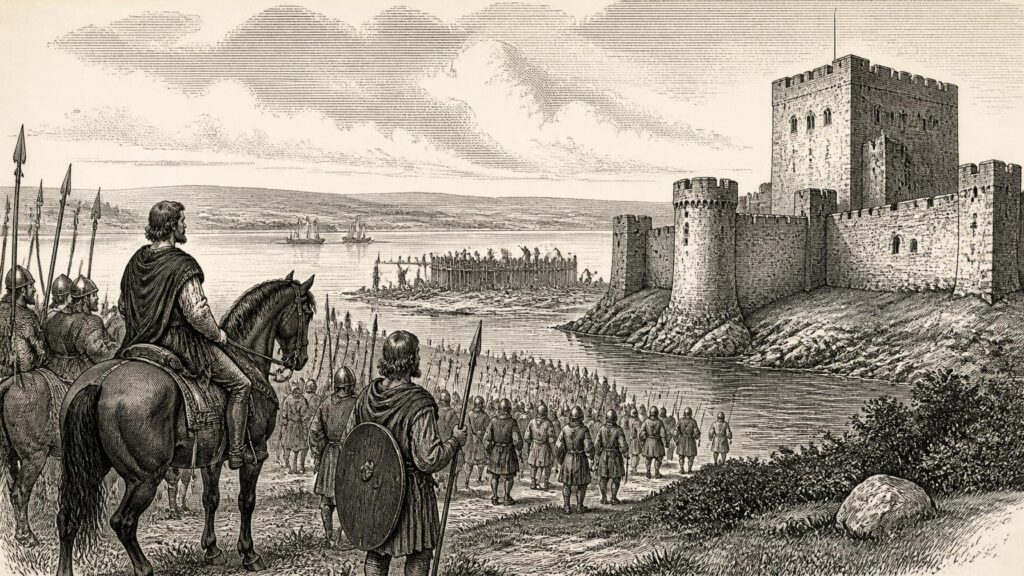
After his return, Kildare led a hosting composed of the English and Irish of Leinster northwards through Magh Line, in present-day County Antrim, to Carrickfergus. The Annals of the Four Masters says that he demolished the castle of Belfast and appointed the son of Sandal as constable of Carrickfergus. The source does not provide a day or a detailed military narrative, so neither the route nor the immediate purpose should be overstated. It does, however, establish a substantial expedition and a deliberate intervention in the contested coastal zone of eastern Ulster.
The ‘castle of Belfast’ of this annal should not be confused with the later and much altered Belfast Castle familiar to modern visitors. In 1503 Belfast was not yet the great commercial town of later centuries. The destruction of a fortification and the installation of a constable at Carrickfergus point instead to control of strongpoints, roads and seaways around Belfast Lough. Carrickfergus Castle remained one of the crown’s most important northern footholds, but its English garrison was not beyond danger. In the same year the sons of Brian, son of Niall Gallda Ó Néill, defeated a force in which leading Englishmen of Carrickfergus were killed or captured.
Niall, son of Conn, son of Aodh Buidhe Ó Néill, also led what the annals call a very great army of English and Irish confederates through Tír Eógain and Iveagh, returning safely. Together, these notices show that identities such as ‘English’, ‘Irish’ and ‘Scots’ did not by themselves define fixed opposing camps. Alliances were assembled around lordship, kinship, local grievances and advantage. Kildare’s northern expedition was powerful, but it did not end that fluidity.
Connacht’s Mercenary War
Conflict in Connacht was equally serious. Mac William of Clanrickard inflicted a major defeat on Ó Ceallaigh and men of Conmaicne. The annal stresses the scale of the loss among gallowglass contingents of Clann Donnell and Clann Suibhne, and records the death of Walter Burke, described as a distinguished captain. Gallowglasses were heavily armed professional warriors, commonly recruited from families with Hebridean and Irish connections. Their presence indicates that warfare was not merely a spontaneous clash of local farmers: rulers and magnates invested in trained military households capable of decisive fighting.
The outcome sharpened the insecurity of the Ó Ceallaigh lordship of Uí Mháine. It also helps place the following year’s famous crisis in context, when Ó Ceallaigh appealed to Kildare after further losses at the hands of Clanrickard. That later escalation belongs to 1504, not 1503; but the battle recorded this year plainly formed part of the developing struggle for supremacy in central and eastern Connacht.
Deaths, Raids and Local Worlds
Several deaths recorded in 1503 mark changes in regional leadership without allowing us to reconstruct every succession. Tibbot Burke, lord of Conmaicne-Cuile-Toladh in Mayo, died at an advanced age. Turlough Ó Conchobair Don died after a long illness at Ballytober in Roscommon. In the south, Tadhg Mac Carthaigh Mór died, as did Cormac Mac Carthaigh in Carbery and Edmund FitzGerald, Knight of Glin. The annals’ concern with such figures reflects a country organised through many lordships, each with its own dependants, landed interests and rival branches.
A raid in west Connacht gives a sharper view of the human costs. O’Brien leaders joined Eóghan Ó Flaithbheartaigh against his kinsmen Ruaidhrí Óg and Donnall ‘of the Boat’ Ó Flaithbheartaigh. They attacked an encampment, carrying off cattle and goods, but were pursued and defeated; sons of Mahon O’Brien and Eóghan Ó Flaithbheartaigh were killed. ‘Preys and spoils’ were not decorative language. Livestock was portable wealth, food, breeding stock and the basis of rents and hospitality. Its seizure affected households well beyond the named commanders.
Faith, Record and Silence
Religion appears throughout the year’s record not as a separate sphere but as part of political life. Maguire’s final Mass, sacramental preparation and chosen burial at Donegal friary show the prestige of the Observant Franciscans and of Columban religious landscapes. The death of Ó Beolláin, coarb of St Columba at Drumcliff, likewise matters. A coarb was the successor or inheritor of a saint’s ecclesiastical foundation, a role which could include spiritual authority, lands and temporal rights. Such offices linked local communities to venerable saints and institutions.
There is no securely dated annalistic evidence for a nationwide famine, plague, exceptional weather, harvest failure, new law or major commercial development in 1503. Nor do these elite sources describe ordinary work in fields, fisheries, workshops or markets. Their silence should not be mistaken for tranquillity. What the year does securely reveal is a politically crowded island: lords protected and preyed upon territories, dynasties used marriage and fosterage across the Irish Sea, fortifications changed hands or were pulled down, and churches provided both sacred care and durable centres of status. In 1503, power in Ireland remained profoundly local, but local struggles were connected by sea routes, mercenary service and the reach of great families.
Primary Sources
- The Annals of Ulster, Year U1503
- Annals of the Four Masters
- Annals of the Kingdom of Ireland, Volume V
- FitzGerald, Gerald (Gearóid Óg, Garrett McAlison)
- Mág Uidhir (Maguire), Cú Chonnacht Óg (‘an Comharba’)
- English Lordship of Ireland and the Irish Sea World: Re-assessing the Origins of the Kildare Ascendancy, c.1390–c.1513
- An Irish Context to a Scottish Disaster: James IV, the O’Donnells of Tyrconnell and the Road to Flodden
- The Red Book of the Earls of Kildare
- The Red Book of the Earls of Kildare (digital edition)
- Calendar of Ormond Deeds, Volume III, 1413–1509
- Patentee Officers in Ireland, 1173–1826
- Calendar of Papal Letters, Volume 17, Part 1, 1492–1503
- Chronicon Scotorum
- Corpus of Early Medieval Architecture of Ireland
- The Hamilton Manuscripts
- Carrickfergus Castle
- Belfast (with an engraved view by Andrew Nichol)
- Carrickfergus Castle – Dublin Penny Journal, 1832
- Ireland under the Tudors, Volume I
- Dictionary of National Biography: Fitzgerald, Gerald (1487–1534)