Dunluce Campaign1584 CE
In 1584 Sir John Perrot became lord deputy, pursuing Elizabethan efforts to convert military victory into durable government. He appointed Richard Bingham in Connacht and John Norris in Munster, where the Peyton Survey prepared forfeited Desmond lands for plantation amid famine and displacement. Negotiations revived towards the Composition of Connacht, while O’Reilly territory was organised as County Cavan. Perrot captured Dunluce but failed to subdue Sorley Boy MacDonnell or secure Ulster. Dermot O’Hurley’s execution highlighted confessional repression. Galway extended harbour defences, and Stanihurst published Latin history. Crown authority expanded through surveys, counties and garrisons, yet remained contested, costly and insecure.
Dateline
In 1584 the Elizabethan administration in Ireland changed hands, but its underlying aims did not. The immediate aftermath of the second Desmond rebellion left Munster devastated, land titles unsettled and crown officials intent on turning military victory into a permanent political settlement. In Connacht, Ulster and the borderlands, Dublin Castle sought the same end by other means: provincial presidencies, fixed rents, sheriffs, garrisons and agreements that translated older lordships into recognisable units of English government. Sir John Perrot’s arrival as lord deputy gave this programme new force. Yet the year also showed its limits. A castle could be taken, a territory renamed or a chief induced to promise soldiers, without power on the ground becoming either secure or accepted.
A New Lord Deputy
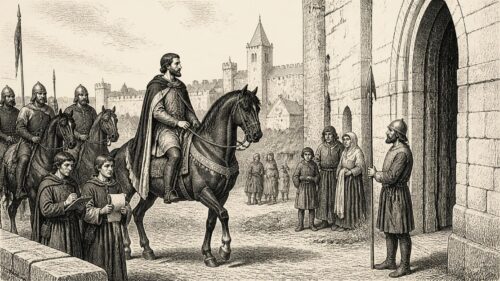
Perrot reached Dalkey on 9 June and entered office formally later that month. He had been appointed in January, after a prolonged interval in which Ireland had been governed by lords justices following the recall of Lord Grey de Wilton. Perrot came with a reputation for blunt energy and with an extensive agenda. He was expected to strengthen royal justice, promote the established church, regularise revenue, deal with the Scottish MacDonnells in north-east Ulster and supervise the disposition of lands forfeited after the Desmond rebellion.
His first movements made clear that this was to be an itinerant administration. During the summer he travelled through Connacht and Munster, inspecting conditions and placing trusted soldiers at the head of the provincial governments. Sir Richard Bingham succeeded the recently deceased Sir Nicholas Malby as chief commissioner in Connacht and Thomond; Perrot knighted him on 21 June. Sir John Norris, a seasoned commander from the wars in the Low Countries, was made president of Munster in July. These appointments mattered because the presidencies were not merely ceremonial. They joined civil authority, military command and revenue collection in hands answerable to Dublin and, ultimately, to Elizabeth I’s privy council.
Irish annalists registered the transition in their own terms. The Annals of Loch Cé date Malby’s death to 3 March and describe him as a powerful foreign captain who had subjected Connacht, while also remembering the works associated with his rule at Athlone and Roscommon. That double judgement is revealing. Crown building and coercion were inseparable in local experience: courthouses, garrisons and administrative centres promised order to some, but could also be instruments through which exactions, arrests and armed pressure reached communities.
Measuring a Ruined Munster
Munster was Perrot’s most urgent institutional problem. Gerald FitzGerald, fifteenth earl of Desmond, had been killed late in 1583, ending a rebellion whose campaigns had brought slaughter, displacement, crop destruction and famine across much of the province. The crown now claimed vast estates through attainder and forfeiture. Before it could distribute them, however, it needed to determine what land had actually escheated, where its boundaries lay, what tenants occupied it and what revenue it could yield.
On 19 June 1584 a commission including Sir Valentine Browne, surveyor general of Ireland, was authorised to investigate the lands claimed by the crown as a consequence of the rebellion. This work became associated with Christopher Peyton and is commonly called the Peyton Survey. It was not yet the full working plantation of later years: English undertakers would begin taking possession from 1585. But the survey was the indispensable preliminary. Its maps, inquisitions and valuations converted landscapes recently ravaged by war into prospective estates, seignories and grants.
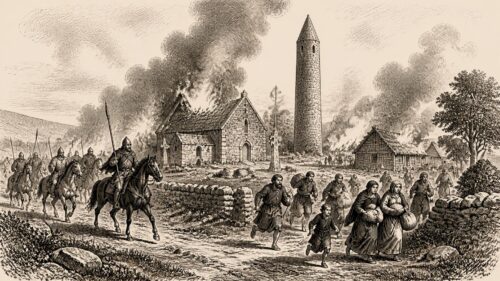
That process should not be mistaken for an empty exercise in measurement. It bore directly upon people who farmed, grazed animals, paid rents, held customary claims or depended upon local magnates for protection. A survey could preserve evidence of occupation, but it could also make long-established rights vulnerable where they did not fit crown definitions of title and forfeiture. Perrot’s government initially coupled its plans with a proclamation of oblivion and indemnity, intended to draw a line beneath rebellion for many who had been involved. The apparent generosity had clear political purpose: pacification was cheaper if former opponents could be made compliant subjects and taxpayers. Nevertheless, the coming land settlement ensured that the end of fighting did not mean an end to upheaval in Munster.
Norris’s arrival exposed another difficulty. Contemporary accounts describe widespread misery in the province, while soldiers under his command sometimes deserted to seek service again in the Low Countries. Munster therefore stood in 1584 between devastation and projected reconstruction. The crown envisaged defensible settlements, market towns, English tenants and a disciplined landed order; inhabitants faced the more immediate realities of recovering food production, homes, cattle and local security.
Connacht’s Uneasy Reordering
In Connacht, Perrot revived negotiations towards what became the Composition of Connacht in 1585. The final agreement lay in the future and should not be credited to 1584. What belongs securely to this year is the reopening of the process under Perrot and Bingham. Composition was designed to replace a complicated and contested mixture of traditional dues, military billeting and lordly exactions with fixed annual payments to the crown, while recognising landholding under English legal forms. It offered some lords confirmation of property and a clearer fiscal settlement; it also widened the reach of English law and reduced the independent authority of chiefs over their followers.
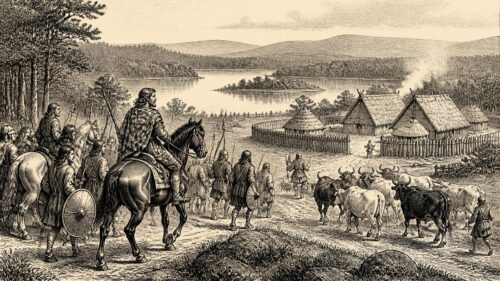
Bingham’s appointment made the policy more than a paper project. His later reputation for severity should not be projected wholesale backwards, but his commission already represented an intrusive form of government. The annals record the death in 1584 of Anthony Fitton, receiver of the queen’s rents in Connacht, a small but telling reminder that royal finance had a human and local presence. They also record raids, killings and the burning of Cill-Midain. Such entries resist any picture of a province simply brought to rest by new administrative arrangements. Political authority was negotiated amid private feud, cattle-raiding, lordship and violence.
Dunluce and the Northern Campaign
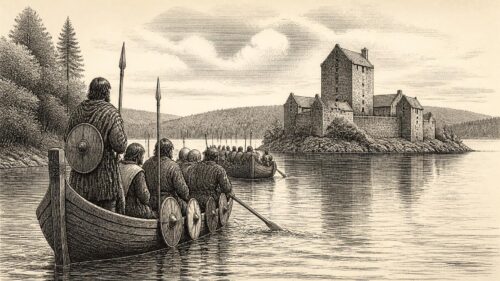
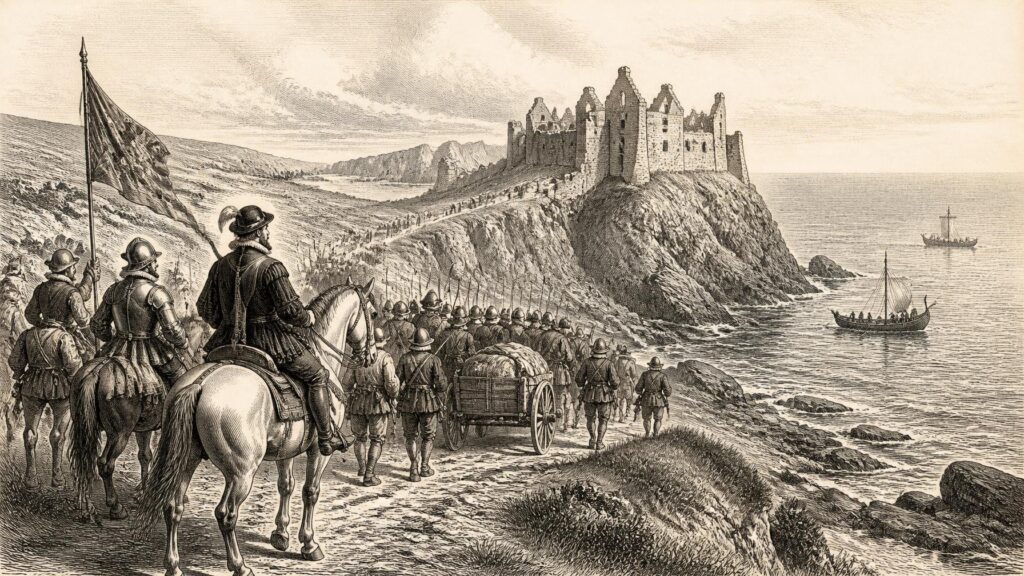
Perrot’s most conspicuous campaign took place in Ulster during the autumn. The immediate concern was the continuing movement of Scottish fighting men and settlers between western Scotland and the Antrim coast, and the power of Sorley Boy MacDonnell in the Route and Glens. To Dublin officials this was a strategic danger: the MacDonnells had kinship networks across the North Channel, access to maritime manpower and a formidable coastal stronghold at Dunluce. To the MacDonnells, the sea route was not a foreign incursion but part of the connected Gaelic world of Ulster and the Hebrides.
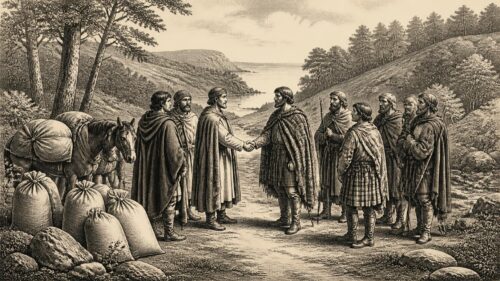
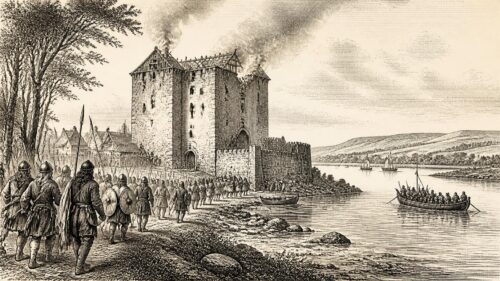
Perrot advanced north after reports of a substantial Scottish arrival. The raiders had dispersed before he came, but he pressed on as a demonstration of royal strength. Dunluce Castle submitted in September after a short siege. From the camp near the castle, on 20 September, Sir Hugh O’Donnell of Tír Chonaill entered an indenture promising to maintain 200 foot soldiers at his own charge. The document shows how the campaign operated: submission meant not only words of loyalty but provision for armed service, with the burden falling on a lordship’s resources.
The expedition did not settle Ulster. Sorley Boy himself avoided capture and withdrew to Scotland to seek assistance. Perrot left garrisons and returned south, but the position remained precarious; Dunluce would again be contested. The Annals of Loch Cé, writing from a Gaelic perspective, preserve a stark notice of a Saxon force slain in the Route by the Scottish Clann Domhnaill and of Dunluce being taken. Its annal-by-annal chronology cannot be used to settle every sequence in this rapidly changing campaign, but its language makes plain that the conflict was remembered not as administrative reform but as warfare between armed communities. Perrot had displayed reach, not achieved mastery.
Counties, Faith and Urban Walls
Administrative change also reached Bréifne. By November, Perrot reported that the O’Reilly country had been erected as County Cavan, and it was divided into seven baronies. This was an effort to make a Gaelic lordship legible to the institutions of shire government: sheriff, sessions, land records and county officers. Such arrangements were significant on official maps and in Dublin correspondence, though their practical operation depended upon cooperation and could be thin beyond places where the government possessed men, money and a secure base.
Religion supplied the year’s most resonant act of state violence. Dermot O’Hurley, the Catholic archbishop of Cashel, had returned clandestinely to Ireland in 1583 after years on the Continent. He was imprisoned, tortured and subjected to martial-law proceedings rather than an ordinary common-law trial. He was sentenced on 19 June 1584 and hanged at Hoggins Green, outside Dublin, the following morning, 20 June. The case joined political loyalty and religious allegiance in the government’s understanding of treason. For many Catholics, however, his death rapidly became that of a martyr; Dubliners recovered and buried his remains, and the memory of the execution endured beyond the authorities’ attempt to conduct it quietly.
Not every development was military or judicial. In Galway, the extension of the town wall at Ceann na Bhalla, later known as the Spanish Arch, was built in 1584 to protect ships using the nearby quay. Its construction points to the practical importance of Atlantic commerce, municipal defence and the busy waterfront of a walled port whose merchants maintained connections with Iberia and other overseas markets. The work was defensive, but it also enabled trade by sheltering vessels and quayside activity.
That same year Richard Stanihurst’s Latin De rebus in Hibernia gestis appeared from Christopher Plantin’s press at Antwerp. Written by a Dubliner of the Old English political world, the history treated Ireland’s medieval past, especially the Anglo-Norman conquest, for a learned European readership. Its publication abroad underlines the continental reach of Irish scholarship and Catholic intellectual networks at precisely the moment when confessional conflict sharpened at home. The death recorded by the Annals of Loch Cé of Tadhg Mac Aedhagáin, an ollamh in Irish law, offers a parallel reminder that learned Gaelic institutions also remained active.
Thus 1584 was neither a simple year of conquest nor a settled peace. Perrot’s government surveyed Munster, renewed Connacht negotiations, remade Cavan on paper and carried royal arms to Dunluce. It also revealed how much remained unresolved: ownership after rebellion, authority in Gaelic lordships, the cost of garrisons, the place of Catholic clergy and the resilience of cross-channel Gaelic power. The deputy’s progress made the crown more visible across Ireland; it did not make its authority undisputed.
Source References
Hover over a number to see the source. Select it to open the source.

- [1] Perrot, Sir John
- [2] Bingham (Byngham), Sir Richard
- [3] MacDonnell, Sorley Boy
- [4] O'Hurley, Dermot
- [5] Wallop, Sir Henry
- [6] O'Rourke (Ó Ruairc), Brian Ballach
- [7] Bingham (Byngham), Sir George
- [8] Annals of Loch Cé, Annal LC1584
- [9] Annals of Loch Cé A.D. 1014–1590
- [10] Sir Hugh O'Donnell
- [11] Calendar of the State Papers Relating to Ireland, 1574–1585
- [12] The Plantation of Munster
- [13] The Plantation of Munster
- [14] The Spanish Arch
- [15] Stanihurst: De Rebus in Hibernia Gestis
- [16] De rebus in Hibernia gestis, libri quatuor
- [17] Richard Stanihurst
- [18] Great deeds in Ireland: Richard Stanihurst’s De Rebus in Hibernia Gestis
- [19] The Chronicle of Ireland, 1584–1608
- [20] The chronicle of Ireland, 1584–1608. Edited by Herbert Wood
- [21] Perrot Manuscripts and Ulster Sources
- [22] The Barony of Clonkee
- [23] John Norris (1547?–1597)
- [24] Ireland Under the Tudors, Volume III
Primary Sources
- Perrot, Sir John
- Bingham (Byngham), Sir Richard
- MacDonnell, Sorley Boy
- O'Hurley, Dermot
- Wallop, Sir Henry
- O'Rourke (Ó Ruairc), Brian Ballach
- Bingham (Byngham), Sir George
- Annals of Loch Cé, Annal LC1584
- Annals of Loch Cé A.D. 1014–1590
- Sir Hugh O'Donnell
- Calendar of the State Papers Relating to Ireland, 1574–1585
- The Plantation of Munster
- The Plantation of Munster
- The Spanish Arch
- Stanihurst: De Rebus in Hibernia Gestis
- De rebus in Hibernia gestis, libri quatuor
- Richard Stanihurst
- Great deeds in Ireland: Richard Stanihurst’s De Rebus in Hibernia Gestis
- The Chronicle of Ireland, 1584–1608
- The chronicle of Ireland, 1584–1608. Edited by Herbert Wood
- Perrot Manuscripts and Ulster Sources
- The Barony of Clonkee
- John Norris (1547?–1597)
- Ireland Under the Tudors, Volume III