The Larne Landing1315 CE
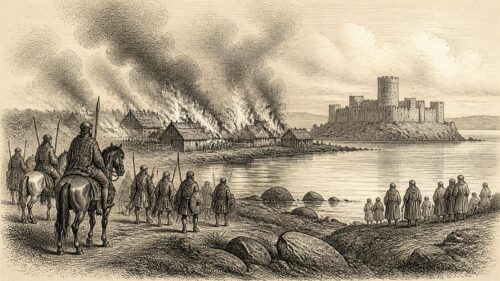
In May 1315 Edward Bruce, brother of Robert Bruce, landed near Larne with a Scottish army, exploiting divisions among Irish rulers, Anglo-Irish magnates and officials. Supported by some Ulster Gaelic lords, he claimed Irish kingship, captured Carrickfergus town and besieged its castle. His forces devastated settlements and supplies, defeated Richard de Burgh at Connor, and advanced into Meath, where opposition faltered amid local rivalries. The invasion also intensified Connacht dynastic conflict. Neither Ireland nor Ulster was unified behind Bruce: Dublin, Trim and Carrickfergus castle remained hostile. Warfare, crop destruction, requisitioning and weather worsened the Great Famine, causing hardship and disorder.

Dateline
In 1315, Ireland became a principal theatre in the wider war between the Scottish Bruces and the English crown. The immediate turning point came on 26 May, when Edward Bruce, earl of Carrick and brother of Robert Bruce, king of Scots, landed on the north-east coast near Larne. His arrival did not unite Ireland behind a single cause, nor did it create a settled Scottish kingdom. It did, however, turn existing rivalries among Irish kings, Anglo-Irish magnates and royal officials into a crisis that reached from Antrim to Connacht and Meath. The year ended with Ulster badly damaged, Carrickfergus under siege, Meath exposed, and famine already compounding the effects of war.
A Scottish Army in Ulster
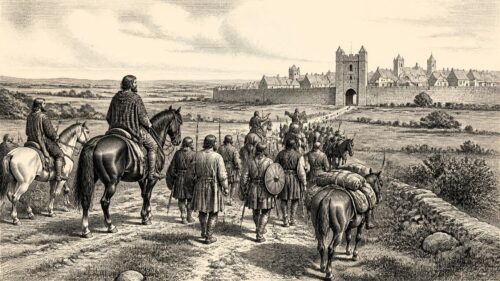
The date of Edward’s landing is unusually secure: the Dublin annals place it on the feast of St Augustine, 26 May 1315. Accounts differ over the size of his expedition. A figure of 6,000 men is often repeated, while the Annals of Connacht speaks dramatically of men in 300 ships. Neither figure should be treated as a precise modern calculation. What is clear is that Edward brought a formidable Scottish force across the narrow sea, including experienced commanders associated with the Bruce war, and that it could draw upon the maritime connections linking western Scotland, the Isles and Ulster.
Edward’s venture followed the Scottish victory at Bannockburn in June 1314. For Robert Bruce, pressure on Ireland could divert English resources and threaten the English-held routes across the Irish Sea. For some Gaelic rulers in Ulster, a Scottish alliance promised leverage against the Anglo-Irish earldom of Ulster and the English royal administration. Later political statements portrayed Domhnall Ó Néill of Tír Eógain as a leading sponsor of Bruce’s kingship. Yet the detailed arrangements made before the landing are uncertain, and it is safer not to imagine a single, united Irish invitation. The alliance was real, but it rested on local interests that varied sharply from lord to lord.
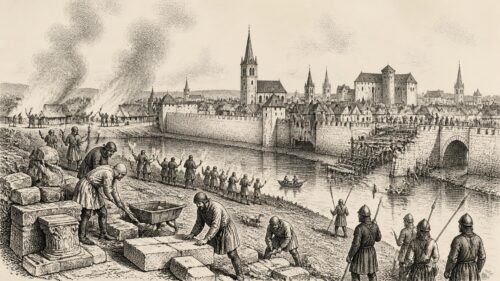
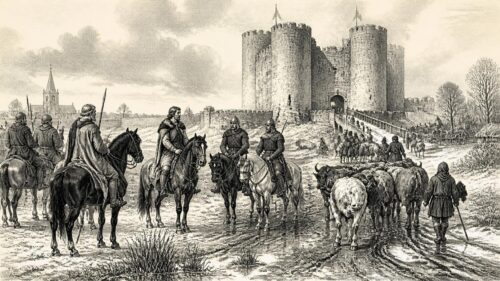
Bruce’s army rapidly made its presence felt. The annals record the burning of Rathmore in Moylinny, then attacks on Dundalk and Ardee. These were not incidental acts of violence. Towns, barns, crops, livestock, bridges and food stores were the logistical foundations of lordship and campaigning. To destroy them was to weaken an opponent’s capacity to feed troops, collect rents and maintain dependants. The same methods had long been used in Irish warfare, but the arrival of a substantial overseas army magnified their scale and consequences.
Lordship Claimed, Not Secured
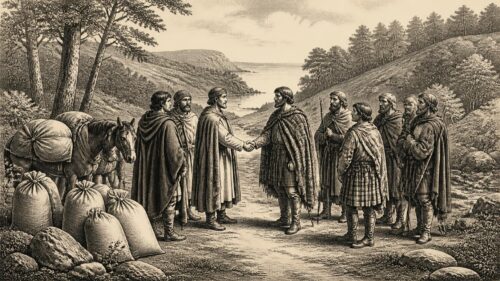
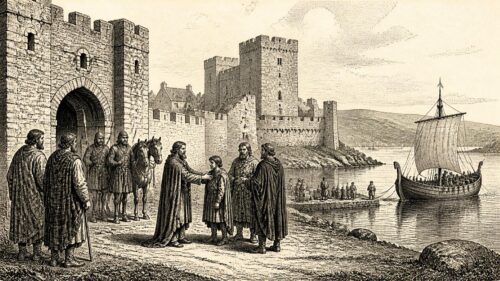
At or near Carrickfergus, Edward received the submission of important northern Gaelic rulers. The Annals of Connacht says that the Ulstermen consented to his being proclaimed king of Ireland and adds, in sweeping language, that all the Gaels agreed to grant him lordship. This is valuable evidence for the ambition of the moment, but not a literal description of political reality. Many Irish rulers did not support Bruce; others acted independently; and the English towns and most Anglo-Irish landholders remained hostile. The more formal inauguration generally associated with Edward’s kingship belongs to 1316, not securely to this year.
Still, the claim mattered. In medieval Ireland, kingship was expressed through assemblies, hostages, military protection and the acceptance of tribute or service, rather than through a single uniform state apparatus. Edward’s supporters could present him as a king because he had an armed following, powerful allies and control over much of eastern Ulster. His title also offered a language through which Gaelic leaders could oppose English authority. But Bruce was not simply restoring an older Irish order. He was a Scottish prince pursuing his own dynasty’s strategic interests, and his army depended upon supplies, coercion and continuing aid from across the sea.
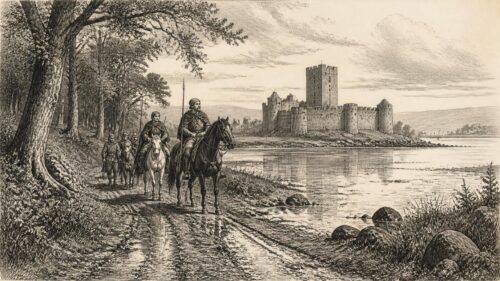
Carrickfergus demonstrated both the strength and the limit of the invasion. Bruce’s force took the town, but the royal castle on its rocky promontory resisted. It was a critical fortress: it commanded Belfast Lough, guarded sea communications and stood as a durable symbol of English royal power in Ulster. The siege begun in 1315 would continue into the following year. Its survival denied Bruce complete control of the coast even while his troops ranged widely through the earldom.
The Red Earl’s Reverse
Richard de Burgh, the ‘Red Earl’ of Ulster, was the most powerful Anglo-Irish magnate in the north and the father-in-law of Robert Bruce. Kinship did not prevent conflict. Richard gathered a large army, drawing support from his Connacht lordship and from allies elsewhere in Ireland. Edmund Butler, the king’s justiciar in Ireland, also moved with a royal force. Yet the two men did not co-operate effectively. The Connacht annalist depicts Richard refusing to allow Butler’s troops to join him, trusting that his own resources could expel the Scots.
This division was politically consequential. The lordship of Ireland had no automatic national army; defence required magnates with different territorial interests to act together. Rivalry, suspicion and disputes over precedence could obstruct the response even in an emergency. The annals also make a revealing moral point: the host gathered to resist Bruce ravaged as it travelled. Churches, lay settlements and sanctuary were not necessarily spared. For ordinary people, an allied army could be nearly as burdensome as an enemy one, taking food, animals and labour while leaving destruction in its wake.
During the summer, Bruce moved north towards Coleraine and the Bann. The opposing forces faced one another across the river, and the Annals of Connacht says that neither side left wood, pasture, corn, crops, stead, barn or church unburned. This picture must retain its annalistic force without being treated as a survey of every place in Ulster. It nevertheless captures the strategic logic of the campaign: deny the enemy forage, damage his local allies and survive by exhausting the countryside first.
On 10 September, at Connor in County Antrim, Bruce defeated de Burgh’s army. Contemporary and near-contemporary narratives differ in detail, but the outcome is firm enough: de Burgh was driven from the field and Bruce acquired supplies from the defeated camp. Grain, flour and wine seized there were especially valuable at a time when provisioning was becoming precarious. The defeat established Bruce as the dominant military power across much of Ulster, though it neither captured every stronghold nor converted the province into a stable kingdom.
Meath, Connacht and Fractured Allegiances
Success in Ulster sent repercussions far beyond the northern coast. By late 1315 Bruce campaigned in Meath, where Roger Mortimer of Wigmore, one of the greatest landholders in Ireland, attempted to oppose him. The battle at Kells is normally placed in November, though the exact sequence of the late-year operations is not wholly clear. Annalistic accounts agree on the central point: Mortimer’s force failed to stop Bruce, and the Lacy interest in Meath was accused of abandoning or weakening his cause. Bruce did not take Mortimer’s great castle at Trim, but his advance exposed how insecure the English lordship could become when local political disputes interrupted co-operation.
In Connacht, the invasion interacted with a contest already under way within the Ó Conchobair dynasty. Feidlim Ó Conchobair, king of Connacht, had marched with de Burgh, but the Annals of Connacht reports that Bruce offered him undivided possession of Connacht if he deserted the earl. Whether or not every detail of the reported negotiation can be recovered, the episode shows Bruce using promises of political advantage as well as force. His arrival encouraged men who wished to overturn existing arrangements, but it did not erase their rivalries.
Rúaidrí Ó Conchobair exploited the absence of de Burgh and Feidlim’s army to launch his own campaign. The annals list towns and castles burned or plundered, including Sligo, Ballymote, Ballintober, Roscommon, Rindoon and Athlone. Such lists should not be read as a neat itinerary or as proof that every structure was obliterated; medieval annals commonly compress campaigns into inventories of destruction. Even so, they show that the year’s upheaval was not confined to the Scottish advance. Local contenders used the opening created by war to seize hostages, cattle, grain and political advantage.
Famine, Faith and the Human Cost
The worsening food crisis gave 1315 its exceptional gravity. The Irish annals record widespread deaths, famine, unusual diseases and severe storms. Across north-western Europe, exceptionally wet conditions and repeated harvest failures inaugurated what historians call the Great Famine of 1315–17. Ireland’s evidence does not permit a modern county-by-county reconstruction of the harvest, but it is clear that scarcity coincided with armies systematically burning crops and requisitioning food. The vulnerability was greatest for households without stored grain, livestock or armed protectors: tenants, labourers, displaced townspeople and those dependent on ecclesiastical or seigneurial estates.
Religious institutions were deeply implicated in this world, not apart from it. Churches and monasteries held lands, grain, cattle and stores; they offered sanctuary and were places where communities expected protection. The year’s annals repeatedly report violations of churches and the seizure of ecclesiastical food. That evidence does not mean religious life ceased. Rather, it shows that sacred places were embedded in the economy and therefore became targets when armies needed supplies or wished to terrorise opponents.
There is one quiet cultural notice amid the campaigns: the death of Tadc Ó hUicinn, described by the Connacht annalist as a master of the arts connected with poetry. Its inclusion is significant. Learned poets and hereditary scholars remained valued figures in Gaelic society even in a year of war and hunger. Their professional world depended on aristocratic patronage, however, and the destruction of lordly households, cattle wealth and food stores endangered the material basis on which such learning rested.
An Unfinished Conquest
By the close of 1315 Edward Bruce had achieved far more than a raid. He had landed successfully, assembled important Irish allies, defeated the earl of Ulster at Connor, pushed into Meath and confined the royal garrison of Carrickfergus to its castle. Yet he had not conquered Ireland. Dublin, the centre of royal government, was intact; Trim remained in hostile hands; Carrickfergus castle still held out; Connacht and Ulster alike contained rival powers; and every advance increased the problem of feeding men and horses.
The year therefore marks the opening, rather than the resolution, of the Bruce invasion. Its most enduring immediate legacy was devastation: ruined crops and settlements, disrupted lordships, broken political alliances and intensified scarcity. In 1315 the contest for Ireland had become inseparable from the struggle to control food, fortresses, sea routes and the allegiance of local communities.
Primary Sources
- Annála Connacht: Annal 1315
- Annals of Inisfallen: Annal AI1315
- The Annals of Ulster
- Annales Hiberniae
- Annalium Hiberniae Chronicon ad annum MCCCXLIX
- Annals of the Four Masters, Part 15
- Annals of Loch Cé
- Annales Dominicani de Roscoman
- Bruce, Edward
- The Bruces in Ireland, 1315–18
- XVII. The Siege of Carrickfergus Castle, 1315–16
- The Impact of the Bruce Invasion, 1315–27
- Bruce Invasion of Ireland (1315–1318)
- Documents on the Early Stages of the Bruce Invasion of Ireland, 1315–1316
- Bruce Invasion: 1315/2015
- Edward Bruce
- A Quantitative Hydroclimatic Context for the European Great Famine of 1315–1317
- The Great Famine in the County of Flanders (1315–17): The Complex Interaction Between Weather, Warfare, and Property Rights
- From Boom to Bust: The Lordship of Ireland and the European ‘Commercial Revolution’
- A Chronology of Ireland
- CELT Project: Annales Hiberniae Chronicon ad Annum MCCCXLIX
- The Bruce Intervention in Ireland, 1315–1322