

Power Arguments
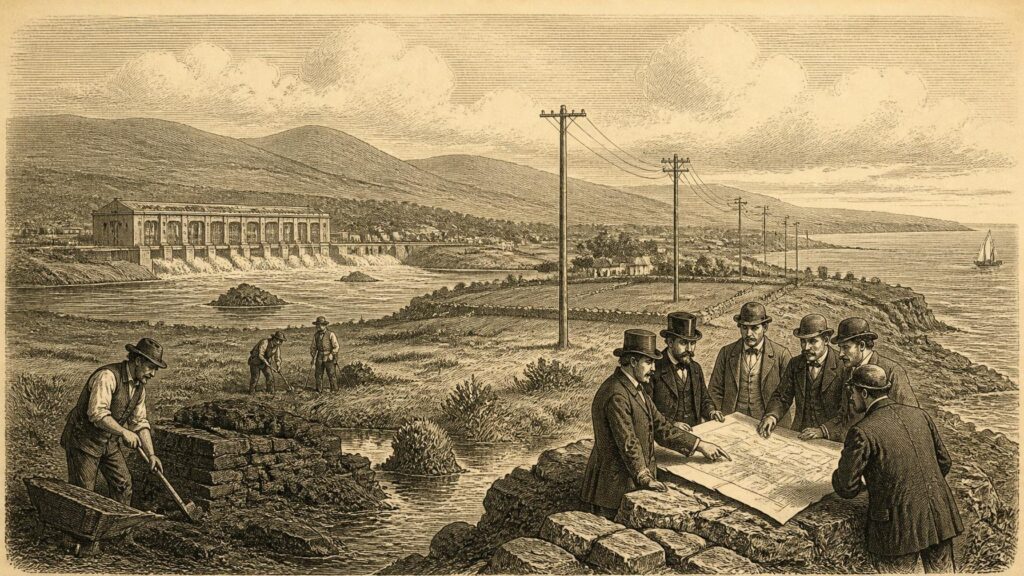
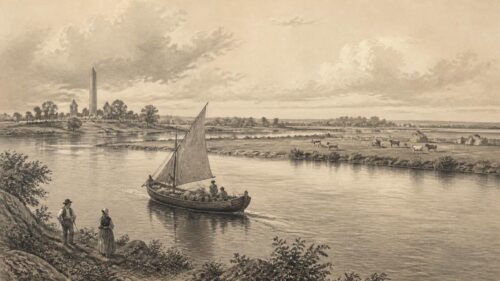
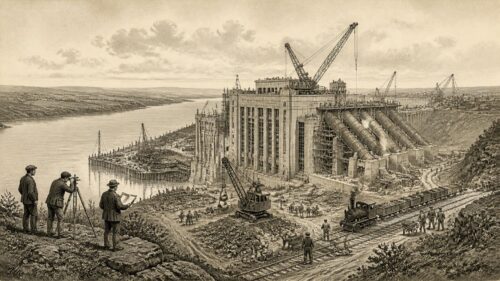
AI generated historical illustration, not a contemporary photograph.
At a Glance
Irish energy policy has been an argument about sovereignty as much as supply. In a state with modest indigenous fossil resources, a dispersed rural population and an island position at Europe’s western edge, decisions about electricity, peat, oil, gas and wind have repeatedly carried larger meanings: independence, equality, industrial progress, landscape, cost and security. The record shows no single settled doctrine. Rather, successive governments, public bodies, engineers, businesses and campaigners have contested what it meant for Ireland to possess power.
State Beginnings
When the Irish Free State emerged in 1922, electricity supply was fragmented. Towns and cities possessed a mixture of municipal and private arrangements, while much of the countryside had none at all. The new state faced a familiar but acute dilemma: how could a small, poor and overwhelmingly agricultural country develop industry and public services without remaining dependent upon systems formed elsewhere? Electricity offered an unusually visible answer. It could light streets and homes, drive machinery, reduce the labour of farms and workshops, and demonstrate that the new state could undertake work on a national scale.
The Shannon Scheme at Ardnacrusha became the foundational expression of that ambition. Begun in 1925 and completed in 1929, it harnessed the Shannon at a scale unprecedented in the country. ESB Archives describes it as the first major project of the Free State and records both its formidable cost and its multinational workforce: thousands of Irish and German workers were employed on a project whose budget represented a striking share of contemporary state revenue. The station was not simply a dam and turbine house. It required canals, transmission lines, new technical expertise, legislation and an institution capable of directing an electricity system beyond a single locality.
The Electricity Supply Board was established in 1927, before Ardnacrusha began operation. That sequence matters. Policy-makers did not leave the new power station to coexist indefinitely with a patchwork of suppliers. They created a semi-state body to take responsibility for an integrated service. ESB gradually absorbed or superseded much earlier provision and became one of the most important instruments of Irish economic development. The decision expressed a belief that electricity was too consequential to be organised solely as a collection of local commercial ventures.
Thomas A. McLaughlin, the Irish engineer closely associated with the scheme, had developed his proposal while working with Siemens in Germany. His plan was technically ambitious but also social in scope. The prospect of a national network joined large-scale engineering to a promise of wider modernisation. Contemporary publicity and later institutional history often present Ardnacrusha as a national triumph, and there is documentary basis for seeing it that way. Yet it is important not to allow patriotic retrospect to hide the controversy and risk involved. The scheme demanded a level of expenditure that critics could reasonably question in a new state facing pressing financial constraints. Its supporters won the argument because they made the case that modern power could create, rather than merely follow, economic development.
That contention marked a lasting pattern. Irish energy debates have frequently revolved around whether demand should determine investment, or whether public investment should create the conditions in which demand, industry and improved living standards could grow. Ardnacrusha embodied the second proposition. In later decades, the same question would reappear in arguments over peat stations, gas pipelines, interconnectors, wind farms and grid reinforcement.
Rural Promise
The first decades of national electrification did not bring equal access. Towns and larger settlements received supply before the countryside. This was economically comprehensible: sparse settlement made rural connections expensive, and early electricity loads were limited. Politically, however, it exposed a contradiction in the modernising promise. An energy policy that privileged urban and industrial centres could hardly claim fully to represent a predominantly rural population.
The aspiration to serve farms was present from the beginning. Material preserved by ESB Archives shows that officials had considered rural electrification in the 1920s, and the original purpose attached to the Shannon undertaking extended beyond town dwellers. But aspiration did not by itself build lines across fields, lanes and bogland. The Second World War delayed the undertaking through shortages and the competing demands of an emergency economy. Imported coal and oil became difficult to obtain; dry conditions also reminded the country that hydroelectricity alone could not remove vulnerability. The period of neutrality, rationing and constrained transport taught a severe lesson in the physical limits of an energy system dependent on external supplies.
The Rural Electrification Scheme, launched in 1946, gave practical form to the earlier promise. The programme divided the twenty-six counties into 792 rural areas and proceeded, over roughly two decades, through an immense programme of surveying, pole erection, wiring and connection. ESB’s archival account records more than 50,000 miles of line and more than one million poles by 1964. The figures convey the scale, but not all the social negotiation behind them. Rural electrification required local consent, subscriptions and a degree of confidence that electricity would justify expense. It also brought the state, quite literally, into farmyards and domestic kitchens.
Its consequences extended beyond the moment when a lamp first shone in a cottage. Electric lighting altered the rhythm of work and leisure. Milking machines, pumps, refrigeration, cookers, irons, radios and later television sets reshaped household routines and agricultural labour. Such changes were uneven and did not mechanically end rural hardship, emigration or inequality. Nor should they be described as gifts bestowed upon passive recipients: rural people made decisions, paid charges, adapted buildings and incorporated new appliances into existing lives. Nevertheless, electrification was a material redistribution of opportunity. It reduced the gulf between places served by urban infrastructure and places where darkness, manual labour and distance had previously imposed distinct disadvantages.
There is a temptation to tell this history as a clean march from darkness to light. That is interpretation, not the whole documentary record. Electricity was welcomed by many, but connection charges, appliance costs and recurring bills could burden households of limited means. The promotional language used by ESB had to persuade consumers that electric power was useful, safe and desirable because supply alone did not create universal use. The achievement lay in the infrastructure and in the sustained public effort to make that infrastructure socially meaningful.
Rural electrification also fixed a powerful expectation in Irish political culture: energy was a public service tied to territorial fairness. That expectation would complicate later reforms. When energy policy turned towards competition, market pricing and private investment, it did so in a country whose experience of electricity had been deeply shaped by a state-led universalising project.
Native Fuels
If hydroelectricity represented a renewable national resource, peat represented a more complicated version of the same hope. Ireland’s bogs had long supplied turf for domestic heating. In the middle decades of the twentieth century, governments and public bodies sought to make peat serve industrial development as well. Bord na Móna, created in 1946, became central to mechanised turf production, while the ESB developed peat-fired generating stations. The strategy joined energy policy to employment, regional development and the desire to reduce dependence on imported coal and oil.
There was a strong logic to this programme in its historical setting. Mid-century policy was shaped by wartime scarcity and the memory of disrupted shipping. A fuel found within the state appeared to offer strategic value even when extraction and transport were costly. Peat development also promised work in the Midlands, where large bogs lay close to communities with limited industrial employment. The state was not merely seeking the cheapest kilowatt-hour. It was trying to use energy investment to redistribute economic activity.
ESB’s generation history records that eleven peat stations added more than 400 megawatts of capacity between 1950 and 1965, and that peat at one stage amounted to about one third of its total generating capacity. These stations formed part of a mixed system alongside hydroelectric development and thermal generation. The mixture itself was policy. Diversification was valued because a country exposed to external fuel markets could not safely rest on a single source.
Yet the case for peat always contained tensions. Peat was indigenous, but it was not inexhaustible; it created jobs, but it also required subsidy and infrastructure; it could be presented as a national resource, but large-scale extraction altered bog landscapes and damaged habitats. Earlier official language commonly treated bogs as underused resources waiting for rational development. Later environmental understanding changed the terms of judgment. Raised bogs came to be recognised not as empty wasteland but as distinctive ecosystems, carbon stores and archives of environmental history.
The shift did not occur overnight, and it would be misleading to impose contemporary assumptions upon earlier officials. Their concerns were real: employment, fuel security and industrial capacity were not invented pretexts. At the same time, historical explanation need not become historical absolution. The later decline of peat-fired power demonstrates how a policy once defended as patriotic and developmental came into conflict with climate science, biodiversity protection and a different conception of national interest.
Peat also reveals that energy debates are arguments about time. A state may gain immediate employment and security from using a local fuel while passing environmental costs to later decades. Conversely, conservation can appear economically restrictive to communities whose livelihoods were built around extraction. The debate has therefore involved more than a simple contest between progress and preservation. It has concerned who receives benefits, who bears costs, and whose future counts in public decisions.
Oil Vulnerability
By the 1960s and 1970s, the limits of hydroelectricity and peat were apparent. Electricity demand rose with industrialisation, new housing, greater domestic consumption and economic change. Imported oil became increasingly important across transport, heating and power generation. This reliance made Ireland acutely sensitive to international events over which it had no control.
The oil shocks of the 1970s gave energy security a sharper political language. What had been a concern about self-sufficiency became an immediate economic problem involving price, supply and national vulnerability. The country could not manufacture a rapid escape from global oil markets. It could, however, search for a combination of alternatives: indigenous gas, coal, expanded interconnection, conservation, peat, imported fuels and nuclear power. Each carried different financial, environmental and geopolitical implications.
The discovery and development of the Kinsale gas field offered an important, though ultimately finite, indigenous resource. Natural gas entered Irish energy planning as a cleaner-burning and potentially more secure alternative to oil. It also encouraged the construction and extension of gas infrastructure, reshaping the relationship between energy policy and urban or industrial development. But indigenous gas did not abolish dependence. Fields decline, demand changes and gas itself remains a fossil fuel. The historical significance of Kinsale lies less in a claim of permanent energy independence than in the temporary room for manoeuvre it gave policy-makers.
Security was never reducible to ownership of a fuel source. A domestic field required offshore equipment, pipelines, technical knowledge, markets and regulatory capacity. Imported fuels, conversely, could sometimes be dependable when obtained through diverse suppliers and strong connections. Irish debate repeatedly moved between these two understandings: autonomy as domestic production, and resilience as a well-managed system of links, storage, diversity and contingency.
The later development of electrical interconnection with Britain illustrates the second approach. Co-operation between electricity systems north and south had been imagined early in the history of the Shannon Scheme, although political division, institutional separation and conflict complicated the issue. Interconnection could lower reserve requirements and improve reliability, but it also made national supply visibly dependent upon external infrastructure. Whether that was prudent partnership or unacceptable exposure depended on the wider moment. The same physical cable could be described as security through diversity or vulnerability through dependence.
By the closing decades of the twentieth century, energy policy was increasingly framed by three tests: security of supply, affordability and environmental sustainability. The language became familiar because no policy could satisfy all three without compromise. Cheap fossil fuel could undermine climate aims; domestic fuels could prove expensive; cleaner technologies could require high initial investment and new networks. The three-part formula did not end disagreement. It made the disagreement more explicit.
Nuclear Contest
No episode better demonstrates the public character of Irish energy policy than the nuclear controversy centred on Carnsore Point in County Wexford. Nuclear power was considered by the ESB and government amid concern about oil dependence and growing demand. The technical attraction was clear enough: a nuclear station promised large volumes of electricity without reliance upon oil shipments and without the air pollution associated with conventional fossil generation. Carnsore was selected as a possible location, and planning for a station became a serious matter of state policy rather than a speculative fantasy.
The proposal encountered opposition that was broad, energetic and culturally distinctive. Environmentalists, local campaigners, scientists, religious figures, trade unionists and musicians contributed to an anti-nuclear movement that made Carnsore a national symbol. Public meetings, pamphlets, demonstrations and the celebrated festivals transformed a specialised question of reactor design into a debate about democracy, public safety, landscape and the authority of expert institutions. The movement connected Irish concerns to wider anxieties about radioactive waste, accidents and the nearby British nuclear industry.
Documented evidence supports the importance of public opposition, but historical care is needed when explaining why the project did not proceed. A durable popular story holds that the music festivals at Carnsore stopped the nuclear station. The story captures an important truth about mobilisation: the events brought visibility, solidarity and political pressure to the cause. It is not, however, a sufficient causal explanation. An account by Engineers Ireland, drawing on the history of ESB’s Nuclear Project Group, states that the ESB’s decision not to proceed for economic reasons had been made before the first 1978 festival. Changes in projected electricity demand, the scale of available reactors and the emergence of Kinsale gas all affected the project’s viability.
This does not render protest irrelevant. It is better understood as a case where technical economics, institutional calculation and public opposition interacted. Protesters challenged the assumption that nuclear power was inevitable and obliged policy-makers to answer questions they might otherwise have treated as internal matters of planning. The public controversy also changed the political cost of proceeding. But it is folklore, rather than established fact, to attribute the outcome to one festival or one moment of protest alone.
The Carnsore debate had a wider legacy. It helped establish environmental politics as a durable force in Irish public life and made nuclear power politically charged long after the immediate proposal faded. It also broadened the idea of energy expertise. Engineers and officials did not lose their relevance, but they no longer possessed uncontested authority merely because a problem was technical. Communities and activists claimed a right to judge risk, siting and national direction.
There was a further irony. Opposition to domestic nuclear generation did not remove Ireland from systems touched by nuclear power. Electricity trade, European energy relationships and concern about facilities across the Irish Sea all ensured that nuclear questions retained an international dimension. The historical point is not that Ireland chose a wholly separate path. It is that the country rejected one proposed form of domestic generation while remaining embedded in a wider European energy environment.
Market Opening
From the 1990s, Irish energy policy was reshaped by European integration, market liberalisation and rapid economic growth. The earlier model had centred on public ownership, long-term system building and a dominant national electricity utility. The newer approach introduced regulation, competition and the separation of functions that had once been gathered within a single public enterprise. This was not a simple retreat of the state. It was a reorganisation of state power: regulators, market rules, network operators and European directives gained greater importance.
The Sustainable Energy Authority of Ireland’s historical data describe the liberalisation of electricity and gas markets as part of a European effort to reduce final energy costs through competition. The language of policy shifted accordingly. Security and public service remained important, but competitiveness acquired heightened force, particularly as Ireland sought overseas investment and export-led growth. Reliable electricity at an acceptable price became part of the national economic offer.
Market opening produced practical and ideological disputes. Advocates argued that competition could promote efficiency, lower costs and encourage innovation. Critics feared that essential infrastructure, built through public investment and designed around universal service, could be weakened by a narrow emphasis on commercial returns. These arguments were not wholly new. They echoed earlier disputes over whether electricity should be treated as a commodity, a developmental instrument or a public right. What changed was the institutional setting in which they were fought.
The growth of gas-fired electricity generation reflected both market conditions and environmental comparison. Gas generally produced less carbon dioxide and local air pollution than coal, oil or peat when used for power generation, and combined-cycle plants offered operational flexibility. Yet a growing reliance on gas created its own exposure, especially as indigenous production declined and connections to Britain assumed greater significance. The apparent solution to one vulnerability could therefore create another.
Meanwhile, wind energy developed from an alternative favoured by campaigners into a central part of electricity policy. The change was not purely cultural. European renewable targets, support mechanisms, technological improvement and the exceptional wind resource of the Atlantic seaboard all mattered. But wind farms reopened old disputes in a new form. Supporters saw domestic renewable generation, rural income and reduced fossil dependence. Opponents could raise valid questions about planning, landscape, habitat, grid infrastructure, local benefit and the fairness of costs. Neither side need be dismissed as simply anti-progress or anti-environment.
The growth of wind also exposed the difference between generating electricity and building an energy system. Variable renewable generation requires networks, forecasting, storage, flexible demand, interconnection and backup arrangements. The political history of electricity therefore returned to a familiar truth from the Shannon era: visible generating stations may attract attention, but grids and institutions determine whether power can be used where and when it is needed.
Climate Reckoning
By the early twenty-first century, climate change transformed the moral and practical setting of energy debate. The earlier objectives of security and affordability did not disappear. Indeed, sharp international fuel-price movements showed their continuing force. But policy could no longer treat the carbon consequences of fuels as secondary. A system designed around oil, gas, coal and peat faced pressure not simply to diversify but to decarbonise.
The 2015 White Paper, Ireland’s Transition to a Low Carbon Energy Future 2015–2030, presented energy transition as a framework for policy across electricity, heat and transport. Its significance lies partly in its breadth. Past debate had often concentrated on generating stations and fuel supply. The low-carbon approach recognised that homes, vehicles, building standards, industrial processes, consumer behaviour and networks all form part of the energy question. Energy policy became inseparable from climate policy, housing policy, transport planning and regional development.
This widened frame also revealed difficult inequalities. Retrofitting a poorly insulated house may reduce bills and emissions over time, but it requires capital, access to grants, skilled labour and disruption. Replacing oil or solid-fuel heating can be more challenging in older or rural homes. Electric vehicles, public transport and charging infrastructure are not distributed evenly. The older lesson of rural electrification remains relevant: a transition perceived as imposed upon households without regard to cost or place will encounter resistance, however strong its environmental justification.
The ending of peat-fired electricity generation is particularly revealing. It marks a break with a mid-century development model, but not an escape from its social obligations. Communities shaped by Bord na Móna employment and associated services require credible alternatives. A just transition is therefore not rhetorical decoration. It is the modern form of an old policy question: can national energy decisions spread opportunity rather than concentrate sacrifice?
Recent official statistics show the scale of change and the distance still to travel. SEAI reports that renewables accounted for 16.0 per cent of Ireland’s primary energy in 2025, while gas, wind and net electricity imports were the leading components of gross electricity supply. These figures should not be read as proof either of success or failure in isolation. They indicate a system in transition: wind has become structurally important, but imported energy and fossil gas remain central. Electricity may be decarbonising faster than heat or transport, yet electrification of those sectors increases the importance of a resilient grid.
The government’s 2023 energy-security strategy gives this continuity an explicit form. It identifies the intended movement from an oil- and gas-based system towards an electricity-led system using renewable potential, flexibility and stronger integration with European systems. The wording is modern, but its underlying dilemma is familiar. Ireland seeks to be less dependent on imported fuels by becoming more interconnected electrically. Independence is no longer imagined solely as isolation or domestic extraction; it is increasingly imagined as resilience within a network of shared European resources.
Enduring Questions
The history of Irish energy policy is not a tale of steady technological replacement. Hydro did not erase thermal power; peat did not deliver complete self-sufficiency; gas did not resolve dependence; markets did not make public authority disappear; wind has not removed the need for networks, planning or imported support. Each innovation has altered the balance of argument while leaving earlier questions recognisable.
One enduring question concerns ownership and control. The Free State’s decision to establish ESB gave institutional expression to the belief that electricity should serve national development. Later liberalisation altered the form of provision, but the public still looks to the state when prices rise, supply is threatened or infrastructure is proposed. The political expectation created by electrification has outlived the institutional conditions of the 1920s.
A second concerns geography. Energy resources and infrastructure are never evenly distributed. Shannon water powered a national scheme from County Clare; Midland bogs supplied stations and employment; Kinsale lay offshore; Carnsore became a symbol of local opposition; wind-rich areas often require new lines to centres of demand. Policy has repeatedly asked some places to host infrastructure for benefits experienced elsewhere. Consent, compensation, environmental protection and local participation are consequently not peripheral matters. They are central to whether a national plan can endure.
A third concerns the meaning of security. The historical record cautions against treating any single fuel or technology as a final answer. Domestic sources can decline or impose environmental costs. Imports can expose a country to international shocks but may also provide diversity and mutual support. The most defensible historical interpretation is that Irish policy has been strongest when it recognised complexity: varied supply, robust networks, efficiency, public legitimacy and adaptable institutions matter together.
Finally, the history shows that public debate is not an obstacle external to energy policy. It is one of the ways policy is made. Ardnacrusha required a political decision to undertake risk. Rural electrification depended upon public acceptance and local participation. Carnsore demonstrated that technical expertise could be contested. The modern climate transition will similarly be shaped not only by targets and turbines, but by whether people judge its burdens and benefits to be fairly shared.
Irish energy arguments have changed their vocabulary from nation-building to competitiveness, sustainability and climate resilience. Their core concern has remained strikingly consistent: how can a small island society secure the power it needs while retaining democratic control over the social and environmental price? The answer has never been a single fuel. It has been, and remains, a continuing public choice.
The article suggests that Irish energy sovereignty has never meant simple self-sufficiency. Ardnacrusha, peat, Kinsale gas, nuclear planning and interconnectors each exposed a tension between domestic control and the practical advantages of diversified connections, expertise and markets. This history is relevant as renewable generation expands, because wind and solar may be indigenous resources while grids, storage technologies and cross-border trading can create dependencies. The article also implies that fairness matters alongside security and cost, given rural electrification’s legacy of universal service. How should Ireland define energy sovereignty today: domestic generation, resilient links, public ownership, equitable access, or a balanced combination?